

A direct competitor is a serviceable option the same buyer credibly considers for the same need using a materially similar offer. An indirect competitor is still an active commercial choice for the same buyer and need, but uses a materially different offer or mechanism. A substitute is an alternative path that can replace, delay or avoid the focal purchase - such as an internal team, spreadsheet, agency, bundled capability or no decision. A reference / context-only entity may be useful for discovery, standards, language or authority without being a commercial rival in the stated scope.
The important word is stated scope. These are decision roles, not permanent labels attached to a company. The same organisation can be DIRECT for one product and market, INDIRECT for another, REFERENCE / CONTEXT ONLY where it cannot serve the buyer, and EXCLUDED from a decision it does not affect.
Four-Role Competitor Orbit
How to read it: select a checkpoint to isolate that part of the method. The canvas shows the relationship; the inspector explains what the checkpoint changes in the decision.
Why competitor classification is harder than a four-box glossary
Most definitions start with product similarity: direct competitors sell similar things; indirect competitors solve the same problem differently. That is useful orientation, but it breaks down quickly in real analysis. Buyers compare software with agencies, enterprise suites with point solutions, commercial tools with internal builds, and a purchase with doing nothing. A domain can also dominate a search result without selling anything the buyer could purchase.
Competition authorities use a stricter idea when they study markets: the question is whether customers can and will switch between alternatives, within a product and geographic context. That legal framework is not a competitor-analysis template, but its discipline is valuable. It moves the analyst away from resemblance and toward effective buyer substitution.
SERPIFAI therefore treats category labels as evidence inputs rather than conclusions. The classification has to survive six questions: who is the buyer, what job or need is being solved, what offer or mechanism is used, whether the option is actually available in scope, whether buyers credibly consider it, and what evidence supports that judgment. The same decision-specific discipline shapes our approach to competitor analysis, rather than assigning every business a permanent label.
The four roles - and the boundary that separates them
Common marketing sources often overlap the terms indirect competitor, substitute and replacement competitor. For operational consistency, this article uses a narrower contract: INDIRECT means an adjacent commercial option; SUBSTITUTE means a path that materially reframes, replaces, delays or avoids the focal purchase. That distinction is a SERPIFAI synthesis for decision work, not a claim that every textbook uses the words this way.
DIRECT
Qualification: same buyer, same underlying need/job, serviceable in scope, credible consideration, materially similar offer or mechanism.
Use it for: buyer-choice, offer, pricing, positioning, proof and win/loss comparisons.
Do not infer: that keyword overlap alone proves direct rivalry.
INDIRECT
Qualification: same buyer and need, active commercial consideration, but a materially different offer or mechanism.
Use it for: alternative routes to value, adjacent-category positioning and category movement.
Do not infer: feature parity or identical economics.
SUBSTITUTE
Qualification: the buyer can achieve, defer or avoid the outcome through a materially different path instead of the focal purchase.
Use it for: demand risk, build/buy/hire/outsource choices, manual workarounds and status-quo risk.
Do not infer: that unlike mechanisms should be compared feature by feature.
REFERENCE / CONTEXT ONLY
Qualification: useful for discovery, standards, authority, language, visibility or benchmarking context, but not qualified as an active commercial alternative in this scope.
Use it for: context and evidence quality.
Do not infer: pricing, product parity, win/loss or market-share competition.
| Role | Buyer relationship | Offer relationship | Commercial consideration | Primary analytical permission |
|---|---|---|---|---|
| DIRECT | Same buyer and need/job | Materially similar | Yes | Commercial benchmark |
| INDIRECT | Same buyer and need/job | Materially different commercial mechanism | Yes | Alternative-mechanism analysis |
| SUBSTITUTE | Same buyer and underlying outcome | Alternative path that replaces, delays or avoids purchase | Yes | Demand-risk and alternative-path analysis |
| REFERENCE / CONTEXT ONLY | May overlap, but not qualified as active buyer alternative | Any | No or not serviceable | Discovery, standards, language, authority or visibility context |
Ask what the buyer is choosing instead. If the buyer is still choosing another commercial solution for the same job, but through a materially different offer or mechanism, classify it as INDIRECT. If the buyer is replacing, delaying or avoiding the focal purchase through a materially different path — for example internal build, a spreadsheet, hiring, outsourcing, a bundle or postponement — classify that path as SUBSTITUTE. If credible evidence supports both interpretations, return UNRESOLVED until the buyer decision is clearer.
Search competitors are candidates, not automatic business competitors
SEO tools legitimately call domains that rank for many of the same keywords organic competitors. That is a search-performance relationship. It tells you who competes for visibility and traffic; it does not prove that the same buyer would switch between the two commercial offers.
This distinction matters even more in AI answers, local packs, marketplaces and comparison pages. A publisher can own the informational query. A directory can own the category page. A marketplace can mediate the transaction. A non-serviceable global brand can appear in every answer. Each is analytically important, but none should enter pricing or product benchmarking until commercial qualification passes.
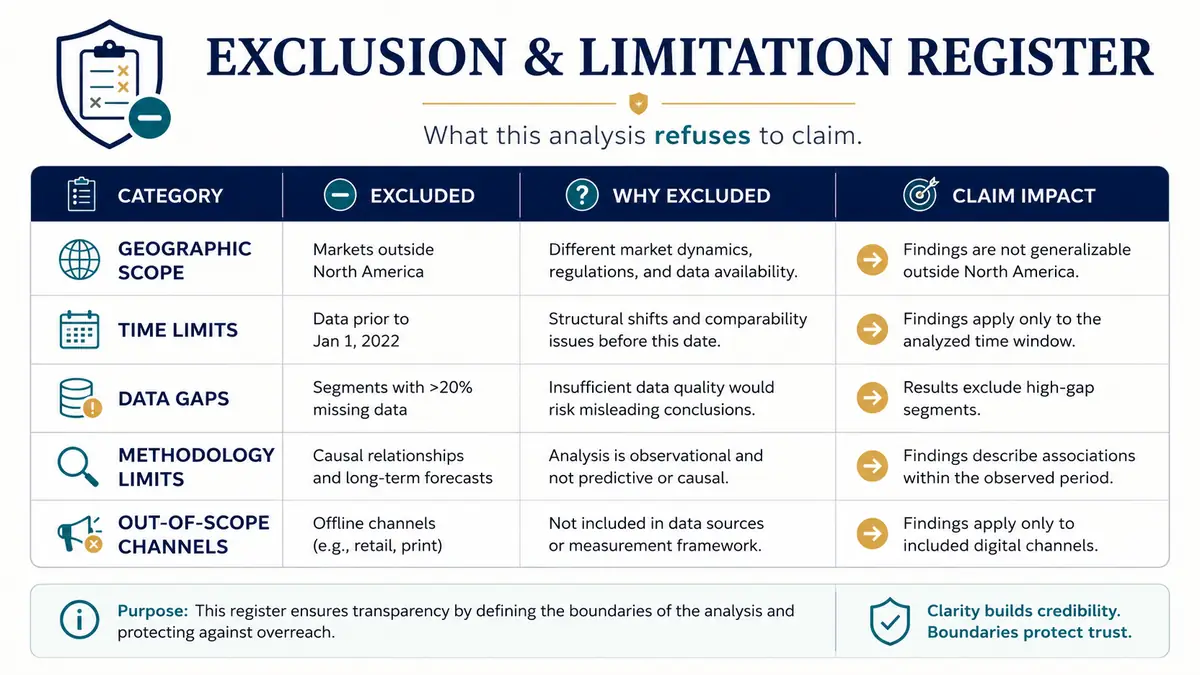
Practical consequence: keep the discovery relationship and the commercial relationship as separate fields. A domain can be a high-priority SEO competitor and still be REFERENCE / CONTEXT ONLY for a pricing decision. For the full search-versus-business boundary, see SEO Competitors vs Business Competitors; for publisher, directory and marketplace edge cases, see when discovery entities are not real commercial competitors.
Define the decision scope before you classify the entity
A competitor role without a decision scope is under-specified. At minimum, record the buyer or segment, the need/job, the focal offer, geography or service market, product tier and the purchase or decision moment. Add channel or regulatory constraints when they materially change what the buyer can choose.
Buyer / segment
Who has the need and who participates in the decision? Enterprise procurement, SMB owner and local consumer can create different sets.
Need / job
What outcome is the buyer trying to achieve? Classify against that outcome, not a vague industry label.
Offer / tier
Which product, service, bundle and price tier are actually being considered?
Market / geography
Can the entity serve this buyer here, under the relevant language, regulation and route to market?
Decision moment
Discovery, shortlist, procurement, renewal and switching can expose different alternatives.
Evidence date
Roles change. Record when the evidence was observed and what would trigger a new review.
A deterministic classification order
Use the rules in sequence. The order prevents an attractive label from overriding a missing scope or a known exclusion.
- Validate the record. If the candidate identity is missing or the decision scope is incomplete, return INVALID INPUT.
- Protect uncertainty. If material evidence is contradictory or unresolved, return UNRESOLVED rather than forcing a competitor type.
- Test serviceability. If the candidate cannot serve the scoped buyer, it is either REFERENCE / CONTEXT ONLY when it has genuine benchmark value, or EXCLUDED.
- Test buyer and need overlap. If either fails, keep the entity only as context when that context has a defined use; otherwise exclude it.
- Test credible buyer consideration. Structural similarity is not enough. Ask whether buyers actually consider, switch to, shortlist, renew against or otherwise treat the option as an alternative.
- Test offer or mechanism similarity. A materially similar active option is DIRECT.
- Test whether the different mechanism is an adjacent commercial option or a purchase-reframing path. Adjacent commercial option = INDIRECT. Internal/manual/no-decision or another materially different path that replaces, delays or avoids the purchase = SUBSTITUTE.
Evidence that should change the role
Classification should be evidence-aware without pretending judgment is a precise score. Keep the role separate from the evidence state: OBSERVED, INFERRED or UNRESOLVED. An inferred DIRECT role can be useful for a working set, but it should not carry the same authority as repeated win/loss or buyer-comparison evidence.
- Strongest: observed buyer comparison — win/loss records, RFP or shortlist evidence, switching behavior, procurement records and direct customer interviews.
- Strong: verified offer, pricing, product, geography, regulation, implementation and serviceability facts.
- Supporting: credible reviews, comparison behavior and community evidence that can reveal considered alternatives when the context is clear.
- Discovery: SERP, keyword, paid-search, marketplace or AI-answer overlap. These identify candidates; they do not prove commercial substitution.
- Inference: analyst interpretation. Keep it explicit and reopen the role when stronger evidence arrives.
Evidence quality is contextual, so this order is a review discipline rather than a numerical score. For a deeper evidence standard, use What Counts as Reliable Evidence in Competitor Analysis? and keep observed, inferred and unresolved evidence separate.
| Signal | What it can support | What it cannot prove alone |
|---|---|---|
| Win/loss records, shortlists, RFPs, switching data, customer interviews | Observed buyer consideration and closeness of substitution | Universal role across every segment or geography |
| Offer, pricing, product, service and route-to-market evidence | Offer/mechanism overlap and commercial availability | That buyers actually compare the options |
| Geography, language, regulation, implementation and serviceability | Whether an option is available in scope | That a serviceable option is actively considered |
| SERP/keyword/AI citation overlap | Discovery and visibility competition | Commercial substitutability |
| Review platforms, comparison pages and community discussions | Candidate discovery and evidence of considered alternatives when context is credible | Representative market share or causality |
| Analyst, publisher or association material | Category language, standards, market context and candidate discovery | That the source itself is a commercial rival |
The U.S. Department of Justice lists switching behavior, win/loss material, customer surveys and objective product characteristics among evidence used to assess substitution between firms. The European Commission likewise emphasizes customer substitutability, product characteristics, intended use, switching barriers and geography. Those are stronger foundations than a one-time visual resemblance between websites. When credible evidence conflicts, keep the assignment UNRESOLVED and use the separate contradictory-evidence workflow rather than forcing a vote on the label.
Worked examples: one entity, different role depending on the decision
| Scenario | Likely role | Why | Boundary |
|---|---|---|---|
| Two dental CRMs sold to the same practice segment in the same country and shortlisted in the same purchase | DIRECT | Same buyer, need, serviceable market and materially similar offer | Recheck if one product is only enterprise or a different product line |
| A dental-specific CRM versus a broad platform configured to manage the same patient follow-up workflow | INDIRECT | Same buyer and job, active commercial alternative, different mechanism/category | If the platform becomes a like-for-like CRM offer, it may become DIRECT |
| A CRM purchase versus a spreadsheet workflow maintained by the practice manager | SUBSTITUTE | The spreadsheet can delay or avoid the software purchase | Do not compare feature parity as if both were products in one category |
| A CRM purchase versus hiring an operations coordinator to run the process manually | SUBSTITUTE | Different resource path toward the same operational outcome | Economics and procurement differ materially |
| A software vendor versus an agency that performs the workflow as a service | SUBSTITUTE | The buyer can outsource rather than buy the focal software | Some markets may treat managed software/service packages as INDIRECT instead; classify from the actual buying set |
| A review marketplace ranking for every commercial query | REFERENCE / CONTEXT ONLY | High discovery value but not automatically the buyer's purchased solution | If the marketplace itself sells a substitutable managed offer, classify that offer separately |
| A category leader that does not serve the target geography | REFERENCE / CONTEXT ONLY | Useful benchmark but not serviceable in this decision | It may be DIRECT in a different geography |
| A publisher ranking for the same keywords | REFERENCE / CONTEXT ONLY | Search competitor and authority source, not proven commercial alternative | A commercial product launch can trigger reclassification |
| A relevant company with conflicting evidence about serviceability or buyer consideration | UNRESOLVED | A missing fact can change the role | Collect the specific missing evidence; do not vote on the label |
| A company that serves a different buyer and different need with no context value | EXCLUDED | No decision relationship in the stated scope | Keep the identity normalized so it is not rediscovered as a new entity |
Can the same company be both direct and indirect?
Yes, across different scopes. A platform can be DIRECT for one product line and INDIRECT for another. Within one tightly defined scope, use one primary role for the active assignment so downstream analysis has a clear permission boundary. If two roles genuinely coexist inside the same purchase because distinct products from the same company are considered, create separate product-level assignments rather than an accidental duplicate company record.
Competitor Role Classification Check
This tool applies the same canonical rules used in the downloadable register. It runs entirely in your browser, sends no entered competitor data anywhere and produces one role, reason code, use boundary and next action. Candidate type is context, not a shortcut to the answer: the classification is determined by the scoped buyer, need, serviceability, consideration, offer/mechanism and evidence inputs.
Canonical role
- Reason code
- Required next action
- Permitted analytical use
- Do not use it for
- Evidence note
A tool result is a structured application of the stated inputs, not independent evidence that the inputs are true. Preserve the sources that support serviceability, buyer consideration and substitution. If the buyer, need, offer/tier, geography or decision moment changes, create a new scope-specific classification rather than reusing this result as a permanent company label.
Take the method into a working record
The browser check is for one candidate at a time. The workbook is the operating record: one normalized Competitor ID, one or more decision Scope IDs, and one active role assignment per Competitor ID + Scope ID. That prevents the same company being copied into separate identities just because its role changes.
Excel workbook with scope records, controlled vocabulary, role assignments, worked examples and 55 canonical fixtures.
XLSX · audit and handoffConcise A4 reference for the role framework, evidence expectations, classification path, examples and final checklist.
PDF · print and shareSeven mistakes that inflate or distort competitor sets
1. Treating every ranking domain as a commercial rival
Organic overlap measures visibility competition. Qualify the buyer decision before using the domain for pricing, product or positioning.
2. Treating product similarity as sufficient
A similar offer outside the buyer segment, geography or tier may be a reference or exclusion rather than an active competitor.
3. Omitting non-vendor substitutes
Internal build, manual process, hire, outsource, bundle, postpone and no decision can be the alternatives that actually block revenue.
4. Calling every different mechanism indirect
Separate adjacent commercial options from paths that materially avoid or replace the purchase so the analysis asks the right questions.
5. Giving one company a permanent role
Classify an assignment against a product and scope. Roles are allowed to change when the buyer, market, tier or decision moment changes.
6. Hiding uncertainty inside a confident label
When evidence is missing or contradictory, UNRESOLVED is a valid state. It tells the next reviewer exactly what must be learned.
7. Mixing benchmarks with threats
Aspirational brands, publishers and analysts can raise your evidence or design standard without belonging in the active commercial set.
Edge-case rulebook: classify the buyer-facing alternative, not the entity label
| Candidate or relationship | Do not assume | Classification rule |
|---|---|---|
| Marketplace, directory, comparison site or publisher | Visibility means commercial competition | Usually REFERENCE / CONTEXT ONLY until its own offer is a credible, serviceable buyer substitute. |
| Reseller, distributor or channel partner | The channel label determines the role | Classify the actual buyer-facing offer. The same entity can be a channel in one scope and a commercial competitor in another. |
| Open-source or free tool | Free means “not a competitor” | Use the normal buyer/need/serviceability/consideration tests. It can be DIRECT, INDIRECT or SUBSTITUTE. |
| Bundled feature or incumbent suite | A bundle is automatically direct | Classify the competing capability. It may be DIRECT, INDIRECT or SUBSTITUTE depending on how the buyer avoids or replaces the standalone purchase. |
| Internal build, spreadsheet, manual process or hiring | Only vendors count | Treat the path as SUBSTITUTE when it replaces, delays or avoids the focal purchase. Do not invent a vendor identity for an internal decision state. |
| Partner or complementor | Partnership prevents competition | Usually REFERENCE / CONTEXT ONLY, but reclassify if its offer becomes substitutable in the defined buyer decision. |
| Parent company, subsidiary, brand or product | Every organizational label is a separate competitor | Normalize the identity hierarchy, then assign the role to the buyer-facing offer/entity relevant to the scope. |
| No decision or postponement | A non-purchase is a company competitor | Model it as a SUBSTITUTE decision path for the relevant period, then review when the decision reopens. |
For B2B/SaaS qualification depth, continue with qualifying B2B and SaaS competitors. The role contract here stays intentionally small: edge cases change the evidence and scope, not the canonical vocabulary.
The same entity can legitimately change role by scope
Role changes are not data-quality failures when the scope changes. They become failures when the scope is hidden. Reclassify when any of the following materially changes: geography, language, regulation, target segment, product family, price tier, route to market, procurement model, decision stage or service availability. Preserve the prior assignment, mark the new record as superseding it and record the observation that triggered review rather than silently overwriting history. For ongoing governance, see when to update a competitor set; for geography-heavy programmes, use the multi-location and multi-market competitor-set method.
| Change | Possible role movement | Why |
|---|---|---|
| Enterprise → SMB | DIRECT → REFERENCE / CONTEXT ONLY | The vendor may no longer be serviceable or economically credible for the smaller buyer |
| US → regulated EU market | DIRECT → EXCLUDED or REFERENCE / CONTEXT ONLY | Availability, compliance or implementation constraints can remove substitutability |
| Point solution → suite bundle | INDIRECT or SUBSTITUTE → DIRECT | The bundle may evolve into a like-for-like active offer |
| Discovery → procurement | REFERENCE / CONTEXT ONLY → DIRECT/INDIRECT/SUBSTITUTE | A candidate discovered through content becomes a real shortlisted alternative |
| Vendor launches a new product | REFERENCE / CONTEXT ONLY → commercial role | Commercial offer and serviceability changed |
A practical workflow for competitor-role classification
- Define the decision.Fix buyer, need/job, focal offer, geography/market, tier and decision moment.
- Discover candidates broadly.Use search, AI answers, marketplaces, sales, customers, review platforms, analyst sources and market evidence.
- Normalize identities.Separate company, brand and product where needed; do not create duplicate identities for different role assignments.
- Qualify serviceability.Confirm the entity can actually serve the scoped buyer under current conditions.
- Test buyer substitutability.Look for credible consideration, switching, shortlist, win/loss, RFP or customer evidence.
- Assign one primary role.DIRECT, INDIRECT, SUBSTITUTE, REFERENCE / CONTEXT ONLY, UNRESOLVED or EXCLUDED.
- Record evidence state and permission.OBSERVED, INFERRED or UNRESOLVED; specify what the assignment may and may not support.
- Version the assignment.Preserve the old role, identify the assignment it supersedes, record the review trigger and state the observation that would reopen the classification again.
Why this changes strategy: a bad role assignment contaminates the next decision. REFERENCE entities distort price and feature comparisons; missed SUBSTITUTE paths weaken positioning and win/loss learning; stale scope assumptions mislead market-entry and monitoring priorities; and search-only competitors can pull SEO evidence into product or pricing decisions where it does not belong. The objective is not a bigger competitor list — it is a competitor set that is fit for the decision it is supposed to support.
A useful competitor record answers four questions without the original analyst present: what decision was scoped, why this entity received this role, what evidence supports it, and what use is permitted next.
Frequently asked questions
What is the difference between direct and indirect competitors?
DIRECT competitors are active options for the same buyer and need with a materially similar offer or mechanism. INDIRECT competitors are active commercial options for the same buyer and need but use a materially different offer or mechanism.
Is a substitute the same as an indirect competitor?
Many sources use the terms loosely or overlap them. In this method, INDIRECT is reserved for an adjacent commercial alternative; SUBSTITUTE is an alternative path that materially replaces, delays or avoids the focal purchase, such as internal build, a manual process, outsourcing, hiring or no decision.
Can one company be both direct and indirect?
Yes across products or decision scopes. Within one narrowly defined assignment, use one primary role. If two different products from the same company are in the buying set, create separate product-level assignments under the normalized company identity.
Are SEO competitors real competitors?
They are real competitors for search visibility. They are not automatically commercial competitors. Shared rankings or keyword overlap should generate candidates for qualification, not bypass buyer substitutability and serviceability checks.
Should marketplaces, directories and comparison sites be treated as competitors?
Usually as discovery or context entities unless they themselves offer a service the buyer can substitute for the focal offer. Classify the commercial offer, not the domain label.
Is “do nothing” a competitor?
It is better treated as a SUBSTITUTE / alternative decision state when buyers can preserve the status quo or postpone action instead of purchasing. It has no company identity, but it can still be a decisive demand risk.
What is a reference competitor?
This method uses the clearer state REFERENCE / CONTEXT ONLY: an entity that is useful for standards, language, authority, visibility, discovery or benchmark context but is not qualified as an active commercial alternative in the stated scope.
What if the evidence is contradictory?
Return UNRESOLVED. Preserve the competing evidence, name the decision it affects and collect the specific observation needed to resolve the role. Do not force consensus by voting on the label.
Sources and method boundary
The public sources below support the substitution, search-competition and buyer-choice principles used in this article. The exact role taxonomy and deterministic decision order are SERPIFAI synthesis for competitor-analysis operations, not a legal market-definition opinion.
- U.S. Department of Justice - 2023 Merger Guidelines: Market Definition - demand substitution, product/geographic scope and serviceability constraints.
- U.S. Department of Justice - Evaluating Competition Among Firms - switching, win/loss, surveys and other evidence of customer substitution.
- European Commission - 2024 Market Definition Notice - customer substitutability, differentiation, geography and switching barriers.
- Ahrefs - Competitive Analysis Guide - direct competitors and the need to distinguish traffic competitors from customer competitors.
- Ahrefs - Keyword Competitive Analysis - business competitors are not always search competitors.
- Semrush - Organic Rankings Competitors Report - organic competitors are derived from shared keyword rankings.
- HubSpot - Direct vs. Indirect Competition - same need/market framing and customer research.
- Shopify - Direct vs. Indirect Competitors - same customer/product versus same customer need with different products.
- Crayon - Competitive Analysis Resources - product, customer and market guardrails.
- Klue - Direct vs. Indirect Competitors - buyer problem and market overlap in competitive intelligence.
- Intercom - Understanding Direct and Indirect Competition - jobs-to-be-done framing for alternative solutions and outcomes.
- Harvard Business Review - Know Your Customers’ Jobs to Be Done - focus on the job customers are trying to accomplish rather than product attributes alone.
- Christensen Institute - Jobs to Be Done Theory - a buyer-progress lens for understanding alternatives that cross product categories.
- UK Competition and Markets Authority - Merger assessment guidelines - demand-side alternatives, closeness of competition and market context.
- Productboard - Competitor Analysis - operational competitor-analysis uses and product/customer evidence.
- Crayon - Win/Loss Insights for Battlecards - buyer evidence about alternatives and competitive decisions.
- Competitive Intelligence Alliance - Direct and Indirect Competition - practitioner framing for indirect competition and buyer alternatives.
Method boundary: Antitrust sources are used for disciplined substitution language and evidence concepts. This article does not define legal relevant markets, assess market power or provide legal advice.