
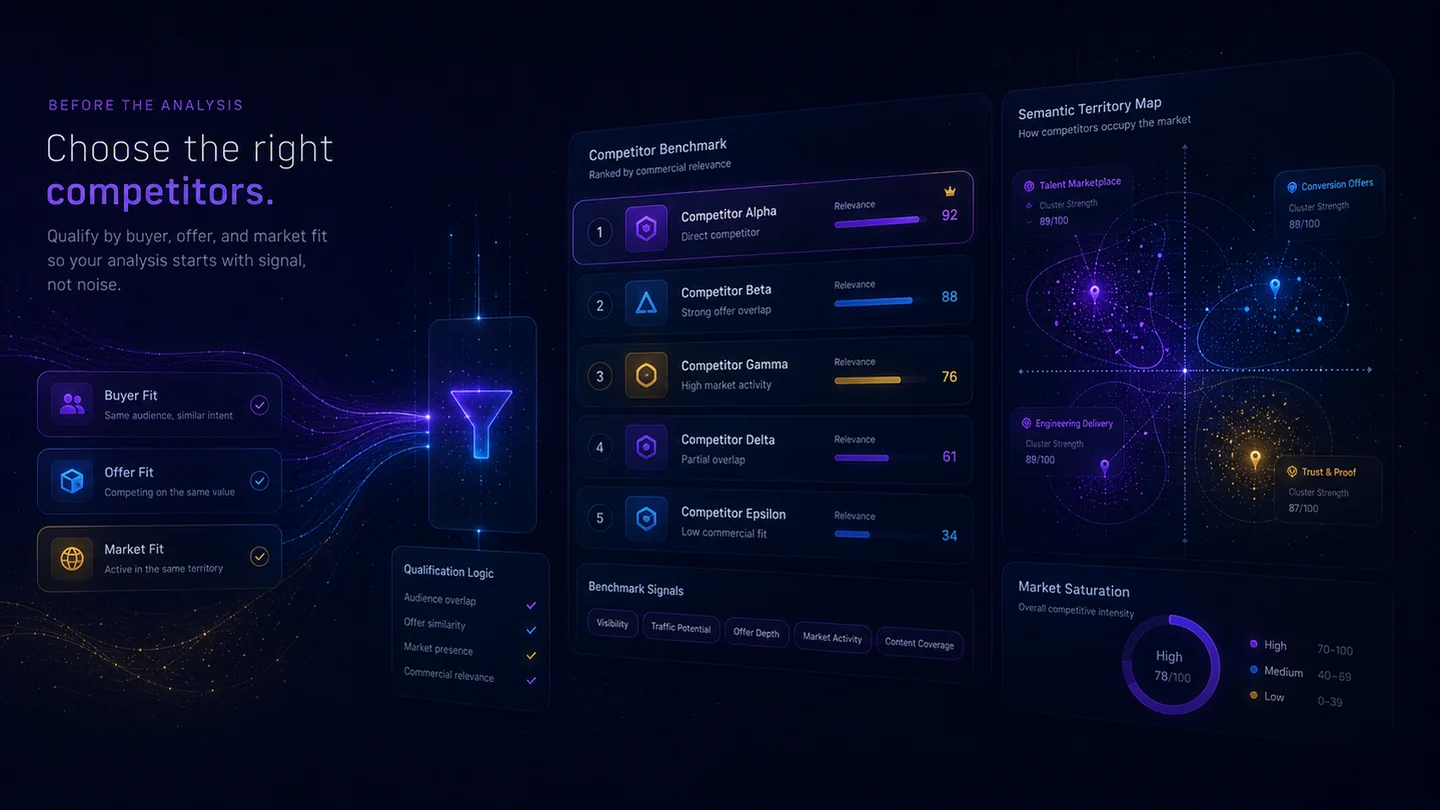
Framework model: candidate discovery → commercial qualification → evidence analysis → territory comparison → founder-reviewed release.
A qualified SEO competitor is an organisation that can credibly win the same buyer, for a comparable need, in the market and decision stage being evaluated. Search visibility can nominate a candidate, but it cannot establish commercial substitutability or decision relevance by itself. The SERPIFAI Competitor Relevance Gate keeps direct competitors, publishers, directories, marketplaces and adjacent providers in distinct analytical roles so later content, authority and investment comparisons answer the correct commercial question.
Buyer consequence: If the wrong rival is allowed into the comparison, accurate data can still push roadmap, positioning, content or budget toward an organisation that cannot win the same decision. Qualification controls whose behaviour is allowed to influence the decision.
Write the decision boundary before opening an SEO tool
Complete this sentence: “We are deciding whether to fund or change ___ for ___ buyers in ___ market at the ___ decision stage.” Then ask of every candidate: Could this organisation realistically change that buyer’s choice?
Keep the candidate and test the full relevance gate.
Keep it as contextual/search-surface evidence, not as a direct competitor.
Mark VERIFY. Do not guess the missing commercial fact.
This pre-check prevents the most expensive mistake in competitor analysis: collecting detailed data about the wrong comparison set.
What this framework is—and what it is not
A pre-analysis governance layer for choosing which domains may influence an evidence-based SEO decision.
Use it before comparing content, authority, demand or opportunity territories for a defined buyer, offer, market and investment question.
It is not a ranking report, popularity list or claim that every visible domain competes for the same customer decision.
The competitor set is part of the decision
Competitor analysis often starts with a list of visible domains. That is convenient, but it is not enough. A site can rank for the same terms and still be commercially irrelevant because it serves a different buyer, sells a different offer, operates in another territory or competes at another stage of the buying process. For a consequential search investment, buyer-focused SEO competitor analysis examines which visible domains could also influence the buyer’s choice.
The selected set determines which gaps look important, which strengths appear defensible and which territories seem open. When the set is wrong, the data can be technically accurate while the commercial conclusion is wrong.
The wrong competitor set can make accurate data answer the wrong commercial question.
Search results are a waiting room, not the decision room
Visibility gets a domain into the waiting room. The relevance gate decides whether it belongs in the direct comparison, should remain contextual, needs verification, or should be excluded. Discovery nominates; qualification admits.
A useful distinction is:
Can realistically win the same customer decision.
Appears beside you in a search surface or topic set.
Explains the market but is not a realistic buying substitute.
The same domain can occupy more than one role. A marketplace may be a search competitor, a discovery channel and a contextual reference without being a direct commercial competitor.
In SEO decision workflows, directories, publishers and direct providers frequently appear together for the same query even though they play different commercial roles. In competitive audits, the same domain may be approved for an authority analysis but receive reduced weight in a local conversion decision.
Six tests for competitor relevance
In many competitive markets, the gate separates candidate discovery from competitor qualification. Keyword overlap, SERP overlap, paid visibility, customer nominations, review sites and marketplace listings can all generate candidates. The six tests then determine which candidates belong in the analytical set—and in what role.
Buyer substitutability
Could a realistic buyer choose this organisation instead of you for the same underlying need?
Offer overlap
Does the competitor sell a comparable service, outcome or engagement—not merely publish related information?
Market overlap
Is the competitor active in the same geography, language, regulation and service radius shaping the decision?
Decision-stage overlap
Does the competitor compete at awareness, evaluation, consultation or purchase—the stage that matters to the question?
Strategic relevance
Would learning from this competitor materially change what the business funds, prepares, defers or ignores?
Evidence availability
Can material conclusions be supported from current, attributable sources without inventing missing commercial facts?
Supporting competition research
Extend the qualification framework
Use the supporting research to distinguish search rivals, business rivals and decision competitors across local, B2B and changing markets.
INCLUDE DIRECT when buyer, offer and market substitution are defensible, the candidate matters to the scoped decision and material evidence is sufficient. Use CONTEXT ONLY when the domain shapes discovery, expectations or market structure without being a like-for-like substitute. Use VERIFY when a potentially material candidate is blocked by unknown or inadequate evidence. EXCLUDE when relevance is outside the decision boundary.
Role before rank: a later score or visibility metric must not promote a failed or unresolved eligibility gate into the direct set. The evidence-availability test connects this gate to the next stage of the system: separating observed evidence from interpretation and uncertainty.
Test one candidate with the Competitor Relevance Gate
Choose only what your current evidence supports. The tool uses your inputs; it does not verify a company, replace reviewer judgment or create a hidden score.
Fail-closed rule: unknown buyer, offer or market eligibility, or insufficient material evidence, cannot be promoted into the direct set by a popularity, traffic or visibility metric.
Four legitimate outcomes from the same candidate-discovery process
Use the controls to see why visibility alone does not determine the analytical role.
Regional implant clinic
Same buyer, comparable clinical need, relevant geography and observable offer evidence.
A practical qualification decision tree
Would both offers enter the same realistic consideration set?
Do they solve the same commercial problem or promise a substitutable outcome?
Are geography, service scope and buying conditions comparable?
Can the comparison support a decision without hidden assumptions?
Commercially substitutable, decision-relevant and sufficiently evidenced for direct comparison.
Shapes discovery, expectations or market structure but is not a like-for-like direct substitute for this decision.
Potentially material, but unknown or inadequate evidence blocks a defensible role assignment.
Outside the scoped buyer, offer, market or decision boundary and not materially useful as context.
If the first three commercial gates appear to pass but the evidence gate fails, the organisation may still be commercially relevant. The correct state is VERIFY, not automatically irrelevant and not automatically direct. Keep the limitation visible rather than replacing it with a synthetic score.
Four common false competitors
| Candidate | Why it appears relevant | Why it can mislead | Typical treatment |
|---|---|---|---|
| Large publisher | Ranks for many category topics. | May inform rather than sell, so buyer substitutability is weak. | Context only |
| Directory or marketplace | Occupies search visibility and comparison queries. | Aggregates providers rather than competing as one comparable offer. | Search-surface obstacle or channel |
| Adjacent service provider | Shares language, audience or a broad problem area. | Solves a different problem or wins another buying moment. | Exclude or reduced weight |
| Global category leader | Sets an aspirational benchmark. | May operate with unmatched brand, budget, geography or product breadth. | Context or benchmark |
Contextual visibility should inform the market model without being allowed to count as direct commercial competition.
Worked example: qualifying a competitor set
Question: Which competitors should influence an implant-consultation investment decision?
The example is fictional and demonstrates the framework rather than client performance.
Regional implant clinic
- Same buyer and consultation need
- Comparable geography and treatment journey
- Current pages and offers are observable
National dental publisher
- Strong informational visibility
- No comparable clinical offer
- Useful for demand and language context
General wellness directory
- Weak service substitution
- Broad category pages
- Limited decision-stage relevance
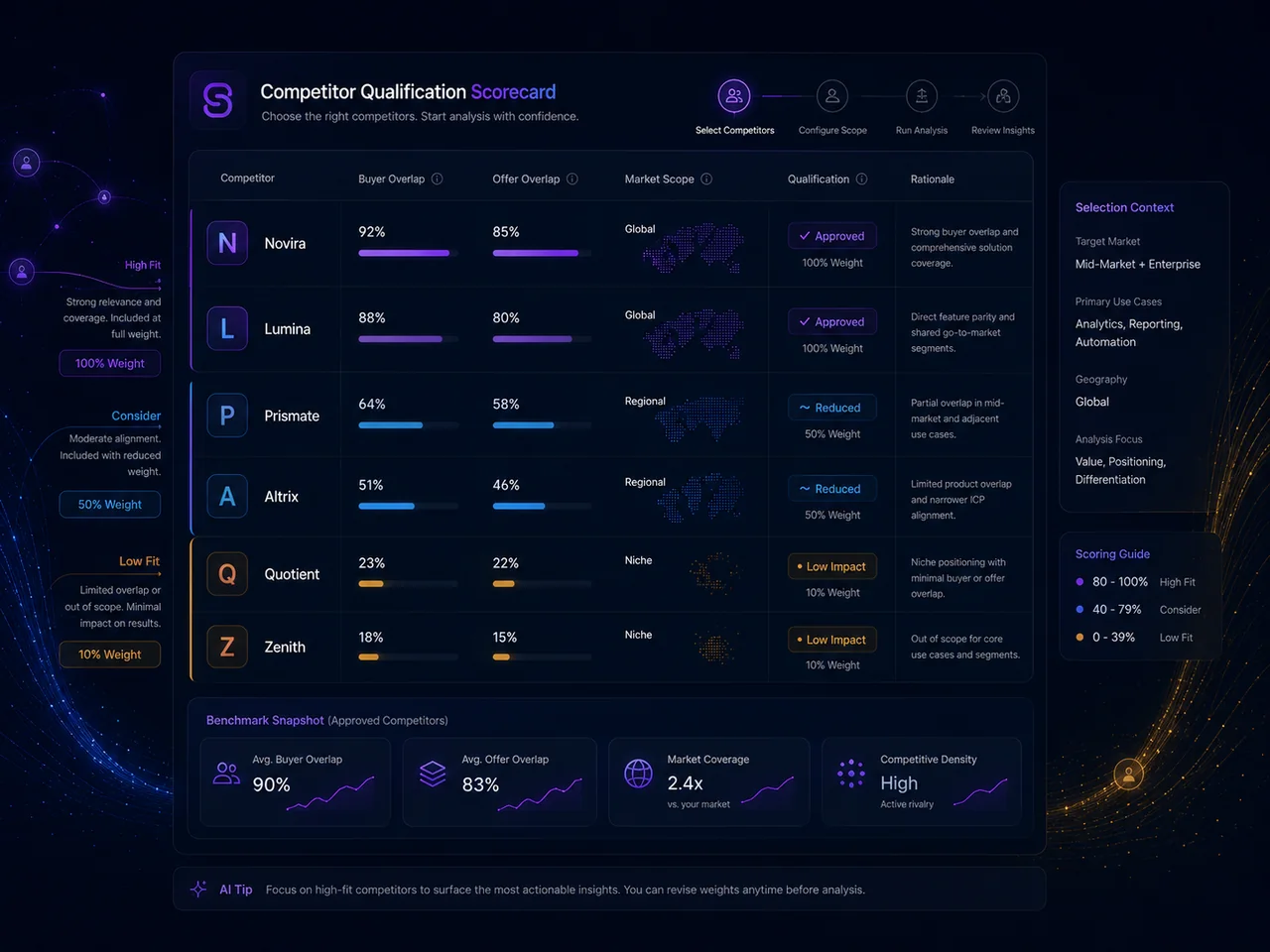
The important result is not the number of domains removed. It is that every included competitor now has a written commercial rationale and every contextual domain has a bounded role.
How competitor qualification changes across markets
In practice, the same visibility pattern can mean very different things. The examples below are illustrative, not client results; they show how the decision boundary changes by buyer, offer, market and evidence role.
A broad enterprise suite may rank for the same category as a specialist product. It is typically a core competitor only when the buyer, procurement path and implementation burden overlap.
A legal directory can dominate results without competing for the same instruction. Treat it as discovery context unless it controls the enquiry or materially redirects buyer choice.
A national franchise may define credibility expectations while receiving reduced weight in a city-level decision where service radius, availability and local reputation shape substitution.
A marketplace can be both channel and competitor. Its weight depends on whether buyers compare the merchant’s offer directly or default to the marketplace for fulfilment, trust and price discovery.
A publisher, hospital system and specialist clinic may appear for the same treatment query. Regulation, referral pathways, clinical scope and geography often determine which can influence the actual patient decision.
Qualify the role the domain plays in this decision—not the label it carries in the market. Depending on the commercial context, the same organisation may be approved, reduced in weight, retained as context or excluded.
How many competitors should pass the gate?
There is no universal correct number—and that is the point. In many focused service, market and buying-stage decisions, three to six defensible direct competitors are more useful than twenty visible domains. Broader sets may be appropriate when the commercial question genuinely spans multiple offers, geographies or buyer segments.
Add contextual references separately rather than inflating the direct set. Expand only when the commercial question genuinely spans multiple geographies, offers or buyer segments.
More competitors can produce a weaker analysis. When the set combines incompatible buyers, offers, markets and business models, additional coverage reduces signal quality. The strongest set is the smallest defensible group that represents the decision accurately, supported by separately labelled contextual domains.
Record qualification before you rank attention
The public worksheet is deliberately a qualification record, not a magic score. It keeps the six tests, classification, rationale, reviewer and review date visible so a later analysis can explain why a domain was allowed to influence the decision.
| Criterion | Question | Decision treatment |
|---|---|---|
| Buyer | Would the same buyer realistically consider both offers? | Direct eligibility gate |
| Offer | Is the promised outcome or engagement comparable? | Direct eligibility gate |
| Market | Are geography, language, regulation and service scope relevant? | Direct eligibility gate where material |
| Decision stage | Does the candidate influence the stage being evaluated? | Role and weight boundary |
| Strategic relevance | Could this candidate materially change what the business does? | Keep, reduce or remove from scope |
| Evidence | Can the material classification be supported transparently? | Unsupported material state → VERIFY |
Gate before aggregate: if you later use weighted ranking for eligible direct competitors, that ranking must not override a failed buyer, offer, market or evidence gate.
Download the competitor relevance worksheet
The existing CSV records candidate, six relevance tests, classification, rationale, reviewer and review date. Use it when you need a lightweight portable record rather than another tool.
Hand off the role, rationale and reopening condition
A useful competitor record survives the meeting. It should let another reviewer reconstruct the decision without guessing why a domain was included, contextual, unresolved or excluded.
Decision question:
Candidate:
Buyer substitutability:
Offer overlap:
Market overlap:
Decision-stage overlap:
Strategic relevance:
Evidence availability:
Classification: INCLUDE DIRECT | CONTEXT ONLY | VERIFY | EXCLUDE
Rationale:
Material limitation or contradiction:
Reviewer:
Review date:
Reopen when:
READY FOR ANALYSIS does not mean permanently correct. It means the set is sufficiently governed for this decision and review window. A material new offer, buyer, market, evidence record or first-party win/loss signal can reopen it.
A controlled qualification workflow
- Write the commercial question first. Define the investment, market, buyer, decision stage and review horizon.
- Collect candidates broadly. Use sales and customer nominations, first-party win/loss information, SERP and keyword overlap, paid-search visibility, review sites, directories and known substitutes.
- Apply the six relevance tests. Record the reason for inclusion, context-only status, reduced weight or exclusion.
- Review contradictions. A candidate may be highly visible but weakly substitutable—or commercially important but poorly observable.
- Freeze the set for the analysis window. Record the reviewer, review date, exclusions, unresolved VERIFY candidates and the condition that would justify reopening.
Candidate discovery may be automated. Final competitor qualification should remain an accountable commercial judgment.
When the competitor set should be reviewed again
A frozen set is stable for the analysis window, not permanent. Requalify it when:
This prevents competitor-set drift: continuing to benchmark against a list that was once reasonable but no longer reflects the market.
Requalify whenever a previously excluded, contextual or reduced-weight candidate could materially change the recommended action.
Decision checklist before collection begins
Only after these conditions pass should the work compare content, authority, positioning, demand or investment territories.
Framework summary
Set the commercial question, buyer, offer, market and decision stage.
Collect candidate domains broadly without treating visibility as qualification.
Apply buyer, offer, market, strategic and evidence tests.
Include direct, retain as context, verify before classifying or exclude—with a written rationale and reopening condition.
Commercial question → candidate discovery → competitor qualification → evidence analysis → investment prioritisation.
Methodological context and professional judgement
The competitor-qualification logic is proprietary to SERPIFAI. It is nevertheless situated alongside established principles from adjacent disciplines: define the decision before comparing options, use multiple evidence sources, distinguish strategic competition from surface similarity and separate available data from information that can change a recommendation.
Define the objective, alternatives, risks and switching conditions before selecting a preferred option. The SERPIFAI sequence uses the commercial question and reversal conditions for the same governance purpose.
Use critical thinking and the best available evidence from multiple sources, including information that supports or contradicts a claim. This supports the separation of observations, inference, gaps and contradictions.
Competition is broader than surface similarity, yet strategic comparison still depends on market structure and the alternatives that can affect buyer choice. Visibility is therefore a candidate signal, not the final definition.
Available data and documents are not automatically decision-relevant information. The framework asks whether an attributable source can materially change the classification or recommendation.
Competitor qualification is not deterministic. In many markets, public evidence is incomplete, buyer substitution is only partly observable and a domain’s role can change by geography, channel or decision stage. When evidence is mixed, reduce weight or retain the domain as context rather than forcing a false binary classification.
Related questions
Is an SEO competitor always a business competitor?
No. A domain can compete for visibility without competing for the same customer decision. Treat visibility as a candidate signal, then apply buyer, offer, market and decision-stage tests.
Should publishers and directories be excluded?
Not automatically. They often belong in a context or search-surface category because they shape discovery and demand without being direct buying substitutes.
How often should the set be updated?
Review it when the offer, buyer, geography, decision stage or first-party win/loss evidence changes materially. Do not change it mid-analysis without documenting why.
Can software choose the final competitors?
Software can discover candidates and organise evidence. Final qualification requires commercial judgment because buyer substitutability and strategic relevance are context-dependent.
What if a candidate looks commercially relevant but the evidence is incomplete?
Use VERIFY. Do not force the candidate into the direct or excluded set until the material unknown is resolved. This preserves a potentially important competitor without inventing facts.
Should a highly visible domain automatically receive more weight?
No. Visibility can justify investigation, but role comes first. A publisher, directory or marketplace can be highly visible and still belong in contextual analysis rather than like-for-like direct comparison.
Selected references
- Google Search Central: Creating helpful, reliable, people-first content
- Google Search Central: Google Search Essentials
- Google Search Central: Article structured data
- HM Treasury, The Green Book 2026: appraisal, options, risk, uncertainty and switching values
- Center for Evidence-Based Management: What is evidence-based management?
- Michael E. Porter, The Five Competitive Forces That Shape Strategy
- Michael K. Buckland, Information as Thing
These sources provide methodological context for decision analysis, evidence use, competition and information quality alongside Google’s technical guidance. They do not originate or define the proprietary SERPIFAI competitor-qualification framework.
Qualification protects every downstream decision
The competitor set is not a pre-analysis convenience. It is the first release gate in the decision system. A strong set is small enough to remain coherent, broad enough to represent the real buying decision and explicit about contextual and unresolved candidates. Once the set is defensible, the next stage is to trace the evidence and keep uncertainty visible. Only then should the business compare territories and decide what to fund next.
Continue the system