

Evidence and assumptions are not the same thing. Evidence is attributable information that supports or contradicts a defined claim. An inference is the analyst’s interpretation of that evidence. An assumption fills a gap that has not been adequately verified. If credible evidence conflicts or the gap cannot yet be resolved, the correct state is unresolved—not “probably true.” In competitor analysis, the practical rule is to keep the observation separate from the interpretation and only write the strongest sentence the evidence actually permits.
Buyer consequence: The expensive failure often happens during handoff. An assumption starts as a tentative analyst interpretation, loses its label in a deck or summary, and arrives at the decision table as if it were established fact. Keep the evidence state attached to the claim so a weak premise cannot quietly become a roadmap, positioning or budget instruction.
Fast action: test a competitor claim in five questions
Before a claim influences an SEO, content or market decision, run this short claim-permission test. It works even when the evidence is incomplete.
What did you directly see, measure or document? Write only that fact first.
What meaning did you add? Label that reasoning as an inference rather than folding it into the observation.
What must be true for the inference to hold, but has not actually been verified?
What credible evidence contradicts the interpretation, or what important evidence is still missing?
What is the strongest sentence you can defend now without hiding the uncertainty?
If you cannot point to the observation that supports a sentence, or you have to silently invent a missing step, do not present the sentence as established evidence.
Interactive claim-permission checker
When a rough competitor note needs safer wording, use this quick checker. It does not replace judgement; it helps you keep the observation, interpretation, uncertainty and decision effect in the right order.
Capture what you observed, what you inferred, where the gap sits and whether contradictory evidence exists. The checker returns the strongest claim state you can defend now.
The checker is intentionally conservative. If the required observation is missing, if the gap remains material, or if contradiction matters, the output should become weaker rather than stronger.
What this framework owns—and what it deliberately leaves to other evidence methods
Decide what a body of competitor evidence legitimately permits you to claim, qualify or leave unresolved.
Choosing which competitive-intelligence source can support which claim belongs to the source-hierarchy method, not this page.
This page determines the evidence state and permitted wording. Detailed confidence assignment is a separate downstream step.
The framework does not make incomplete evidence complete. It makes the gap visible so the recommendation cannot outrun its support.
For source-to-claim fit, use Competitive intelligence sources: which sources can support which claims? For the narrower evidence-state protocol, use Observed, Inferred and Unresolved Evidence.
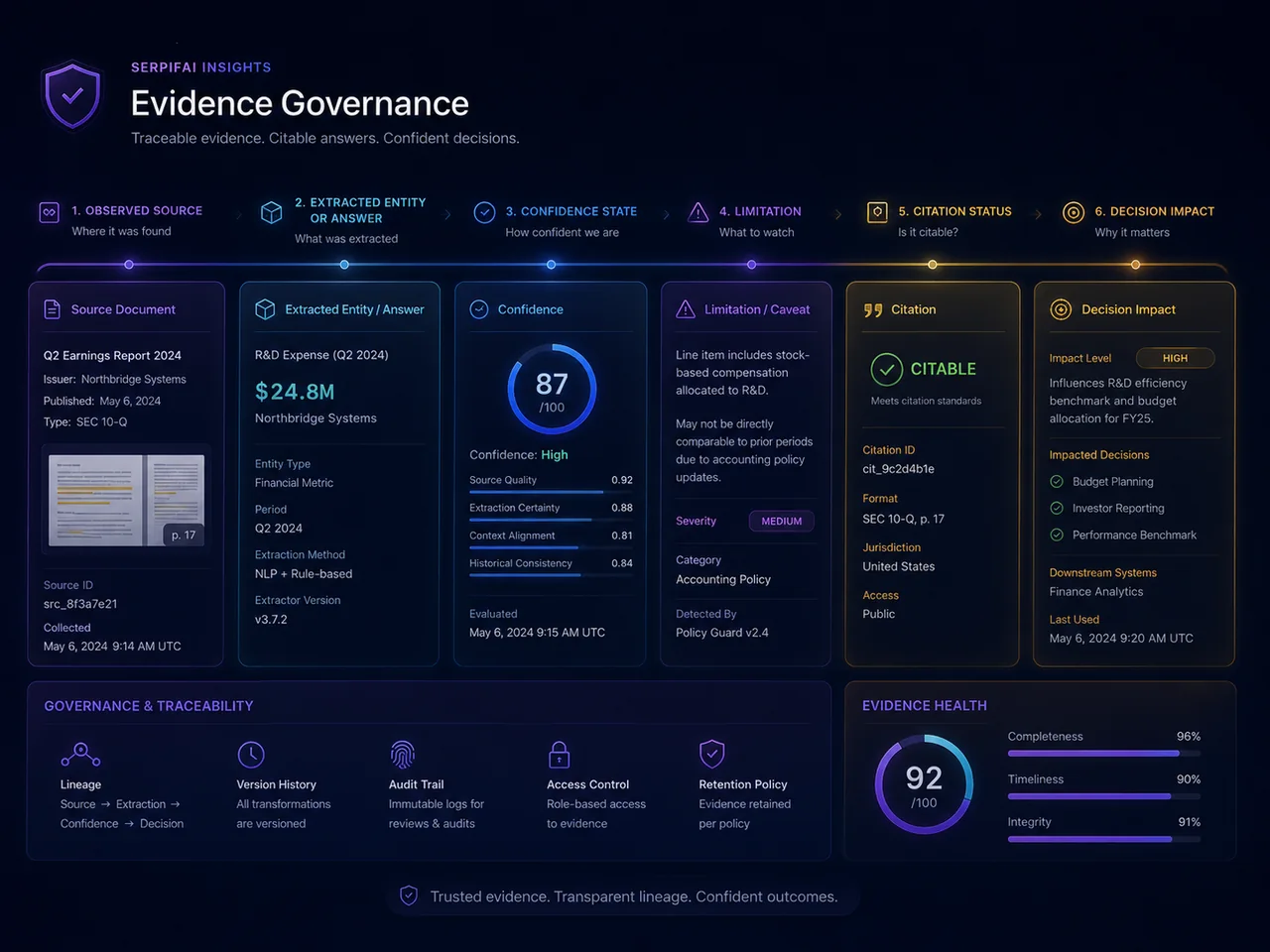
The core distinction: evidence controls the wording you are allowed to use
A competitor page, SERP capture, review, internal sales record or third-party estimate does not become a conclusion automatically. It first gives you an observation. You may then infer an explanation, but the inference inherits the limits of the underlying evidence and the logic used to connect it.
Keep the camera separate from the caption. The observation is what the camera captured. The inference is the caption you add. An assumption is a missing part of the scene that you filled in without enough evidence.
| What you have | What you may say | What you should not say |
|---|---|---|
| Direct observation | “The competitor currently publishes…” or “We observed…” | Do not turn the published claim into proof of adoption, performance or commercial success. |
| Reasoned inference | “The evidence suggests…” followed by the rationale and limitation. | Do not rewrite the inference as an observed fact. |
| Unverified assumption | “This remains an assumption to validate…” | Do not let it silently control the recommendation. |
| Material contradiction | “Available evidence supports competing explanations…” | Do not average the disagreement away or select the preferred source without justification. |
| Unresolved gap | “Current evidence does not establish…” | Do not convert missing evidence into a negative fact. |
Evidence vs assumption: five states that keep claims honest
This article uses five plain-language states. They are not scores and they do not imply a universal hierarchy of source quality.
| State | Meaning | Decision effect |
|---|---|---|
| Observed | Directly visible, measured or documented information from an attributable record. | Can support a factual statement within the source’s actual scope and date. |
| Inferred | A reasoned interpretation built from one or more observations. | Can inform a decision when the reasoning and limitations remain visible. |
| Assumed | A proposition used to bridge a material gap without enough direct support. | Record it as a validation requirement, not as evidence. |
| Contradictory | Credible observations support materially different explanations. | Reduce certainty and preserve the disagreement until the context is resolved. |
| Unresolved | The available evidence cannot yet establish the claim or distinguish between plausible explanations. | Use conditional wording, investigate further or defer the affected decision. |
The specialist article Observed, Inferred and Unresolved Evidence goes deeper into evidence-state classification. Here, the taxonomy exists only to determine what the final claim is allowed to say.
From observation to decision: the claim-permission chain
The governing sequence is deliberately simple. Each transition must remain inspectable.
Observation → Inference → Unresolved or contradictory evidence → Permitted claim → Decision effect.
- Observation: preserve the exact source record, date, market context and what was actually seen.
- Inference: state the interpretation separately and explain the reasoning that connects it to the observations.
- Unresolved or contradiction check: identify missing evidence, alternative explanations and credible evidence that does not fit the interpretation.
- Permitted claim: choose wording that matches the real support: direct statement, qualified inference, explicit assumption or unresolved conclusion.
- Decision effect: state whether that claim materially changes the action, only informs context, or requires further validation before action.
This sequence is not a claim that every decision is linear. It is a review order designed to stop interpretation from being mistaken for observation.
Animated claim-permission pipeline
This animated visual shows the same piece of evidence moving through the framework. The purpose is not to dramatize the method; it is to make the permission boundary visible before a sentence reaches a recommendation.
Watch how the observation stays separate from the caption, how gaps and contradictions interrupt the chain, and how the final wording becomes narrower when the support is weaker.
Preserve what you directly saw, measured or documented, with scope and date.
State the interpretation separately so the reasoning remains inspectable.
Expose what is missing or what points in another direction before the claim hardens.
Choose the strongest sentence the support still justifies after the limits remain visible.
State whether the claim changes action, informs context or blocks action pending validation.
If you prefer reduced motion, the article remains fully usable without the animation. The logic does not depend on the movement.
Source quality comes first, but source authority does not settle the claim
A source can be authoritative for one proposition and weak for another. A competitor website can establish what the competitor publicly states. It cannot, by itself, establish customer adoption or profitability. A SERP capture can establish what appeared for a recorded query, place, device and time. It cannot establish the competitor’s internal conversion rate.
A23 answers “Which source can support this kind of claim?” This article answers “Given the evidence we have, what are we actually permitted to conclude?”
Use the competitive-intelligence source hierarchy when the problem is source choice, provenance, corroboration or source-specific limitations. Return here when the problem is the jump from evidence to wording and decision use.
A well-sourced assumption is still an assumption
Analysts sometimes strengthen a weak conclusion by adding more citations. That can improve provenance without fixing the reasoning gap. Ten pages may document that a competitor promotes an enterprise product, but none may establish that enterprise buyers are the company’s dominant revenue source.
Write the conclusion, then ask: “What must be true for this sentence to hold that I have not directly established?” Whatever appears in that answer is the assumption layer.
Worked examples: turn the same evidence into safer competitor claims
The examples are illustrative. They show how evidence state changes wording; they are not client results.
| Context | Observation | Unsafe leap | Permitted wording |
|---|---|---|---|
| B2B SaaS | A competitor publishes an integration directory and enterprise-security documentation. | “Enterprise is its most successful segment.” | “The competitor visibly supports enterprise-oriented requirements; adoption and segment economics remain unverified.” |
| Professional services | A firm has dedicated pages for the target practice area and jurisdiction. | “It competes for the same client profile and budget.” | “The firm visibly targets the same practice area and geography; buyer, budget and intake overlap still require validation.” |
| Local service | A provider appears in the local pack for the target service and area. | “It serves the same radius and has comparable capacity.” | “The provider is visible for the target local query; service coverage and capacity are not established by the ranking alone.” |
| Ecommerce | A retailer lists the same product category and delivery promise. | “Its fulfilment experience is equivalent.” | “The retailer publishes a comparable category and delivery proposition; actual stock depth and fulfilment performance remain separate questions.” |
| Healthcare | An official page confirms that a clinic provides a named treatment. | “The clinic is a substitute for the same patient pathway.” | “The treatment is publicly offered; patient eligibility, referral route, payment conditions and current constraints must be checked separately.” |
A controlled workflow for evidence-based competitor decisions
- Define the decision. State the commercial question, buyer, market, channel, time horizon and action that could change.
- Write the material claims. Define what would need to be true for the recommendation to make sense before collecting confirming evidence.
- Capture observations. Record source identity, date, exact observation, method and relevant context without embedding interpretation.
- Write the inference separately. Explain why the observations may support a conclusion and what logic connects them.
- Expose assumptions and alternatives. Name the missing conditions, competing explanations and contradictory evidence.
- Set permitted wording. Decide whether the claim is directly supportable, must be qualified, remains an assumption or is unresolved.
- Connect the claim to the decision. State whether the claim changes the recommendation, only provides context, or blocks action pending validation.
- Define the reopen trigger. Record the new evidence or market change that would force the claim and recommendation to be reconsidered.
Software can help preserve records, dates, links and dependencies. It should not silently promote an inference into an observation or fill an unresolved gap merely because a generated answer sounds confident.
Confidence is downstream from evidence state
A confidence label should describe how defensible a judgement is after evidence state, context and contradiction are visible. It should not rescue a claim that is still an unverified assumption.
Relevant, attributable and sufficiently current evidence supports the claim with no unresolved material contradiction.
The claim is supportable, but an important limitation, dependency or context gap remains.
The conclusion depends heavily on indirect evidence, modelled estimates or substantial inference.
Available evidence is insufficient or contradictory, so the claim should not control the decision yet.
For the full confidence method, use How to Assign Confidence Without Fake Precision. Confidence and evidence state are related but not interchangeable.
Common ways assumptions get disguised as evidence
An analyst’s interpretation is repeated until it reads like an observed fact.
Multiple pages repeat the same underlying claim and are treated as independent confirmation.
Evidence from another geography, buyer, product tier or decision stage is applied without qualification.
A competitor’s public promise is treated as proof of delivery, adoption or customer value.
Failure to find public evidence is converted into a statement that the capability or outcome does not exist.
A generated summary is treated as primary evidence without tracing the underlying material and checking whether the summary accurately represents it.
When should a claim be downgraded, reversed or reopened?
Evidence-based analysis is provisional by design. Reopen the claim when a material support condition changes.
- The underlying source is removed, corrected or shown to be inaccurate.
- The competitor changes its offer, pricing, geography, positioning or delivery model.
- First-party conversion, sales, win/loss or customer evidence contradicts the public-market interpretation.
- A supposedly independent source is shown to derive from the same underlying claim or dataset.
- New evidence supports a credible alternative explanation that would change permitted wording.
- The decision question changes enough that previously relevant evidence no longer answers it.
Reopen whenever new information would change the evidence state, the permitted claim or the material decision effect.
Portable handoff: use a claim-permission record
You do not need another workbook to use this framework. For a material claim, a short semantic record is usually enough to preserve the reasoning for review, handoff or later reopening.
| Field | What to record |
|---|---|
| Claim | The exact sentence the decision may rely on. |
| Observation | What was directly seen, measured or documented, with source and date. |
| Inference | The interpretation added by the analyst and the reasoning behind it. |
| Assumption / gap | What must be true but is not yet established. |
| Contradiction | Credible evidence that supports a different explanation. |
| Permitted wording | The strongest statement the current evidence can support. |
| Decision effect | What changes if the claim is accepted, qualified or left unresolved. |
| Reopen trigger | The new evidence or market change that requires another review. |
If the claim must be retained across reviewers or tools, connect it to the Auditable Competitor Evidence Record rather than copying the conclusion without its provenance.
Copy a governed starter template or print a one-page claim-permission handoff without building a separate workbook.
Framework summary
Record what the evidence directly establishes.
Write the inference separately from the observation.
Expose assumptions, gaps, contradictions and alternative explanations.
Choose wording that matches the actual level of support.
State whether the claim changes action, informs context or blocks action pending validation.
Record what new evidence would change the claim or recommendation.
Do not ask whether a claim sounds plausible; ask what the current evidence permits you to say.
Supporting evidence research
Go deeper without duplicating the framework
Use the specialist articles when the problem is source selection, evidence-state classification, confidence, contradiction, false precision or auditability.
Related questions
What is the difference between evidence and an assumption?
Evidence is attributable information that supports or contradicts a claim. An assumption is something treated as true even though the required support has not yet been established. Assumptions can be useful for planning, but they should remain labelled and should not be presented as evidence.
Is an inference the same as evidence?
No. An inference is a reasoned interpretation of evidence. It can be useful and well supported, but it should remain distinguishable from the observations it interprets.
When can an assumption influence a decision?
Only transparently. If action cannot wait for validation, state the assumption, explain why it is necessary, identify the risk it creates and define what evidence would confirm or overturn it. Do not hide the assumption inside a factual claim.
What should happen when credible evidence contradicts the preferred recommendation?
Preserve the contradiction, reduce the strength of the claim, investigate the contextual difference and make the recommendation conditional or unresolved if the disagreement is material.
Can an AI-generated answer count as competitor evidence?
An AI-generated answer can help discover or organise possible evidence, but the generated text is not automatically primary evidence for the underlying competitor claim. Trace consequential statements to inspectable sources, check whether the source supports the wording and record any uncertainty or contradiction.
How do I know what wording is safe to use?
Write the observation first, then the inference, then the missing or contradictory evidence. The permitted wording is the strongest sentence that remains accurate after those limitations are included rather than silently removed.
Selected references and methodological context
- Center for Evidence-Based Management — What counts as evidence?: background for treating evidence as information that supports or contradicts a claim and for judging relevance in context.
- W3C PROV Model Primer: provenance concepts for origins, entities, activities and derivation.
- UK Government — Professional Development Framework for all-source intelligence assessment: supports source evaluation, explicit assumptions, analytical confidence and auditable reasoning within its domain.
- NIST — Generative AI Profile: supports caution around confidently generated but inaccurate or inconsistent AI output.
- Google Search Central — Creating helpful, reliable, people-first content: search-quality context for transparent sourcing, expertise and reader-first usefulness.
These sources provide external methodological context. They do not originate the SERPIFAI claim-permission sequence, article taxonomy or decision workflow.
The difference between evidence and assumption is a permission boundary
A strong competitor analysis does not eliminate inference. It makes inference inspectable. It does not pretend assumptions never exist. It labels them before they can masquerade as facts. And it does not resolve contradictions by preference. It preserves them until the evidence justifies stronger wording.
The practical discipline is simple: record the observation, separate the inference, expose the assumption or contradiction, then write only the claim the evidence permits. That makes the recommendation easier to challenge, easier to hand off and safer to reopen when the market changes.
Pero Baldjiev is the named founder reviewer for SERPIFAI managed decision briefs. His release responsibility includes evidence state, material limitations and the final recommendation sequence.