

Thirty-second answer
Qualify a B2B or SaaS competitor against one defined buying decision, not against a category label. Confirm the decision scope, then record account and buying-group fit, problem and outcome fit, the offer/workflow relationship, commercial and technical feasibility, any named contextual use, and a dated evidence note. Apply the rules in order. The result is one of: Qualified competitor, Qualified alternative, Context only, Exclude, Review required, or Refused when the decision is not defined.
This playbook does not calculate a score. Unknown and contradictory evidence remain visible instead of becoming neutral numbers.
Buyer consequence: A wrong reference class can pull feature, pricing, packaging, positioning or sales choices toward organisations that do not compete for the same buyer decision. Qualification controls whose behaviour is allowed to influence those choices.
Operating playbook
What decision this playbook enables
Use this method when you already have candidate organizations or alternatives and need to decide how each may be used in a B2B or SaaS competitor analysis. The practical output is a reviewable qualification record for one candidate and one exact offer.
Supported use
- Choose candidates for product, positioning, content, sales or investment analysis.
- Separate like-for-like products from broader suites, services, internal builds and the status quo.
- Keep search-visible but non-substitutable organizations in a named Context only lane.
- Preserve exclusions, uncertainty, reviewer decisions and reopening triggers.
Not supported
- Defining a legal market, market share or a complete competitor universe.
- Proving customer intent from rankings, feature overlap or public positioning alone.
- Scoring evidence reliability or confidence; use reliable evidence in competitor analysis, confidence without fake precision, contradictory competitor evidence, and observed, inferred and unresolved evidence for those deeper controls.
- Replacing Direct, Indirect, Substitute and Reference Competitors Explained as the complete competitor-classification method.
What competitor qualification does—and does not—prove
A candidate is qualified only for the recorded decision, exact offer, account segment, geography and evidence date. The same company can be a Qualified competitor for one product decision, a Qualified alternative for another, Context only for a third, and Excluded from a fourth.
Qualification answers a bounded operational question: how may this candidate be used in this analysis? It does not prove a permanent market identity. Search visibility, public category labels and a shared feature are discovery signals; they are not final evidence of commercial rivalry.
Seven-Factor Competitor Qualification
How to read it: select a checkpoint to isolate that part of the method. The canvas shows the relationship; the inspector explains what the checkpoint changes in the decision.
Before you qualify a candidate, define the decision
The first input—the decision scope—prevents the method from producing a polished answer to an undefined question. Record the decision or action, candidate organization, exact offer, target account or segment, material geography, evidence cut-off date and explicit scope confirmation.
For example, “Who competes with us?” is not a usable scope. “Select candidates for a competitor analysis supporting the UK and EU positioning of an enterprise workflow platform for regulated operations teams over the next 12 months” is bounded enough to test.
For the full scoping method, use How to Define the Decision Before Analyzing Competitors. This B2B/SaaS competitor-qualification playbook uses the confirmed scope as an input and refuses to classify when it is missing.
The seven inputs
Decision scope confirmed
What action will this analysis support, for which offer, account, geography and date?
Account and buying-group fit
Can the candidate realistically serve the target account and influence the people who approve, evaluate, buy and use the solution?
Problem and outcome fit
Does the candidate address the same material problem and desired business outcome, even through a different delivery model?
Offer and workflow relationship
Choose one decision-specific relationship: like-for-like, partial product, suite/platform, service, internal build/open source, manual/status quo, no material overlap, Unknown or Contradictory.
Commercial and technical feasibility
Can the target buyer realistically procure, deploy, integrate, secure and operate the candidate within the decision boundary?
Context contribution
If the candidate is not substitutable, does it still have a material, named use such as category education or out-of-scope market expectations?
Evidence note and source date
Record what supports the inputs and when the source or observation applies. This records evidence; it does not certify its reliability.
Validate the record before classifying
- Decision-scope gate: check scope completeness and confirmation first. Missing or unconfirmed scope returns Refused — define the decision first.
- Evidence-record gate: after scope passes, a missing evidence note or source date returns Review required — incomplete evidence record.
- Input-integrity check: after scope and evidence-record checks pass, malformed or unsupported controlled values produce a technical validation error and no disposition.
- Contradiction review before uncertainty review: Contradictory evidence takes precedence over Unknown evidence.
- Qualification decision: determine the governed competitor, alternative, named context, exclusion or review state.
- Complete decision handoff: a record is not handoff-ready until all thirteen governed output fields are present.
The sequence matters. A context label cannot override contradiction. A checked confirmation box cannot repair missing scope fields. Feature overlap cannot override a supported feasibility failure.
The qualification outcomes
Qualified competitor
The account, outcome and feasibility are Supported and the scoped offer is like-for-like. Use it for bounded primary comparison, subject to review.
Qualified alternative
The candidate fits the same decision but through a partial product, suite/platform, service, internal build/open source, or manual/status-quo relationship. Keep the exact subtype visible.
Context only
A material fit failure or no overlap prevents substitution, but a reviewer-approved named context remains useful. Do not use it as a primary benchmark.
Exclude
A supported material no-fit exists and no named context remains. Preserve the exclusion reason and reopening trigger; do not silently delete the record.
Review required
The evidence record is incomplete, a required input is Unknown, or evidence is Contradictory. The state identifies the next evidence or review action.
Refused
The decision scope is absent, incomplete or unconfirmed. Define the decision before assigning a competitor outcome.
Candidate qualification context versus SEO competitor-set context
Candidate qualification: Context only
Context only means this candidate is not realistically substitutable for the recorded decision but has one named analytical use.
SEO competitor-set construction
Context is a later lane used when assembling the final competitor set after candidates have been qualified. Use How Many SEO Competitors Should an Analysis Include? for that set-construction decision; it does not repair an unresolved qualification record.
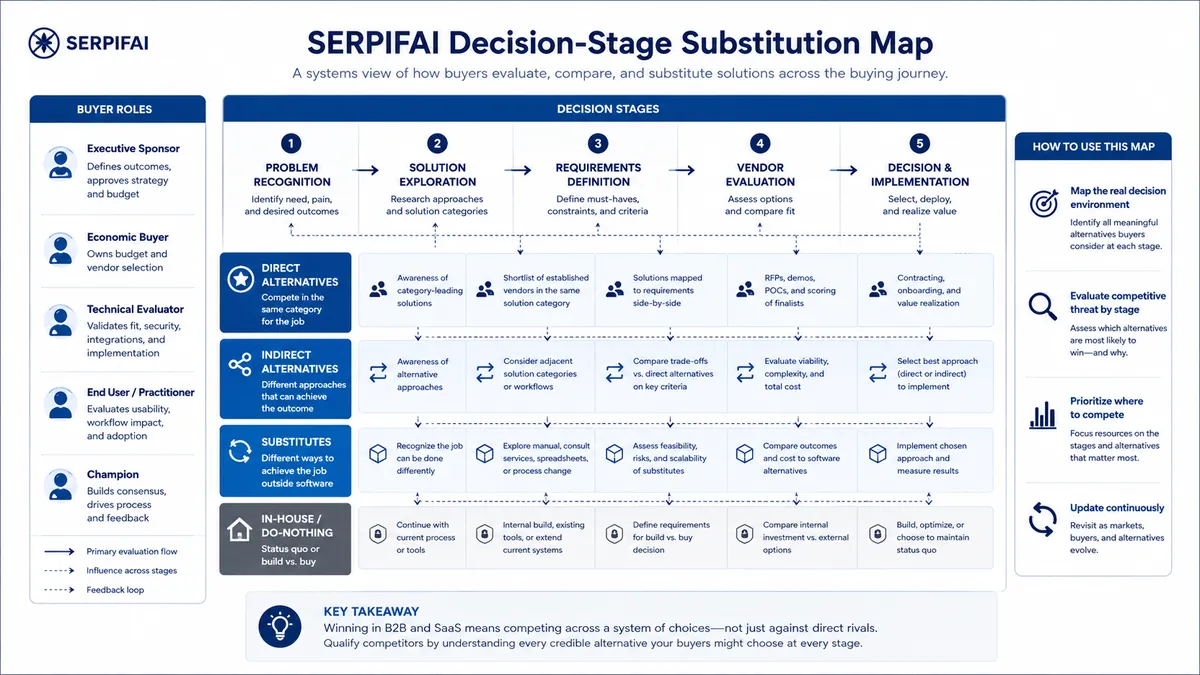
Preserved contextual visual
How alternatives appear at different decision stages
The preserved Decision-Stage Substitution Map remains useful for showing that a buyer may encounter products, suites, services, internal options and the status quo at different stages. It is contextual—not the canonical candidate-qualification rule engine. For the complete role taxonomy, use Direct, Indirect, Substitute and Reference Competitors Explained.
Semantic qualification relay
From decision scope to a defensible outcome
Read the relay from top to bottom. Validation gates run before classification. Each branch names the decision basis and the permitted analytical lane.
Confirm the decision scope first
Missing or unconfirmed scope returns Refused — define the decision first, even when later fields are missing or malformed.
Complete the evidence record
After scope passes, a missing evidence note or source date returns Review required — incomplete evidence record.
Validate the controlled states
After scope and evidence-record checks pass, reject malformed or unsupported qualification values. No disposition is produced.
Resolve contradiction before uncertainty
Any Contradictory input
Review required — contradictory evidence.
Otherwise any Unknown input
Review required — incomplete evidence.
Test supported fit and relationship
Supported + like-for-like
Qualified competitor.
Supported + accepted alternative relationship
Qualified alternative with the exact subtype.
Handle material no-fit transparently
Named material context
Context only for the named use.
No named context
Exclude for this decision.
Return the complete handoff
Expose all thirteen governed handoff fields, including permitted use, prohibited inference, reviewer requirement and reopening trigger.
- Qualified competitor
Bounded like-for-like analysis. - Qualified alternative
Separate subtype analysis. - Context only
Named contextual use. - Exclude
Preserved exclusion record. - Review required
Evidence or contradiction queue. - Refused
Scope-definition queue.
- Qualified competitor
Method reference
This reference explains the public qualification contract in plain language. Internal audit identifiers remain implementation-only and are not part of the public reading or copied handoff.
Qualification inputs
- Decision scope
- Decision/action, candidate, exact offer, target account or segment, material geography and evidence cut-off date.
- Account and buying-group fit
- Whether the candidate can realistically serve the target account and relevant buying group.
- Problem and outcome fit
- Whether it addresses the same material problem and desired business outcome.
- Offer and workflow relationship
- The decision-specific relationship between the candidate and the scoped offer.
- Commercial and technical feasibility
- Whether the candidate can realistically be procured, deployed, integrated and operated.
- Context contribution
- A named analytical use when the candidate is not realistically substitutable.
- Evidence record
- A dated note and source or observation reference supporting the entered states.
Validation and decision order
- Confirm the decision scope.
- Confirm the evidence record is complete.
- Validate the controlled input states.
- Resolve contradictory evidence before incomplete evidence.
- Determine competitor, alternative, named context, exclusion or review state.
- Confirm the decision handoff is complete.
Public handoff
The handoff preserves disposition, decision basis, scope, candidate and offer, decisive reasons, alternative subtype, unresolved evidence, permitted use, prohibited inference, reviewer requirement, reopening trigger, evidence note/date and method version.
For adjacent decisions, use competitor-analysis scope, SEO competitor-set construction, reliable competitor evidence, and competitor classification.
Fast Action
Qualify one candidate
Complete this after you have evidence. The tool runs locally, sends no data and assigns no score.
Local-only · no score
Correct the record
Qualification result
- Decision scope
- Candidate and offer
- Decisive reasons
- Alternative subtype
- Missing or contradictory evidence
- Permitted use
- Prohibited inference
- Reviewer requirement
- Reopening trigger
- Evidence note and date
Decision basis and method
This public view translates implementation identifiers into reader-facing decision language. The underlying qualification rules are unchanged.
- Decision basis
- Available after evaluation.
- Method version
- 1.0.1
- This result applies only to the stated decision, offer, segment, geography and date.
- It does not establish a legal market, market share, customer intent or complete competitor universe.
- It records evidence but does not validate its reliability.
- Reviewer approval remains separate.
No-JavaScript manual method
- Record the complete decision scope, dated evidence note and five controlled qualification states.
- Run the decision-scope gate first. If the scope is incomplete or unconfirmed, return Refused — define the decision first and stop.
- Run the evidence-record gate next. If the evidence note or source/observation date is incomplete, return Review required — incomplete evidence record and stop.
- Run the input-integrity check. If a controlled qualification value is malformed or unsupported, return a technical validation error and no disposition.
- Review contradiction before uncertainty, so conflicting evidence is never treated as merely missing.
- Apply the qualification decision in order: Qualified competitor, Qualified alternative, Named context, Exclude from this decision, or the governed review state.
- Complete the full decision handoff before sharing or approving the record.
Manual output template: disposition; decision basis; decision scope; candidate and exact offer; decisive reasons; alternative subtype or explicit not-applicable statement; missing/contradictory evidence; permitted use; prohibited inference; reviewer requirement; reopening trigger; evidence note/date; method version.
The collapsed Method reference maps these plain-language steps to the public qualification contract.
Fictional worked example: Northstar Workflow Systems
Illustrative fictional composite — not client or market evidence
Decision: select candidates for a positioning and product-investment analysis for an enterprise workflow-automation platform serving regulated financial-services operations teams in the UK and EU over the next 12 months.
| Candidate | Decisive evidence pattern | Outcome | Permitted use | Reviewer/reopening action |
|---|---|---|---|---|
| FlowCore Enterprise | Same account, buying group, outcome, procurement and deployment model. | Qualified competitor | Bounded like-for-like comparison. | Approve for consequential use; reopen after material offer or feasibility change. |
| MegaSuite Operations Cloud | Same decision and buyer; broader suite and higher implementation burden. | Qualified alternative — Suite/platform | Separate suite/platform alternative analysis. | Confirm subtype; reopen after packaging or implementation change. |
| ProcessWorks Managed Service | Same outcome and budget; human-delivered service. | Qualified alternative — Service/managed service | Service-alternative analysis. | Confirm delivery-model boundary. |
| Spreadsheet + email workflow | Current manual process can retain the budget and avoid migration. | Qualified alternative — Manual/status quo | Status-quo analysis. | Reopen after workflow failure or change approval. |
| OpsReview Directory | High category visibility; no substitutable offer; useful for category education. | Context only | Named category-education context. | Confirm context; reopen if a substitutable offer emerges. |
| RegionalFlow US | Strong feature fit; UK/EU serviceability is Unknown. | Review required — incomplete evidence | Evidence-resolution queue. | Collect geography and support evidence. |
| QuickFlow SMB | SMB self-service buyer, no enterprise controls, no named context. | Exclude | Preserved exclusion record. | Reopen if enterprise scope or context changes. |
The example does not rank the candidates. It separates analytical lanes so that a suite, service, status quo and directory are not averaged into a single “fit” score.
Difficult B2B and SaaS cases
Suite versus point solution
A suite can be a Qualified alternative when it solves the same outcome for the same account but changes scope, implementation and buying economics. Do not force like-for-like comparison.
Partner and competitor
The same platform may complement one workflow and replace another. Qualify the exact offer and decision; do not assign a permanent company-wide role.
Internal build or open source
Technical possibility is not enough. Record approved resources, hosting, security, support and timing. Unknown feasibility remains Review required.
Geography and procurement
A product can look like-for-like but fail the decision because of serviceability, residency, contract, security or procurement constraints.
Publisher, directory or marketplace
High visibility may justify Context only, not rivalry. Use When Publishers, Directories and Marketplaces Are Not Real Competitors when a search-visible domain may be an intermediary rather than a real competitor.
Emerging claims
Strong launch language without verified availability, customer, pricing or implementation evidence should remain Unknown or Contradictory—not “average confidence.”
Fictional failure story: the broad-category shortcut
Illustrative fictional scenario
A team copies ten products from a software category and the first search-results page, compares features and price, then assigns a weighted “competitor fit” percentage. The list mixes SMB tools, enterprise suites, directories, a managed service and products unavailable in the target geography. Missing pricing and procurement evidence becomes a neutral score. The internal-build plan and status quo disappear because they are not vendors.
The executive summary looks precise but cannot support the decision. Qualification should have happened first: define the scope, preserve Unknown and Contradictory evidence, separate like-for-like competitors from alternatives and context, and state what each result may support.
Qualification checklist
- The decision/action, exact offer, account/segment, material geography and evidence date are recorded.
- The scope is explicitly confirmed; a checkbox does not override missing fields.
- The five qualification dimensions use only the accepted controlled values.
- The evidence note and source/observation date are complete.
- Contradictory evidence is resolved before Unknown evidence.
- The exact alternative subtype remains visible.
- Context only has a named use and is not treated as primary rivalry.
- Exclusions retain reasons and reopening triggers.
- All thirteen governed handoff outputs are complete.
- A reviewer approves consequential use separately from the automated outcome.
Reviewer control
The tool and workbook can apply the canonical rule order; they cannot approve the business decision. A reviewer must check whether the evidence supports the entered states, whether the permitted use is proportionate, and whether the question should move to a more specific method: competitor-analysis scope, SEO competitor-set construction, competitor evidence quality, evidence confidence, contradictory evidence, evidence-state classification, or competitor-role classification.
For consequential outputs, record the reviewer, decision, date and any return reason. Never overwrite the prior record; create a successor version and link it to the earlier one.
When to reopen a qualification
- The target segment, geography, buying group or decision changes.
- The candidate changes packaging, product scope, pricing, contract, deployment or service model.
- New procurement, security, integration or regulatory evidence changes feasibility.
- An Unknown becomes supported or no-fit evidence.
- A contradiction is resolved or a new contradiction appears.
- A candidate becomes substitutable, loses substitutability, or gains/loses a named context.
- The evidence cut-off date is no longer suitable for the decision.
For monitoring cadence and competitor-set drift, use When Should You Update Your Competitor Set?. This playbook records event-based reopening triggers so the next review knows why the qualification must be revisited.
Use the workbook for repeated qualification work
The workbook separates decision scope, candidate records, evidence, review, handoff and reopening history. It exposes the decision basis and keeps reviewer approval separate from the automated outcome.
B2B/SaaS Competitor Qualification Register
Seven visible sheets for repeated candidate qualification, evidence tracking and versioned review. No macros, external connections, score or hidden logic.
Competitor Qualification Decision Handoff
A tagged, print-safe handoff template with the complete output contract and a fictional example. It does not replace the article or workbook.
Evidence and claim limitations
SERPIFAI methodology: the seven inputs, validation order, outcomes and handoff fields are a versioned decision method. They are not external consensus, a statistical model or a market-share calculation.
External context: the original source used official public product pages and implementation context to illustrate how offer scope, delivery and procurement can differ. Public positioning is discovery evidence only; customer-approved records, win/loss evidence, procurement documents and direct observations may be more decision-specific when available.
- Semrush — public toolkit scope
- Ahrefs — public enterprise scope
- MarketMuse — public content-planning scope
- Conductor — public platform scope
- NIST — software implementation and switching context retained from source
These links do not validate SERPIFAI classifications and do not certify rankings, revenue, ROI, customer intent or client outcomes. External link response and freshness remain direct review items.
Completed task
Your qualification record is complete when…
The decision is confirmed, every canonical input is controlled, the evidence record is dated, one decisive validation or rule is visible, all thirteen output fields are complete, the permitted use and prohibited inference are explicit, and a reviewer and reopening trigger are recorded.
At that point, the record can move into SEO competitor-set construction or remain in an evidence, context or exclusion queue. It should not be converted into a universal competitor label.