

Direct answer
Observed, inferred and unresolved are disclosure states—not confidence scores
Observed evidence records what was directly detected or measured within an exact entity, scope, time, method and source. Inferred evidence states a bounded conclusion drawn from visible observations through an exposed reasoning bridge and assumptions. Unresolved evidence states that the intended claim is not yet established because a required input, scope, provenance, reconciliation or detection opportunity is missing.
An observation can be stale, partial or unusable for a decision. An inference can be rigorous and decision-useful. Unresolved is a legitimate result. The state tells readers how the claim relates to the evidence; confidence, contradiction, materiality and permitted action are separate controls.
Plain-English definitions
Observed
A direct recorded observation or measurement tied to the exact entity, scope, time, method, source, definition and decision context.
Not automatically: complete, current, causal, representative or decision-ready.
Inferred
A conclusion that goes beyond direct observation but is supported by explicit observed inputs, visible reasoning, stated assumptions and bounded, reviewable logic.
Not automatically: weak, speculative or low confidence.
Unresolved
The evidence does not establish the intended claim because something material is missing, unclear, unknown, unreconciled or not detectable with the available method.
Not the same as: false, absent, observed, inferred or low confidence.
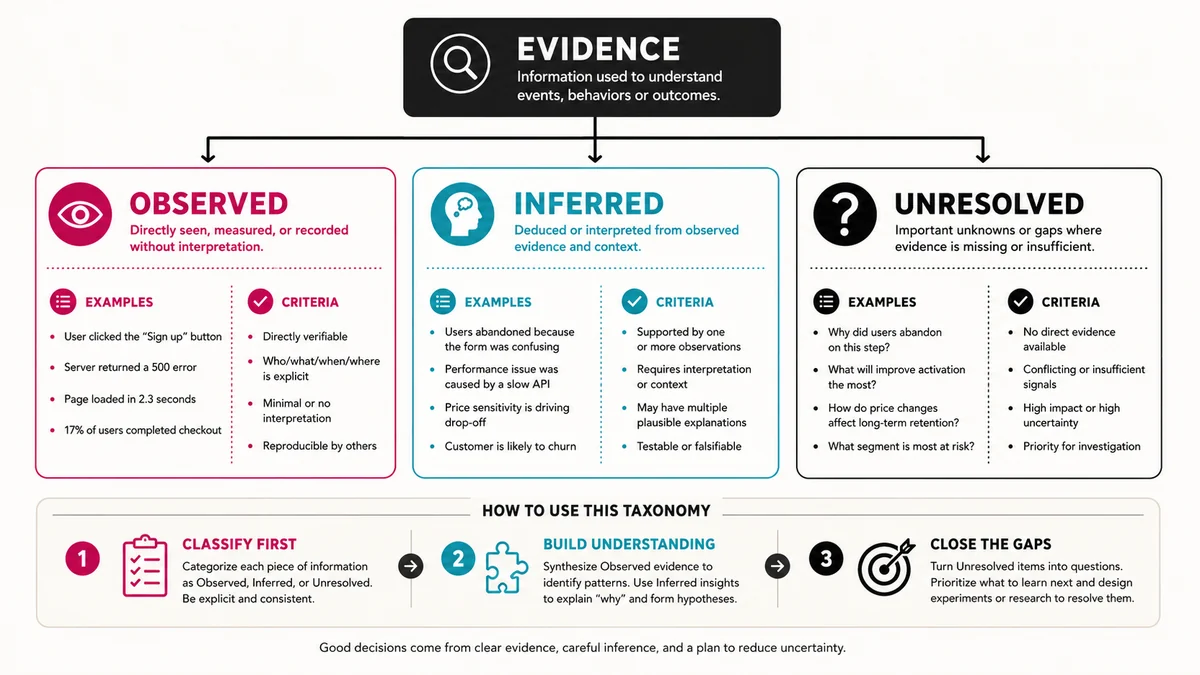
Why evidence state matters
Teams often write a direct observation, an interpretation and an unanswered question in the same grammatical voice. That erases the evidence boundary. A reader then cannot tell which part can be rechecked, which part depends on reasoning, or which part should hold the decision open.
Observed evidence: direct does not mean complete
Use Observed only when the record identifies the exact entity, relevant scope, observation time or review window, method, source, definition and decision context. The sentence should be reproducible at the level that matters: another reviewer should know what to inspect, what was counted or detected, and what boundary applied.
When an observation becomes stale, partial or out of scope
The historical fact can remain observed while its eligibility changes. A page captured six months ago may still be an observed historical record, but it may be stale for a current launch decision. A crawl may directly observe what the crawler detected while remaining method-limited for content loaded only after interaction. A UK pricing page is an observation about the UK page—not automatically the US product.
Inferred evidence: rigorous reasoning is still inference
An inference is publishable when its observed inputs are named, the reasoning bridge is exposed, assumptions are stated, scope is bounded, and the logic can be challenged or falsified. The requirement is disclosure, not apology. A strong inference may be more useful than a narrow observation, but it must never be presented as direct observation.
Example: “We directly observed enterprise security pages, procurement FAQs and named integrations. Based on those records, we infer that enterprise evaluation is a deliberate acquisition motion, assuming the pages remain current and represent active sales support.”
Unresolved evidence: name the gap and its decision effect
Use Unresolved when evidence is missing, scope is unclear, provenance is unknown, assumptions cannot be supported, a required observation is unavailable, or a material contradiction has not yet been handled. Unresolved should name the exact condition, why it matters, what evidence could change the state, who owns the review and when the record reopens.
Missing evidence does not establish absence. An absence claim needs a credible detection opportunity: a defined place, period and method in which the signal could reasonably have appeared and been detected.
What evidence state does not mean
State is not confidence
Confidence is governed separately by How to Assign Confidence Without Fake Precision. Do not convert Observed into “high confidence” or Unresolved into “low confidence” automatically.
State is not contradiction
When records conflict, preserve and reconcile them using How to Handle Contradictory Competitor Evidence. A contradiction is not silently collapsed into one of the three states.
State is not disposition
Materiality and reversibility determine whether the team proceeds, narrows the claim, requests review or holds the affected decision.
Canonical classification protocol
- PreserveRecord the exact claim, decision and evidence.
- Classify inputIdentify what was directly observed.
- Expose reasoningShow the bridge and assumptions.
- Test scopeCheck entity, market, segment, tier, time, definition and method.
- Assign stateObserved, Inferred or Unresolved.
- Bound and governSet wording, action, owner, reviewer, next evidence and reopen condition.
Deterministic precedence
- Stop for an unresolved material contradiction and apply How to Handle Contradictory Competitor Evidence.
- Stop for a missing essential input, unknown provenance or unclear scope.
- Stop an absence claim without a credible detection opportunity.
- If the claim goes beyond direct observation, test the inference requirements.
- If the claim is direct, test all observation requirements.
- If neither basis is eligible, classify the intended claim as Unresolved.
Observed → Inferred → Unresolved
How to read it: select a checkpoint to isolate that part of the method. The canvas shows the relationship; the inspector explains what the checkpoint changes in the decision.
Evidence state versus confidence, contradiction, materiality and disposition
| Control | Question answered | Allowed values | Do not do |
|---|---|---|---|
| Evidence state | How does the claim relate to the evidence? | Observed; Inferred; Unresolved | Use it as a score. |
| Eligibility | Can this evidence support the intended claim? | Usable; Usable with limitation; Not yet usable for the intended claim | Assume direct equals usable. |
| Confidence | How strongly may the eligible claim be expressed? | How to Assign Confidence Without Fake Precision vocabulary | Derive it silently from state. |
| Contradiction | Do relevant records conflict? | How to Handle Contradictory Competitor Evidence outcomes | Average or hide the conflict. |
| Materiality | Would the state change the decision? | Material; non-material | Change the state because stakes are high. |
| Disposition | What action is allowed? | Proceed; Proceed with limits; Review; Hold the affected decision | Treat it as a synonym for confidence. |
Permitted and prohibited wording
| State | Permitted | Prohibited | What changes the state |
|---|---|---|---|
| Observed | “We directly observed…” followed by scope, date and method. | “This proves they intend…”, “always”, “complete” or causal wording without separate support. | A corrected source, changed scope, new method, expired review window or definition mismatch. |
| Inferred | “Based on X and Y, we infer…” plus assumptions and boundary. | Writing the inference as direct observation, certainty or motive. | New observation confirms, narrows or falsifies the reasoning bridge. |
| Unresolved | “The available evidence does not establish…” plus the missing condition and decision effect. | “There is none”, “false”, “low confidence” or silent conversion to another state. | Required provenance, scope, observation, assumption support or contradiction resolution becomes available. |
Worked examples
Pricing page
Observed: A publicly accessible annual-pricing page displayed three tiers on 30 July 2026.
Limit: This does not establish transaction volume, discounting or sales strategy.
Enterprise motion
Inferred: Security, procurement and integration pages suggest support for enterprise evaluation.
Assumption: The pages are current and linked to an active go-to-market motion.
Customer absence
Unresolved: No named healthcare customer was detected in the reviewed public pages.
Boundary: That does not establish that no healthcare customers exist.
One recommendation can contain several states
A recommendation should preserve claim-level labels: “We directly observed three implementation pages. We infer that implementation reassurance is an evaluation-stage priority. It remains unresolved whether this concern materially reduces conversion. Run a reversible content test before committing to a full programme.”
Edge cases
- Copied evidence family: ten pages repeating one origin are not ten independent observations; preserve provenance.
- Machine detection: the observation is what the method detected, not the whole world outside its detection limits.
- Negative search result: “not found in the defined search” can be observed; “does not exist” usually remains unresolved.
- Changed definition: a source can be accurate but unusable when its definition does not match the claim.
- Mixed recommendation: classify each material clause, not the paragraph as one state.
Manual method
- Write one exact claim and the decision it will influence.
- Record the direct evidence with entity, scope, time, method, source and definition.
- Underline every word that goes beyond the direct record.
- For those words, list observed inputs, reasoning bridge and assumptions.
- Mark missing, unclear, unknown, contradictory or undetectable conditions.
- Assign state, eligibility, materiality and disposition separately; then add owner, reviewer, next evidence and reopen condition.
Quick guided tool
Use this for one prepared claim. It produces a bounded first-pass classification, not a completed audit record.
60–90-second first pass with prepared evidence
Classify one bounded claim
Quick classification — not a completed evidence handoff. One step is shown at a time. Nothing is transmitted, and unknown audit fields remain blank.
Step 1 of 3
- Exact claim
- Evidence summary
- Affected decision
- Evidence relationship
- Source or provenance
- Source lineage
- Capture reference
- Transformation notes
- Observation time / review window
- Scope
- Method
- Observed inputs
- Reasoning bridge
- Material assumptions
- Inference scope
- Relationship-unresolved description
- Unresolved-condition description
- Combined unresolved summary
- Materiality
- Reversibility
- Narrowed-claim status
- Narrowed claim
- Evidence state
- Reason code
- Eligibility
- Eligibility reason
- Disposition
- Limitations
Permitted wording
Prohibited wording
Computed next evidence
Computed reopen condition
Confidence boundary
Contradiction boundary
Technical JSON record
Detailed audit-ready workflow
Detailed review: usually 5–15 minutes with prepared evidence
Build an audit-ready evidence record
One stage is shown at a time. Unknown values remain blank. Optional local draft controls use this browser only; nothing is transmitted automatically.
Stage 1 of 4
- Exact claim
- Evidence summary
- Affected decision
- Evidence relationship
- Source or provenance
- Source lineage
- Capture reference
- Transformation notes
- Observation time / review window
- Scope
- Method
- Observed inputs
- Reasoning bridge
- Material assumptions
- Inference scope
- Relationship-unresolved description
- Unresolved-condition description
- Combined unresolved summary
- Materiality
- Reversibility
- Narrowed-claim status
- Narrowed claim
- Evidence state
- Reason code
- Eligibility
- Eligibility reason
- Disposition
- Limitations
- Entity
- Relevant definition
- Review or falsification test
- Contradiction boundary
- Absence and detection details
- Staleness detail
- Out-of-scope detail
- Method-limitation detail
- Owner
- Reviewer
- Next evidence
- Reopen condition
- Approval date
- Approval status
- Prior state
- Reclassification reason
Permitted wording
Prohibited wording
Computed next evidence
Computed reopen condition
Confidence boundary
Contradiction boundary
Technical JSON record
Workbook and PDF
Evidence Register workbook
Use the workbook for repeated evidence-state classifications, controlled vocabulary, worked examples and the 67 canonical fixtures.
Evidence-state handoff PDF
Use the PDF for a portable static handoff with claim, inputs, assumptions, unresolved conditions, wording, action and governance.
Frequently asked questions
Is an inference automatically weak?
No. A visible, bounded and reviewable inference can be rigorous. It remains Inferred because the conclusion goes beyond direct observation.
Is an observation automatically decision-ready?
No. It may be stale, partial, method-limited, out of scope or irrelevant to the intended decision.
Can unresolved evidence be published?
Yes, when the wording names what is unresolved, why it matters and what action is permitted. Material unresolved evidence should hold the affected decision.
How should assumptions be exposed?
Name the assumption next to the inference, explain how it connects the observed inputs to the conclusion, and state what evidence would change it.
Who owns reopening?
The record should name an owner, accountable reviewer, next evidence and explicit reopen condition.
Sources and method boundary
This proprietary SERPIFAI classification method adapts general transparency, provenance and analytical-quality principles. The external sources below support those principles; they do not validate this framework or its deterministic rules.
- W3C PROV Data Model — provenance records entities, activities and agents involved in producing data or things.
- NIST AI Risk Management Framework and its Playbook — transparency, documentation, uncertainty and accountable review are distinct risk-management practices.
- UK Government AQuA Book — analysis should be fit for purpose, quality assured and explicit about uncertainty and assumptions.
- National Academies: Reproducibility and Replicability in Science — clear, specific methods and available records enable others to understand and check results.
Use evidence state to make the decision boundary visible
Before a material competitor claim enters a strategy, label what was directly observed, what was inferred and what remains unresolved. Then govern confidence, contradiction, materiality and action separately. The result is not a more cautious report; it is a more usable one.
When an unresolved boundary changes a consequential decision, SERPIFAI’s Competitive Decision Intelligence service can structure the evidence record, qualify the decision scope and submit a review-ready recommendation without hiding the limits.