
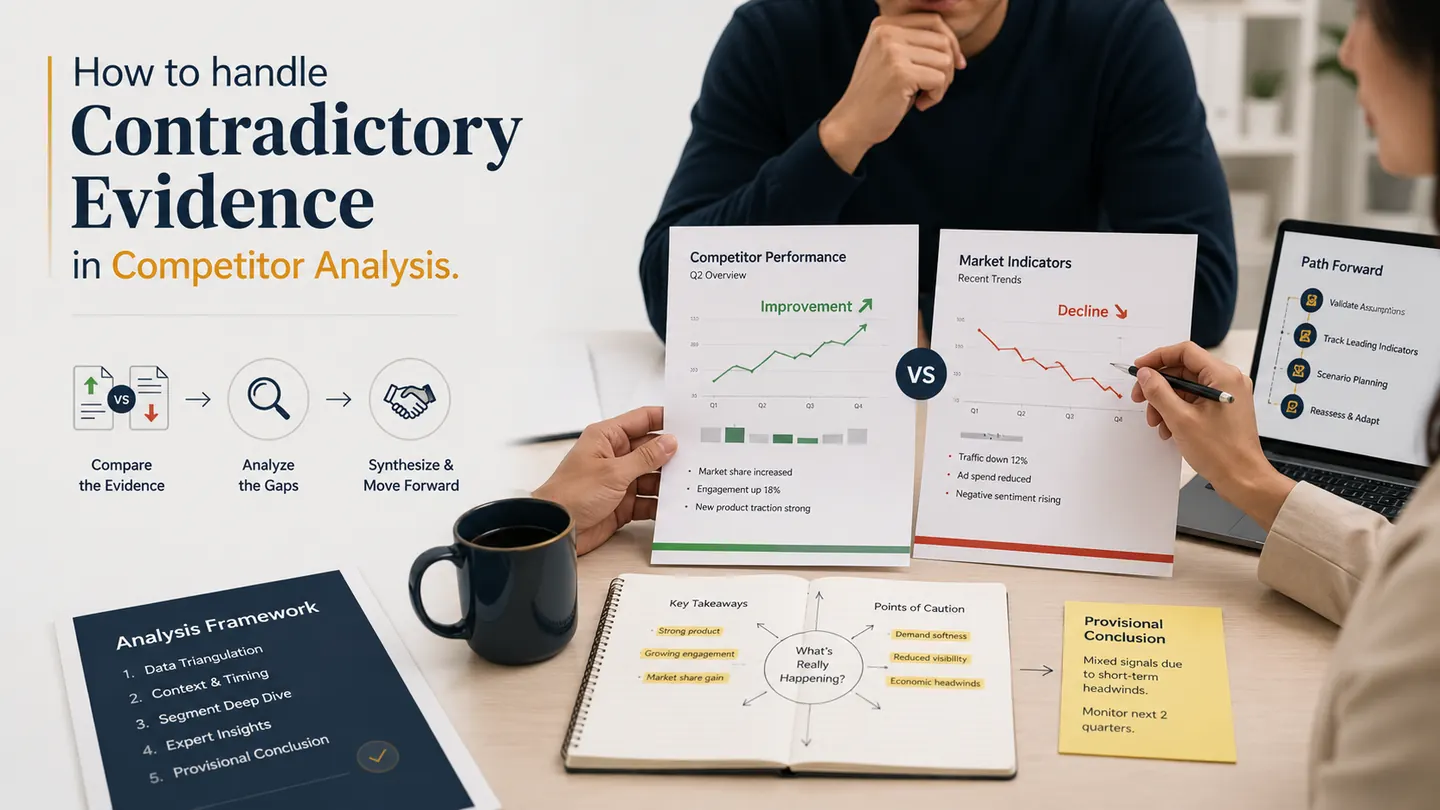
Direct answer
Do not average contradictory competitor evidence into a false midpoint. First fix the exact claim and decision it would support. Then normalize scope, market, segment, product tier, metric definition, date and collection method. Trace each record to its original source and test whether the sources are genuinely independent. Only then decide whether the disagreement is apparent, methodological, provenance-based or a genuine factual contradiction. Preserve both records, choose a controlled disposition, and state the strongest action the evidence permits.
In plain English: two sources can look as if they disagree because they measured different things. Your first job is to make the comparison fair. Your second job is to decide whether the remaining conflict changes the decision.
Beginner bridge
Why conflicting competitor data is not automatically a true contradiction
A contradiction exists only when two records make incompatible claims about the same proposition under comparable conditions. A pricing page for the United States and a reseller page for Germany may show different prices without contradicting each other. A traffic estimate for last year and a direct observation from this week may point in opposite directions because the market changed. A vendor claim and an analyst observation can also coexist because one is messaging and the other is observed behaviour.
Buyer consequence: The danger is not that two records disagree. The danger is hiding, averaging or simplifying that disagreement until an uncertain claim becomes a confident instruction. A governed contradiction should narrow the permitted claim, permitted action or both.
Apparent contradiction
The records differ because scope, time, definition, method or evidence state is not equivalent. The correct action is usually to segment, narrow or split the claim.
Genuine contradiction
The records address the same normalized proposition and still cannot both be true. The conflict must be preserved, adjudicated or allowed to block the decision.
A copied report does not become independent corroboration because several websites repeat it. Independence is a provenance question, not a count of URLs.
SERPIFAI public protocol
The SERPIFAI Contradiction Adjudication Protocol
This protocol converts conflict into an auditable decision record. It does not produce a percentage, composite score or automatic truth verdict.
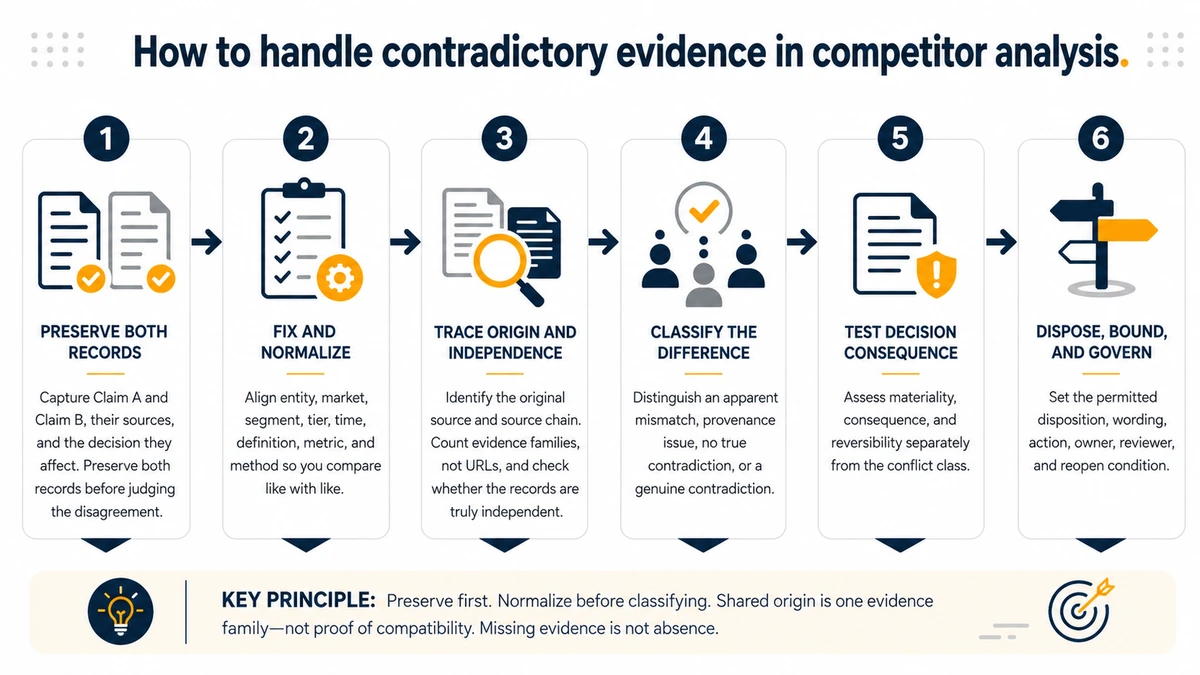
- FixWrite the exact proposition and decision use.
Replace a broad topic with one testable statement. State what decision would change if the statement were accepted or rejected.
- NormalizeAlign entity, scope, market, segment, tier, metric, definition, time and method.
Differences in any of these dimensions can create an apparent contradiction.
- TraceFollow each record to its original provenance.
Record who produced it, what activity generated it, when it was collected and whether another source merely copied it.
- TestDetermine whether the sources are independent.
Two reports derived from the same dataset or press release provide one origin, not two corroborating observations.
- ClassifyName the conflict class.
Use the taxonomy below rather than the vague label “conflicting data.”
- Test consequenceAssess materiality, reversibility and decision consequence.
A contradiction can be real but immaterial to a low-cost reversible action. The same conflict can block an irreversible investment.
- DisposeSelect one controlled outcome.
Segment, narrow, split, prefer with reasons, preserve unresolved, refuse the claim or collect defined evidence.
- BoundState confidence impact, permitted wording and permitted action.
Lower confidence is meaningful only when it changes what can be claimed or done.
- GovernAssign owner, reviewer and reopen condition.
Preserve the rejected record and state what new evidence, date, market change or method change would reopen the decision.
Preserved editorial context
Keep the conflict visible while the decision is bounded
The protected editorial visual below remains part of the original article shell. It shows the earlier resolution concept; the protocol above supplies the complete operational controls used by the tool, workbook and handoff.
Controlled conflict classes
Classify why the records disagree
| Conflict class | What it means | Typical handling after materiality review |
|---|---|---|
| Missing-evidence confusion | A search did not find evidence, but absence is being asserted without a credible detection opportunity. | Refuse the claim |
| Entity mismatch | The records concern different competitors, products or legal entities. | Split the claim |
| Geography or market mismatch | The geography or market differs. | Segment the records |
| Customer-segment mismatch | The records concern different customer segments. | Segment the records |
| Product-tier mismatch | The records concern different plans, packages or product tiers. | Split the claim |
| Time conflict | The records describe different dates or periods. | Segment the records |
| Definition conflict | The same or similar label uses different definitions. | Split the claim |
| Metric conflict | The unit, denominator or metric differs. | Narrow the claim |
| Method conflict | The collection or estimation method differs. The class explains the cause; materiality determines whether the decision can proceed. | Non-material: preserve unresolved with a method limitation. Material or undetermined: defer or collect method-comparable evidence. |
| Evidence-state conflict | A claim, observation, model or inference is being treated as the same evidence state. | Split the claim |
| Provenance or source conflict | The records share an origin, provider or derivation path, or independence remains unproven. | Treat them as one evidence family. Test compatibility separately. Non-material: preserve dependence as a limitation. Material: defer and collect independent-origin evidence. |
| No true contradiction | The records are compatible after normalization. | Retain as compatible records |
| Genuine factual contradiction | Comparable records address the same proposition and remain incompatible. | Non-material: preserve unresolved with a limitation. Material: preserve unresolved and block the dependent decision. |
Trace provenance before deciding which conflicting source to trust
Provenance records the entities, activities and responsible agents that produced a record. The practical question is simple: where did this observation originate, and did the second source generate new evidence or repeat the first?
One evidence family is not a compatibility verdict. Shared provenance means the records cannot be counted as independent corroboration. Their definitions, periods, transformations and wording still require a separate compatibility test.
Corroboration count: one origin. The copied reports may improve discoverability, not independence.
First-party claims versus observed behaviour
A competitor website is usually authoritative for what the company publicly claims, offers or prices at the time of capture. It is not automatically authoritative for adoption, customer outcomes or market impact. A first-party statement and a third-party observation may therefore answer different questions. Preserve both and label their roles.
For each record, preserve the immediate source, earliest known origin, source chain, underlying data provider, observation date, publication or retrieval date and known limitations. Repeated copies of one origin remain one evidence family.
Missing evidence is not automatically evidence of absence
Missing evidence means the investigation did not find an observation. Evidence of absence means a suitable observation process was capable of detecting the thing, searched the right scope and still found nothing. The distinction depends on detection capability.
Weak absence claim
“We did not find enterprise pricing, so the competitor has no enterprise plan.” The website may hide pricing behind sales contact or regional access.
Permitted wording: “No public enterprise price was found in the reviewed pages on the stated date.”
Stronger absence evidence
A complete, current plan catalogue explicitly lists every tier and states that no enterprise plan is offered. The source is in scope and designed to disclose the feature.
Permitted wording: “The current official catalogue explicitly states that no enterprise plan is offered.”
Materiality decides whether the conflict blocks action
Materiality is not a property of the evidence alone. It is the relationship between the unresolved conflict and the decision consequence. Ask what changes if the claim is wrong, how reversible the action is, and who bears the cost.
| Decision condition | Conflict treatment | Permitted action |
|---|---|---|
| Low-cost, reversible test; conflict does not change guardrails | Preserve unresolved — non-blocking | Proceed with a bounded test and monitor the reopen condition. |
| Material investment; conflict affects the choice | Preserve unresolved — decision-blocking | Pause the recommendation until review or defined evidence is collected. |
| One record is demonstrably more direct, current and decision-fit | Prefer one record with explicit reasons | Proceed within the preferred record’s scope; retain the competing record. |
| Claim cannot survive a material unresolved contradiction | Refuse the claim | Do not use the claim in the recommendation. |
Contradiction Resolution Bridge
How to read it: select a checkpoint to isolate that part of the method. The canvas shows the relationship; the inspector explains what the checkpoint changes in the decision.
Controlled outcomes
Use a disposition that changes the decision record
Retain as compatible records
Use when normalization shows that both records can coexist without supporting one combined claim.
Segment the records
Use when geography, market, segment, tier or time requires separate conclusions.
Narrow the claim
Use when the evidence supports a smaller, more precise proposition.
Split the claim
Use when one label hides different entities, definitions, tiers or evidence states.
Prefer one record with explicit reasons
Use only when directness, currency and decision fit provide a recorded basis.
Preserve unresolved — non-blocking
Use for a genuine but non-material conflict in a bounded reversible action.
Preserve unresolved — decision-blocking
Use when the unresolved conflict could change a material recommendation.
Refuse the claim
Use when no responsible bounded wording can support the proposition.
Collect defined additional evidence
Name the specific observation, source chain, owner and reopen trigger required.
Illustrative fictional example
Worked example: a competitor’s enterprise adoption claim
Decision: whether to position a new service against a competitor as an established enterprise standard.
Record A — first-party claim
The competitor’s website says the platform is “built for global enterprises” and shows several large-company logos.
- Provenance
- Current official product page
- Evidence state
- Attributed first-party claim
- What it supports
- The competitor targets enterprise buyers publicly
Record B — observed market signal
A current, independently collected customer sample contains mostly small and mid-market organizations, with limited verified enterprise deployment evidence.
- Provenance
- Independent observed sample
- Evidence state
- Observation with sampling limits
- What it supports
- Verified adoption in the sampled population is not predominantly enterprise
Adjudication
- The exact proposition “the competitor is widely adopted as an enterprise standard” is broader than either record proves.
- The records do not directly contradict: one describes positioning; the other describes a limited observed adoption sample.
- The conflict class is evidence-state conflict with a potential scope issue.
- The disposition is Split the claim.
- Strongest permitted wording: “The competitor explicitly targets enterprise buyers, while the reviewed sample provides limited evidence of broad enterprise adoption.”
- Prohibited wording: “The competitor is the enterprise market leader” or “the enterprise claim is false.”
- Permitted action: position against the competitor’s enterprise message, but do not base investment sizing on unverified adoption.
- Reopen condition: a representative customer dataset, verified enterprise deployment list or current market-share evidence.
Difficult edge cases
Two search tools estimate very different traffic
Classify this as a method conflict until metric definitions, geographic databases, keyword coverage and estimation dates are aligned. Do not average the estimates. Use them directionally or collect first-party analytics when authorized.
A press release is repeated by ten news sites
Trace the lineage. If all reports derive from the same release, they provide one source origin. Independent reporting requires new observation, verification or analysis.
An old source is more detailed than a current source
Detail does not override time fit. Preserve the old record for history, but narrow current claims to what the current evidence supports.
A direct observation conflicts with a first-party claim
Check whether they address the same scope and time. If they do, classify a provenance conflict or genuine factual contradiction. Record incentives and collection limits; do not automatically dismiss either source.
The conflict affects only one part of a recommendation
Split the recommendation. Block only the dependent claim or action, not unrelated conclusions that remain supported.
State the strongest permitted wording — and the wording you reject
| Evidence state | Strongest permitted wording | Prohibited wording |
|---|---|---|
| Scope mismatch | “The records describe different markets or segments and should be interpreted separately.” | “The sources prove opposite conclusions.” |
| Copied sources | “Multiple publications repeat one original claim.” | “Several independent sources confirm the claim.” |
| Unresolved, non-material | “The evidence remains mixed; a bounded reversible test may proceed.” | “The evidence is settled.” |
| Unresolved, material | “The contradiction is unresolved and blocks this recommendation pending review.” | “We are confident enough to proceed.” |
| Preferred record | “Record A is preferred for this decision because it is more direct, current and in scope; Record B remains preserved.” | “Record B was wrong” unless independently demonstrated. |
| Missing evidence | “No evidence was found in the stated search scope.” | “The feature does not exist.” |
Works without JavaScript
Manual contradiction-adjudication method
- Write one exact proposition and the decision it would change.
- Copy Record A and Record B into separate fields; never overwrite either.
- Compare entity, market, segment, tier, metric definition, date and method.
- Trace each record to its original source and mark shared origins.
- Label each record as claim, observation, estimate or inference.
- Choose the first material conflict class from the taxonomy.
- Test whether the conflict changes a material or hard-to-reverse decision.
- Select one controlled disposition and write the permitted and prohibited wording.
- Assign an owner, reviewer and concrete reopen condition.
If a required comparison is unknown, do not produce a resolved outcome. Record what must be checked next.
Adaptive contradiction triage
Find the safest next action without completing an audit form
Start with two prepared claims and the decision they affect. The path adapts to the first meaningful difference, so many checks finish after three focused steps. Open the detailed review only when provenance, approval or handoff controls are needed.
Claim A
Claim B
Decision
- Likely conflict type
- Decision effect
- Provisional handling
- Evidence-family treatment
- Strongest safe wording
- Next action
Build an audit-ready evidence recordDetailed review: usually 5–15 minutes with prepared evidence
Complete the detailed review in four controlled stages. The interface shows one stage at a time, preserves mapped quick answers, validates only the active stage and keeps the final handoff fail-closed. Allow roughly 5–15 minutes with prepared evidence.
Controlled assessment
- Validity
- Same proposition?
- Conflict class
- Materiality
- Controlled disposition
- Evidence-family treatment
- Confidence impact
- Strongest permitted wording
- Prohibited wording
- Permitted action
- Additional evidence
- Review requirement
- Reopen condition
Portable handoff statement
Portable working files
Preserve the record beyond this page
Method limitations
- The protocol structures judgment; it does not prove which source is true.
- A preferred source can still be wrong. Preference must be limited to the stated decision and preserved with reasons.
- Public competitor evidence may omit private contracts, experiments, regional offers or discontinued states.
- Search-tool estimates are model outputs, not direct access to a competitor’s analytics.
- A contradiction can be reopened by new evidence, a changed market, a revised definition or a better collection method.
Questions and answers
Common questions about conflicting competitor evidence
Should contradictory competitor data be averaged?
No, not by default. Averaging can hide a scope, time, definition or method mismatch. Normalize the records first and preserve the reason they differ.
Which source should win when two sources disagree?
No source wins by reputation alone. Prefer a record only when its provenance, directness, recency and decision fit provide an explicit, documented reason.
Can a decision proceed with unresolved evidence?
Yes when the conflict is non-material, the action is bounded and reversible, and a reopen condition is assigned. Material conflicts should block the dependent recommendation.
Is a competitor website reliable evidence?
It is direct evidence of what the competitor publicly claims or offers at the captured time. It is not automatic proof of adoption, performance or customer outcomes.
Do multiple articles count as independent corroboration?
Only when they contain independent observation or verification. Repetition of one press release or dataset is one provenance origin.
What should be documented when the conflict remains unresolved?
Preserve both records, the normalized scope, conflict class, materiality, disposition, wording controls, permitted action, owner, reviewer and reopen condition.
Authority and method boundary
Sources that informed the protocol
- Office of the Director of National Intelligence: analytic objectivity, source quality, uncertainty and alternatives
- UK Government AQuA Book: robust, fit-for-purpose analysis, assurance, documentation and sign-off
- W3C PROV-O: entities, activities, agents and derivation chains
- CIA Tradecraft Primer: structured challenge, alternative hypotheses and contradictory evidence
- BMJ editorial: reporting uncertainty and distinguishing absent evidence from evidence of absence
- W3C WCAG 2.2: labels, keyboard access and text error identification for the interactive form
SERPIFAI’s taxonomy, dispositions, tool rules, workbook logic and worked example are an original decision-control method. External sources support general analytical assurance, provenance, challenge and accessibility principles; they do not endorse this product.