

Direct answer
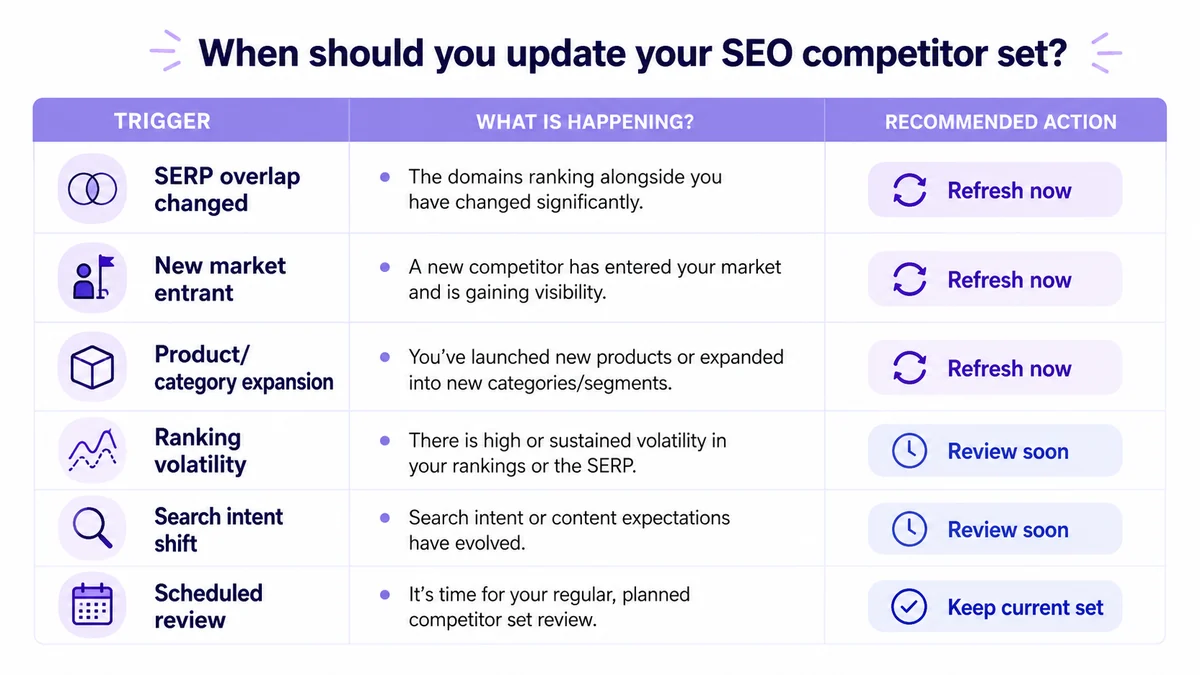
Update a competitor set when supported evidence shows a material change that could alter who can win the recorded decision, how a candidate may legitimately be used, or whether the original scope still holds. A noticed event is only a signal; it is not an approved set change. There is no universal weekly, monthly or quarterly schedule. Use scheduled review as a backstop, open an earlier review when a material event occurs, and allow the review to conclude that no change is required. A ranking fluctuation may need diagnosis; a verified market entry may justify a bounded refresh.
The lifecycle-control problem
Do not confuse noticing change with authorising change
Most competitor-monitoring systems are designed to surface activity: a product launch, a pricing page edit, a new ranking domain, an acquisition announcement or repeated sales feedback. That activity can be useful, but it does not answer the lifecycle question. Article 22 begins after a competitor set has already been approved for a defined buyer decision. Its job is to decide whether the baseline remains defensible, which records are affected, what must remain protected and who may approve a new version.
This is a governance model, not a scoring system. The logic is deliberately inspectable: Signal → Trigger → Review → Change. “Change” includes a documented decision to retain the current set.
Memorable explanation
Signal → Trigger → Review → Change
Signal
An observed event or pattern worth recording, such as a pricing change, market entry, ranking movement or evidence conflict. It is not yet proven material.
Trigger
A sufficiently relevant and supported signal that opens a formal review against the current approved baseline.
Review
Test evidence, materiality, affected scope, contradictions, ownership and whether the original decision still holds.
Change
Record one governed lifecycle outcome, preserve the prior baseline and set the next review condition.
No change required
Evidence does not support a material consequence. Retain the approved baseline and record what would reopen review.
Evidence check required
Admissibility, freshness, contradiction or affected breadth must be adjudicated before a final change.
Partial refresh
Update one candidate or bounded product, segment, market or geography. Protect unaffected records.
Full competitor-set rebuild
Set-wide assumptions, roles or coverage no longer hold, while the original decision remains defined.
Decision-scope review required
The buyer, offer, geography, route to market or original decision materially changed. Define scope before editing the set.
Review deferred — evidence insufficient
Required evidence is unavailable. Preserve the baseline and name the evidence needed to resume.
Refused — define the original decision first
No lifecycle review is valid when the decision boundary and approved baseline are undefined.
Competitor monitoring is not competitor-set maintenance
Monitoring tells you what changed; maintenance determines whether the approved set should change. Monitoring may be continuous, weekly or alert-driven because its cost is low and its purpose is observation. A competitor-set review is a controlled decision that can invalidate prior comparisons, benchmarks and recommendations, so it needs a defined trigger, evidence, an accountable reviewer and a preserved version history.
| Task | Primary question | Typical output | Authority |
|---|---|---|---|
| Monitoring | What changed or may have changed? | Dated signal, alert or observation | Monitoring owner records it |
| Evidence check | Is the signal admissible, current and consistent? | Supported, unresolved, stale or contradictory evidence state | Evidence owner or reviewer adjudicates |
| Set review | Could the change alter the decision, role, use or coverage? | One of seven lifecycle outcomes | Accountable reviewer confirms |
| Version control | What changed, what stayed protected and what is superseded? | Approved version and next-review condition | Reviewer approves; owner preserves |
Monitoring products often encourage frequent alerting. That convention is useful for detection, but it is not proof that a competitor list should be edited. The SERPIFAI lifecycle model treats vendor monitoring advice as workflow context, not validation of its proprietary outcomes.
Use a scheduled backstop and event-driven review
There is no defensible universal review frequency. Review intensity should reflect market volatility, evidence age, decision consequence, monitoring capacity and the cost of acting on a wrong set. A stable local market may need a light scheduled check and event triggers. A fast-moving SaaS category may need frequent signal monitoring, but still only a formal set review when a trigger is relevant and supported.
This proportional approach is consistent with change-control disciplines that preserve an agreed baseline and subject proposed changes to review. NIST defines a baseline configuration as an agreed state changed through formal control; Article 22 applies that principle by analogy, not as a competitor-analysis standard.
Light monitoring
Collect meaningful events without treating every alert as a review. Suitable when the market and decision are stable.
Scheduled backstop
At a recorded date or condition, test whether the baseline, evidence and decision scope still hold—even when no major event occurred.
Event-driven opening
Open an earlier review when a supported event could materially affect a candidate, market, role, coverage or the original decision.
Every review must end with a next-review condition. A date alone is acceptable only when its reason is stated, such as “review after the first quarter of enterprise win/loss evidence” or “review within six months because pricing evidence ages quickly.”
What makes a competitor-set change material?
A material change is not simply noticeable. It is a supported change that could alter a consequential part of the approved analysis. Test the consequence against the recorded decision:
- Buyer: would a different buyer, stakeholder or account segment consider a different alternative?
- Offer: did a candidate begin or stop offering a genuinely comparable way to solve the recorded problem?
- Market or geography: can the candidate now serve—or no longer serve—the relevant market?
- Route to market: did a channel, platform, integration or transaction role change how the buyer can choose?
- Candidate role or permitted use: should the domain move between core, context, reference or exclusion?
- Coverage: do the current records still cover the decision without systematic omission or contamination?
- Decision scope: did the original buyer, offer, geography, route or required output change?
A signal is material only when evidence supports a plausible consequence for the recorded decision, candidate role, permitted analytical use, set coverage or original scope. Do not convert importance, publicity or visibility into materiality without that link.
Seven trigger families worth recording
Product, offer, pricing or packaging
A new tier, service, delivery model or price may change substitution. A feature announcement alone does not prove that the target buyer can or will switch.
Ownership, acquisition or merger
An announcement can justify attention, but the set changes only when operating control, offering, serviceability, buyer choice or competitive role materially changes.
Market or geography
Entry, exit, language support, regulation, service radius or account coverage may justify a bounded market refresh.
Route to market, channel or integration
A marketplace, partner, embedded integration or transaction path can change access or role. Reclassify the role before assuming direct competition.
Sales, customer or win/loss evidence
Repeated, contextualised deal evidence can expose missing alternatives. Anecdotes without buyer, offer and decision context remain contributor signals.
Search or AI visibility
Ranking, traffic, citations and answer-engine presence reveal discovery movement. They do not prove commercial substitution or buyer preference.
Evidence age or contradiction
Stale, missing or conflicting sources may require an evidence check or deferral even when no market event occurred.
Manual method
Review one signal in seven steps
- Freeze the baseline. Record the defined decision, current approved set version, buyer, offer, geography, route to market, monitoring owner and reviewer.
- Record the signal. State what was observed, the category, source and date. Separate the observation from the interpretation.
- Test whether review may proceed. Refuse an undefined decision. Defer when required evidence is unavailable. Route admissibility, staleness or contradiction to evidence review.
- Test materiality. Ask whether the evidence could change the decision, candidate role, permitted use, coverage or original scope.
- Bound the effect. Identify whether no approved record, one candidate, a bounded subset, the whole set or the original decision is affected.
- Apply outcome precedence. Record exactly one lifecycle outcome. Do not let a convenient refresh bypass a scope or evidence problem.
- Approve and preserve. Keep reviewer confirmation separate, retain the prior version, name protected unchanged records, state supersession and set the next-review condition.
Blank copyable review record
This no-JavaScript record is sufficient to perform and hand off a manual review.
The seven lifecycle outcomes
| Outcome | Use when | Preserve or hand off |
|---|---|---|
| Refused — define the original decision first | The original decision or baseline is not clearly defined. | Do not create a new set. Define or reopen the decision. |
| Decision-scope review required | The buyer, offer, geography, route to market or original decision materially changed. | Freeze the current set; redefine scope before membership changes. |
| Review deferred — evidence insufficient | Required evidence is unavailable. | Retain the baseline and state the exact evidence needed to resume. |
| Evidence check required | Admissibility, freshness, contradiction, scope or consequence remains unresolved. | Route to evidence governance; do not force a set outcome. |
| Partial refresh | A supported material consequence affects one candidate or bounded subset. | Create a new version that protects all unaffected records. |
| Full competitor-set rebuild | Supported change affects set-wide assumptions, roles or coverage while the decision remains defined. | Preserve the prior set and hand coverage/stopping rules to Article 19. |
| No change required | Available evidence does not support a material consequence. | Retain the baseline and record the next-review condition. |
Five worked lifecycle examples
No change required
A temporary ranking drop
A provider loses positions across a few queries after broad search volatility. The recorded buyer, offer, market and candidate roles are unchanged; traffic diagnosis points to several plausible causes. Google advises diagnosing drops because technical issues, seasonality, changing demand and ranking updates can produce different patterns, and small fluctuations may not require drastic action. Google Search Central: debugging traffic drops.
Result: retain version 3.2. Monitor until a specified date or until role/coverage evidence changes. Ranking movement alone does not prove a competitor change.
Partial refresh
One provider enters one recorded geography
A credible provider begins serving the same buyer with a comparable offer in one country. Evidence confirms availability and substitution there, but not in the other five markets.
Result: refresh the affected country records, create version 3.3 and protect all other markets. Requalify the provider using the relevant Article 21 method.
Full competitor-set rebuild
Set-wide coverage no longer holds
Several previously excluded alternatives now serve the recorded decision, and the existing set omits an entire commercial model. The decision remains unchanged, but coverage assumptions fail across the set.
Result: rebuild the set, retain version 3.3 as superseded evidence and use coverage and stopping rules rather than choosing a new count by preference.
Decision-scope review required
SMB self-serve becomes enterprise managed service
The organisation changes from a self-serve software decision to an enterprise managed-service decision. The buyer group, offer, procurement path and required evidence all change.
Result: do not edit the competitor list. Reopen the decision definition, then qualify a new set.
Review deferred — evidence insufficient
An acquisition is announced
A buyer announces an acquisition, but operating control, product integration, service availability and market coverage are not yet verified. Merger guidance treats competitive effects as fact-specific and capable of changing with entry, expansion and future products; the announcement alone is not the final competitor record. U.S. DOJ and FTC: 2023 Merger Guidelines.
Result: preserve the baseline and record the evidence required to resume. Do not infer that every acquisition changes membership.
Competitor-Set Update Trigger
How to read it: select a checkpoint to isolate that part of the method. The canvas shows the relationship; the inspector explains what the checkpoint changes in the decision.
Fictional failure story: the spreadsheet nobody could explain
Illustrative fictional example
A team overwrites its competitor spreadsheet after every monthly ranking shift. Domains are added when they appear, removed when they fall and reclassified when a salesperson mentions them. Six months later, the team cannot explain which buyer decision each version represented, why three candidates disappeared, whether a marketplace was ever a direct competitor or which recommendations depended on the old set. The problem was not insufficient monitoring. It was silent baseline replacement without evidence, reviewer authority, protected records or supersession history.
Article 22 prevents this failure by making a no-change decision legitimate, separating monitoring from approval and requiring each new version to identify affected records, protected unchanged elements and the next review condition.
Difficult cases: the tempting conclusion is usually too early
Rankings moved, so the set changed
Tempting conclusion: add every newly visible domain. Signal: ranking or traffic movement. Evidence question: did the buyer alternative, offer, discovery role or permitted use change? Possible result: evidence check or no change. Cannot infer: visibility equals commercial competition.
An AI answer now cites a new domain
Tempting conclusion: treat the cited domain as a business rival. Signal: new AI-search visibility. Evidence question: is the domain a substitutable provider, intermediary, reference source or non-comparable publisher? Possible result: evidence check, role reclassification or no change. Cannot infer: a citation equals buyer substitution.
A merger or acquisition was announced
Tempting conclusion: immediately merge or replace competitor records. Signal: ownership event. Evidence question: did operating control, offering, availability, geography or competitive role materially change? Possible result: deferral, partial refresh, rebuild or no change. Cannot infer: every transaction is material to the recorded decision.
A new integration or route-to-market partnership appeared
Tempting conclusion: the partner became a direct competitor. Signal: integration, marketplace or channel announcement. Evidence question: what does the entity actually do in the buyer journey? Possible result: evidence check or intermediary-role review. Cannot infer: access or visibility proves substitution.
A competitor changed price or packaging
Tempting conclusion: change membership because the announcement is commercially important. Signal: price or package change. Evidence question: does the recorded buyer now compare, reject or switch differently? Possible result: no change, partial refresh or evidence check. Cannot infer: importance to the company equals materiality to this decision.
Sales repeatedly names a new rival
Tempting conclusion: add the name because it appears in deals. Signal: repeated sales or win/loss reports. Evidence question: do the reports share the same buyer, offer, geography, decision stage and outcome? Possible result: evidence check or requalification. Cannot infer: contributor frequency alone proves admissibility.
The evidence is old
Tempting conclusion: delete the record or assume the market changed. Signal: evidence age. Evidence question: is the claim time-sensitive, and is fresher evidence available? Possible result: evidence check or deferral. Cannot infer: old evidence is automatically false.
Authoritative sources disagree
Tempting conclusion: choose the source that supports the preferred change. Signal: material contradiction. Evidence question: do the sources describe the same date, market, offer and operating state? Possible result: evidence check required. Cannot infer: Article 22 resolves the contradiction; use the dedicated evidence method.
Separate monitoring, review, approval and preservation
| Role or record | Responsibility | Boundary |
|---|---|---|
| Monitoring owner | Collects signals, dates, sources and observations; opens review when conditions are met. | Does not automatically approve membership changes. |
| Accountable reviewer | Confirms the lifecycle outcome, affected scope, evidence limitations and supersession. | Must understand the commercial decision, not only search data. |
| Approved baseline | Identifies the current decision, set version and effective date. | Remains protected until a new version is approved. |
| Superseded version | Preserves the prior set, rationale and downstream context. | Is retained, not silently deleted. |
| Next-review condition | Names the event, evidence, date-with-reason or risk that should reopen review. | Prevents both constant churn and indefinite neglect. |
In a small team, one person may hold both owner and reviewer roles, but the record should disclose the dual role and still separate proposal from confirmation. Metadata must not claim an independent reviewer unless a real reviewer is evidenced.
Fast Action
Competitor Set Change Check
Use this check when one event or pattern has raised a question about the current approved set. It narrows the next action; it does not certify evidence, approve a new set, assign confidence or replace reviewer judgment.
Correct the following fields
Current result
Technical record
Deep Work and portable handoff
Competitor Set Change Register
The workbook manages recurring signals and approved versions. It is not a score, a confidence calculator or a generic competitor database. Its eight visible sheets preserve the baseline, separate observation from inference, suggest one lifecycle outcome, keep reviewer confirmation distinct, mark changed confirmations stale and produce a portable handoff without deleting prior versions.
Download the Competitor Set Change Register
Use the workbook for repeated signal logging, candidate or market review, version history, approval and the next-review condition.
- Eight visible sheets; no macros or hidden material logic
- Plain-language outcomes matching the article and check
- Worked examples plus blank working rows
- Print-ready approval and handoff
| Sheet | Reader task |
|---|---|
| START HERE | Understand monitor → review → approve → preserve and the seven outcomes. |
| SET BASELINE | Record the decision boundary, current version, owner, reviewer and next condition. |
| CHANGE SIGNALS | Record dated observations, sources, facts, inferences, missing evidence and affected breadth. |
| CANDIDATE REVIEW | Test the affected candidate or scope; compare the formula suggestion with reviewer confirmation. |
| VERSION HISTORY | Retain prior versions, supersession, protected records and limitations. |
| APPROVAL & HANDOFF | Create one readable transfer record without carrying stale approvals. |
| WORKED EXAMPLES | Inspect transparent fictional examples for all seven outcomes. |
| METHOD & VALUES | Audit definitions, controlled values, precedence, validation and parity. |
Evidence limits and ownership handoffs
Article 22 controls the lifecycle decision. It does not absorb the specialist methods that produce or adjudicate its inputs. Use the appropriate handoff when review reaches a boundary:
- Define or reopen the decision when the original buyer, offer, geography or required output changed.
- Reclassify the competitor role when visibility, commercial or decision-substitute roles may have changed.
- Rebuild coverage and stopping rules when the change is set-wide.
- Review an intermediary or marketplace role when a channel or platform changes function.
- Requalify a B2B or SaaS candidate when product, procurement or market evidence changes eligibility.
- Check whether evidence is reliable before treating a signal as decision-ready.
- Review confidence without a score when evidence changes strength but not necessarily membership.
- Resolve contradictory evidence when material sources conflict.
- Label observed, inferred and unresolved evidence so the record does not turn inference into fact.
- Review evidence freshness when age opens a lifecycle review.
- Monitor or reverse a funded decision when competitor-set changes affect an investment already in execution.
The external sources cited here provide competition, platform or change-control context. They do not validate SERPIFAI’s proprietary lifecycle labels, approve an outcome, certify a ranking effect or guarantee a commercial result.
Frequently asked questions
How often should you update a competitor set?
Use a scheduled backstop proportionate to market volatility, evidence age, decision risk and resources, plus event-driven review when a supported material trigger appears. There is no universal monthly, quarterly or annual interval.
What is the difference between a signal and a trigger?
A signal is an observation worth recording. A trigger is a relevant and sufficiently supported signal that opens formal review against the approved baseline. Neither automatically changes the set.
Can a competitor-set review end with no change?
Yes. No change required is a successful governed outcome when available evidence does not support a material consequence. Record the rationale, retain the baseline and state what would reopen review.
Do ranking or AI-visibility changes mean the competitor set changed?
No. They show discovery movement. Change the set only when supported evidence links that movement to the recorded buyer decision, candidate role, permitted use or coverage.
When should you partially refresh instead of rebuild?
Use a partial refresh when a supported material consequence affects one candidate or a bounded product, segment, market or geography. Rebuild when set-wide assumptions, roles or coverage no longer hold.
Why preserve old competitor-set versions?
Prior versions explain why recommendations changed, protect unaffected records, support audit and prevent silent overwriting. A new version should name the superseded version, reviewer, effective date, limitations and next-review condition.
Finish the review before changing the list
Record the signal, test whether it is a trigger, review the evidence and scope, then preserve one of the seven outcomes. A no-change decision is not wasted work; it is evidence that the current baseline still holds under the recorded conditions. Use the free check for one signal and the workbook for repeated reviews and version handoff.
Decision Scope Review
Escalate only when the decision boundary is consequentially unclear
A scope review is relevant when multi-market or multi-product change, set-wide coverage failure, disputed evidence, unclear approval authority or a changed buyer, offer, geography or route makes the original decision unsafe to reuse. The review clarifies the boundary; it does not guarantee an outcome.