

The direct answer
A publisher, directory, marketplace, review platform or aggregator is not automatically a business competitor because it appears for the same search demand. It belongs in Core competitor only when it can credibly win the relevant customer, budget, contract, booking, lead, subscription, sale or transaction. Keep it in Context only when it materially affects visibility, discovery, comparison, trust, distribution or transaction access. Use Exclude from this decision when its role and evidence cannot support the decision.
The practical difference is simple: one domain may compete for rankings, clicks, attention or answer visibility while another competes for the commercial outcome. Some do both. Classification therefore depends on the decision and the evidence—not on a tool label or a high ranking.
Why visible domains are mistaken for commercial rivals
Publishers can cover a category with thousands of educational pages. Directories can organise providers by location or speciality. Review platforms can become a trusted comparison layer. Marketplaces can aggregate inventory, capture bookings or process payments. These models often earn broad visibility because they satisfy discovery and comparison needs at scale.
Search visibility means that a domain appears where customers search. Commercial competition means that it can win the same decision through a comparable offer or substitute outcome. Shared visibility is evidence of an overlapping search journey; it is not proof that the buyer can choose one business instead of the other. That separation also matters in SEO competitor analysis for buyer decisions, where a ranking intermediary may be useful context without being a valid business benchmark.
Founder observation: The highest-ranking domain is often the easiest candidate to notice and the hardest one to compare responsibly.
The analytical error is not recording an intermediary. The error is allowing it to influence product, pricing, conversion or investment conclusions that its business model cannot support.
Search overlap supports the assessment, but it does not prove a role by itself. Search-intent overlap is supporting evidence only. It cannot independently prove that a candidate operates a publishing, comparison, review, directory, discovery, transaction or infrastructure function. Without separately supported observable-function evidence, the method returns More evidence needed rather than manufacturing Search visibility rival or Provider and platform.
Proprietary classification method
How the Competitor Role Check works
The Competitor Role Check separates the evidence you observe from the function a domain actually performs. Function supports role, role supports disposition, and disposition controls what the evidence may be used to conclude. The method records uncertainty instead of forcing a false score; it does not describe search-engine mechanics or define a legal market.
Visibility-first shortcut
- Notice search overlapA visible domain enters the list because it ranks, reviews, compares or routes demand.
- Apply a competitor labelVisibility is treated as proof that the domain competes for the same customer and outcome.
- Benchmark the businessIts content, pricing, product or scale is compared without proving commercial comparability.
- Make the decisionThe recommendation inherits the wrong business model and unsupported assumptions.
Outcome: a visible domain is allowed to prove more than its evidence supports.
The Competitor Role Check
- Define the decisionRecord the candidate, customer, outcome, offering, market and query group.
- Record the evidenceUse Supported, Partial, No or Unknown across the six tests.
- Verify observable functionConfirm what the domain actually publishes, compares, lists, facilitates or fulfils.
- Assign supported rolesChoose one primary role and only the secondary roles that independently qualify.
- Choose the dispositionPlace it in Core competitor, Context only or Exclude from this decision.
- Bound the useState permitted analysis, prohibited inference and the next evidence action.
- Review or reopenUse the result only when ready; revisit it when the decision or evidence changes.
Outcome: the classification is defensible, reviewable and limited to what the evidence can prove.
When a domain matters but is not a direct competitor
A domain can shape the decision environment without being able to win the same commercial outcome. Use these five questions to keep that influence useful without turning it into a false direct-competitor comparison.
Can it deliver the same outcome?
If yes, continue the direct-competitor test. If no, do not use it as a product, service, pricing or delivery benchmark.
Can it redirect the same buyer or budget?
Record how it influences discovery, comparison, referral, booking, payment or contracting without assuming that influence equals substitution.
Does it change how customers discover, compare or transact?
Verify the observable publishing, listing, review, marketplace, transaction or market-access function separately from search overlap.
What can its evidence safely support?
Use it only for a named purpose such as search-results-page composition, comparison criteria, trust, distribution, booking access or platform dependency.
When should it be excluded?
Exclude it from this decision when it cannot support direct comparison, has no useful contextual role, or would distort the stated conclusion.
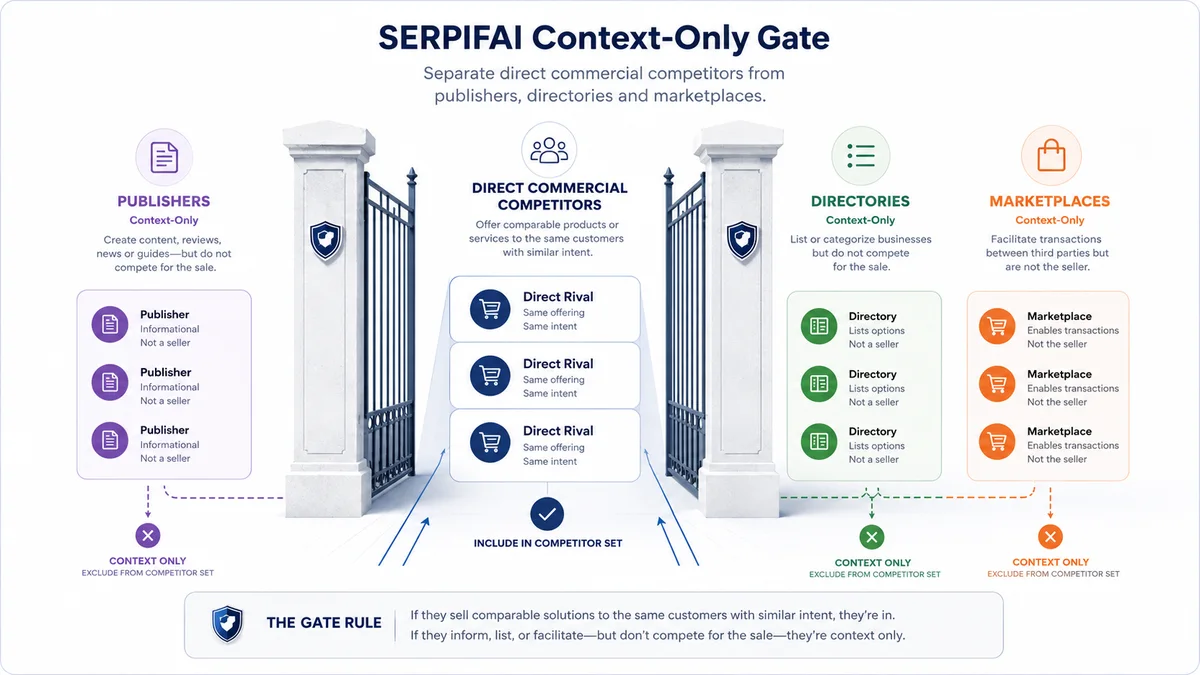
The seven ways a domain can matter
An intermediary sits between a customer and one or more providers, products or information sources. An aggregator collects options or information into one surface. These are observable functions, not automatic competitor labels. Search-intent overlap may support the assessment, but it does not create a function or role.
Search overlap is supporting evidence only. First verify an observable publishing, visibility, discovery, comparison, review, directory, transaction, marketplace or infrastructure function. A Provider and platform also needs direct-commercial conditions and an owned, fulfilled comparable offer. Apply role precedence only after each role qualifies; precedence never manufactures a role.
| Role | What the domain does | Usual output | Evidence needed before use |
|---|---|---|---|
| Direct competitor | Can win the same customer and commercial outcome through a comparable offer or substitute. | Core competitor | Customer, market, offering and transaction evidence. |
| Provider and platform | Competes for the outcome while also operating a platform, publisher, comparison or transaction function. | Core competitor for the offer; Context only for the intermediary function. | Direct-offer evidence plus evidence of the additional role. |
| Search visibility rival | Operates a supported visibility, publishing or discovery function for overlapping search intent without sufficient direct-commercial comparability. | Context only | Dated search evidence plus a separately observable qualifying function. |
| Choice influencer | Influences choice through listings, rankings, reviews, comparisons or recommendations. | Context only | Observable comparison, referral and decision-influence evidence. |
| Transaction gateway | Owns or facilitates booking, checkout, payment, ordering, contracting or lead capture. | Context only, unless it also supplies the outcome. | Terms, payment, contract, lead and fulfilment evidence. |
| Market access platform | Provides discovery, aggregation, listing or platform access without being a like-for-like provider. | Context only or Exclude from this decision | Access rules, coverage, participation and dependency evidence. |
| Ranking-only domain | Appears for related demand but has a materially different purpose, audience, market, offering or decision role. | Exclude from this decision, except for narrow search-result context. | Page-purpose evidence and a documented mismatch. |
Direct competitor
Required evidence: the same or substantially overlapping customer, relevant geography, comparable outcome, active offering and a credible sales, booking, lead or contracting path. Permitted uses: product, service, pricing, positioning, customer-choice and commercial-content comparisons where terms are genuinely comparable. Do not infer: equal scale, resources, capacity, margins or full-market similarity from one shared query.
Provider and platform
Required evidence: all direct-competitor evidence plus proof of an actual additional publishing, comparison, listing, transaction or infrastructure function. Permitted uses: benchmark the owned offer in Core competitor and assess the additional function in Context only. Do not infer: that platform inventory or traffic describes the owned offer.
Search visibility rival
Required evidence: a separately observable and supported publishing, visibility, discovery, comparison, review, directory or attention-intermediation function; Supported or qualifying Partial search-intent overlap; and no sufficient direct-commercial comparability for the relevant conclusion. Permitted uses: search-result composition, content formats, topic coverage, authority surfaces and answer visibility. Do not infer: product parity, pricing parity or commercial dominance. Search overlap never creates the role by itself.
Choice influencer
Required evidence: an observable listing, ranking, review, comparison or recommendation function and evidence that customers use it during evaluation. Permitted uses: review exposure, trust, comparison criteria and customer-choice influence. Do not infer: provider operations, direct substitution or delivery performance.
Transaction gateway
Required evidence: observable checkout, booking, payment, contracting or lead-capture behaviour. Transaction-control evidence alone is not a transaction function. Permitted uses: distribution, fees, channel dependency, lead access and transaction ownership. Do not infer: that platform inventory equals provider capacity.
Market access platform
Required evidence: platform rules, market coverage, access conditions, supplier participation and the function through which businesses reach customers. Permitted uses: market access, distribution and platform dependency. Do not infer: direct product, pricing or operational parity.
Ranking-only domain
Required evidence: a dated visibility observation plus proof that the audience, geography, offer, model, page purpose or decision role does not match. Permitted uses: explain mixed search intent. Do not infer: business competition, market share, product gaps or investment priorities.
Run the six evidence tests
Freeze the decision before testing the domain. Then mark each test Supported, Partial, No or Unknown. Unknown means evidence is missing or cannot be inspected; it must not be silently converted to No.
Supported means current evidence directly supports the test. Partial means only part of the relationship is shown. No means available evidence contradicts it. Unknown means the evidence is missing or unavailable.
Does it serve the same customer?
Does the domain pursue or serve the same customer or decision maker? Check audience statements, eligibility, geography and segments.
Can it win the same commercial result?
Can it win the same sale, subscription, contract, lead, booking, budget or transaction? This is central but not sufficient alone.
Does it offer a comparable solution?
Does it provide a meaningfully comparable product, service, substitute or customer outcome?
Is its business model comparable?
Is the way it creates value and earns revenue comparable enough for the intended conclusion?
Does it appear for the same search need?
Does it satisfy the same need or aggregate, explain, compare or redirect options? This is evidence only and cannot prove a role by itself.
Does it control or facilitate the transaction?
Does it own, facilitate, influence or avoid the transaction? This evidence does not establish transaction participation by itself.
Partial, Unknown or contradictory evidence may support a provisional direction, but it cannot approve a final Core competitor result. Record what is unresolved and the next evidence action.
Decide Core competitor, Context only or Exclude from this decision
Classification status is different from set membership
Ready to use means the complete boundary and evidence support a bounded result. More evidence needed means unresolved, partial or contradictory evidence prevents approval. Cannot complete the classification means required decision details are missing or the requested conclusion exceeds the method.
Core competitor: competes for the decision
Include in the principal analysis when the domain can credibly win the relevant customer and commercial or strategic outcome. A real competitor can be Core competitor even when it ranks poorly.
Context only: changes the decision environment
Include only for a named secondary purpose such as visibility, discovery, reviews, category framing, distribution, market access or transaction structure.
Exclude from this decision: cannot support this decision
Remove from the decision set when the role, market, model or evidence is not comparable enough and no relevant contextual use remains.
When a domain matters but is not a direct competitor
| Gate question | When supported | When partial, No or Unknown |
|---|---|---|
| Can the domain deliver the same outcome? | Continue the Core competitor competition test. | Test whether it has a defined Context only role. |
| Can it redirect the same buyer or budget? | Classify its decision, channel or transaction influence. | Keep only narrower discovery or visibility context when useful. |
| Does it materially change the route to market? | Analyse the platform, dependency, listing or transaction surface. | Do not let it determine commercial investment priorities. |
| Can its scale and model be compared realistically? | Benchmark only the comparable dimension. | Prohibit direct volume, cost or performance parity. |
| Would inclusion improve the stated decision? | Record Core competitor or a named reason for Context only. | Exclude from this decision and state why. |
A Context only domain may explain visibility, discovery, influence, distribution or transaction structure, but it must not determine a direct commercial benchmark unless it can credibly win the same decision.
Founder observation: Exclusion is not a judgment that a domain is unimportant. It is a limit on what that domain is allowed to prove.
Minimum classification record
- Candidate and the decision being supported.
- Customer, commercial outcome, offering, market, geography and query group.
- Six evidence states and separately verified observable functions.
- Primary role and every supported secondary role.
- Evidence date, owner and reviewer.
- Ready to use, More evidence needed or Cannot complete the classification.
- Core competitor, Context only or Exclude from this decision when the evidence permits a final disposition.
- Permitted analytical use, prohibited inference and next action.
- Confidence, reviewer note and reopening trigger.
The Competitor Role Check
Is this domain a real competitor?
Answer four guided questions to decide whether the domain is a Core competitor, belongs in Context only, or should be excluded from this decision—and what its evidence can safely support.
Optional technical audit record
For auditors and maintainers only. The normal result and copied decision record do not require these identifiers.
When the classification cannot be completed, no previous record remains available to copy.
Manual classification method
- Complete every required decision detail: candidate, decision, customer, commercial outcome, offering, market and geography, query group, evidence date, owner and reviewer. Refuse an incomplete record.
- Record the six evidence tests as Supported, Partial, No or Unknown. Unknown is not No.
- Treat transaction-control evidence separately from transaction participation. Assign Transaction gateway only when lead capture, booking, payment, checkout or contracting is observable and supported.
- Treat search-intent overlap as supporting evidence only. Search visibility rival requires a separately observable and supported visibility or intermediation function.
- Apply primary-role precedence only after each role qualifies. Dual-role also requires an owned comparable offer and an actual additional function.
- Use Core competitor only for supported direct-commercial competition; Context only for a named secondary purpose; and Exclude from this decision only with a decision-specific reason.
- Return More evidence needed when critical evidence is Unknown, Partial or contradictory, and record the next evidence action.
- State permitted uses, prohibited inferences, reviewer confirmation and a reopening trigger before handoff.
Worked example: turn a mixed clinic list into a defensible set
Illustrative fictional composite
A private clinic is deciding how to improve local patient acquisition without confusing search visibility with commercial competition. The initial list was created from frequently visible domains and therefore mixes providers, publishers, directories, marketplaces, review platforms and general information sources.
Before: one undifferentiated competitor list
Every visible domain is treated as a direct competitor. This makes the publisher's output look like a realistic content target, the marketplace's inventory look like clinic capacity, and the review platform's influence look like service delivery. It also misses a nearby clinic that has weak organic visibility but actively competes for the same consultations.
After: role, evidence and use boundary
| Candidate | Evidence and role | Output | Permitted use | Prohibited inference and review record |
|---|---|---|---|---|
| Nearby Clinic A | Same local patients, comparable consultations and direct booking. Customer, outcome and offering overlap: Supported. | Core competitor Direct competitor | Services, pricing, positioning, trust and booking comparison. | Do not assume equal capacity or margins. Confidence: High. Reviewer note: verify current services. Trigger: material offer or location change. |
| Nearby Clinic B | Weak search visibility but active local service, referral and booking paths. Commercial overlap: Supported. | Core competitor Direct competitor | Commercial and market analysis even though it ranks poorly. | Do not exclude because of low organic visibility. Confidence: Moderate. Reviewer note: confirm service availability. Trigger: closure or market exit. |
| Health publisher | Educational pages satisfy early information needs; no treatment or booking fulfilment. Search-intent overlap: Supported; commercial outcome: No. | Context only Search visibility rival | Topic expectations, terminology, evidence formats and answer visibility. | No treatment, pricing or conversion parity. Confidence: High. Reviewer note: use only for information-stage analysis. Trigger: launch of a competing clinical service. |
| Provider directory | Lists clinics by location and speciality and sends users to provider profiles. Decision influence: Supported; transaction control: No. | Context only Choice influencer | Discovery, listing coverage, profile completeness and comparison criteria. | No operational or service benchmark. Confidence: Moderate. Reviewer note: listing rules are partly Unknown. Trigger: lead sale or booking ownership. |
| Appointment marketplace | Compares providers and captures bookings; independent clinics deliver care. Transaction control: Partial; fulfilment: No. | Context only Transaction gateway | Booking path, fees, channel dependency and customer access. | No treatment quality, staffing or capacity parity. Confidence: Moderate. Reviewer note: verify payment and data terms. Trigger: own-brand care launch. |
| Review platform | Collects reviews and ranks providers; it does not supply treatment. Decision influence: Supported. | Context only Choice influencer | Trust, reputation, comparison language and customer concerns. | No direct substitution or provider conversion benchmark. Confidence: Moderate. Reviewer note: sample bias remains. Trigger: direct booking or owned service. |
| National health-information portal | General educational purpose, national audience and no local provider decision role. Relevant contextual use: No. | Exclude from this decision Ranking-only domain | Optional note explaining mixed search intent. | No local competitor, pricing or investment conclusion. Confidence: High. Reviewer note: retain outside the decision set. Trigger: local comparison feature. |
The resulting sets
- Core competitor: Nearby Clinic A and Nearby Clinic B.
- Context only: the publisher for information-stage visibility; the directory and review platform for decision influence; the marketplace for booking and transaction access.
- Exclude from this decision: the national information portal from the local commercial decision set.
The example corrects two failures at once. It removes false positives created by visibility and restores a false negative: the commercially relevant clinic that ranking data failed to surface.
Mixed-role marketplace: one domain can hold several roles
Illustrative fictional composite
Consider a healthcare booking platform that lists independent clinics, ranks providers and captures appointments. In one country it also launches and fulfils an owned telehealth service offering comparable consultations. In another country it remains only a booking platform. The domain cannot receive one permanent label.
| Decision | Observed role | Output | Use boundary |
|---|---|---|---|
| Benchmark local in-person clinic services | Lists providers and captures bookings; independent clinics deliver care. | Context only — transaction intermediary | Use for booking-channel and distribution analysis; exclude from treatment, staffing and service-delivery parity. |
| Assess online consultation competition where its own service is active | Sells and fulfils a substitute telehealth consultation while operating the marketplace. | Core competitor for the offer and Context only for the platform — dual-role domain | Benchmark the owned service separately from marketplace scale and inventory. |
| Review organic visibility for comparison queries | Ranks for provider comparisons and appointment searches. | Context only — visibility competitor | Use for query, format and SERP analysis; do not infer service-market leadership. |
| Assess a country where its own service is unavailable | Facilitates choice and booking but cannot supply the treatment outcome. | Context only — decision and transaction intermediary | Do not transfer Core competitor status from another geography. |
Reclassify the platform when the market, query, transaction model or decision changes—or when it launches an offer, collects payment, becomes the contracting party, owns customer data, assumes fulfilment or exits the market.
Founder observation: An intermediary may matter more than a direct competitor for a distribution decision and far less for a pricing or product decision.
What misclassification changes
A mixed competitor list does more than create untidy reporting. It can direct money and management attention toward a business model the company cannot and should not copy.
| Analysis | Appropriate roles | Misclassification risk |
|---|---|---|
| SEO competitor analysis | Search visibility rivals, intermediaries and Core competitors, kept in separate lenses. | A ranking domain is mistaken for the closest commercial rival. |
| Content-gap analysis | Search visibility rivals for information demand; Core competitors for commercial and evaluation content. | A specialist is judged against a publisher designed to produce thousands of pages. |
| Product or service benchmarking | Core competitors and the comparable offer of a dual-role domain. | Marketplace features or directory structure are treated as provider capability. |
| Pricing analysis | Core competitors with comparable scope, terms and geography. | Listing fees, commissions or advertised ranges are treated as provider prices. |
| Positioning | Core competitors plus decision intermediaries that reveal customer comparison language. | Category framing is copied without proving commercial relevance. |
| Authority analysis | Publishers, review platforms and marketplaces for contextual authority; Core competitors for realistic commercial comparison. | Network effects or institutional authority become an impossible brand target. |
| Customer-journey analysis | Decision and transaction intermediaries, visibility competitors and Core competitors. | Referral, review and booking influence disappears from the journey. |
| Market entry | Core competitors, transaction intermediaries and market infrastructure. | Channel access is confused with provider competition or ignored entirely. |
| Investment recommendations and forecasts | Only roles whose evidence matches the forecast assumption. | Unlike economics are averaged, producing unsupported cost, traffic or conversion expectations. |
- Content-volume distortion: a provider appears weak beside a publisher whose operating model rewards enormous publishing scale.
- Authority distortion: marketplace network effects or institutional authority are mistaken for a realistic provider target.
- Intent distortion: informational visibility is treated as evidence of purchase-stage strength.
- Investment distortion: the plan funds broad publishing when the real gap is trust, evaluation support, distribution or conversion.
Evidence boundaries and the next decision
Provenance and confidence
A domain's role must come from observable evidence: pages, offers, terms, transaction flows, listing rules, market availability and dated search observations. Do not present a candidate as originating from proprietary fieldwork, an observed research record or external validation unless the source, collection method, date and permitted use can be inspected.
The clinic and marketplace examples in this article are fictional composites. Their sample dates demonstrate the record structure; they are not client results or claims about named organisations. Confidence belongs beside the classification and should fall when evidence is stale, partial, disputed or Unknown.
Questions that resolve common edge cases
Is a marketplace a real competitor?
Sometimes. It is Core competitor when it can supply a comparable outcome or win the same transaction. It is Context only when it only compares, distributes, books or processes the transaction for other providers.
Should directories be included in SEO competitor analysis?
Include them in Context only when they materially compete for discovery or influence customer choice. Do not use them as direct product, pricing or operational benchmarks unless they also provide a comparable offer.
Can a publisher be a business competitor?
Yes, when it launches a substitutable commercial offering for the same customer and market. Until then, use it for information demand, authority or visibility—not direct provider parity.
Can one domain belong in both Core competitor and Context only?
Yes. A dual-role domain can be Core competitor for its owned offer and Context only for its marketplace, publishing, comparison or transaction function. Keep those evidence uses separate.
Why can a high-ranking domain be a poor benchmark?
Its visibility may come from a different audience, content scale, revenue model or customer role. High ranking shows visibility under observed conditions; it does not prove commercial comparability.
Where this article fits
Article 18 explains the broad difference between SEO competitors and business competitors. This article provides the specialist role-and-exclusion method for publishers, directories, marketplaces, review platforms and aggregators. Article 19 sizes the competitor set only after these domains have been separated into Core competitor, Context only and Exclude from this decision.
- Compare provider and intermediary roles in local markets.
- Test whether a platform owns a B2B transaction or only routes demand.
- Reclassify a domain when its role materially changes.
External context and claim limits
- US DOJ and FTC — products, services and routes to market used by rivals
- US DOJ and FTC — competition involving multi-sided platforms
- UK CMA — roles and value chains in online platforms and digital advertising
These sources provide external context for substitution, market boundaries and platform roles. They do not validate the proprietary SERPIFAI taxonomy, classify any domain in this article, or certify rankings, revenue, ROI or client outcomes.
Optional technical method reference
This optional appendix is for auditors, maintainers and cross-component parity checks. Readers can use the article and the Competitor Role Check without opening or understanding these identifiers.
Decision Boundary
A20-B01CandidateA20-B02DecisionA20-B03CustomerA20-B04OutcomeA20-B05OfferingA20-B06Market and geographyA20-B07Query groupA20-B08Evidence dateA20-B09OwnerA20-B10Reviewer
Evidence states
A20-S01SupportedA20-S02PartialA20-S03NoA20-S04Unknown
Classification status
A20-ST01ReadyA20-ST02Review requiredA20-ST03Refused
Visibility and primary-role authority
A20-P14A20-E05 is evidence only; a separately observable supported function is requiredA20-P15A direct provider with no additional function remains Direct, even with E05 Supported or PartialA20-P17Search overlap without a verified function returns Review required and no final dispositionA20-P18Dual-role requires direct-commercial conditions, an owned comparable offer and an actual additional functionA20-P20Apply precedence only after each role qualifies
Roles
A20-R01Direct commercial competitorA20-R02Dual-role domainA20-R03Visibility competitorA20-R04Decision intermediaryA20-R05Transaction intermediaryA20-R06Market infrastructureA20-R07Non-comparable ranking domain
Authority cases
AUTH-01/02Direct provider + E05 Supported/Partial + no functions → Ready / Direct / no secondary roles / CoreAUTH-03Direct provider + actual additional function → Dual-role with exact supported secondary roleAUTH-04Non-direct + E05 + supported function + Context purpose → ContextAUTH-05E05 without an observable function → Review required / no forced role / no dispositionAUTH-06Evidence supports exclusion + reason → Non-comparable / Exclude
Dispositions
A20-D01CoreA20-D02ContextA20-D03Exclude
Refusal and review
A20-F01Missing Decision BoundaryA20-F02Requested conclusion exceeds the methodA20-F03Visibility is being used as proof of commercial rivalryA20-F04Material evidence contradiction
Reopening triggers
A20-RE01Decision changesA20-RE02Market, geography or query changesA20-RE03Owned offer changesA20-RE04Transaction or data ownership changesA20-RE05Business model or fulfilment changesA20-RE06New evidence resolves or contradicts the recordA20-RE07Evidence becomes stale or is challenged
The rule identifiers support parity and review. They are not scores.
Five-question self-check
- Can this domain win the same commercial outcome?
- Does it own, facilitate or only influence the transaction?
- Which role does current evidence support?
- Is it included for commercial comparison or only for a named contextual purpose?
- What conclusion would become misleading if it were treated as a direct competitor?
Deep Work and portable handoff
Use the right surface for the task
The Competitor Role Check — working workbook
Use The Competitor Role Check working workbook when several domains need evidence, ownership, approval, prior versions and reopening controls. It includes the same decision method and fictional clinic case used here. The example rows are learning records; preserve them or create a clean working copy before entering live project records.
Download the classification register (.xlsx)The Competitor Role Check — decision handoff
Use The Competitor Role Check decision handoff PDF to transfer one approved decision set. The included populated pages are explicitly illustrative; create a live handoff only from reviewer-approved records. It carries Core competitor, Context only, Exclude from this decision, unresolved evidence, prohibited conclusions, ownership and reopening without reproducing the full article or workbook.
Download the decision handoff (.pdf)The article remains complete without either download. Use The Competitor Role Check for one candidate, the working workbook for repeated work, and the PDF only after the classification is approved.