
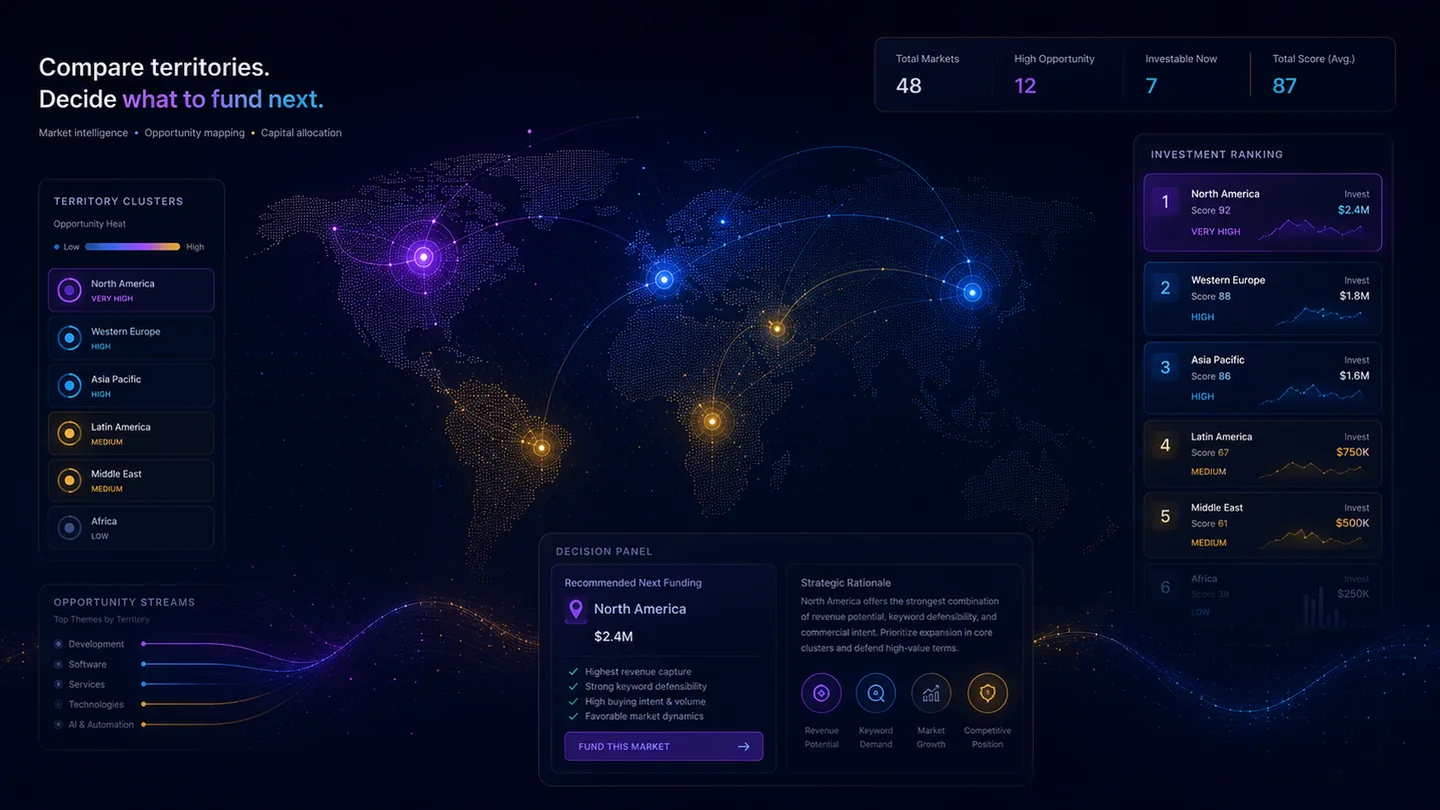
SEO investment prioritisation means deciding which SEO opportunity gets budget and team time first—and which opportunities should wait. Here, a “territory” simply means one defined SEO opportunity, such as a service, market, use case or category. The SERPIFAI Territory Investment Gate asks six practical questions: Does this matter to a valuable buyer? Is the evidence strong enough? Can we compete credibly? Can we deliver it? Can we learn fast enough to make the next decision? Can we change course without wasting a disproportionate amount of money or effort? Funding one option also displaces another, so the best first investment is often the smallest credible move that produces useful evidence rather than the largest visible traffic gap.
60-second fast action
Run one territory through the investment gate
Classify one candidate without inventing a weighted score. Start with two floor-gate questions: does it matter commercially, and is the evidence strong enough? If either answer is unresolved, keep it unresolved instead of hiding the gap inside a total score.
Select all six conditions, then classify the territory. Unknown is a valid condition when the evidence is genuinely unresolved.
- The tool applies explicit gate logic rather than a hidden numerical score.
Candidate decision record
Classify a territory to create a copy-ready decision record.
What the SERPIFAI Territory Investment Gate is—and what it is not
The framework is a decision system for situations in which several plausible SEO, content, authority or market opportunities compete for the same limited resources. It converts SEO competitor analysis into an accountable investment-prioritisation recommendation.
What it is
A comparative appraisal of candidate territories using the same commercial, evidential and operational criteria.
What it is not
A traffic forecast, keyword-volume sort, automated score, or substitute for first-party economics and executive judgement.
When it applies
When the business has a defined objective, multiple credible options and a real funding, sequencing or capacity decision to make.
When it should pause
When the competitor set is unstable, the evidence chain is weak, the offer is undefined, or delivery capacity cannot be confirmed.
This framework does not decide whether SEO is valuable in the abstract. It decides which defined territory deserves the next bounded investment under current evidence and constraints.
In investment prioritisation contexts, the framework should sit after two prior controls: a qualified competitor set and a traceable evidence standard. If either changes materially, the ranking must be reconsidered.
Define the territory before comparing the options
An opportunity territory is not simply a keyword cluster. It is a commercially coherent space in which a buyer problem, offer, search behaviour, competitor pattern, required capability and measurable business response can be evaluated together.
| Territory component | Decision question | Why it matters |
|---|---|---|
| Buyer and problem | Whose decision is being influenced, and what problem is active? | Prevents high-volume but commercially remote demand from dominating. |
| Offer and decision stage | What can the business credibly provide at this stage? | Connects content and visibility to a real commercial pathway. |
| Search and information behaviour | How is the need expressed, researched and validated? | Separates a market territory from a list of isolated queries. |
| Competitor types | Which direct businesses, search-result competitors, publishers, marketplaces or platforms shape the territory? | Prevents the analysis from confusing visibility rivals with commercial substitutes. |
| Capability requirement | What expertise, authority, content, technical work and operational support are required? | Exposes whether the opening is executable rather than merely visible. |
| Measurement path | Which first-party signals can confirm, weaken or reverse the case? | Turns the territory into a testable investment proposition. |
In SEO decision workflows, territories should be defined at the smallest level that still represents a meaningful commercial choice. Overly broad territories hide operational differences; overly narrow ones create false precision and fragmented action.
Why SEO prioritisation fails even when the opportunity analysis is correct
Opportunity discovery tells you what might be available. Prioritisation decides what deserves scarce money and team capacity first. Funding one territory always displaces something else: content, development, specialist time, sales attention or another market bet. The cost of a weak priority is therefore not only wasted SEO spend; it is the valuable work delayed while the team learns too slowly.
The strongest first investment may be the smaller territory—not because its upside is larger, but because it can resolve the most important uncertainty with the least irreversible commitment.
This inversion matters. A broad category can look louder because it has more searches, more competitors or more stakeholder attention. None of those signals proves that it is the best first investment. If it requires a larger authority programme, slower measurement and assumptions the business has not yet tested, a narrower commercial territory may create a cleaner learning loop and a more defensible basis for expansion.
| Common failure mode | Why it distorts the decision | Governance response |
|---|---|---|
| Ranking by search volume | Demand size is treated as commercial value. | Require buyer, offer and decision-stage fit. |
| Ranking by competitor gap | A visible absence is assumed to be an attractive opening. | Test whether the gap reflects weak demand, capability or economics. |
| Using one composite score | A high total can conceal a fatal weakness in evidence or execution. | Apply minimum gates before relative ranking. |
| Ignoring sequencing | A valuable territory is advanced toward funding before prerequisites exist. | Use “prepare next” rather than forcing a fund/advance-or-defer choice. |
| Ignoring reversibility | Capital is locked into a weak assumption before learning is possible. | Define a bounded first tranche with stop conditions for authorized review. |
Compare every territory through the same six dimensions
Think of these as six practical questions, not six mathematical weights. Together they test whether an opportunity matters commercially, is supported well enough, can be delivered and competed for, can be measured in time, and can be changed or stopped if the evidence weakens. Their relative importance still depends on the business objective, risk tolerance, time horizon and commercial context.
1. Commercial relevance
Does this opportunity connect to a valuable buyer and a real business goal? Check the current offer, decision stage and strategic objective.
2. Evidence strength
How sure are we that the opportunity is real? Inspect whether the supporting evidence is current, attributable, independent and important enough to change the decision.
3. Competitive defensibility
Can we compete credibly? Identify the advantages already held by competitors and the distinctive capability, authority or distribution needed to challenge them.
4. Implementation burden
Can we actually deliver it? Count the content, expertise, authority, technical work, sales or compliance support, operating capacity and ongoing cost required.
5. Measurement speed
How soon can we learn something useful? Define meaningful leading indicators and first-party commercial signals without mistaking activity for business impact.
6. Reversibility
If the bet is wrong, can we change course without losing most of the commitment? Consider sunk cost, contracts, asset reuse, review timing and the effort needed to stop or revise.
| Dimension | Strong condition | Warning condition | Evidence to inspect |
|---|---|---|---|
| Commercial relevance | Clear buyer, offer and value pathway | Traffic potential without decision proximity | Offer economics, sales input, customer language, first-party demand |
| Evidence strength | Multiple current and attributable sources | Repeated assumptions or copied market claims | SERP observations, first-party data, competitor records, expert review |
| Defensibility | Credible differentiated position | Incumbent advantage cannot be matched | Authority patterns, capability gaps, brand and distribution strength |
| Implementation burden | Bounded scope with accountable capability | Hidden cross-functional dependencies | Resource plan, compliance, production, technical and maintenance needs |
| Measurement speed | Early signals connect to a decision | Only distant traffic outcomes are observable | Search Console, analytics, qualified leads, sales and delivery feedback |
| Reversibility | Test can expand, revise or stop cleanly | Large sunk cost before evidence improves | Tranche size, contract constraints, asset reuse and review cadence |
The SERPIFAI evidence-to-investment model
The model separates qualification from ranking and ranking from commitment. That distinction prevents an attractive option from bypassing weak evidence or an unmeasurable implementation plan.
- 01ObjectiveName the business decision.
- 02TerritoriesDefine comparable candidates.
- 03QualifyRelevance, evidence and capability first.
- 04CompareDefensibility, burden, measurement and reversibility.
- 05ClassifyFund / advance, prepare, defer, ignore—or refuse classification.
- 06BoundDefine the minimum credible tranche for authorized review.
- 07ReviewExpand, revise, stop or reclassify.
In applied analysis scenarios, the quality of the decision usually improves when the team first removes ineligible territories and only then ranks the remaining options. A single weighted score can be useful as a discussion aid, but it should never conceal a failed minimum condition.
Use floor gates before relative ranking
The Territory Investment Gate uses two passes. The first determines whether a territory is eligible for active comparison. The second determines its relative place in the investment queue.
| Pass | Purpose | Key questions | Output |
|---|---|---|---|
| 1. Qualification | Remove territories that cannot support a responsible recommendation. | Is the territory commercially relevant? Is the evidence sufficient? Can the business credibly act? | Eligible, prepare prerequisite, or exclude from active comparison. |
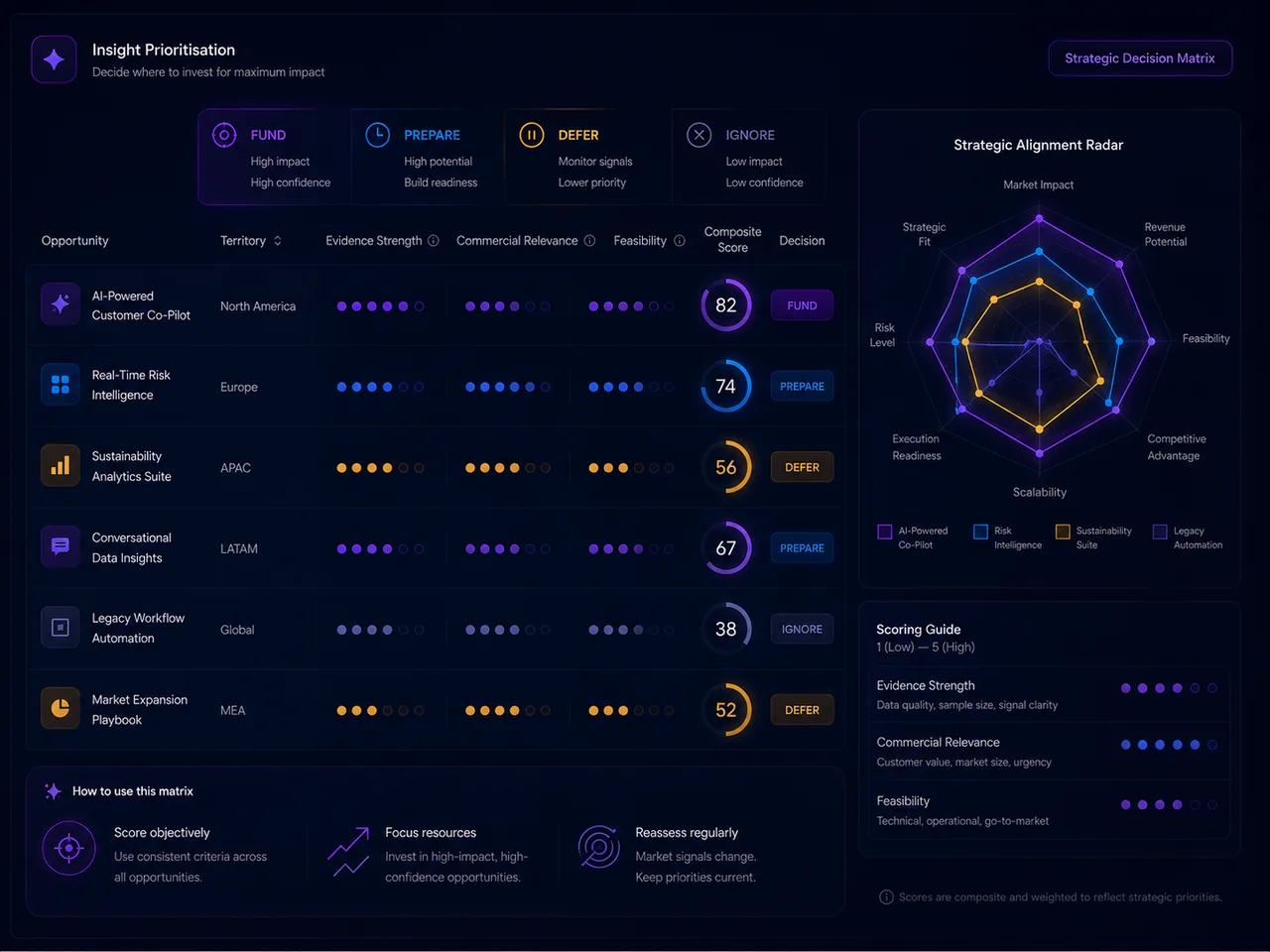
| 2. Relative ranking | Compare eligible territories under the same decision criteria. | Which option is more defensible, executable, measurable and reversible now? | Fund / advance, prepare next, defer or ignore. |
A territory cannot compensate for failed commercial relevance or inadequate evidence by scoring highly on easier dimensions. Minimum gates come before ranking.
Evidence-based SEO does not require invented decimal precision. Use explicit qualitative judgements—such as strong, mixed, weak or unresolved—alongside the evidence record and reviewer rationale. Depending on the commercial context, a business may apply formal weights, but the assumptions behind those weights must remain visible.
Translate comparison into a four-state investment queue
A good prioritisation system must make it safe to say “not now.” Prepare, defer and ignore are legitimate decisions when evidence, feasibility or timing is not ready; they protect capital and attention for stronger opportunities.
Authority boundary: Fund / Advance means the evidence supports moving the territory to the next funding-approval gate. It does not approve expenditure; the authorized decision-maker separately approves, changes or rejects the proposed first tranche.
| Decision state | Meaning | Typical condition | Required next step |
|---|---|---|---|
| Fund / Advance | Evidence supports advancing this territory to the next funding-approval gate; it does not authorize spending. | Relevant, sufficiently supported, executable, measurable and reversible. | Define the proposed first tranche, owner, scope, signals, review date and stop condition for authorized review. |
| Prepare next | Build a named internal prerequisite without treating the programme as funded. | Strategically promising but blocked by a specific evidence, capability, compliance or sequencing prerequisite the organisation can work on. | Resolve the named prerequisite and state the re-entry test. |
| Defer | Keep the option behind an explicit external, capacity, timing or sequencing gate. | Potentially valuable but not the best current use of capital. | Record the governing condition and date for reconsideration. |
| Ignore | Remove the territory from the active decision set. | Weak relevance, misleading visibility, structural infeasibility or no credible decision impact. | Document why it should not consume further attention. |
The queue is governed rather than permanent. Each state should include the condition that would move the territory forward, hold it in place or remove it. Without that condition, classification becomes opinion rather than a decision framework.
How the framework changes across commercial contexts
These examples are illustrative and do not represent client outcomes. They show how the same six dimensions can produce different conclusions when economics, regulation, capacity and measurement paths change.
| Context | Candidate territory | Material decision factor | Possible first classification |
|---|---|---|---|
| SaaS | A narrow integration use case versus a broad category page | Pipeline relevance, product readiness and whether qualified demand can be attributed | Advance the integration territory to funding review; prepare the broader category authority programme |
| Law firm | A high-value practice area in one jurisdiction | Intake capacity, ethical constraints, geographic fit and case economics | Prepare next if operational intake or compliance review is incomplete |
| Local services | A service-and-location territory with strong intent | Service capacity, proximity, review strength and qualified-call measurement | Advance to funding review when the local opening and delivery capacity are both credible |
| Ecommerce | A product category with visible search demand | Margin, stock depth, return rate, merchandising capability and seasonality | Defer when demand is large but unit economics or inventory resilience is weak |
| Healthcare | A treatment or consultation territory | Clinical governance, patient suitability, practitioner capacity and compliant claims | Prepare next until evidence and operational safeguards support public investment |
Which dental growth territory should receive the next defined investment?
The scenario is fictional and demonstrates decision structure rather than performance.
Implant consultation
- Direct commercial relevance
- Strong current evidence
- Focused build and faster measurement
Implant financing
- High buyer relevance
- Evidence incomplete
- Needs pricing and compliance inputs
Broad cosmetic dentistry
- Larger visible category
- High competitive burden
- Weak fit to the immediate question
In competitive audits, the broad category should not be rejected merely because it is difficult. It should be deferred when a narrower territory offers a more credible test, faster learning and a stronger basis for deciding whether wider investment is justified.
Propose a controlled first investment—not an open-ended programme
The first commitment should be large enough to test the proposition credibly and small enough to revise without strategic damage. The aim is not to prove an entire SEO strategy in one move; it is to buy enough learning to justify, revise or reject the next tranche. It should define:
Propose one focused commercial page and the minimum supporting assets for authorized review. Review search visibility, qualified enquiries, sales quality and delivery fit before seeking approval for a broader territory programme.
Measurement speed does not mean demanding immediate revenue from every SEO action. It means selecting a chain of observable signals that can improve the decision before the organisation commits the next tranche.
Release the recommendation as a one-page decision memo
- Decision question: what funding or sequencing choice is being resolved?
- Recommended state: fund / advance, prepare next, defer or ignore.
- Selected territory: the commercial space and why it outranks the alternatives.
- Material evidence: the few records that change the decision.
- Comparison rationale: the six dimensions and any failed floor gates.
- Limitations: what is unknown, inferred or operationally unconfirmed.
- First tranche: owner, scope, resources, signals and review date.
- Reversal conditions: the observations that would expand, revise, stop or reclassify the investment.
Download the territory comparison scorecard
Compare the same six dimensions across every candidate territory and record the decision state, evidence basis and reversal condition.
Define reversal conditions before approval
A recommendation should be reversed, downgraded or returned to “prepare next” when the evidence supporting its current state no longer holds. Typical triggers include:
Do not defend the original ranking after its governing assumptions change. Re-run the affected gates, preserve the evidence trail and issue a new state with a new review condition.
In many competitive markets, priorities will move as evidence accumulates. That is not instability; it is the intended behaviour of a governed investment queue. The failure is not changing the decision. The failure is changing it without recording why.
Framework summary
| Stage | Control | Executive output |
|---|---|---|
| 1. Define | Specify the buyer, offer, search behaviour, competitor types, capability and measurement path. | Comparable opportunity territories. |
| 2. Qualify | Apply commercial relevance, evidence and capability floor gates. | Eligible options and named prerequisites. |
| 3. Compare | Assess defensibility, burden, measurement speed and reversibility under the same context. | Relative ranking with visible rationale. |
| 4. Classify | Assign fund / advance, prepare next, defer or ignore—or refuse classification when evidence is unresolved. | Governed investment queue. |
| 5. Commit | Put the minimum credible first-tranche proposal before the authorized decision-maker. | Proposed owner, scope, signals, review date and stop condition. |
| 6. Review | Observe first-party evidence and apply reversal conditions. | Expand, revise, stop or reclassify. |
Define comparable territories. Remove options that fail minimum gates. Rank the eligible set through six dimensions. Advance one bounded first-tranche proposal to authorized review. Review the result against explicit reversal conditions.
Supporting investment research
Move from opportunity to accountable decision
Use the supporting research to prioritise commercial value, compare territories, define funding states and record reversal conditions.
Related questions
Should the highest-volume SEO territory be funded first?
No. Volume can be outweighed by weak commercial relevance, inadequate evidence, high competitive burden, slow measurement or poor operational fit.
How is an opportunity territory different from a keyword cluster?
A keyword cluster groups related queries. An opportunity territory connects search behaviour to a buyer, offer, competitor pattern, capability requirement and measurable commercial decision.
Should the six dimensions use fixed numerical weights?
Not automatically. Weights may help comparison when the business context is stable, but they should remain transparent and should not allow a failed minimum gate to disappear inside a composite score.
What is the difference between prepare next and defer?
Prepare next means a strategically promising territory has a named prerequisite worth resolving now. Defer means the option should remain behind an evidence, capacity, timing or sequencing condition.
How should unknown economics be handled?
Keep them explicit. Use a bounded first investment to collect first-party evidence rather than converting unknown margin, close rate, capacity or lifetime value into assumed precision.
How often should the investment queue be reviewed?
At the agreed review date or whenever a material reversal condition occurs. High-cost, regulated or fast-changing decisions often require shorter review cycles.
Selected methodological references
The SERPIFAI Territory Investment Gate is an original framework. The following sources provide adjacent guidance on people-first search content, evidence-based decisions, structured options appraisal and the distinction between information objects and decision use; they do not originate the SERPIFAI taxonomy.
- Google Search Central: Creating helpful, reliable, people-first content.
- Google Search Essentials.
- HM Treasury: The Green Book 2026—structured appraisal of costs, benefits and risks across options.
- Center for Evidence-Based Management: What is evidence-based management?
- Michael K. Buckland: Information as Thing—context for distinguishing available information from how it is interpreted and used.
Prioritisation turns opportunity analysis into accountable investment
Useful SEO competitor analysis should not end with a larger backlog. It should end with a bounded recommendation, a visible comparison, an owner, a measurement path and the evidence that would justify changing course. The public sample decision brief shows how this structure can be released without inventing client outcomes.
Complete the system