

Direct answer
An SEO competitor competes for relevant search visibility. A business competitor can win the same customer, contract or budget. One organisation can be both, but the two labels are not interchangeable. A publisher may outrank you without selling a comparable offer, while a real business rival may rely on referrals, direct sales or brand demand and rarely appear beside you in search.
In plain English, appearing in the same search results shows competition for attention. It does not, by itself, prove competition for revenue. Classify the candidate’s role before using its rankings, links, content or commercial offer as evidence.
Proprietary framework
SERPIFAI Three-Lens Competitor Model
The Three-Lens Model separates three relationships that teams often compress into the single word competitor. It structures a decision and makes the classification reviewable. It is not a ranking formula and does not describe a search engine’s internal systems.
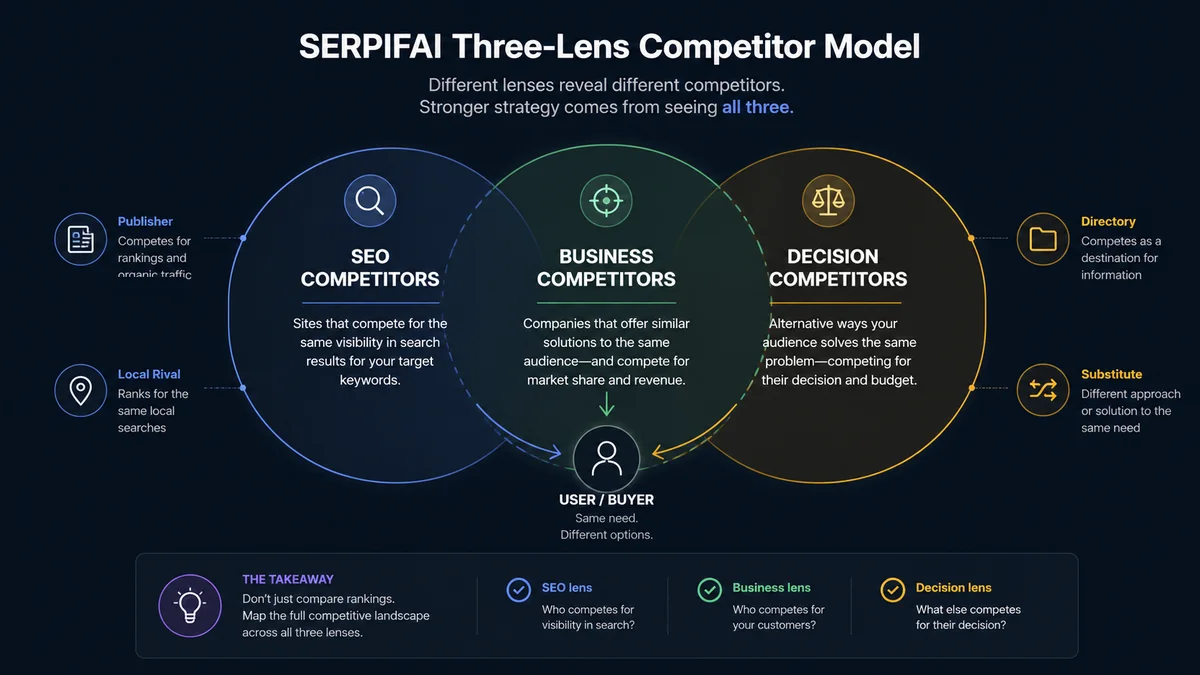
Three different ways a candidate can compete
A candidate domain can pass one, two or all three tests. The tests diagnose the relationship; they do not yet decide whether the candidate belongs in every analysis.
Business-competition lens
Can the organisation credibly win the same customer, contract, budget or commercial outcome? This is the test of commercial substitutability: whether the buyer could realistically choose one offer instead of the other.
Search-competition lens
Does the domain materially compete for the same relevant discovery demand? Search overlap means recurring overlap across useful searches—not one accidental ranking. A non-branded search does not contain the company name, and search intent is the task the searcher is trying to complete. Organic visibility means presence in unpaid search results or answer surfaces.
Decision-competition lens
Can the candidate influence, replace, delay or redirect the same buying decision? An internal team, software product or the status quo may affect the budget even without sharing the same offer or search footprint.
The practical difference is simple: the lenses reveal how the candidate competes. The taxonomy below decides how the candidate may be used.
Use the taxonomy as an operating sequence
Scope → Test the Three Lenses → Assign Role → Record Evidence → Set Disposition → Review or Reopen
The sequence turns the taxonomy into a repeatable decision record. Each step remains manual because the evidence and the decision scope determine the result.
- Scope: state the exact decision, buyer, offer, geography and analytical use before selecting candidates.
- Test the Three Lenses: review search competition, commercial competition and decision substitution separately.
- Assign Role: select one evidence-backed primary role and, when useful, one supported secondary role.
- Record Evidence: preserve sources, observations, dates and the context needed for another reviewer to inspect the judgment.
- Set Disposition: choose Include, Context, Exclude or Review required for the stated decision scope.
- Review or Reopen: confirm the record remains valid, or create a new version when a material condition changes.
What happens when competitor roles are mixed
A company can collect thousands of rankings, links, pages and traffic estimates and still reach the wrong conclusion because the competitor set contains different types of organisations. A broad publisher can make a specialist’s content coverage look inadequate. A marketplace can set an unrealistic authority benchmark. A low-visibility commercial rival can disappear from market planning simply because an SEO tool did not surface it. Our search and AI competitor analysis distinguishes search visibility from buyer competition before using either to justify a recommendation.
Search overlap tells you where attention is contested. Buyer substitutability tells you where revenue is contested.
Both are useful, but neither can substitute for the other. The damage appears when one mixed list is reused for content gaps, market positioning, product comparison, forecasting and executive investment conclusions.
Founder observation: Teams often export a competitor list from an SEO platform and begin analysis before asking what role each domain actually plays.
Founder observation: The most visible domain is not automatically the most important commercial rival, and the most important commercial rival may be almost invisible in organic search.
The SERPIFAI Competitor-Role Taxonomy and Inclusion Matrix
The matrix assigns one primary operational class for the stated decision. A candidate may have secondary roles, but each role requires separate evidence. The default output is not universal: Include means include in the primary analysis for the named decision; Context means retain without treating it as a direct benchmark; Exclude means remove from that analysis and record why.
For classification, a publisher mainly creates information, a directory lists providers, a marketplace connects buyers and sellers, and an aggregator collects offers or information from several sources. Any of these may own visibility without offering the same service.
| Class | Include when | Evidence required | Permitted uses | Do not infer | Default output |
|---|---|---|---|---|---|
| SEO competitor A domain competing for relevant visibility, clicks or answer-surface presence. |
Relevant non-branded searches, result features or discovery journeys overlap materially and repeatedly. | Query-level observations, search intent, ranking or answer-surface overlap, geography, date and comparable content purpose. | Ranking diagnosis, content gaps, search intent, SERP composition, link environment and organic visibility strategy. | Comparable offer, shared customers, revenue, market share—the portion of sales or demand held—or commercial substitutability. | Include for search decisions; Context or Exclude for commercial decisions unless business rivalry is proven. |
| Business competitor An organisation competing for the same customer, contract, budget or commercial outcome. |
The same buyer could realistically select the other offer within the relevant segment, geography and buying context. | Offer, buyer, segment, geography, pricing or procurement comparison, with assumptions made explicit. | Positioning, product or service comparison, sales enablement, market entry and commercial investment decisions. | Search visibility, ranking strength, content breadth, link authority or organic acquisition opportunity. | Include for commercial analysis; Context for SEO work when search overlap is weak. |
| Dual-role competitor A meaningful business rival that also materially competes for search visibility. |
Both commercial substitutability and search overlap are separately supported. | The full business-competitor record plus the full SEO-competitor record for the same organisation or controlled domain. | Integrated search and commercial benchmarking, content-positioning analysis and offer-to-search alignment. | Equal scale, equal authority, equal conversion performance, equal customer value or identical operating models. | Include, with the intended analytical role stated. |
| Visibility intermediary A publisher, directory, marketplace, review site, aggregator or platform shaping discovery without necessarily selling the same offer. |
The domain materially influences discovery, comparison, referral or transaction access for the relevant demand. | Recurring visibility, page purpose, intermediary model and evidence of who owns the offer, transaction or customer relationship. | SERP composition, discovery-path analysis, platform dependency, referral strategy and visibility risk. | Direct provider parity, equivalent service capability, revenue competition or market share. | Context; Include only when the decision concerns discovery or intermediary dependence. |
| Business rival with weak search overlap A real commercial rival that rarely appears in the same organic search footprint. |
Commercial rivalry is established but material search overlap is absent, weak or not yet developed. | Buyer and offer overlap plus an explicit search review confirming weak overlap and possible alternative acquisition channels. | Commercial risk, positioning, product comparison, sales analysis, market entry and investment planning. | Low revenue, low market share, weak demand or low strategic importance from search invisibility. | Include for commercial decisions; Context or Exclude for search benchmarking. |
| Non-comparable ranking domain A visible domain without sufficient commercial, decision or analytical comparability. |
Use this class only to document why a ranking result is not a valid competitor: for example, intent mismatch, irrelevant geography or an unrelated authority page. | The ranking observation, page intent, role assessment and a recorded exclusion reason. | Explaining SERP noise, query-quality problems and false positives from automated tools. | Commercial relevance, provider capability, product parity, market position or forecast value. | Exclude, while preserving the reason. |
| Decision substitute A different way to solve, postpone or avoid the same problem. |
The option can redirect the same budget or buying choice, such as an internal team, software substitute or doing nothing. | A credible substitution, delay or avoidance path tied to the same decision. | Buyer-decision analysis, sales objections, demand modelling, positioning and product strategy. | Search competition, direct market rivalry, like-for-like service capability or ranking comparability. | Context or Include when buyer alternatives are part of the decision. |
Article 18 boundary: this taxonomy defines visibility intermediaries only to the depth needed for classification. For the specialist treatment of publishers, directories, marketplaces and aggregators, read when ranking intermediaries are not real business competitors.
Set Include, Context, Exclude or Review required
Ask what decision is being made, test the commercial, search and decision relationships, identify the candidate’s operating role, then set the disposition. Never let an SEO-tool label serve as proof of commercial competition.
- Commercial test: Can the organisation credibly win the same customer, contract or budget?
- Search test: Does the domain materially compete for the same relevant discovery demand?
- Decision test: Can it replace, delay or redirect the same buying choice?
- Role test: Is it a provider, intermediary, publisher, marketplace, substitute or unrelated ranking domain?
- Evidence test: Is the label supported by direct observations rather than a copied tool category?
- Use test: What specific analytical question can this candidate answer?
- Output test: Should it be included, retained as context or excluded for that question?
Include
The candidate belongs in the primary analysis for the stated decision. Record the role; inclusion does not make the candidate valid for every analysis.
Context
The candidate explains visibility, authority, discovery or buyer choice but must remain separate from direct comparable benchmarks.
Exclude
The candidate cannot support the stated decision or would distort it. Preserve the exclusion reason so the set remains auditable.
Review required
The candidate remains unresolved because the evidence is Partial, Unknown or Contradictory. Keep it out of the primary decision set until the missing or conflicting evidence is reviewed.
Use one of five evidence states
- Supported: current inspectable evidence is sufficient for the stated decision scope and claimed relationship. Include, Context or Exclude may be selected, subject to the role and decision scope.
- Partial: some evidence exists, but one or more material conditions remain unverified.
- No: current inspectable evidence supports that the tested relationship is not present; this is a valid negative finding. It may support Context, Exclude or another role when the rest of the record is sufficient.
- Unknown: the required evidence has not been collected or cannot yet be verified.
- Contradictory: credible evidence points to incompatible role or disposition conclusions.
Do not force a candidate into Include, Context or Exclude when the evidence is insufficient for the decision scope. Use Review required when the evidence is Partial, Unknown or Contradictory.
Founder observation: A single competitor set reused for content, positioning, forecasting and investment decisions will eventually produce unsupported conclusions.
Founder observation: Exclusion rules are not administrative cleanup. They stop high-authority but non-comparable domains from setting the wrong benchmark.
SERPIFAI Competitor Role Record v1.0
The Competitor Role Record is the canonical operating object for one candidate at one decision scope and one record version. The article defines every field below. The workbook stores repeated records, but it does not calculate a role, evidence state or disposition.
| Field | Canonical explanation |
|---|---|
| Analysis ID | A stable identifier linking all candidate records reviewed for the same analysis. |
| Decision Scope | The exact decision or analytical question the record is allowed to support. |
| Candidate Name | The organisation, platform, publication, internal alternative or other candidate being classified. |
| Domain | The relevant hostname when one exists; record that no public domain exists when the candidate is an internal or offline alternative. |
| Buyer Context | The buyer, customer or decision-maker whose choice defines commercial relevance. |
| Offer Context | The product, service, substitute or information offer being compared. |
| Geography Context | The market, service area or location boundary in which the classification applies. |
| Search-Competition Evidence | Dated observations of relevant query, intent, ranking or answer-surface overlap. |
| Commercial-Competition Evidence | Evidence that the candidate can or cannot win the same customer, contract, budget or commercial outcome. |
| Decision-Substitute or Intermediary Evidence | Evidence that the candidate redirects the same buying decision or controls discovery, comparison, referral or transaction access. |
| Evidence Sources | Inspectable URLs, documents, observations or notes supporting the record; dropdown selection is not evidence. |
| Observation Date | The date on which the evidence was observed or collected. |
| Primary Role | One of the seven Article 18 roles that best fits the stated decision scope when evidence is sufficient. |
| Secondary Role | One additional supported role, or None; it does not replace the primary-role decision. |
| Evidence Status | Supported, Partial, No, Unknown or Contradictory, based on the evidence needed for the scope. |
| Disposition | Include, Context, Exclude or Review required for the stated decision scope. |
| Permitted Analytical Use | The analyses and conclusions the record may legitimately support. |
| Prohibited Inference or Exclusion/Context Reason | The conclusion that must not be drawn, or the explicit reason the candidate is contextualised or excluded. |
| Reviewer | The person responsible for inspecting the evidence and accepting the manual judgment. |
| Last-Reviewed Date | The most recent date on which the record’s scope, evidence, role and disposition were reviewed. |
| Reopening Trigger | The material condition that requires a later review or a new record version. |
| Record Version | The visible version identity for this preserved row, such as 1.0 or 2.0. |
Download the SERPIFAI Competitor Role Register v1.0 workbook. Use one row per candidate and record version. Classification remains manual: no role, evidence state or disposition is calculated, and this article remains the canonical method.
Worked example: correcting Northbridge Advisory’s mixed competitor list
Illustrative fictional composite
Northbridge Advisory is a fictional specialist consultancy deciding where to invest across organic search, market positioning, sales enablement and commercial growth. Its initial list combines domains suggested by an SEO tool, sales conversations, leadership assumptions and search results.
Before classification: one list called “competitors”
| Candidate | Why it entered the list | Initial mistake |
|---|---|---|
| SignalPoint Advisory | Similar specialist offer and recurring search overlap. | Listed without separating commercial and search evidence. |
| GlobalAxis Consulting | Well-known global consultancy named by leadership. | Assumed to be a like-for-like benchmark despite broader scale and offer. |
| Executive Research Review | Ranks for educational queries used by prospective buyers. | Treated as a service provider because it owns visibility. |
| AdvisoryMatch | Marketplace pages rank and compare consulting providers. | Mixed into provider-performance benchmarks. |
| Northbridge client’s internal strategy team | Can absorb the budget instead of hiring outside support. | Ignored because it has no public domain to analyse. |
| Regional Decision Partners | Sales evidence shows it competes for the same regional contracts. | Omitted because it rarely appears in sampled searches. |
| Public Policy Institute guide | A high-authority guide ranks for a broad research query. | Accepted from an automated overlap report despite different intent. |
| PlanForge software | Some buyers use software instead of commissioning part of the advisory work. | Either ignored or forced into a direct-consultancy comparison. |
After classification: separate sets for separate decisions
| Candidate | Final class | Output | Valid analytical uses | Invalid uses |
|---|---|---|---|---|
| SignalPoint Advisory | Dual-role competitor | Include | Search, positioning and integrated content-offer comparison. | Assuming equal scale, conversion or customer value. |
| GlobalAxis Consulting | Business competitor or strategic reference, depending on buyer and engagement scope | Context unless direct substitution is proven | High-level positioning, category expectations and selected enterprise cases. | Default budget, authority or content-volume benchmark for Northbridge. |
| Executive Research Review | Visibility intermediary | Context | Educational-query visibility, topic framing and link environment. | Offer parity, pricing or sales comparison. |
| AdvisoryMatch | Visibility intermediary with transaction influence | Context; Include for channel-dependence decisions | Discovery, comparison and marketplace dependence. | Treating marketplace inventory as one comparable consultancy. |
| Internal strategy team | Decision substitute | Include for buyer-choice and sales analysis | Budget substitution, objections and make-versus-buy positioning. | Ranking, link or public-content benchmarking. |
| Regional Decision Partners | Business rival with weak search overlap | Include commercially; Context in SEO | Regional positioning, sales risk, offers and contract competition. | Concluding low business importance from low organic visibility. |
| Public Policy Institute guide | Non-comparable ranking domain | Exclude | Documenting query noise and informational intent. | Any commercial or provider benchmark. |
| PlanForge software | Decision substitute | Context or Include for product-strategy questions | Partial substitution, packaging and buyer alternatives. | Like-for-like consultancy comparison without service evidence. |
Northbridge now has four governed outputs rather than one universal list:
- Search-analysis set: SignalPoint plus relevant visibility intermediaries, with intermediaries kept in a separate role column.
- Commercial-analysis set: SignalPoint, proven GlobalAxis cases and Regional Decision Partners.
- Decision-alternative set: the internal strategy team and PlanForge software.
- Context and exclusion record: Executive Research Review and AdvisoryMatch as context; the policy guide excluded with its reason retained.
No named real organisation or unverified first-party ledger is used. The example demonstrates classification logic only and does not claim client outcomes, rankings, revenue or market evidence.
In the register, each of these eight candidates becomes one row for the same Northbridge analysis. SignalPoint Advisory is the workbook’s clearly labelled fictional sample row. If later evidence materially changes its role, evidence status or disposition, preserve the original row and append a new row with a higher Record Version.
Which competitor set should each analysis use?
One undifferentiated list cannot support every conclusion. Choose the set that matches the decision and keep other roles visible but separate.
| Analytical task | Primary class or set | Boundary |
|---|---|---|
| Content-gap analysis | SEO competitors; relevant intermediaries in a separate context group | A publisher’s topic breadth is not proof of a provider’s missing commercial capability. |
| Ranking analysis | SEO competitors | Validate intent, geography and material overlap before comparison. |
| SERP composition | SEO competitors, visibility intermediaries and labelled non-comparable results | Do not convert every visible domain into a business rival. |
| Market positioning | Business competitors and decision substitutes | Search visibility may inform discovery, not commercial substitutability. |
| Product or service comparison | Comparable business and dual-role competitors | Exclude publishers, marketplaces and unlike-for-like substitutes from parity tables. |
| Link analysis | SEO competitors, publishers and intermediaries separated by role | A publisher’s link profile is context, not automatically a realistic provider target. |
| Authority assessment | Search competitors and relevant visibility authorities | Define whether authority means topical visibility, institutional credibility or commercial trust. |
| Sales enablement | Business competitors and decision substitutes | Include internal and status-quo alternatives when they affect the buyer. |
| Market entry | Business competitors, dual-role competitors and relevant intermediaries | Apply geography, serviceability and buyer-segment evidence. |
| Forecasting and investment | Only decision-specific classes with explicit assumptions | Do not forecast commercial outcomes from rankings or tool-estimated traffic alone. |
| Executive conclusions | A governed set tied to the stated decision | The conclusion must not silently switch from search competitors to market competitors. |
Difficult mixed-role cases
A marketplace owns the rankings but not the service
Classify the marketplace as a visibility intermediary when it controls discovery or comparison but does not deliver the same service. Include it for channel, referral and visibility decisions. Do not use its inventory, authority or page count as if it represented one comparable provider. If the marketplace also sells its own substitutable offer or retains the customer relationship, record that additional role separately.
A review publisher influences the buyer
The publisher may be both an SEO competitor and a decision influence. It still is not a business competitor unless it can win the same commercial outcome through a comparable offer. Use it to analyse discovery, trust signals and consideration pathways—not price or provider capability.
A real business rival has little organic visibility
Keep the rival in commercial analysis when customer, offer and market evidence establishes substitution. Its weak search overlap may reflect referrals, paid acquisition, partnerships, procurement networks or brand demand. The practical difference is that low visibility limits SEO comparability; it does not erase commercial risk.
One organisation occupies several roles
Record each supported relationship, then name one primary role for the decision. A platform can be an intermediary in search analysis, a channel in distribution analysis and a business competitor only when its own offer can win the same buyer and budget. The role changes with evidence and decision scope, not with convenience.
Review, reopen and preserve the previous decision
A record must be reopened when a material condition could change its role, evidence status, disposition, permitted use or prohibited inference. Reopening is a governed review, not a silent edit.
- Decision scope: the question or intended analytical use changes.
- Buyer: the relevant customer, decision-maker or budget owner changes.
- Offer: the compared product, service or substitute changes materially.
- Geography: the market or serviceability boundary changes.
- Search overlap: relevant visibility or intent overlap changes materially.
- Commercial substitution: evidence about the same customer, contract or budget changes.
- Entity or intermediary role: the candidate begins or stops acting as a provider, publisher, directory, marketplace, platform or other intermediary.
- Transaction ownership: control of the lead, transaction or customer relationship changes.
- Evidence age or reliability: evidence becomes stale, unavailable, contradicted or materially less trustworthy.
Preserve the previous row and create a new Record Version when a material role, evidence or disposition decision changes. A clerical correction that does not change meaning may be documented without inventing a new analytical outcome. The reviewer remains responsible for the evidence and the reopening decision.
The governed competitor-set decision
A search competitor is not automatically a business rival, and a business rival is not always visible in search. Strong analysis records which role each candidate plays, the evidence supporting that role, the decision it may inform and the conclusions it must not support.
Include a candidate only when its role and evidence fit the decision. Keep useful but non-comparable domains as context. Exclude candidates that would distort the analysis and preserve the reason. Use Review required instead of forcing a result when evidence is Partial, Unknown or Contradictory.
The output is not one permanent competitor list. It is a set of decision-specific, versioned records that can be reviewed or reopened when a material condition changes.
Sources, evidence boundaries and provenance
Established search concepts describe observable discovery and publishing conditions. Market-definition guidance provides external context for customer substitution and commercial boundaries. The Three-Lens Competitor Model, Competitor-Role Taxonomy, five evidence states, four dispositions and SERPIFAI Competitor Role Record v1.0 are proprietary SERPIFAI editorial methods.
- Google Search Essentials
- Google Search Central — SEO Starter Guide
- US Department of Justice — competition and customer substitution context
- US Department of Justice — market definition and substitute products
- UK Competition and Markets Authority — demand-side substitution and market boundaries
Evidence boundary: these sources do not validate the proprietary taxonomy and do not certify a complete competitor set, rankings, revenue, market share, ROI or client outcomes. Search observations require a defined query sample, location, device or surface, and date. Commercial classifications require separate buyer, offer and market evidence.
Provenance control: Northbridge Advisory and every organisation in its example are fictional composites. The unverified named-organisation ledger from the source has been removed rather than represented as accepted first-party evidence.
Workbook boundary: the register preserves manual judgments for repeated use and handoff. Dropdowns do not validate evidence, no role or disposition is calculated, and the reviewer remains responsible for source quality, decision scope and reopening.