

Direct answer
There is no single best competitive intelligence source. The right source is the one that can support the exact claim you need to make, for the market, buyer, geography and time period in the decision. A competitor website is strong evidence of what that competitor publicly displays. An official filing is strong for facts inside the filing. Your CRM can be strong for your recorded buyer interactions. A third-party traffic tool can support a directional estimate. None of those sources automatically proves adoption, buyer intent, revenue, market leadership or strategy.
Use a claim-relative source hierarchy: first ask what must be established, then choose the closest source that can establish it, record what the source cannot prove, and add corroboration when the decision consequence or inference requires it. After source selection, qualify the evidence for freshness, provenance, context, contradiction and permitted use.
If you cannot finish the sentence “This source can establish ___, but it cannot prove ___,” the source-to-claim boundary is not ready for analysis.
Fast action · source-to-claim selector
Competitive intelligence source hierarchy: choose by claim fit
A source hierarchy should not rank websites by prestige. It should rank source-to-claim fit. The same source can be high-authority for one proposition and weak for another. Use the table to identify the closest source class, then carry its limits into the final wording.
Prefer direct, reopenable evidence of the exact proposition. Use independent primary observation or formal records where they match the question. Treat aggregated or modelled data as directional unless its method supports more. Treat derivative or AI-generated material as discovery until the underlying sources are reopened.
| Source class | Can establish | Can indicate or estimate | Cannot prove alone | Corroboration trigger | Freshness trigger |
|---|---|---|---|---|---|
| Internal first-party evidence: analytics, CRM, sales, win/loss, support | Your organisation’s recorded behaviour, interactions and outcomes within the captured sample and instrumentation | Patterns in your own buyers, funnels, objections or competitive encounters | The whole market, a competitor’s internal performance, or universal buyer preference | When generalising beyond your owned sample or when incentives and incomplete recording could distort the pattern | When buyer mix, tracking, offer, sales process or decision window has materially changed |
| Competitor-owned pages, documentation, pricing, announcements | What the competitor publicly displays, documents or claims at a recorded time and market | Possible positioning, packaging or product direction when changes are tracked over time | Adoption, customer preference, realised performance, revenue or truth of self-reported claims | When the underlying proposition—not merely the published claim—drives a consequential decision | Recheck volatile pages such as pricing, product capabilities and availability before current-use claims |
| Official and formal records: filings, registries, patents, procurement, regulatory records | Facts formally recorded within the document’s definitions, jurisdiction and reporting period | Business events or constraints when interpretation is clearly separated from the record | Current strategy, causation, future performance or facts outside the record’s scope | When interpretation extends beyond the formal fact or when current conditions matter | Use the record for its stated period; reopen when a newer filing or event could change the decision |
| Primary research: interviews, surveys, buyer or partner conversations | What named or sampled participants reported under the documented method and context | Needs, switching triggers, perceptions and hypotheses within the sample | Population prevalence, market-wide frequency or causal truth without appropriate design | When the claim generalises beyond the sample, is disputed, or materially affects strategy | Refresh when the market, product, buyer segment or decision question changes |
| Customer reviews and community discussions | That particular experiences, complaints or praise were reported in the captured material | Issues to investigate, language buyers use, and possible recurring themes | Representativeness, prevalence, verified causation or the experience of all customers | When moving from anecdote discovery to a claim about frequency, quality or market preference | Check recency, product/version context and whether older experiences still match the current offer |
| Marketplaces, directories and comparison platforms | Visible listings, categories, attributes, ratings or availability as presented by that platform | Category participation, comparison dimensions and discoverability patterns | Complete market coverage, verified performance, buyer intent or objective category leadership | When the platform’s coverage, commercial incentives or inclusion rules could shape the conclusion | Recheck dynamic listings, rankings, ratings and category definitions near the decision date |
| Independent research, trade reporting and news | What the publisher independently observed or reported within its stated method and sourcing | Market context, events and hypotheses that can be traced to their evidence | Independent confirmation when multiple articles repeat the same original release or source | When the underlying event is material, disputed, consequential or traceable to one origin | Align publication date with the underlying observation period; newer publication does not guarantee newer evidence |
| SERP and platform observations | What appeared for a recorded query, market, device, account state and time | Visibility patterns, result formats and candidates for deeper inspection | Stable ranking, total demand, revenue, buyer intent or market dominance | When the claim extends beyond the observed query/context or volatility could change the decision | Search results and platform surfaces can change quickly; record the observation time and relevant context |
| Third-party modelled datasets: SEO, traffic, audience or market estimates | The provider’s model output under its documented method, period and database | Directional comparison, relative movement and prioritisation hypotheses | Actual competitor traffic, revenue, adoption, preference, intent or exact market share | For exact, causal or high-consequence performance claims; compare methods or seek direct evidence | Refresh when the provider updates methodology/data or the decision requires a newer comparison period |
| AI-generated summaries and answer systems | What the system returned and which sources or citations it surfaced at that time | Discovery paths, candidate sources, clustering and questions for verification | Correctness, independence or provenance merely because an answer sounds confident or shows citations | For every material claim: reopen the cited/original source and verify that it supports the exact statement | Regenerate only for discovery; current use depends on the freshness of the underlying evidence, not the AI response date |
Boundary with the rest of the evidence system: this article owns which source type should support which claim. For the separate question of whether a specific observation is a fact, inference or unresolved proposition—and what wording that evidence permits—use Evidence vs Assumptions in Competitor Analysis. For SEO-provider selection specifically, use the Source Reliability Matrix for SEO Data.
Reliable Evidence Stack
How to read it: select a checkpoint to isolate that part of the method. The canvas shows the relationship; the inspector explains what the checkpoint changes in the decision.
Start here
Start with the claim, not a favourite source
Do not ask “Which source is most trustworthy?” before you ask “What exactly am I trying to establish?”
Write one bounded proposition first. “Competitor X shows three plans on its US pricing page” is different from “Competitor X is moving upmarket.” The first can be checked directly against a current page. The second is an interpretation that needs a wider evidence chain.
- Exact proposition. State one claim, not a topic such as “pricing” or “positioning.”
- Decision scope. Record the market, buyer, geography, product and time window that matter.
- Source role. State whether the source can establish the proposition directly, only indicate it, or merely help discover better evidence.
- Permitted wording. Write the strongest statement the source can support and the stronger statement it cannot support alone.
This page deliberately stops short of owning the full observation-versus-inference taxonomy. That belongs to the Evidence vs Assumptions guide; use it when the question changes from which source fits? to what may we legitimately claim?
The practical evidence model
After source selection, qualify four layers before using the claim
Choosing the right source class is only the first gate. A well-matched source can still be stale, contradictory, badly scoped or overextended. Work through four layers in order:
- Evidence form: Is this a Direct observation, Source-reported claim, Modelled estimate or Testimony / internal commercial evidence?
- Evidence condition: Is it Fit, Limited / weak, Stale, Contradictory or Missing for this claim?
- Claim status: Is the exact claim Supported, Inferred or Unresolved?
- Primary outcome: May the claim be used, limited, reviewed, refused or recorded as no material change?
Provenance means where information came from and how it was produced. Known provenance makes the record traceable; it does not automatically make the information accurate. A disciplined analysis also records reopenability: whether another reviewer can return to the exact source, date, context and underlying observation.
If direct claim fit is “No,” the outcome is Refuse claim. A reputable source cannot rescue a claim it does not support.
A prestigious source can still be weak for your claim
Weak evidence is information that cannot responsibly support the proposed claim because its origin, method, date, context, independence, coverage or limitations are inadequate for the use. Weak does not mean useless. It means the evidence may support a narrower statement, a historical description, a discovery step or a request for further review.
Direct and fit
A dated screenshot of a competitor’s public pricing page can support the bounded statement that the page displayed a named offer at that time.
Direct but overextended
The same screenshot does not prove adoption, buyer intent, revenue, global availability or strategy.
Modelled and limited
A traffic estimate may support directional comparison when method, period and context are recorded.
Missing or contradictory
When required evidence is absent or material sources disagree, keep the gap visible instead of filling it with confidence language.
Use explicit reasons and outcomes instead of a reliability score. A number can hide the judgement that matters: which condition is decisive, which statement is allowed, which stronger statement is prohibited and what evidence would change the result. The full critique of scoring belongs in why competitor-analysis scores create false certainty.
Current versus stale evidence depends on the decision window
Evidence is stale when its observation period no longer covers the decision window or the subject is likely to have changed enough to alter the use. There is no universal expiry period. A corporate filing may remain useful for a historical ownership fact, while a pricing page, search result or product capability may need much more recent observation.
A newly published page can report old observations. Keep these dates separate:
- Source publication or update date: when the page, report or document was released or changed.
- Observation or data period: when the underlying event, behaviour or measurement occurred.
- Evidence review date: when your analyst assessed the record.
- Next review or reopen date: when the evidence must be checked again, if a date is appropriate.
Stale evidence may still permit a clearly historical claim. Use Use with limits only when the time boundary travels with the statement. Use Review required when current relevance could change the decision, and Refuse claim when a current or general claim cannot be narrowed responsibly. For lifecycle triggers, see when to update the competitor set; for the dedicated freshness method, see the evidence freshness and reliability standard.
Primary versus secondary sources: proximity is not authority
Primary means closer to the original statement, observation or collection—not automatically better for every claim. A competitor website is primary evidence of what that company displays or claims. It may be biased, incomplete or unsuitable as proof of the underlying performance claim.
Secondary evidence interprets, reports or aggregates an earlier source. It can add useful context or independent observation, but it can also copy the same claim without adding verification. The correct question is whether the source is close enough, transparent enough and fit for the exact proposition.
One direct, reopenable and context-fit source can support a narrow low-consequence claim. A consequential, disputed or inferred claim may require independent corroboration or accountable review.
Corroboration means independent origins, not repeated URLs
Independent corroboration is support from evidence with a genuinely separate origin or observation, not merely another page repeating the same material. Count independent origins, not URLs.
These may look like three confirmations, but they may still trace to one origin. The copy chain should remain visible, and uncertainty about the chain should be labelled rather than guessed. Independent sources can still share bias, definitions or context mismatch, so independence is necessary for some uses but is never a universal guarantee.
Full lineage and audit fields belong in the complete auditable competitor evidence record.
Use consequence, not certainty theatre
A reversible descriptive use may need less assurance than a claim that changes budget, positioning, product strategy or approval. The harder an error is to reverse, the stronger the evidence and review should be. That does not mean every high-consequence claim requires a fixed number of sources or a score above a threshold.
Low consequence
Use a bounded observation to guide what to inspect next.
Material
Require clearer provenance, context and limitations before the claim influences a recommendation.
Consequential
Use independent support or accountable review where an error would be costly or hard to reverse.
Evidence quality should constrain the strength and wording of the claim, expose uncertainty and determine whether use, limits, review or refusal is appropriate. For a fuller method for expressing confidence without fake precision, use the confidence guide. This protocol focuses on whether and how the claim may be used.
Contradiction, missing evidence and unresolved claims
When material sources conflict, preserve the disagreement until source, date, definition and context are reconciled. Do not average contradictory numbers merely because a midpoint looks objective. Some conflicts disappear when periods or definitions are aligned; others remain material.
Missing evidence is information the claim or decision needs but the review has not obtained or verified. Record the gap unless the method was designed and sufficient to test absence. “We did not find it” is not the same as “it does not exist.”
| Condition | Claim status | Outcome boundary | Next action |
|---|---|---|---|
| Apparent conflict resolved by date or context | Supported or Inferred | Use or Use with limits | Record the alignment and limit. |
| Material conflict remains recoverable | Unresolved | Review required | Seek the evidence that can reconcile the sources. |
| Required evidence is unavailable for the consequential claim | Unresolved | Refuse claim | State the narrower claim, if any, and the blocked wording. |
| Coverage is missing | Unresolved | Review required or Refuse claim | Do not convert the gap into a negative finding. |
A claim should remain Unresolved when the available evidence does not responsibly settle it because of poor fit, uncertain provenance, missing coverage, contradiction or insufficient assurance for the consequence. Unresolved does not mean false. For full adjudication, use the contradiction-resolution method.
Six evidence-fitness checks
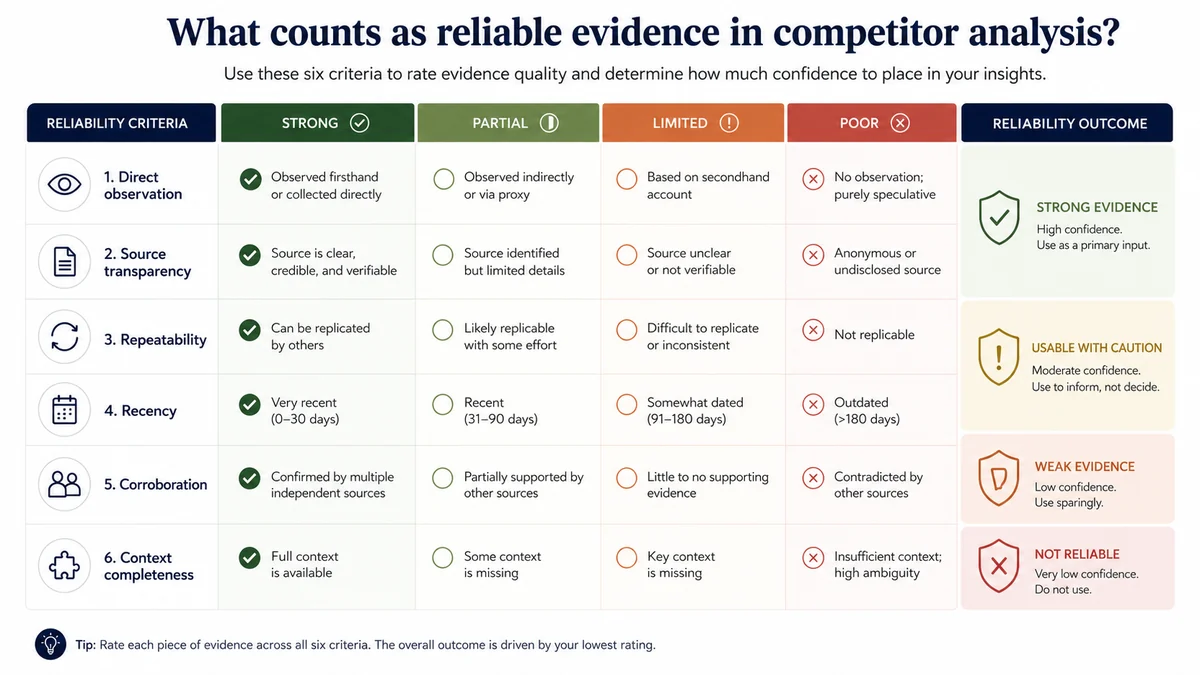
Use these six checks to expose what the evidence can and cannot support before you select a permitted-use outcome.
Check the evidence without grading it
- Source proximity and provenance
- Identify the original source, its relationship to the observation and any derivative reporting.
- Reopenability and transparency
- Another reviewer can return to the same source, method, date and context.
- Observation and interpretation
- Keep what was recorded separate from what the analyst concludes.
- Freshness and decision window
- The observation period is current enough for the use, or its historical limit is explicit.
- Independent support and copy chain
- Count distinct origins and show when several pages repeat one source.
- Context, coverage and consequence
- The market, buyer, geography, definition and coverage fit the claim, and assurance rises with the cost of error.
These checks do not produce a grade, score or fixed expiry date. Their job is to identify the condition that controls the exact claim and use.
From evidence to permitted use
The semantic flow keeps the method selectable, printable and understandable without the bitmap visuals.
- RecordExact claim, decision use, evidence form, source and dates
- TestClaim fit, context, reopenability, independence, contradiction and missing evidence
- ClassifyEvidence condition: Fit, Limited / weak, Stale, Contradictory or Missing; claim status: Supported, Inferred or Unresolved
- PermitUse, Use with limits, Review required, Refuse claim or No material change
- ReopenNext evidence, Evidence owner, Accountable reviewer or approver, and review or reversal condition
No material change is available only after an otherwise valid evidence record is compared with an existing recommendation and the material consequence remains unchanged. It is never a fallback for weak, stale, missing or contradictory evidence.
Illustrative fictional example
Worked review: from original source to a bounded claim
Imagine a fictional industry association publishes a survey saying that 63% of mid-market respondents plan to increase cloud-software spending in the next 12 months. A market blog repeats the figure, and an analyst proposes: “Mid-market companies are increasing cloud-software spend.”
Evidence-review ledger
- Original source
- Fictional industry-association survey report.
- Publication/update date
- 15 May 2024.
- Observation/data period
- April 2024 survey collection.
- Copied summary
- A blog repeats the original report and adds no independent collection.
- Exact claim under review
- “Mid-market companies are increasing cloud-software spend.”
- Evidence form
- Source-reported claim supported by testimony from a survey sample.
- Material limitation
- Stated plans are not actual spending; the sample and definition of “mid-market” limit scope.
- Claim status
- Inferred.
- Primary outcome
- Use with limits.
- Strongest statement allowed
- “In the surveyed mid-market sample, 63% said they planned to increase cloud-software spending over the following 12 months.”
- Prohibited stronger statement
- “Mid-market companies increased cloud-software spending by 63%.”
- Next evidence
- Actual-spend data or independently observed purchasing behaviour for the target segment.
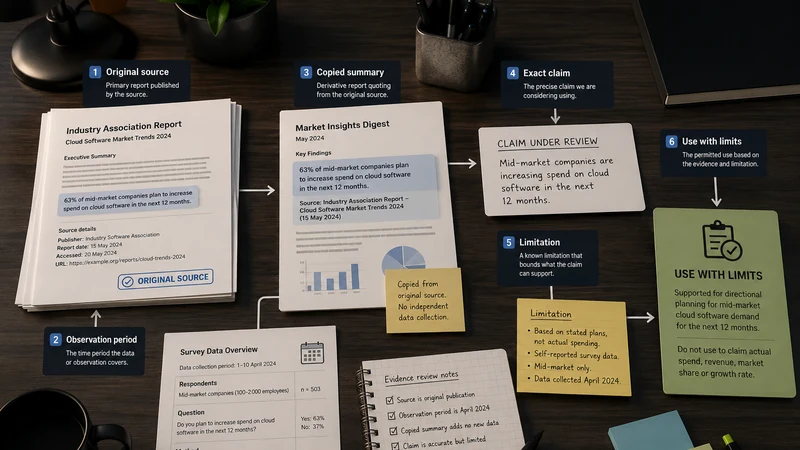
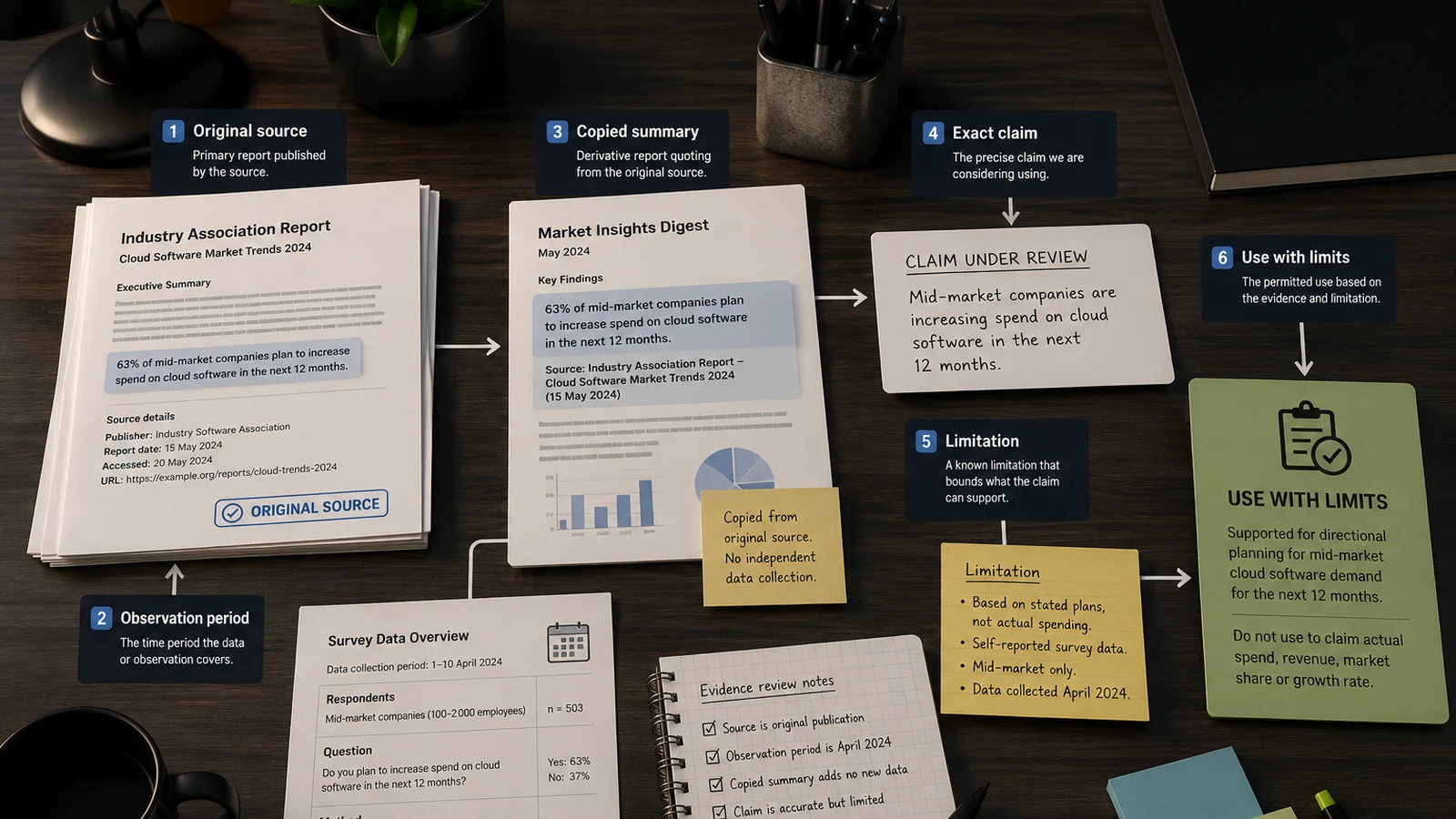
The visual is complementary. The complete reasoning is in the ledger above, so the example remains usable if the image fails to load or is omitted from print.
The five outcomes control use—not how certain you feel
Use
Example: A current, reopenable public page directly supports the bounded statement that a named offer was displayed in a named market on the review date.
Blocked: It does not prove adoption or commercial success.
Use with limits
Example: A modelled visibility estimate may be used directionally with the method, period and market stated.
Blocked: Do not report it as actual traffic, revenue, buyer intent or market leadership.
Review required
Example: Two sources conflict, but the disagreement may be resolved by aligning dates, definitions or geography.
Next: Reopen the sources and obtain the evidence that can settle the material difference.
Refuse claim
Example: The proposed statement says a competitor is the market leader, but the evidence only shows search visibility.
Blocked: The wording cannot be used; record the narrower visibility observation instead.
No material change
Example: Valid new evidence is reviewed against the current recommendation and does not change its material consequence.
Required: State what stayed unchanged and what would reopen the decision. This is not “we found nothing.”
Fast action · approximately 30–60 seconds with a prepared record
Quick evidence check
Stage 1 makes the evidence decision. Stage 2 adds the owner, reviewer and reopen condition needed for a completed handoff. The stages are workflow steps, not extra outcomes.
Automated check unavailable: use the manual method
- Write the exact claim and decision use.
- Record the evidence form, source, reopenability, publication date, observation period, context and limitations.
- Apply the precedence rules in order: claim fit; contradiction; missing evidence; provenance and reopenability; date, context and separation; modelled or non-independent evidence; valid direct support; valid No material change.
- Select exactly one outcome: Use, Use with limits, Review required, Refuse claim or No material change.
- Record the strongest allowed wording, prohibited stronger wording, next evidence, Evidence owner, Accountable reviewer or approver and reopen condition.
Copy and print automation are unavailable, but the evidence method remains complete.
EVIDENCE DECISION COMPLETE — HANDOFF DETAILS REQUIRED
HANDOFF COMPLETE
Use the evidence-quality register for repeated work
For many claims, use one row per claim and evidence record. The register keeps publication date, observation period, review date and reopen date separate; preserves the exact observation and interpretation; and carries outcome, reasons, limitations, strongest allowed wording, prohibited wording, next evidence, owner and reviewer.
Evidence Quality Register
Repeated-use XLSX with Start Here, Evidence Register, Decision Summary, Review Queue and a clearly fictional Example.
Use the PDF for a material decision handoff
The PDF is a one- or two-page handoff for material claims and decisions. It is not a duplicate of the workbook and not the complete evidence record. It carries the decision and scope, material claim, evidence form and condition, status, outcome, provenance, observation period, limitations, contradiction, missing evidence, strongest and prohibited wording, next evidence, owner, reviewer and reopen condition—then points back to the full register.
Evidence Decision Handoff
Portable maximum-two-page PDF for accountable review of material decisions.
Competitive intelligence source FAQs
What are the best sources of competitive intelligence?
There is no universal best source. Use the source closest to the exact proposition: competitor-owned material for what the competitor publishes, formal records for facts inside those records, owned analytics or CRM for your recorded behaviour, primary research for sampled participant reports, and modelled tools for directional estimates. The decision question determines the hierarchy.
Can a competitor website be trusted as a source?
Yes for a bounded claim about what the competitor publicly displays or states at a recorded time. No as automatic proof that the underlying marketing or performance claim is true. Separate “the page says” from “the proposition is independently established.”
Are customer reviews reliable competitive intelligence?
Reviews are useful for discovering reported experiences, language and possible issues. They do not by themselves establish prevalence or representativeness. Use them as evidence of the captured reports, then corroborate before making a market-wide claim.
Are directories and marketplaces reliable competitor sources?
They can establish what the platform lists, categorises, rates or makes visible. They cannot prove complete market coverage or objective leadership unless the platform’s method and coverage support that stronger claim. Record inclusion rules and commercial incentives when they matter.
Can one source be enough?
Yes. One direct, reopenable and context-fit source can support a narrow low-consequence observation. A consequential, disputed or inferred claim may require independent corroboration or accountable review. Several copied pages may still be one origin.
When is a competitive intelligence source too old?
When its observation period no longer covers the decision window or the subject may have changed enough to alter the use. Publication date is not a substitute for observation date; a new article can still report old evidence.
Are SEO and traffic tools reliable competitive intelligence sources?
They can support modelled, directional comparisons when the method, database, period and context are recorded. Their estimates are not direct measurements of a competitor’s actual traffic, revenue, buyer intent or market leadership.
Can an AI answer be used as competitive intelligence evidence?
Use AI output for discovery and organisation unless the underlying evidence is independently reopened. For a material claim, verify the cited or original source, its date, scope and exact support. A citation shown by an AI system does not itself establish correctness.
What should happen when competitive intelligence sources conflict?
Keep the disagreement visible. Align dates, definitions, geography and source origins, then seek evidence capable of resolving the material difference. Use Review required or Refuse claim when the conflict blocks responsible use.
How should competitive intelligence evidence be documented?
Record the exact claim, decision scope, source class, provenance, publication and observation dates, limitations, contradiction state, permitted wording, prohibited stronger wording, next evidence, owner, reviewer and reopen condition. The workbook and PDF on this page support repeated review and accountable handoff.
Research basis, ethics and limits
This source hierarchy is a SERPIFAI synthesis for competitor-analysis decisions. It combines claim-to-source fit with provenance, freshness, independence, contradiction and consequence. The external sources below support transferable practices inside their own remits; they do not prove that SERPIFAI’s method produces correct competitor decisions and they do not endorse this framework.
The article’s original bounded landscape review inspected 25 pages and found that most of that sample emphasised source lists, monitoring or templates rather than connecting source classes to permitted and prohibited claims. That remains a bounded observation of that review—not proof that no comparable framework exists.
- UK Government — all-source intelligence assessment professional framework: supports evaluating and articulating source strengths and weaknesses and maintaining a usable analytical audit trail within its domain.
- Strategic Consortium of Intelligence Professionals — Code of Ethics: supports legal, transparent and honest competitive-intelligence collection and conclusions; it is ethics guidance, not a reliability ranking.
- W3C PROV Model Primer: defines provenance concepts for origins, entities, activities and derivation.
- Full Fact — How we fact check: provides a professional example of preferring primary sources and seeking multiple sources for central claims, with a one-source exception where only one relevant source exists.
- NIST AI RMF Generative AI Profile: supports verification, evaluation and risk-aware use of generative-AI systems within its remit; SERPIFAI applies that cautiously to AI-derived competitive-intelligence discovery.
- Ahrefs methodology, Similarweb methodology and Semrush methodology: primary sources for the vendors’ own models and stated limitations, not neutral validation of a particular estimate.
Ethical boundary: this method assumes lawful, authorised and appropriately disclosed collection. It does not treat deception, unauthorised access or confidential material obtained improperly as legitimate competitive-intelligence sourcing. Legal requirements vary by jurisdiction; SCIP’s ethics guidance is not legal advice.
Choose the source, bound the claim, then decide what changes
A competitive intelligence source is useful only to the extent that it supports the exact proposition in the decision. Start with the claim, choose the closest source class, record what it cannot prove, keep provenance and copy chains visible, and increase corroboration as inference or consequence rises.
- Can this source establish the exact proposition—or only indicate it?
- Does the source match the market, buyer, geography, product and time window?
- Can another reviewer reopen the original source and underlying observation?
- Have copied origins, contradictions, model limits and missing coverage remained visible?
- Is the strongest permitted wording explicit, and is the stronger unsupported wording blocked?
- Is the next evidence or reopen condition named if the decision remains material?
If source selection is complete but the boundary between observation, inference and unresolved judgement is still unclear, continue with Evidence vs Assumptions in Competitor Analysis. When the unresolved boundary is consequential and the decision scope itself is unclear, a bounded Decision Scope Review can establish what must be proven before deeper analysis begins.