

Direct answer
Validate the relationship, not just the company name
Competitor-set validation tests whether a proposed competitor belongs in a specific decision view. Public and digital evidence generates candidates. Sales, customer, win/loss, procurement, renewal and churn evidence tests whether those alternatives participated in real buyer decisions. Neither source class is complete on its own. When the resulting classification could change an investment, competitor analysis consulting can examine the evidence and its decision limits together.
A safe result does more than say “yes” or “no.” It preserves the competitor identity, the product or offer, buyer, market, geography and decision stage; distinguishes buyer observation from seller interpretation; checks whether records share one provenance; and states the role, permitted use, unsupported use, next evidence, owner, version and review trigger.
Fictional composite
Three search competitors become six buyer alternatives
A software team begins with three domains that dominate category searches. Sales remembers a famous loss to a fourth vendor, but the CRM competitor field is blank on many opportunities. Buyer interviews reveal an internal spreadsheet. Procurement introduces an enterprise-only supplier. One visible search domain never appears in a real shortlist, while another matters in enterprise deals but not self-serve. Three documents that seem to confirm the famous competitor all come from the same lost opportunity. One candidate remains unresolved.
Three search-visible platforms enter the candidate register.
A memorable loss adds a hypothesis, not a confirmed role.
An internal spreadsheet appears as the day-to-day substitute.
An enterprise supplier is relevant only at a late stage and tier.
Three records collapse to one underlying buyer decision.
Discovery, self-serve, enterprise and procurement views keep different assignments.
Why search-only and sales-only certainty both fail
Public and market evidence
Keyword overlap, paid-search overlap, traffic similarity, directories, marketplaces, review categories and analyst discovery are efficient candidate generators. They can identify publishers, tools, substitutes and emerging alternatives that internal teams have not recorded.
Boundary: they do not prove shortlist, pricing, procurement or revenue relevance.
First-party evidence
CRM opportunities, buyer interviews, sales calls, win/loss records, RFPs, procurement, onboarding, renewal, churn and support records show what happened inside commercial situations.
Boundary: capture can be incomplete, memories can be selective and several records may repeat one decision.
Search and market evidence generate candidates. Sales and customer evidence test commercial relevance. Neither source class becomes absolute truth.
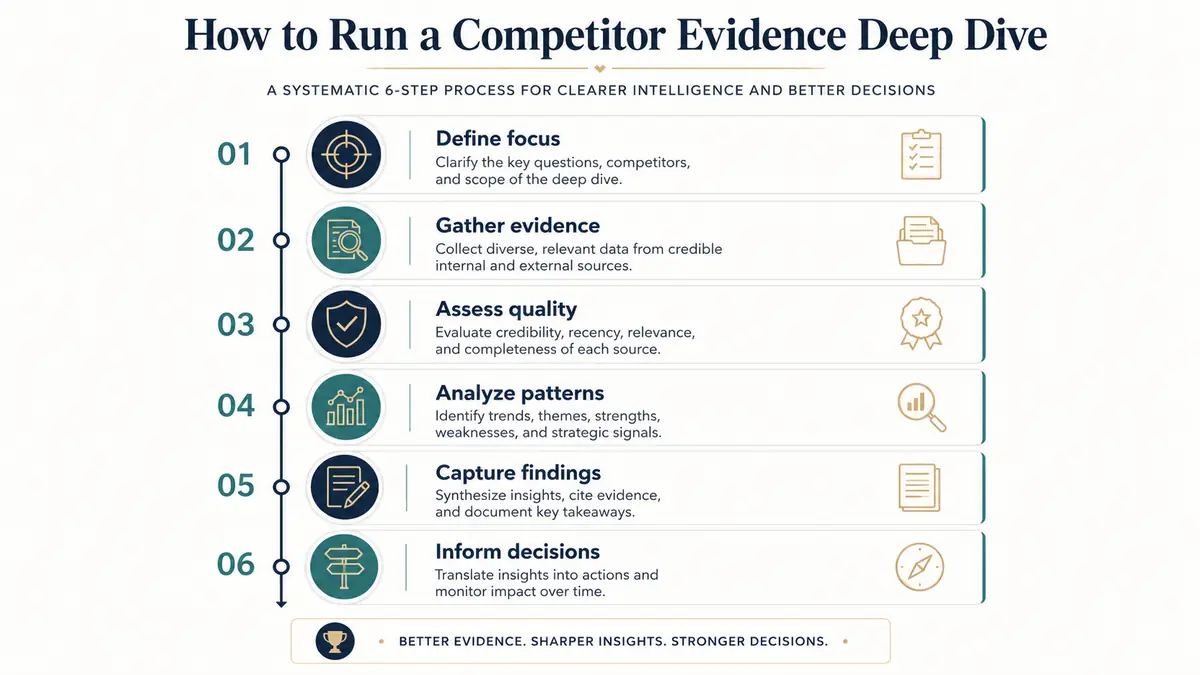
Use one six-stage validation protocol
- Define
- Sample
- Normalize
- Triangulate
- Reconcile
- Approve, version or reopen
1. Define the decision
Name the exact downstream use first: SEO discovery, content planning, battlecards, product comparison, shortlist, procurement, pricing, renewal or executive strategy. Then record the product or offer, buyer or buying group, job or need, market, geography, serviceability and decision stage. A competitor can be validated for one view and unvalidated for another.
2. Sample the relevant buyer situations
Choose records that can answer the decision. Include wins, losses and no-decision outcomes where relevant; add renewal, churn and procurement for post-sale or late-stage views. Record missing segments, geographies, outcomes and sources. There is no universal interview count: the evidence must cover the scope you intend to claim.
3. Normalize identities and alternatives
Resolve parent, brand, product and tier. Keep the stable competitor identity separate from the decision-scoped role. Allow non-vendor alternatives such as internal builds, spreadsheets, consultancies, agencies, incumbents, open-source tools, free tools, no decision and status quo.
4. Triangulate source families
Keep direct buyer observations, seller or internal observations, recorded commercial events, customer or user records, public discovery evidence and analyst or AI interpretations separate. Link every derived summary to the underlying record.
5. Reconcile agreement, absence and contradiction
Check whether the records address the same product, buyer, market, geography and stage. A blank CRM field is missing data, not exclusion proof. Three notes from one opportunity are one underlying decision, not three independent confirmations. A material contradiction returns RESOLVE EVIDENCE with a named next action.
6. Approve, version or reopen
Publish the scoped role, permitted use, unsupported use, owner, effective period and trigger. Preserve the previous version. Reopen when new buyer evidence, a launch, acquisition, pricing change, geography expansion or review date challenges the approved result.
What counts as evidence—and what it can support
| Evidence family | Examples | Safe use | Boundary |
|---|---|---|---|
| Direct buyer observation | Buyer interview, verified shortlist, RFP, buyer statement in a call | What appeared in that decision and stage | One decision does not prove broad relevance |
| Seller or internal observation | Seller interview, CRM note, manager review | Internal account of the opportunity | Keep separate from buyer observation |
| Recorded commercial event | Won, lost, no decision, POC, procurement, renewal, churn | Event and outcome context | Outcome alone does not prove cause |
| Customer or user record | Onboarding, previous solution, support workaround, feedback | Substitutes, incumbents and user context | Customers are a selected population |
| Public / market discovery | SERP overlap, paid overlap, directory, marketplace, product page | Candidate generation and discovery/reference roles | Not shortlist or procurement proof |
| Analyst or AI interpretation | Analyst synthesis, coded theme, AI summary | Triage and interpretation | Must link to underlying records; adds no independent decision |
Multiple records are not multiple independent decisions
Search, market and analyst discovery
Buyer, sales, CRM and commercial events
After identity, scope and provenance checks
A transcript summary and CRM note from the same call share provenance. Three CRM rows from one opportunity share one underlying buyer decision. Ten pages repeating one announcement are one public signal. Independent corroboration comes from separate buyer decisions whose scopes are comparable.
Search + Sales + Customer Convergence
How to read it: select a checkpoint to isolate that part of the method. The canvas shows the relationship; the inspector explains what the checkpoint changes in the decision.
Nine controlled outcomes cover the complete decision
CONFIRM
Keep the current role in the tested view.
ADD
Add an overlooked commercial alternative.
DOWNGRADE
Limit an over-broad, stale or partially matched role.
RECLASSIFY
Change the scoped assignment while preserving identity.
RETAIN FOR DISCOVERY / REFERENCE
Keep channel or reference relevance outside the commercial view.
EXCLUDE FROM THIS COMMERCIAL VIEW
Remove only from the tested view when adequate matching evidence supports non-participation.
RESOLVE EVIDENCE
Preserve insufficiency, contradiction, missingness or non-independent provenance.
REOPEN
Suspend a prior validation after a trigger or material new evidence.
INVALID INPUT
Correct a malformed or incomplete record before making a claim.
Guided product
Competitor Set Validation Check
Use a generic label such as “Candidate A.” Do not enter customer, account or deal names. Nothing is sent to an external API.
Validation outcome
- Why
- Role / view effect
- Supported use
- Unsupported use
- Next evidence
- Review trigger
- Provenance / sample warning
- Safe next action
Worked composite: one identity, four different view effects
| Candidate | Evidence finding | Outcome | View effect |
|---|---|---|---|
| Visible search platform | Strong organic overlap; never appears in adequate matching shortlist evidence | RETAIN FOR DISCOVERY / REFERENCE or scoped EXCLUDE | Keep for SEO; do not use for shortlist or procurement |
| Famous lost vendor | Three records trace to one enterprise loss | RESOLVE EVIDENCE | Collect independent buyer decisions before broad use |
| Internal spreadsheet | Buyers repeatedly use it before purchase | ADD | Add as a substitute in the matching self-serve view |
| Enterprise-only supplier | Procurement introduces it after shortlist | RECLASSIFY | Enterprise procurement role only |
| Unresolved candidate | Seller memory conflicts with buyer interview and scope is uncertain | RESOLVE EVIDENCE | No final role change until comparable evidence exists |
Operate repeatedly and hand off the method
Competitor Set Validation Register
Use the native-safe workbook to connect candidates, first-party records, validation reviews and versioned sets. Blank rows remain blank; calculated outputs follow the same outcome hierarchy as the browser check.
Download the workbookSales and Customer Evidence Validation Guide
Use the portable guide for workshops, review meetings and handoffs. It contains the six-stage method, evidence map, outcome rules, provenance cautions and review checklist.
Download the PDF guidePrinciples worth sharing and citing
Search and market evidence generate candidates. Sales and customer evidence test commercial relevance.
Buyer observation and seller interpretation are not the same record.
Multiple records are not multiple independent decisions.
Absence from CRM is not proof of irrelevance.
A validated set preserves different roles rather than forcing one source to win.
Frequently asked questions
Can one buyer mention validate a competitor?
It validates that the alternative appeared in that buyer decision. It does not establish broad relevance across products, segments, markets, geographies or stages.
What if CRM competitor fields are incomplete?
Treat the evidence as capture-limited. Do not infer absence. Combine other records and begin prospective capture with normalized names, source relationship, stage and outcome.
How many interviews are enough?
There is no universal number. Use enough independent decisions to cover the intended scope and disclose missing outcomes, segments, geographies and buyer roles.
Should internal builds, spreadsheets and no decision count?
Yes, when they perform the buyer's job or prevent a purchase. Record them as scoped alternatives rather than forcing every record into a vendor list.
What if search and first-party evidence disagree?
Preserve both. A domain can remain a discovery competitor while commercial use is restricted; a low-visibility alternative can be added to a buyer or procurement view.
How often should the set be reviewed?
Use a date or event trigger: new buyer evidence, product launch, acquisition, pricing change, market expansion, serviceability change or scheduled review.
Product boundaries
The article, browser check, workbook and PDF do not replace CRM, competitive-intelligence software, win/loss platforms, call-recording systems, customer-research systems, proprietary traffic or keyword datasets, research panels or automated monitoring. They perform no external API call, automatic ingestion, statistical confidence calculation or real-world outcome validation.
Privacy: the browser check processes inputs only in the page. It does not transmit entered competitor, customer, account, deal or evidence data. Do not enter sensitive names; use generic labels and keep source records in your governed system.
Decision Scope Review
Your search tools, CRM, sales team and customers produce different competitor lists—but which one is safe for the decision?
A Decision Scope Review connects stable identity, buyer and offer scope, first-party evidence, contradiction, permitted use, versioning and review triggers before the set shapes content, pricing, enablement or strategy.
Start free Scope ReviewResearch basis
The method uses representative primary, professional and authoritative sources from the frozen 52-source research authority. The links below show the load-bearing public basis and its limits; none implies endorsement of the SERPIFAI protocol.
- Microsoft Dynamics 365 competitor records
Supports: Supports normalized competitor records and opportunity association.
Does not establish: Does not prove field completeness, buyer nomination or data quality.
- Salesforce competitor tracking
Supports: Supports a repeatable capture, validation, reporting and adoption workflow.
Does not establish: Seller-entered data remains an internal observation until corroborated.
- Gartner B2B buying journey
Supports: Supports nonlinear buying jobs, validation and consensus across digital and human interactions.
Does not establish: Does not impose one universal stage model on every market.
- Forrester buying group roles
Supports: Supports distinguishing users, decision-makers and ratifiers where roles change evidence or use.
Does not establish: Does not require a separate competitor set for every stakeholder.
- Productboard linked insights
Supports: Supports keeping customer evidence connected to the originating record and decision.
Does not establish: A linked insight can still be duplicated, selected or misinterpreted.
- Intercom Jobs-to-be-Done research
Supports: Supports reconstructing the context and sequence of a real switch.
Does not establish: Retrospective interviews remain vulnerable to recall and selection effects.
- Semrush online competitors
Supports: Supports using organic and paid overlap to generate candidate domains.
Does not establish: Search overlap does not prove shortlist, procurement or revenue competition.
- Similarweb search competitors
Supports: Supports identifying paid and organic search competitors for channel analysis.
Does not establish: A modeled search relationship does not establish buyer comparison.
- CIPS supplier evaluation
Supports: Supports evaluating and monitoring suppliers in procurement scope.
Does not establish: Supplier evaluation is broader than competitor validation and applies only to relevant late-stage decisions.
- NIST Research Data Framework
Supports: Supports provenance, stewardship and lifecycle controls for auditable records.
Does not establish: It is not a competitor-analysis standard or endorsement of this method.
- ONS quality assurance assessment
Supports: Supports explicit treatment of non-response, anomalies and quality controls.
Does not establish: Statistical weighting and official-survey methods are not reproduced in this practical tool.