

An SEO competitor analysis should include the smallest set that covers the material buyer alternatives, market boundaries, search environment and strategic reference roles required by the decision. The set is large enough only when it passes four coverage tests, the last two relevant candidates add no material decision information and every unresolved candidate has a documented evidence action or exclusion.
That may mean three Core competitors in a narrow local market. It may mean more than ten candidates across several query groups, geographies or business models—but those candidates should not be blended into one undifferentiated average.
In plain English, count only the domains that the conclusion actually needs. Keep publishers, directories, marketplaces, benchmarks and uncertain candidates visible, but do not pretend they are interchangeable direct rivals.
Why a fixed competitor number fails
Many tools ask for a fixed number of competitor domains before the analysis question is defined. Filling those slots can make the work look complete while leaving a material buyer alternative unexamined—or adding irrelevant domains only because space remains.
Founder observation: teams often choose a competitor count because a tool asks for one. The interface default then becomes an accidental research method.
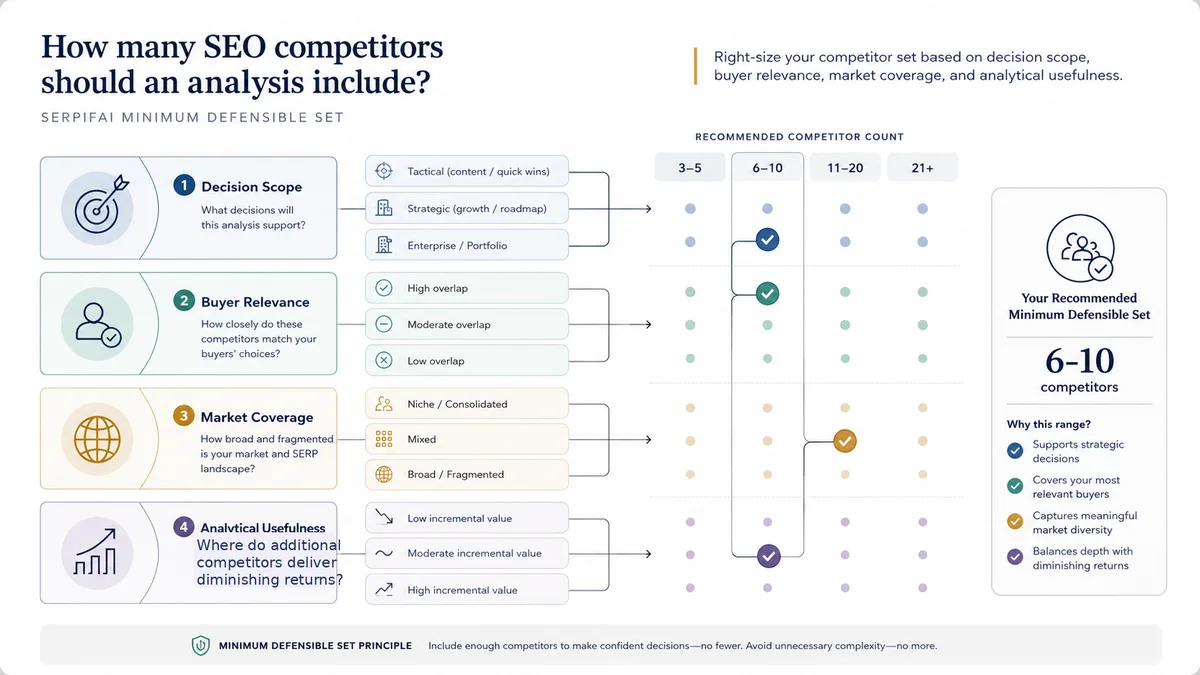
A number is useful only after the decision, buyer, market, search territory and competitor roles are bounded. A tightly scoped local decision may stabilize quickly. A multi-market or platform decision may require several segmented sets. The goal is not maximum collection. It is minimum sufficient representation.
Too small
- One visible market leader controls the benchmark.
- A material local rival, substitute or buyer segment is absent.
- The query sample covers only one stage of discovery.
- Removing one domain collapses the whole conclusion.
Unnecessarily large
- Unlike domain roles are averaged together.
- New candidates repeat evidence already represented.
- Review time is spent explaining irrelevance.
- The recommendation would survive the candidates’ removal.
Founder observation: more domains can create more data while reducing confidence, because the analysis starts averaging businesses that do not play the same role.
The SERPIFAI Minimum Defensible Set
The SERPIFAI Minimum Defensible Set is the smallest documented competitor set that covers the material buyer alternatives, market boundaries, search environment and strategic reference roles required by the decision—without mixing unlike domains or retaining candidates that no longer change the conclusion. In SEO competitor analysis, adding another domain is useful only if it changes the evidence or decision—not simply the size of the list.
No unnecessary Core domain
A candidate does not remain in Core merely because it ranks, is famous, was suggested internally or fits a software slot.
Every disposition has a reason
Core, Context, Watchlist and Exclude decisions are tied to evidence, permitted use and a documented review condition.
The model governs who enters the principal analysis, which references remain contextual, when research should stop, what the final set may support and when the set must be reopened. It does not claim to describe search-engine mechanics or provide a statistically representative sample of an entire market.
The Minimum Defensible Set Ledger
The signature operating asset is a ledger that records the role and permitted use of every candidate. The displayed competitor count normally means the Core count; the other dispositions stay visible without contaminating Core comparisons.
Can influence the principal conclusion
A sufficiently evidenced buyer alternative in the relevant market that contributes material information not already represented.
Explains the environment
A publisher, directory, marketplace, benchmark, intermediary, adjacent model or non-comparable substitute that shapes discovery, expectations, exceptions or risk.
Potentially material, not yet classifiable
A candidate with an unresolved role, territory, buyer overlap or evidence problem. It receives an evidence action and reopening trigger.
Does not belong in the bounded analysis
A candidate outside the decision, wrong for the buyer or territory, unsupported, stale or duplicative without material marginal value.
| Ledger field | What to record | Why it matters |
|---|---|---|
| Candidate and observed role | Domain or alternative; direct rival, substitute, marketplace, directory, publisher, benchmark or unresolved role. | Prevents unlike entities from being treated as interchangeable units. |
| Decision, buyer and territory fit | The evidence connecting the candidate to the bounded decision, audience and service market. | Separates visibility from relevance. |
| Coverage contribution | Buyer, market, search or strategic gap filled. | Shows why the candidate is needed. |
| Marginal evidence | What pattern, benchmark, exception, risk or recommendation changed. | Makes expansion and stopping reviewable. |
| Disposition and permitted use | Core, Context, Watchlist or Exclude; which conclusions the candidate may influence. | Protects the principal comparison from role mixing. |
| Reason and reopening trigger | Inclusion, exclusion or evidence-action reason; condition that would require reconsideration. | Preserves the analysis boundary over time. |
Founder observation: the largest or most visible domain is not automatically the most useful benchmark. It may serve a different buyer, territory or operating model.
Six gates for every candidate
Apply the gates in order. A candidate does not become Core simply because it appears frequently in search results.
Decision-fit gate
Can the candidate materially affect the specific investment, benchmark, market or search decision? If not, Exclude it.
Buyer-choice gate
Could the relevant buyer choose this offer or represented alternative? If not directly, decide whether it still belongs in Context.
Market and serviceability gate
Does current evidence place it in the relevant geography, segment, price band, service model or delivery territory?
Role-integrity gate
Is its role clear enough to determine which metrics and conclusions are valid? Undefined or blended roles cannot enter Core.
Evidence-sufficiency gate
Is the role supported by current, inspectable offer, buyer, territory, business-model and query-sample evidence?
Marginal-evidence gate
Does the candidate add a new pattern, benchmark, exception, risk or recommendation change rather than repeat an existing role?
| Gate outcome | Disposition |
|---|---|
| Passes decision, buyer, territory, role, evidence and marginal-value gates. | Core |
| Material to the decision environment but not suitable for the principal comparison. | Context |
| Plausibly material, but evidence or role classification remains unresolved. | Watchlist |
| Outside scope, irrelevant, unsupported, stale or duplicative without material value. | Exclude |
Four tests for sufficient coverage
A set is not complete because it reaches a preferred count. Each test is marked covered, incomplete or not applicable—with a reason.
Buyer coverage
Does the set represent the material alternatives the same buyer could realistically choose, including meaningful substitutes when they affect the decision?
Failure: a recommendation may ignore an alternative that changes buyer choice.
Market coverage
Does it represent the relevant geography, segment, price band and service model? In plain English, cover the market the decision is about—not every visible company in the category.
Failure: unlike markets are blended or a material model is omitted.
Search coverage
Does it explain the domains shaping the documented query sample—the planned searches representing how the audience discovers, compares and evaluates options?
Failure: the commercial list looks accurate while discovery is misunderstood.
Strategic coverage
Does it include the benchmarks, substitutes, exceptions and risks capable of changing the investment decision?
Failure: the set is commercially plausible but strategically incomplete.
Expand until marginal evidence saturates—then stop
Marginal evidence is the additional decision value supplied by the next candidate. It is material when the candidate adds or changes a buyer alternative, market model, search pattern, benchmark, exception, risk, permitted conclusion or recommendation.
Saturation is the point where another relevant candidate keeps repeating what the current set already shows. It does not mean every available domain was collected or that uncertainty disappeared.
- Coverage condition: the decision-required roles, market boundaries and four coverage tests are complete or explicitly documented as not applicable.
- Saturation condition: the last two relevant candidates reviewed add no material decision information—no new buyer alternative, market model, search pattern, benchmark, exception, risk or recommendation change.
- Unresolved-evidence condition: every unresolved candidate or role has either a Watchlist evidence action or a formal exclusion with a reason.
Prove that the retained Core set is minimum
After expansion stops, remove each Core candidate in turn and ask: Would a coverage test fail, would a material role disappear or would the conclusion become materially less reliable? If not, demote the candidate to Context when it still adds interpretation; otherwise Exclude it as redundant.
Founder observation: a documented exclusion and a documented stopping reason are analysis evidence, not administrative leftovers. They show where the conclusion’s boundary came from.
From an initial candidate pool to a final documented set
Use this sequence so another reviewer can reproduce the selection logic.
- Define the decision inputs. Record the decision, buyer, offer, geography, segment, query sample, relevant roles, evidence threshold, review capacity and permitted conclusion.
- Build a broad candidate pool. Combine known rivals, buyer alternatives, selected query results, marketplaces, directories, publishers, substitutes, benchmarks and stakeholder suggestions.
- Assign provisional roles. Unknown or ambiguous roles go to Watchlist rather than being forced into Core.
- Apply the six gates. Record the evidence, failed gate, disposition and permitted use for every candidate.
- Build the first Core set. Start with the smallest group covering the clearly material buyer alternatives and decision roles. Do not start with a target count.
- Build Context separately. Preserve discovery intermediaries, benchmarks, publishers, directories and non-comparable substitutes without blending their metrics into Core.
- Run the four coverage tests. Search for a missing role or boundary—not for another domain to fill a quota.
- Expand by expected evidence value. Review the strongest candidate for the unresolved coverage gap next and record exactly what changed.
- Apply the stopping and removal tests. Stop only when all three conditions pass, then prune Core candidates that are not necessary.
- Freeze the record. Publish Core, Context, Watchlist and Exclude lists, coverage status, stopping reason, conclusion boundary, limitations and reopening conditions.
Worked example: reduce 18 candidates to a defensible set
Illustrative fictional composite. The names and evidence are invented to demonstrate the method. They do not represent a client, market result or external validation.
Decision: should a UK-focused B2B software company invest in comparison and category content for field-service scheduling software used by mid-market service businesses?
Inputs: UK buyers; mid-market service teams; a query sample covering discovery, comparison and implementation questions; a principal conclusion about content and positioning investment—not market share, revenue or causal performance.
| Candidate | Observed role and evidence added | Disposition and reason |
|---|---|---|
| 1 · RouteFlow | Closest UK mid-market offer and buyer match; establishes the baseline direct pattern. | Core. Principal comparable. |
| 2 · WorkPilot | Adds a lower-price, self-serve model the same buyer could choose. | Core. Changes the price and onboarding benchmark. |
| 3 · FieldAxis | Adds a vertical-specialist model for regulated service teams. | Core. Adds a segment exception. |
| 4 · ServiceGrid | Adds a regionally delivered implementation and support model. | Core. Changes serviceability comparison. |
| 5 · OpsCloud | Adds a broader operations suite considered by the same buying committee. | Core. Adds a suite-versus-specialist choice. |
| 6 · CompareStack | Review marketplace shaping comparison searches, but not a software provider. | Context. Discovery evidence only; excluded from Core metrics. |
| 7 · TradeOps Journal | Publisher visible for category education and implementation questions. | Context. Explains awareness and evaluation content. |
| 8 · LocalPro Directory | Directory surfacing consultants and implementation partners. | Context. Discovery intermediary, not a product rival. |
| 9 · EnterpriseWorks | Large-enterprise benchmark outside the target segment and buying capacity. | Context. Capability reference; not directly comparable. |
| 10 · Spreadsheet/manual process | Status-quo substitute that may delay software purchase. | Context. Strategic risk; no software metrics blended into Core. |
| 11 · IntegratorPlus | Service intermediary with no material buyer substitution or additional discovery pattern for this bounded decision. | Exclude. Fails decision-fit and marginal-evidence gates. |
| 12 · SchedulerEU | Appears relevant, but current UK serviceability and support evidence are unclear. | Watchlist. Verify UK contracts and support before reopening. |
| 13 · MobileRoster | Targets microbusiness buyers below the bounded segment. | Exclude. Fails buyer and segment gates. |
| 14 · FleetDesk | Fleet-maintenance product with superficial keyword overlap. | Exclude. Fails decision and role-integrity gates. |
| 15 · FieldSuite Lite | Potentially relevant pages are stale and the offer appears discontinued. | Exclude. Fails evidence-sufficiency gate. |
| 16 · JobTrack | Adds a usage-based pricing model and contractor-heavy buyer pattern. | Core. Changes pricing and buyer-risk conclusions. |
| 17 · DeskDispatch | Repeats RouteFlow’s buyer, offer, pricing and discovery pattern. | Exclude. First consecutive candidate adding no material evidence. |
| 18 · TaskRoute | Repeats the existing direct pattern without a new exception or recommendation change. | Exclude. Second consecutive candidate adding no material evidence. |
What changed as the set expanded
- The first candidate supplied only a single direct benchmark.
- WorkPilot changed the price and onboarding pattern.
- FieldAxis exposed a segment exception.
- ServiceGrid changed the serviceability benchmark.
- OpsCloud added a suite-versus-specialist alternative.
- JobTrack added usage-based pricing and contractor-heavy buyer risk.
- Context candidates explained discovery, implementation, category expectations and the status-quo substitute without entering Core averages.
Why expansion stops
Buyer, market, search and strategic coverage are marked covered. Candidates 17 and 18 add no new buyer alternative, market model, search pattern, benchmark, exception, risk or recommendation change. SchedulerEU has a documented Watchlist evidence action. All three stopping conditions therefore pass.
The removal test retains all six Core candidates because removing any one would erase a material price, segment, serviceability, suite, usage or direct-baseline pattern.
Core: 6. Context: 5. Watchlist: 1. Exclude: 6. The number six is an output of this decision—not a benchmark for another analysis.
Permitted conclusion and limitations
The set can support a bounded comparison of selected UK mid-market offers, positioning patterns, discovery intermediaries and substitute risks for the defined content-investment decision. It cannot support claims about international market share, every buyer segment, revenue, causal performance or a universal ideal competitor count.
Difficult cases where the number changes
What if there are only two genuine direct competitors?
Keep the Core set at two when both cover the material direct alternatives. Add Context for substitutes, directories, marketplaces or benchmarks only when they affect the decision. Do not invent a third direct competitor to satisfy convention.
What if the search results are fragmented by query group?
Build a shared candidate pool, then create separate Core sets for materially different query clusters or decision stages. A domain can be Core for one cluster and Context or Exclude for another. Report the difference instead of averaging the clusters.
What if new candidates keep contradicting the pattern?
Saturation has not been reached. Check whether the decision boundary is too broad, whether roles are being mixed or whether the market genuinely contains several models. Segment the analysis or escalate the unresolved contradiction rather than forcing a stop.
Can three competitors be enough while ten are insufficient?
Yes. Three may cover a narrow market with two direct alternatives and one material substitute. Ten may still be insufficient when several geographies, service models, query clusters or buyer segments remain uncovered.
Illustrative cross-market boundary checks
Illustrative scenarios—not a study or observed result. These examples preserve the earlier instructional contrast without claiming an inspectable LOCUS record, client outcome or external validation.
| Illustrative market | Likely set boundary | Operating implication |
|---|---|---|
| Austin dentistry | A small Core of local providers plus marketplace and education references in Context. | Local serviceability may stabilize the direct set quickly; discovery domains must not inflate the Core count. |
| Manchester SME accounting | Core providers plus distributed service models, a benchmark and professional directories. | Online serviceability and intermediaries may justify a broader role set. |
| Dublin business law | A small direct Core plus large-firm benchmarks, a directory and publisher context. | A limited direct set can coexist with a larger reference set when their metrics remain separate. |
When to reopen the competitor set
A frozen set is not permanent. Reopen the ledger when:
- the decision, buyer, offer, category or investment question changes;
- the geography, segment, price band or service territory changes;
- the query sample changes materially;
- market structure or an important competitor role changes;
- new evidence contradicts the current pattern;
- a Watchlist candidate becomes classifiable;
- the supporting evidence becomes stale.
Reopening does not mean rebuilding the analysis from zero. Re-run the affected gates, coverage tests and stopping record, then document what changed.
What the final set can responsibly prove
The final record supports only the decision and territory it was designed to cover.
It can support
- bounded comparisons among the documented Core competitors;
- identification of contextual discovery roles and material substitutes;
- a reasoned benchmark, exception and risk record;
- a documented explanation of why research stopped.
It cannot automatically support
- market share or revenue claims;
- causal explanations of performance;
- every geography, buyer or query group;
- a universal ideal number of competitors;
- claims based on Context domains as if they were direct rivals.
The practical consequence is that a competitor set may be excellent for one investment decision and inadequate for another. The conclusion must travel with its buyer, market, query sample, evidence date and role boundaries.
Evidence context and method limits
The Minimum Defensible Set, Ledger, dispositions, gates, coverage tests, stopping rule and removal test are proprietary SERPIFAI operating recommendations. They are not externally validated statistical sampling rules.
- Saunders et al. — uses and limits of saturation in qualitative research
- Guest et al. — a transparent method for assessing thematic saturation
- US DOJ and FTC — case-specific market definition guidance
Method boundary: these sources provide context for documenting diminishing information gain, substitution and bounded market definition. They do not establish a universal SEO competitor count, validate the proprietary SERPIFAI classifications or certify rankings, revenue, ROI or client outcomes.