
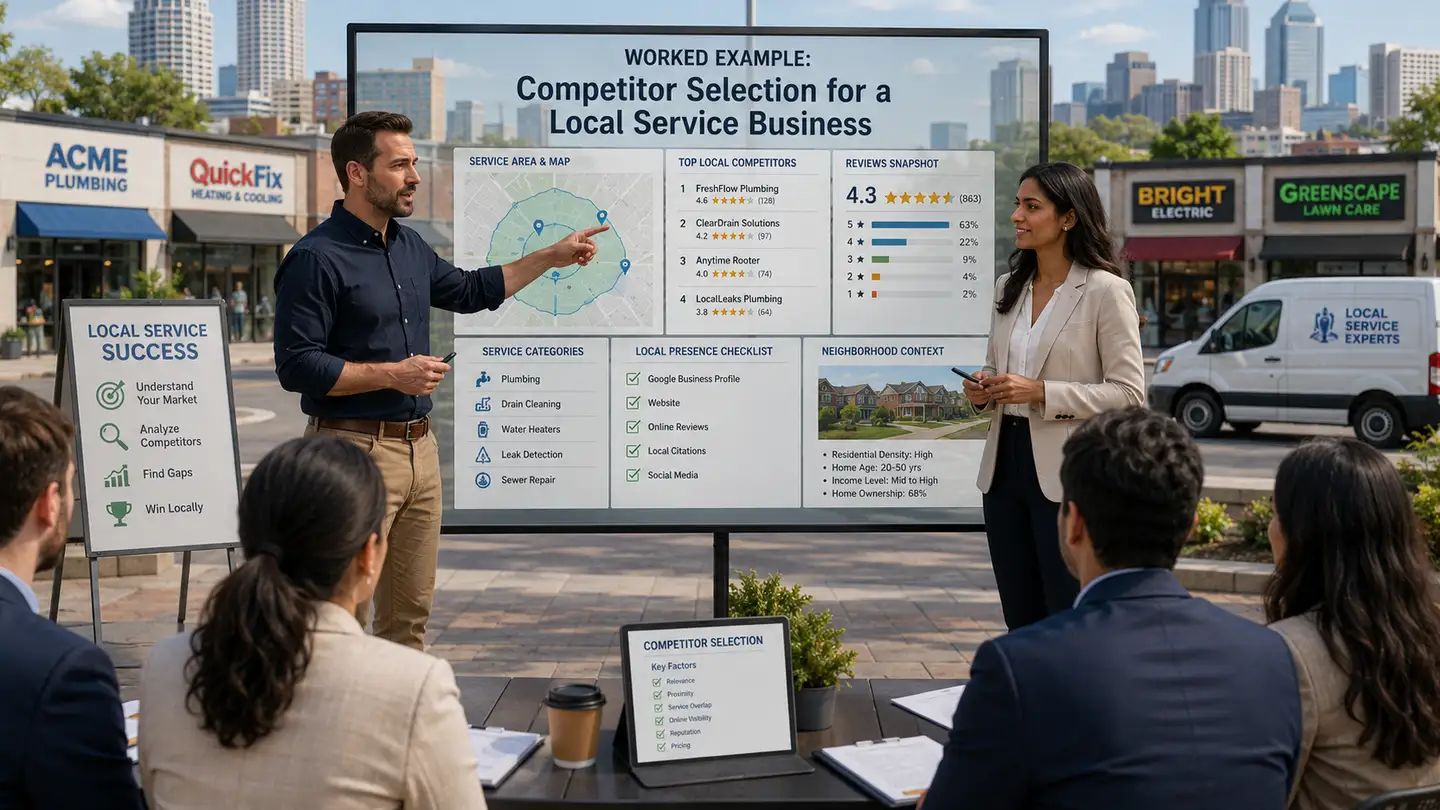
A local-search competitor becomes a direct business competitor only after serviceability survives the evidence check. In this fictional plumbing case, the visible search set starts with six plausible rivals. After the same-job, service-area, availability, buyer and fulfilment checks, only one qualifies as a direct emergency-service competitor; one remains conditional, and the others resolve to indirect, intermediary, reference or direct-exclusion roles. The practical lesson is simple: discovery finds candidates; qualification decides what they are allowed to influence.
Status: fictional composite Founder reviewed by Pero Baldjiev. It contains no client data, measured client outcome, ranking result, lead result or revenue claim.
Scenario boundaries: define the job before the competitors
Imagine a fictional plumbing company with one dispatch base and a stated 20-kilometre operating boundary. A homeowner needs an urgent burst-pipe response tonight. The same company also sells scheduled drain inspections, but that is a different decision moment. A business that can handle a scheduled job next week is not automatically substitutable for tonight's emergency call.
Residential homeowner responsible for authorising the callout.
Emergency burst-pipe diagnosis and repair, not general home improvement.
Target postcode inside the fictional provider's 20-kilometre service boundary.
Same-evening emergency availability, not scheduled daytime capacity.
Which providers should influence emergency offer, local visibility and conversion decisions?
Public observations are illustrative. Live dispatch capacity and real buyer choice remain unknown.
The map is a candidate list, not a competitor set. A business has to cross the serviceability boundary before its pricing, pages, reviews or conversion path become a like-for-like benchmark.
Fast Action
Qualify one visible local candidate before benchmarking it
Use only observable evidence. The diagnostic returns a role, a permitted comparison and the smallest next evidence step. It deliberately produces no competitor score.
Area × Availability × Offer × Visibility
How to read it: select a checkpoint to isolate that part of the method. The canvas shows the relationship; the inspector explains what the checkpoint changes in the decision.
Evidence packet: what the case actually knows
The fictional case deliberately starts with mixed surfaces because that is how local competitor discovery normally feels: map listings, organic pages, franchise pages, directories and advice sources appear together. The evidence packet separates what was observed from what that observation is allowed to prove.
| Candidate | Observed evidence | Evidence state | What it can prove | What it cannot prove |
|---|---|---|---|---|
| Candidate A - local emergency plumber | Same service, target postcode, current emergency-hours page, own-team fulfilment. | Current / coherent | Plausible direct substitution for the scoped emergency call. | Actual live capacity, quote acceptance or customer preference. |
| Candidate B - franchise local operator | Brand page says emergency service; local branch page shows daytime booking. | Conflict | The brand participates in the market and a local unit exists. | Same-evening substitutability until local availability is resolved. |
| Candidate C - lead marketplace | Strong local visibility, quote form and reviews; terms route work to third parties. | Current / role-specific | Discovery and lead-routing pressure. | Provider-level service capacity or technician fulfilment. |
| Candidate D - national brand page | Organic visibility for the city; no current local operator evidence for the postcode. | Incomplete | Brand/search visibility. | Local direct competition. |
| Candidate E - DIY publisher | Ranks for burst-pipe advice; no service transaction. | Current / coherent | Information competition before a buyer calls. | Commercial fulfilment. |
| Candidate F - drain specialist | Same geography and buyer, but the scoped emergency repair is outside the observed offer. | Current / coherent | Adjacent need and possible cross-service substitution. | Like-for-like emergency plumbing parity. |
Evidence role: Google says local results are mainly based on relevance, distance and popularity; that describes visibility, not a complete commercial-substitution test. Google also asks service-area businesses to state the areas they serve accurately. The worked case therefore treats local visibility as discovery evidence and serviceability as a separate qualification gate.
Conflicting evidence: where the visible story breaks
A worked application is more useful when the evidence disagrees. The case therefore refuses to “average” conflicting observations into false certainty.
A map listing says “open 24 hours”; the local branch page offers next-day booking. Decision: emergency role stays unresolved until the local operating condition is refreshed.
Reviews mention jobs outside the stated service area; the current provider page excludes the target postcode. Decision: the current declared service boundary controls until contrary fulfilment evidence is verified.
A lead marketplace uses provider-like landing pages, but the transaction routes to independent contractors. Decision: classify as intermediary, not direct provider.
A visible business looks direct online, but internal call records repeatedly show buyers naming a different provider class. Decision: preserve the contradiction and investigate; do not overwrite first-party evidence with SERP visibility.
Inclusion and exclusion decisions: every role needs a reason
| Candidate | Disposition | Role | Reason | Safe benchmark |
|---|---|---|---|---|
| A - local emergency plumber | INCLUDE DIRECT | Direct local provider | Same job, buyer, postcode, timing and own-team fulfilment are coherent. | Emergency offer, service-area clarity, callout information, booking/call path, trust and local landing unit. |
| B - franchise local operator | MONITOR / CONDITIONAL | Potential direct provider | Local operator exists, but emergency availability conflicts. | Franchise/local-unit architecture and scheduled-service presentation only until timing is resolved. |
| C - lead marketplace | INCLUDE REFERENCE | Discovery / lead intermediary | Shapes discovery and enquiry routing but does not fulfil the service itself. | Lead capture, comparison structure and local discovery mechanics. |
| D - national brand | EXCLUDE DIRECT | Visibility reference | No verified local operator for the target postcode. | Brand/search messaging only; no local operating parity. |
| E - DIY publisher | INCLUDE REFERENCE | Information competitor | Competes for the pre-call question, not the repair transaction. | Emergency explanation, safety framing, decision-support content and answer structure. |
| F - drain specialist | INCLUDE INDIRECT | Adjacent / substitute provider | Same geography and buyer, different observed service for this job. | Adjacent need framing and cross-service positioning, not emergency-plumbing parity. |
Why the line matters: even formal market-analysis guidance treats product/service and geographic boundaries as distinct line-drawing problems and recognises that substitutes can be closer or more distant. This article uses that principle only as methodological context; it is not an antitrust market-definition exercise.
Decision changed: the qualified set is smaller, but more useful
All six could have been placed in one spreadsheet because they appeared around the same local need.
The set now tells the team what each candidate is allowed to influence.
The important change is not the count. It is the decision permission. Candidate A can inform like-for-like emergency offer and conversion work. Candidate B cannot yet drive emergency benchmarks. Candidate C can inform lead-marketplace mechanics. Candidate E can inform answer content. Candidate D cannot be used as proof of local competitive pressure until local serviceability exists.
A cleaner competitor set can contain more roles but fewer false peers. That is often more useful than expanding the list of domains.
Controlled action: what each role permits next
| Role | Permitted action | Evidence still needed | Do not infer |
|---|---|---|---|
| Direct local provider | Compare scoped service page, emergency proposition, callout transparency, contact path, trust evidence and service-area communication. | Current operating details plus first-party call/quote evidence where available. | Review count equals capacity; visibility equals market share. |
| Conditional provider | Track the unresolved dimension and use only the parts already comparable. | Fresh local hours, postcode coverage or fulfilment evidence. | Brand-level capability automatically applies to the local unit. |
| Indirect / adjacent provider | Study substitution, objections, cross-service positioning and alternative buyer paths. | Evidence that the buyer would actually switch for this need. | Same geography means same service. |
| Directory / lead intermediary | Analyze lead capture, local comparison UX and discovery visibility. | Transaction/lead-routing ownership and current provider network if material. | The intermediary itself performs the job. |
| Publisher / reference | Analyze information coverage, evidence, safety framing and answer usefulness. | Current content/source evidence. | Information visibility proves service substitution. |
Review evidence caution: reviews can contribute to popularity signals and buyer trust, but the workbook keeps review observations separate from serviceability and capacity. The FTC's Consumer Reviews and Testimonials Rule also reinforces the need to treat review evidence as governed evidence rather than something to manufacture or manipulate.
Optional strategy translation: turn the governed role into useful research
This layer comes after role qualification. It does not create another competitor score. It tells a reviewer where deeper research can create value without confusing visibility with substitution.
| Governed role | Buyer pain / job | Query or keyword lens | Entity relationship to verify | Strategic value | Proof before action |
|---|---|---|---|---|---|
| Direct local provider | “I need this exact job solved here, at this time.” | Same-job local intent: service + location/postcode + timing/availability. | Provider → service → service area → availability → booking/fulfilment. | Like-for-like offer, service-area clarity, contact path, evidence and trust can be compared. | Current serviceability plus first-party call, quote or booking evidence where available. |
| Conditional provider | “This looks comparable, but can it really serve my decision moment?” | Keep query expansion narrow until the unresolved boundary is refreshed. | Brand/local operator → postcode → hours → actual fulfilment. | Prevents a plausible candidate from becoming a false benchmark. | The smallest fresh observation that resolves timing, geography, ownership or fulfilment. |
| Directory / lead intermediary | “Help me compare or reach providers quickly.” | Compare providers, get quotes, marketplace and lead-routing intent. | Marketplace → enquiry → routed provider → buyer. | Benchmark lead capture, comparison UX, routing friction and trust cues separately from delivery. | Current terms, routing model and provider-network evidence. |
| Publisher / reference | “What should I do before I call someone?” | Problem-solving, symptom, emergency checklist and evidence-led informational intent. | Problem → immediate action → risk → provider handoff. | Benchmark explanation, evidence and decision support without treating the source as a service substitute. | Current content/source evidence and reader-task coverage. |
| Indirect / adjacent provider | “Would another service or timing solve enough of the need?” | Adjacent need, substitute service, scheduled-service or alternative-solution intent. | Buyer → adjacent need → substitute service → timing. | Expose substitution, objections and positioning without contaminating the direct set. | Evidence of actual switching or a material service-scope change. |
Human-first guardrail: query variants are research clues, not reasons to manufacture more pages. Consolidate overlapping intent unless a distinct user task genuinely needs a separate canonical owner.
Paid Local Services surface: Google Local Services Ads use service areas and job types to match businesses with local demand, while ad ordering also uses auction and profile-quality inputs. Treat that paid visibility as candidate-discovery evidence; it still does not prove that two visible businesses are operationally equivalent.
What remains unresolved: the case stops where the evidence stops
- Live dispatch capacity: a current page can show stated hours, not whether a technician can accept this job now.
- Actual buyer substitution: only first-party call, quote, booking or customer evidence can show which alternatives are repeatedly considered in this specific business.
- Franchise operating reality: national claims may not describe one local operator's hours, staff or territory.
- Subcontracting and lead routing: public pages may not reveal who fulfils the job or owns the customer relationship.
- Seasonality and incidents: weather, holidays, staff changes and temporary closures can change the active set quickly.
- Pricing comparability: headline callout fees may exclude parts, minimum charges, after-hours surcharges or diagnostic scope.
Deep Work: the smallest governed method behind the case
Use one sequence from discovery through handoff. Do not create a second scoring system beside it.
- SCOPEFix buyer, job, geography, timing and decision.
- DISCOVERCollect visible providers, franchises, intermediaries, publishers and adjacent substitutes.
- VERIFYCapture current evidence for service, geography, timing and fulfilment.
- CONFLICTRetain contradictory evidence instead of forcing a clean label.
- DECIDEInclude direct, include indirect, include reference, monitor/conditional or exclude direct - with one reason.
- ACTAllow only role-compatible comparisons and actions.
- REOPENChange the role only when material evidence changes.

Portable Handoff
Carry the same decision logic into the workbook and field guide
The workbook is the deeper governed workspace: it links evidence IDs to candidates, preserves contradictions, binds each controlled action to the correct decision, and adds an optional Strategy Map for buyer pain, query opportunity, entities, proof and reopening triggers. The PDF is the accessible field guide for review meetings or evidence collection. Neither asset changes the rules used by the article or Fast Action diagnostic.
A reviewer should be able to answer: why is this candidate in this role, which evidence supports it, what may we compare, what may we not infer, who owns the next evidence step, and what reopens the decision?
Questions a reviewer should be able to answer
Who counts as a direct competitor for a local service business?
A direct competitor can realistically win the same buyer for the same job, in the same service area, at the relevant decision time. Search visibility alone is not enough.
Should every business in the local pack be included?
No. A local-pack observation is candidate-discovery evidence. Verify the service, geography, operating hours or availability, buyer fit and fulfilment role before assigning direct-competitor status.
How should a national franchise be treated?
Classify the local operating unit, not the national brand in the abstract. A franchise may be direct for one postcode or service window and only contextual elsewhere.
Is a directory or lead marketplace a competitor?
It may compete for discovery, enquiries or transaction routing without fulfilling the service. Keep that intermediary role separate from provider-to-provider benchmarking.
How should conflicting service-area evidence be handled?
Do not average the conflict away. Record both observations, mark the role unresolved or conditional, and collect the smallest evidence needed to decide which operating condition is current.
Do reviews prove that a provider has more capacity?
No. Reviews can be useful trust and experience evidence, but review volume does not prove current technician availability, dispatch capacity, service radius or response time.
What should trigger a rerun of the competitor set?
Reopen the affected candidates when service area, branch coverage, operating hours, emergency availability, fulfilment model, ownership or first-party buyer evidence changes materially.
What is the final output of this worked example?
A role-governed competitor set with inclusion and exclusion reasons, unresolved conflicts, permitted comparison actions, evidence gaps, owners and reopening triggers - not a universal ranking or score.
Where this worked application fits in the decision system
Use these pages to move from the fictional case into the governing competitor-selection and evidence methods.
Sources and methodological limits
- Google Business Profile - local ranking uses relevance, distance and popularity
- Google Business Profile - manage service areas accurately
- Google Business Profile - service-area and storefront representation guidelines
- FTC - Consumer Reviews and Testimonials Rule Q&A
- US DOJ - service/product and geographic market-boundary concepts
Google sources explain local visibility, service-area representation and Local Services ad mechanics; they do not certify SERPIFAI's competitor taxonomy. FTC material is used only for review-evidence governance. DOJ market-definition material provides a boundary/substitution analogy only; this worked example is not legal or antitrust analysis. The case data, candidate names and dispositions are fictional teaching constructs and do not represent real businesses or client outcomes.