

Direct answer
Segment competitors by the decision, not by a universal company list
Keep one stable competitor identity, then create only the views needed for real decisions. Before comparing a competitor, define the product or offer, buyer and need, market or serviceability when it matters, decision stage, analytical purpose and the evidence supporting relevance.
Then choose one view action: assign to this view, keep as reference, resolve evidence, or exclude from this view. The competitor's role - direct, indirect, substitute or reference - remains a separate field.
Fast rule: Segment before you compare. Build views for decisions - not combinations.
Why one competitor list fails - and why a giant matrix fails too
A single company-wide list feels efficient because every team sees the same names. The problem is that the list silently turns identity into relevance. A company that competes for a self-serve product can be irrelevant to enterprise procurement. A domain that dominates organic search can disappear from buyer shortlists. A spreadsheet can be a credible substitute during early problem exploration but fail security, scale or procurement requirements later.
The opposite response is equally dangerous: creating every theoretical product × persona × market × channel × stage combination. That produces duplicate identities, empty cells, stale rows and a maintenance burden that eventually becomes larger than the decisions the system is meant to support.
One competitor label is reused across decisions where the underlying product, buyer, stage or evidence differs.
Every possible combination becomes a record even when no recurring decision uses it.
The practical middle ground is a stable identity register plus sparse, decision-scoped assignments.
The master register stores identity. The view stores relevance.
A competitor identity answers who is this entity? A competitor view answers where, for whom, when and for what decision does it matter? Keeping those questions separate lets several teams share evidence without pretending they need the same competitor set.
| Layer | What stays there | What should not be stored there |
|---|---|---|
| Competitor identity | Competitor ID, name, parent or group, aliases, primary URL, identity status. | Permanent claims that the company is always direct, always relevant or always in the shortlist. |
| View definition | Decision, product or offer, buyer need, market/serviceability, stage, purpose and effective period. | Duplicated competitor facts. |
| Evidence record | Observed fact, source, date, evidence state, freshness and contradiction flag. | A final relevance conclusion without a view. |
| Scoped assignment | Competitor ID + View ID, role, assignment state, permitted use, prohibited use, next evidence and review trigger. | A universal company label reused everywhere. |
Use a separate identity for a product line or subsidiary only when it behaves as a genuinely distinct competitive entity for the decisions you track. Otherwise, preserve the parent/brand/product relationship and let scoped assignments carry the changing relevance.
Worked example
The discovery view is not the enterprise shortlist
Imagine a B2B SaaS company with two offers: self-serve analytics and enterprise governance.
| Candidate | Evidence | Valid view | Do not infer |
|---|---|---|---|
| Competitor A | Ranks strongly for broad analytics searches and is common during early research for small teams. | Assign to the self-serve discovery view. | Do not assume enterprise shortlist or procurement relevance. |
| Competitor B | Weak search visibility, but repeatedly appears in enterprise RFPs and meets security/procurement requirements. | Assign to the enterprise evaluation and procurement views. | Do not exclude it because SEO overlap is weak. |
| Internal build / spreadsheet | Buyers consider it while defining the problem or controlling cost. | Assign as a substitute where evidence shows it is considered. | Do not assume it remains viable through enterprise procurement. |
One competitor universe can therefore produce several valid views. The starter-product view is not the enterprise-product view. Search presence can earn a place in discovery without earning a place on the shortlist.
Use the minimum viable competitor view
Start with the fewest dimensions that prevent a misleading comparison. For most operating decisions, six fields are enough. Add another dimension only when it changes inclusion, role, permitted use or evidence requirements.
What is actually being bought or compared: product, tier, module, bundle or service line?
Which buyer role, segment or buying group - and which job, problem or use case - defines the alternative set? Split buyer scope only when that difference changes competitor inclusion, evidence requirements or permitted use.
Can the candidate serve the defined market and buying conditions? Use the dedicated multi-market competitor-set method for deeper serviceability logic.
Is this discovery, evaluation, shortlist, proof, procurement, purchase, renewal or another locally meaningful decision state?
What will this view govern: SEO research, feature benchmarking, positioning, battlecards, RFP analysis, pricing, win/loss or renewal?
What evidence period is valid, and what event should force review?
Persona, channel, geography and other dimensions can be useful, but they are not mandatory merely because a spreadsheet can hold them. If a dimension does not change a decision, keep it out of the view.
Competitor Roles Across Product & Funnel
How to read it: select a checkpoint to isolate that part of the method. The canvas shows the relationship; the inspector explains what the checkpoint changes in the decision.
Map decision stages; do not pretend every buyer follows one linear funnel
“Funnel stage,” “buyer journey stage” and “sales pipeline stage” are not synonyms. A marketing funnel describes how demand or engagement is organized. A buyer journey describes tasks buyers work through. A sales pipeline stage describes the seller's internal opportunity process. Complex B2B purchases can loop across buying tasks while the CRM still advances through discrete stages.
Gartner's current B2B buying guidance describes buyers revisiting buying jobs rather than moving through a predictable linear sequence, while Salesforce's competitor-tracking examples attach competitor evidence to opportunity stages. That is why this method uses an adaptable decision-stage mapping: keep your organization's terminology, but define what evidence would prove relevance in each stage.
Several buying jobs can be active at once. Do not create a separate competitor list for every participant or every moment in a non-linear journey. Keep one view when the competitor set, evidence requirement and permitted use are materially the same; split the view only when a different buying job, role or group changes the decision boundary.
Capture stage evidence when it actually appears. If historical CRM or deal records cannot reliably reconstruct which competitor was present at a past stage, do not backfill the assignment from memory. Keep the earlier state unresolved, define the evidence you need and begin prospective capture from a known date.
| Normalized decision state | Typical evidence | Permitted competitor use |
|---|---|---|
| Discovery / problem definition | Search results, AI answers, reviews, publishers, communities, buyer research. | Framing, terminology, search/content analysis. Not shortlist proof. |
| Consideration / evaluation | Comparison behavior, demos, trials, solution research, sales-call mentions. | Positioning, product comparison and objection research when scope matches. |
| Shortlist / proof | Shortlist records, trial/POC, buyer interviews, CRM opportunity evidence. | Battlecards, proof requirements, win/loss hypotheses. |
| Security / procurement / purchase | RFPs, security reviews, procurement records, commercial alternatives. | Enterprise capability, risk, commercial and implementation comparison. |
| Adoption / renewal / expansion | Implementation feedback, renewal calls, churn reasons, switching alternatives. | Retention, replacement, migration and expansion threat analysis. |
Search visibility is a view signal, not automatic commercial competition
Search platforms make this distinction visible. Semrush separates organic, paid, AI-visibility, backlink and traffic competitors, and Ahrefs identifies organic competitors through shared rankings and keywords. Those are valid channel views. They answer who competes for attention or discovery, not automatically who a buyer can or will purchase.
Commercial stages need stronger evidence. Salesforce's competitor reporting groups competitors with opportunity stage and win/loss outcomes. Klue and Crayon emphasize internal sales and buyer evidence alongside public monitoring. The operational rule is simple:
A candidate can be assigned to a discovery view while remaining keep as reference or resolve evidence for a shortlist view. Conversely, a low-ranking company can be a direct procurement competitor if repeated RFP, shortlist or win/loss evidence supports it.
The six-step operating method
- Define the decision. Write the decision the view must support. “Competitors” is not a decision; “which alternatives should enter the enterprise-governance procurement comparison this quarter?” is.
- Scope the view. Set product/offer, buyer/need, market/serviceability when material, decision stage, purpose and effective period.
- Normalize competitor identity. Reuse the existing Competitor ID when the entity is the same. Store aliases and parent relationships instead of creating duplicate companies.
- Qualify evidence for this view. Link observed evidence to the exact scope. Keep evidence reliability, observed/inferred/unresolved state and contradictions explicit rather than burying uncertainty in a relevance score.
- Assign role and view state. Classify role using the dedicated direct, indirect, substitute and reference method. Separately choose assign, reference, resolve or exclude.
- Use, then reopen. State permitted and prohibited analytical use, next evidence and the review trigger. When scope or evidence changes, supersede the assignment rather than silently rewriting history. Use the competitor-set update method for deeper lifecycle governance.
Keep role, view inclusion and evidence state separate
| View action | Use when | What it means |
|---|---|---|
| ASSIGN TO THIS VIEW | Scope is valid and stage-specific evidence supports active relevance. | The candidate can be used for the stated purpose within the recorded boundary. |
| KEEP AS REFERENCE | The candidate helps with context, framing or monitoring but lacks enough evidence for active commercial assignment. | Useful context; not a confirmed active alternative for this view. |
| RESOLVE EVIDENCE | Serviceability, role, stage presence, freshness or contradictory evidence could change the decision. | Do not force a conclusion. Collect the next decision-changing evidence. |
| EXCLUDE FROM THIS VIEW | Evidence shows the candidate is not eligible or not present in this scope. | Excluded here, not erased from the master identity register or other valid views. |
| INVALID INPUT | Identity, product/offer, buyer need or stage is undefined. | The view itself is not valid enough to evaluate. |
Do not collapse these states with competitor role, evidence confidence or monitoring intensity. A direct competitor can still be excluded from a particular view. A reference entity can have strong observed evidence. An emerging entrant can remain unresolved without being ignored; use the emerging-competitor method for that deeper question.
Prevent matrix explosion with sparse view rules
If nobody will use a product × buyer × stage combination, do not create it.
Do not split views when product, need, evidence and permitted use are effectively the same.
One competitor record should feed many assignments without duplicating names, URLs or parent relationships.
A blank theoretical cell is not missing data unless a real decision depends on it.
A small team does not need CI software to operate the model.
History should remain reconstructable without keeping obsolete rows active. Retire the view itself when the recurring decision disappears or no owner or downstream team still uses it.
Build views for decisions - not combinations.
What changes downstream when the view changes
| View | What it can govern | What it should not silently govern |
|---|---|---|
| Search/discovery | Keyword research, SERP analysis, AI visibility, content framing. | Enterprise shortlist, pricing or RFP decisions. |
| Product/use-case | Comparable feature, workflow and roadmap research for a defined need. | Unrelated product lines or buyer needs. |
| Sales evaluation | Battlecards, objections, proof and positioning for active deals. | SEO gap analysis unless search evidence is separately scoped. |
| Procurement | Security, commercial, implementation and enterprise capability comparison. | Discovery visibility assumptions. |
| Renewal/expansion | Switching, migration, manual-workaround and retention threats. | Acquisition competitor set by default. |
| Executive portfolio | Roll-up of view-specific implications and investment priorities. | A flattened “top competitors” list that hides scope. |
The view is therefore a permission boundary. It tells the next analyst what the evidence can support and what it cannot.
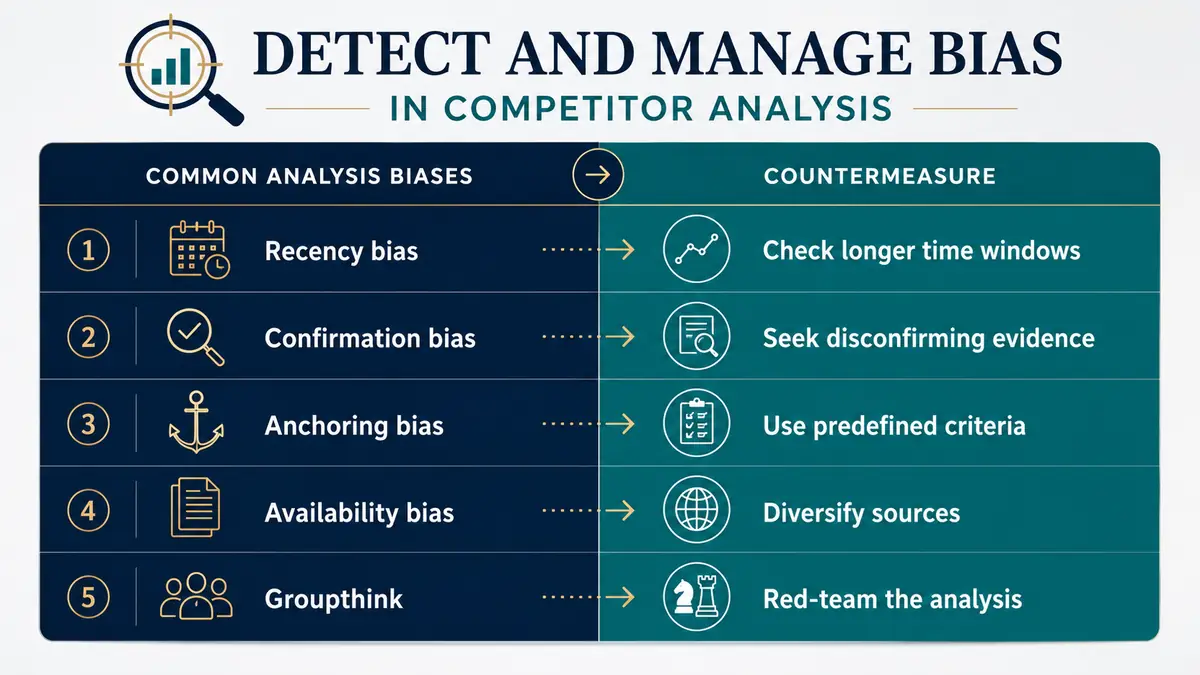
A visual reminder: segmentation still needs bias control
The existing protected figure below remains part of the source image system. Its bias-control message is supporting context: even a well-scoped competitor view can be distorted by familiarity, availability, confirmation or category assumptions. The image itself is preserved without reinterpretation or replacement.
Quick tool
Competitor View Check
Use this bounded check for one candidate and one already-defined view. It does not replace the workbook, role-classification method or evidence register.
Use the workbook for operating records and the PDF for handoff
Use the workbook when you need stable identities, view definitions, evidence records, scoped assignments, worked examples and canonical fixtures.
Use the PDF when you need the method, field checklist and decision boundaries in a portable review format.
The quick tool answers one bounded assignment question. The workbook is the operating record. The PDF is the portable handoff. They are complementary rather than duplicate products.
Competitor segmentation questions
Should every team use the same competitor list?
They should share the same competitor identities and evidence where appropriate, but not necessarily the same relevance view. SEO, product, sales, procurement and renewal teams can have different valid sets when their decision scope and evidence differ.
What is the minimum viable competitor view?
State the decision, product or offer, buyer need, market/serviceability when material, decision stage, analytical purpose and effective period. Add another dimension only if it changes inclusion, role, evidence or permitted use.
Can the same company have different competitor roles?
Yes. Role is scoped. A company can be direct for one product, a substitute for another, reference-only during discovery, and absent from a procurement view. Use the dedicated competitor-role method for the classification itself.
Should SEO and sales use the same competitors?
Not automatically. Organic or AI visibility can justify a search/discovery view. Sales evaluation, shortlist and procurement views need buyer or deal evidence appropriate to those stages.
How do you avoid too many competitor lists?
Do not create lists for theoretical combinations. Create a view only when a recurring decision needs a materially different competitor assignment. Reuse stable identity and evidence records instead of copying companies.
What should happen when evidence is contradictory or stale?
Use resolve evidence, preserve the current observations, collect the next decision-changing evidence and reopen the assignment. Do not force a role or relevance conclusion simply to fill a matrix cell.
How should renewal competitors be tracked?
Use a renewal or switching view because post-purchase alternatives can differ from acquisition competitors. Include manual workarounds, migration options or substitutes when actual renewal/churn evidence supports them.
When should an assignment be updated?
Reopen it when the product, buyer need, serviceability, decision stage, role evidence or underlying evidence changes enough to alter the permitted use. Supersede the old assignment rather than silently erasing history.
What if different buyers are working on different stages at the same time?
Treat the stage as a decision state or buying job, not a rigid sequence. Keep one view when the competitor set, evidence requirement and permitted use remain the same. Split the view only when a buyer role, buying group or concurrent job materially changes those boundaries.
Should I backfill old competitor-stage data from memory?
No. If historical competitor-stage evidence cannot be reconstructed reliably, keep that period unresolved and begin prospective capture from a known date. Do not manufacture stage history to make a register look complete.
Research and method context
- Semrush - distinct organic, paid, AI, backlink and traffic competitor views
- Ahrefs - organic competitors based on shared search visibility
- Salesforce Trailhead - competitor evidence by opportunity stage and win/loss
- Salesforce Trailhead - deployment discipline when historical competitor data is incomplete
- Gartner - non-linear B2B buying jobs and journey complexity
- Forrester - buying groups and multi-person B2B decisions
- Productboard - customer-need segmentation for product decisions
- Intercom - product and marketing scope around jobs-to-be-done
- Similarweb - multi-dimensional competitive analysis across customer, product and marketing
- Klue - public and experienced/internal competitive intelligence
These sources support the component distinctions used here. The stable-identity/scoped-assignment state machine is a SERPIFAI methodological synthesis for this task, not an external industry standard.