

Rerun the Competitor Fit Challenge only when a named material condition has changed and that change could alter the competitor treatment, evidence readiness or next action. Time passing by itself is not a trigger. Dissatisfaction with the previous result is not a trigger. A rerun should test changed reality, not search for a preferred score.
If you are asking “when should we refresh or rerun competitive analysis?”, separate two jobs: monitor continuously; rerun selectively. Monitoring detects changes. A governed rerun asks whether a detected change is verified, material and capable of changing the treatment, evidence ceiling or next action.
Current competitive-intelligence guidance increasingly favors continuously updated competitor profiles, while also warning that an up-to-date profile is not automatically strategically useful. Valona's July 2026 competitor-profile guidance emphasizes the need to judge whether a development is significant. A72 governs that narrower decision: a monitoring signal may deserve attention without authorizing a full CFC rerun.
A rerun is a controlled reassessment of an existing result. It keeps the old result visible, limits new work to the changed conditions, and records whether the decision treatment actually moved.
Five changes can justify reopening the result
The trigger must be decision-relevant. A change matters when it could alter a protected relationship lens, a critical gate, the evidence ceiling or the action the result is allowed to support.
| Material trigger | What changed | Why a rerun may be justified |
|---|---|---|
| Decision boundary | Buyer, offer, geography, market or decision purpose changed. | You may no longer be evaluating the same competitive relationship. |
| Candidate behaviour | The company launched, removed or materially changed an offer, fulfilment model, pricing structure or service area. | Offer overlap, geographic relevance or buyer substitution may have changed. |
| Material evidence | New buyer, sales, customer, public-web or independent evidence resolves or contradicts a material claim. | A lens answer or critical gate may now deserve different treatment. |
| Evidence freshness | A source that the decision depends on is now too stale for the current decision window, or a fresher source materially changes it. | Evidence Readiness can fall or rise without the relationship itself changing. |
| Decision stakes | A screening result is about to support a more consequential commitment. | The relationship may be unchanged, but the evidence standard required for action may be higher. |
Rerun on changed reality, not elapsed time.
What does not justify another pass
- A calendar reminder with no decision-relevant change.
- A ranking fluctuation that does not change the candidate’s commercial role.
- A stakeholder disliking the previous classification or score.
- Collecting more pages that repeat the same evidence role without resolving a blocker.
- A cosmetic website change with no buyer, offer, market, comparison or decision consequence.
- Changing an answer because a reviewer feels more certain while the underlying evidence is unchanged.
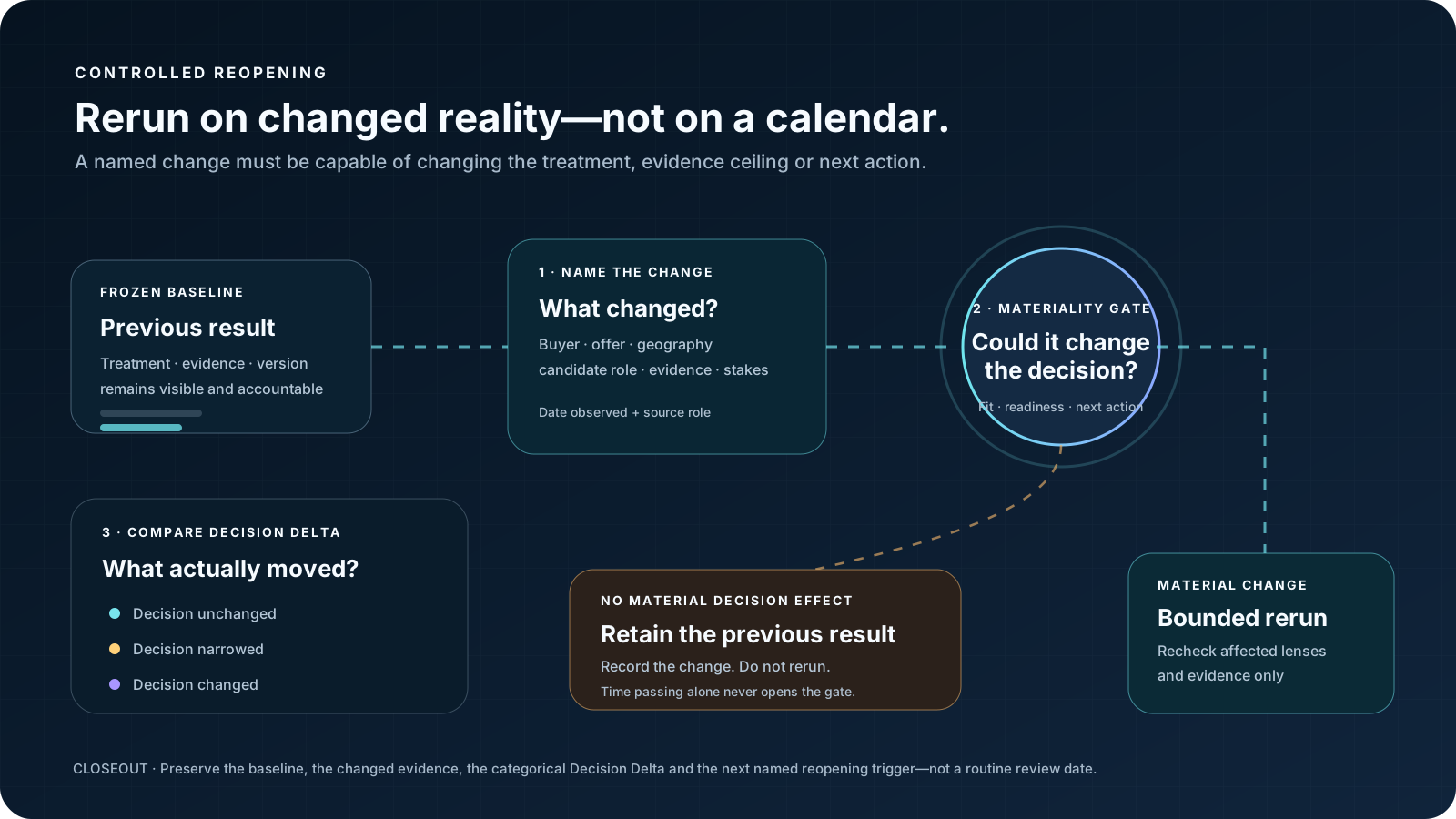
Apply the materiality gate before reopening anything
A valid trigger is not enough by itself. Ask whether the change could matter to the current decision.
| Gate | Question | If no | If yes |
|---|---|---|---|
| 1 · Named change | Can you state exactly what changed and when? | Do not rerun. | Continue. |
| 2 · Affected relationship | Could it alter Buyer overlap, Offer overlap, Commercial-demand overlap, Geographic relevance, Customer-comparison likelihood or Decision relevance? | Check readiness/stakes instead. | Scope the affected lens. |
| 3 · Evidence ceiling | Could it resolve, weaken or invalidate evidence required for the current use? | Do not expand evidence work. | Scope the affected evidence role. |
| 4 · Decision effect | Could it change classification, permitted use or next action? | Record the change but retain the prior treatment. | Authorize a bounded rerun. |
This materiality test prevents minor changes from reopening the entire model and also prevents a meaningful evidence change from being dismissed merely because the headline fit number barely moves.
Fast Action: decide whether to retain, verify, rerun or reopen
Use this local rerun-authority router before reopening a result. It never recalculates CFC points, does not approve a commercial decision, and begins at AWAITING INPUT. The router first protects the frozen baseline, then tests whether the change is real, material and still comparable to the prior run.
Relationship fit and Evidence Readiness can change separately
The current Competitor Fit Challenge keeps relationship fit and evidence readiness separate. That distinction matters during a rerun.
A new offer or service area changes a relationship lens, while the underlying evidence remains strong enough for the same decision use.
First-party buyer evidence resolves an Unknown or contradiction without changing the underlying relationship treatment.
A critical source becomes stale or is contradicted, so the same provisional fit can support less consequential use.
A rerun can be necessary even when the score barely changes. If material evidence changes the permitted use, the decision state changed.
If a material blocker remains unresolved after the new evidence is reviewed, keep MORE EVIDENCE REQUIRED. The rerun does not earn a stronger conclusion merely because another pass occurred.
Run the controlled recheck in seven steps
| Step | Control | Required output |
|---|---|---|
| 1 | Freeze baseline — preserve the previous answers, treatment, evidence record and date. | Versioned baseline. |
| 2 | Name trigger — state the changed condition and evidence date. | Rerun authority record. |
| 3 | Map impact — identify affected lens, gate, evidence role or decision-use boundary. | Bounded rerun scope. |
| 4 | Collect selectively — gather the smallest credible evidence capable of resolving the changed condition. | Focused update record. |
| 5 | Re-answer only affected items — do not rewrite unchanged evidence to make the new result look coherent. | Revised lens/evidence state. |
| 6 | Compare treatment — check classification, Evidence Readiness and next action against the baseline. | Decision Delta. |
| 7 | Close or reopen — record the current treatment and the next named trigger, not a routine date. | Portable handoff. |
Never overwrite v1 with v2. Preserve the prior result, its scope, evidence date and permitted use. The rerun must be traceable as a new version derived from the frozen baseline.
If the CFC methodology version changed, preserve the old-method result and treat the new assessment as a versioned method rebase. Do not attribute output differences to changed competitive reality until the method change itself is verified and recorded.
Use Decision Delta to compare the result categorically
Decision Delta is a sensitivity check, not a score-difference contest. The useful question is: did the changed condition alter how the candidate may be treated?
The new fact is real but not material enough to alter role, permitted use or next action. Keep the current treatment and record the change.
Evidence weakened or scope changed, so the candidate can support a less consequential use or remains MORE EVIDENCE REQUIRED.
A material lens, gate or evidence state moved enough to change classification or the next action.
Do not describe a rerun as meaningful merely because the provisional score moved by a few points. Preserve the named transition and the evidence that caused it.
Worked example: candidate launches direct fulfilment
This fictional record demonstrates the control. It is not a reported client result.
| Field | Baseline | Controlled rerun |
|---|---|---|
| Assessment ID | CFC-2026-014 v1 | CFC-2026-014 v2 |
| Recorded at | 3 July 2026 | 5 July 2026 |
| Candidate role | Marketplace intermediary | Hybrid marketplace + direct competitor for one service tier |
| Named trigger | None; baseline frozen | Candidate launched and directly fulfils its own service tier |
| Affected lenses | Offer overlap and Decision relevance limited | Offer overlap and Decision relevance require re-answering |
| Evidence action | No additional collection | Verify direct fulfilment, service scope and buyer-facing offer |
| Decision Delta | Exclude from direct product comparison | Include the first-party tier in product/pricing comparison |
| Next reopening condition | Material offer, buyer or fulfilment change | Material offer, buyer, fulfilment or decisive evidence change |
The passage of two days is not why the rerun was allowed. The direct-fulfilment launch is the trigger. If that launch had not occurred, the baseline would remain the accountable result.
Guided and Analyst modes should tell the same reopening story
Guided mode should lead with the named trigger, the affected treatment and the next evidence task. A first-time user should not need to compare score decimals to understand why the result was reopened.
Analyst mode can expose changed lens answers, answer coverage, critical gates, source records and Decision Delta detail. The extra mechanics explain the update; they do not create authority for a rerun that lacks a material trigger.
Portable handoff: what every rerun record should preserve
Previous result, scope, version and evidence state.
The named material change, date observed and evidence supporting it.
Affected lens, gate, evidence role or decision-use boundary.
Unchanged, narrowed or changed treatment—and why.
Decision-usable at the stated boundary or MORE EVIDENCE REQUIRED.
The condition that would justify another review. Do not substitute a routine calendar date.
The browser handoff adds the exact rerun-authority state and next control. It creates no handoff while inputs are incomplete.
Six ways reruns become score shopping
| Failure | Why it fails | Better move |
|---|---|---|
| Calendar rerun | Time passed but nothing material changed. | Use a named trigger. |
| History overwrite | The new result replaces the baseline, hiding what changed. | Version both states. |
| Whole-model refresh | One small change causes every answer to be reconsidered. | Limit work to affected lenses/evidence. |
| Score shopping | The Challenge is repeated until the number looks better. | Freeze the baseline and compare treatment. |
| Evidence-volume inflation | More repetitive sources are mistaken for stronger readiness. | Collect evidence that resolves the blocker. |
| Fake precision | A small numerical movement is presented as a material strategic shift. | Report the categorical Decision Delta. |
Questions before approving another pass
Should we rerun the Challenge every quarter?
No. A quarterly date is not evidence that the relationship changed. Reopen only when a named material condition or evidence boundary changes enough that the decision could move.
Does stale evidence automatically require a full rerun?
No. First identify whether the stale source is material to the current treatment. Refresh the affected evidence role and reopen only the lenses or gates that depend on it.
What if new evidence improves readiness but not fit?
Record the readiness change. A stable relationship treatment can become more decision-usable when a material Unknown or contradiction is resolved.
What if the score changes but the decision does not?
Record Decision Delta as unchanged. A score movement is not automatically a strategic change.
Can team disagreement trigger a rerun?
Only if the disagreement exposes a material scope difference or new evidence. Disagreement alone should first be resolved through the Team Disagreement guide rather than averaged into a new run.
What should replace a scheduled review date?
A named reopening condition: for example, a material buyer, offer, fulfilment, geography or decisive evidence change. A calendar reminder can prompt a check for triggers, but it should not authorize the rerun by itself.
Use the trigger to choose the next guide
Method and evidence boundaries
- SERPIFAI — Competitor Fit Challenge methodology
- SERPIFAI — How to Read the Six Competitor Fit Lenses
- SERPIFAI — Separate Fit From Evidence Readiness
- SERPIFAI — What an Uncertain Competitor Fit Result Means
- W3C — PROV overview for provenance, versioning and derivation
- HM Treasury — The Green Book 2026 on uncertainty and sensitivity analysis
- Valona Intelligence — 5 Questions Every Competitor Profile Should Help Answer (31 July 2026)
SERPIFAI's CFC method controls rerun logic. W3C PROV supplies general provenance/versioning context; the Green Book 2026 supplies general sensitivity/uncertainty context; Valona supplies current CI-market context for continuous competitor monitoring and the need to judge signal significance. None of these external sources validates SERPIFAI's proprietary rerun states, weights, classifications or Evidence Readiness.
Before rerunning anything, write one sentence: “The result is being reopened because ___ changed, and that could change ___.” If you cannot complete both blanks with a material condition and decision effect, retain the baseline.