
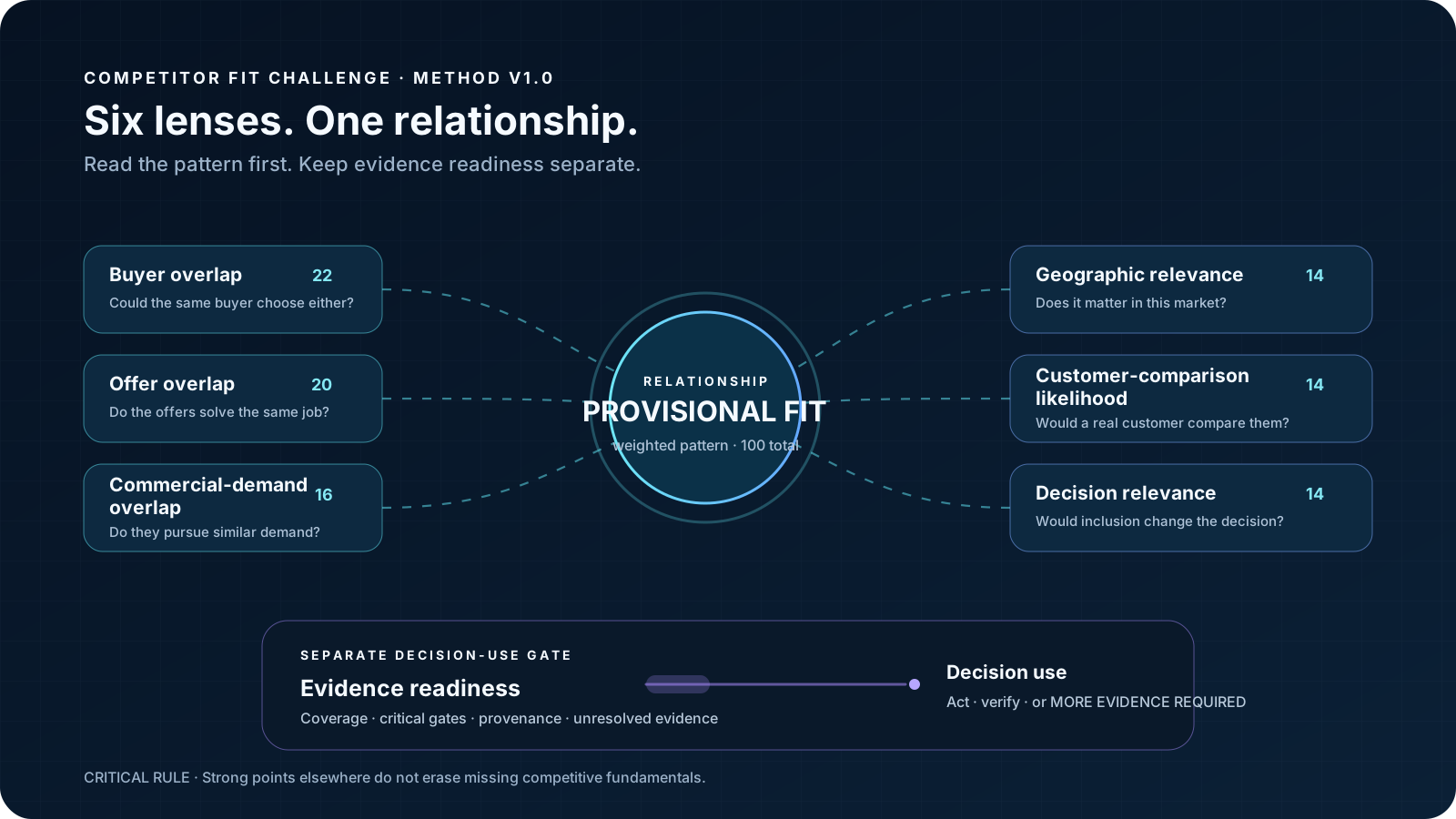
The six Competitor Fit Challenge lenses describe one thing: how competitor-like the relationship is. Buyer overlap, offer overlap, commercial-demand overlap, geographic relevance, customer-comparison likelihood and decision relevance contribute to provisional fit. Evidence readiness is checked separately and limits how far you can act on that result.
What each of the six competitor-fit lenses measures
The Methodology 1.1 uses six fixed weighted lenses that sum to 100 points. The weights are part of the method contract; they are not sliders to tune for a preferred answer.
| Lens | Weight | Beginner question | What strong support means |
|---|---|---|---|
| Buyer overlap | 22 | Could the same buyer realistically choose either company? | The candidate competes for materially similar buyers or buying situations. |
| Offer overlap | 20 | Does the candidate solve the same job with a substitutable offer? | A buyer could plausibly compare the offers as alternatives, not merely related resources. |
| Commercial-demand overlap | 16 | Do the companies pursue materially similar commercial demand? | The candidate competes around overlapping needs, categories or demand that can affect the same opportunity. |
| Geographic relevance | 14 | Does the candidate matter in the market you are actually deciding about? | The competitor relationship exists inside the defined geographic or operating scope. |
| Customer-comparison likelihood | 14 | Would a real customer put these companies in the same consideration set? | There is a credible path to comparison, switching or substitution. |
| Decision relevance | 14 | Would including this company materially change the decision? | The candidate deserves attention for the specific strategic question, not just because it is visible. |
Methodology 1.1 treats 22 / 20 / 16 / 14 / 14 / 14 as deterministic contribution shares in a 100-point provisional Relationship Fit calculation. They are versioned method parameters, not probabilities, effect sizes or empirically calibrated estimates of how likely a company is to be a competitor.
The accepted public method record does not cite a calibration study that proves why Buyer is exactly 22 rather than 20 or 25. What the published contract does establish is the arithmetic influence: Buyer and Offer contribute the most, Commercial Demand follows, and Geography, Customer Comparison and Decision Relevance contribute 14 each. Critical gates remain non-compensating, so a lower-weight lens can still block a stronger treatment. Changing the weights would create a new method version and require revalidation.
Method boundary: these are the protected public weights for Methodology 1.1. Do not add a seventh “confidence” lens or manually reweight the six dimensions inside this guide.
Read the lens pattern before the total
A weighted total is useful for consistency, but it compresses six different questions. The pattern tells you why a candidate looks competitor-like and which condition could reverse the interpretation.
Direct substitution becomes more plausible. Verify comparison behavior and market scope before treating the candidate as direct.
The domain may be a publisher, intermediary, marketplace, directory or reference source rather than a commercial substitute.
The relationship may be plausible, but the result must travel with an evidence ceiling and a named verification task.
The total tells you “how much support.” The lens pattern tells you “what kind of relationship.”
How this differs from two common competitor-analysis patterns
Two current examples help show A71's information gain without turning market examples into method authority.
| Approach | Primary question | What A71 adds |
|---|---|---|
| Weighted competitor matrix | How do rivals score across criteria the analyst chose and weighted? | CFC fixes the six relationship lenses and method version, then requires the pattern and critical gates to be read before the aggregate. |
| Direct / indirect competitor classification | Is this a similar offer to the same customer, or a different solution competing for the same need? | CFC separates buyer, offer, demand, geography, actual customer comparison and decision relevance instead of collapsing the relationship into one label. |
| CFC Methodology 1.1 | Does the six-lens relationship pattern support a governed competitor treatment for this bounded decision? | Fixed contribution shares, non-compensating gates, Unknown preservation and separate Evidence Readiness keep the score from becoming the verdict. |
Current-market illustrations: Outmano's 2026 matrix builder lets users choose criterion weights and score rivals into weighted totals; Shopify's 2025 direct-vs-indirect guide distinguishes similar offers to the same customer from different solutions competing for the same need. These sources illustrate current practice; they do not validate the CFC weights or method.
Fast Action: read a six-lens pattern without recalculating the score
Use this local teaching reader to see what a qualitative six-lens pattern suggests before you look at a total. The dropdown states are teaching states, not protected CFC answer tokens. The tool never calculates points, changes the fixed weights or produces a final competitor classification.
Keep evidence readiness separate from relationship fit
The current Challenge deliberately refuses to hide evidence quality inside the fit score. A candidate can have strong provisional fit while the evidence needed for a consequential decision is still incomplete.
| Output | What it answers | Do not confuse it with |
|---|---|---|
| Provisional fit | How much supported relationship fit exists across the six weighted lenses? | A confidence percentage or permission to act. |
| Answer coverage | How much of the required lens evidence is answered rather than Unknown? | Positive fit support. |
| Critical-gate status | Do essential competitive conditions support the stronger treatment? | An average that can be compensated by unrelated strengths. |
| Verification need | What missing or contradictory evidence could change decision use? | A generic request for “more research.” |
If evidence readiness is too low for the intended use, the correct state is MORE EVIDENCE REQUIRED—not a confidence multiplier applied to the fit score.
Why some weak lenses cannot be averaged away
The method uses non-compensating gates because commercial competition depends on fundamentals. High support elsewhere cannot manufacture a direct competitive relationship when the underlying buyer, substitution or customer-comparison conditions are missing.
- Buyer reality: confirm that the same or materially similar buyer is in scope.
- Substitution reality: confirm that the offers can credibly compete for the same job or outcome.
- Comparison reality: confirm that customers could plausibly compare, switch between or choose one over the other.
Worked example: visible does not mean substitutable
Suppose a specialist software company and a major industry publisher appear repeatedly for the same research queries. Search visibility alone can make the publisher look like an obvious competitor. The six-lens pattern prevents that shortcut.
| Lens | Observed condition | Interpretation |
|---|---|---|
| Buyer overlap | Some support | Both attract the same professional audience, but not necessarily the same buyer. |
| Offer overlap | Little support | One sells software; the other primarily provides information and media. |
| Commercial-demand overlap | Some support | They can compete for attention around related demand without being purchase substitutes. |
| Geographic relevance | Strong support | Both matter in the target market. |
| Customer-comparison likelihood | Unknown | No direct buyer evidence yet shows they enter the same consideration set. |
| Decision relevance | Strong support | The publisher still matters for visibility, messaging and information competition. |
The useful result is not “high” or “low” from a teaching total. It is a role hypothesis: reference or information competitor, not yet proven direct substitute. The next evidence task is to test real customer-comparison behavior.
Unknown is unresolved—not neutral
Unknown contributes no positive support toward provisional fit, but it must remain visible as unresolved. Converting Unknown into a midpoint makes missing evidence look like measured neutrality and creates false precision.
The evidence has not established the lens. This is the state for “we have not checked enough” or “we cannot yet tell.” It remains unresolved and contributes no positive fit support.
Reviewed evidence supports absence of overlap for the defined scope. This is a negative finding, not an absence-of-research label. If you simply have not established the answer, use UNKNOWN instead.
Sources disagree; preserve the contradiction and identify what would resolve it.
Guided mode explains the treatment; Analyst mode exposes the mechanics
The two modes use the same protected method. They differ in presentation, not authority.
| Mode | Lead with | Use it for |
|---|---|---|
| Guided | Qualitative treatment, strongest reason, evidence ceiling and next verification task. | Understanding what the result means before interpreting the exact score. |
| Analyst | Weighted score, lens-level answers, coverage, gates, source records and sensitivity. | Inspecting how the result was produced and challenging the evidence. |
Analyst mode exposes more detail; it does not grant the result more authority.
Five common ways to misread the six lenses
| Failure | Why it fails | Better move |
|---|---|---|
| Reading only the total | Contradictory lens patterns disappear inside one number. | Read buyer, offer and comparison conditions first. |
| Treating search visibility as competition | Visibility can indicate a publisher, marketplace or reference role. | Test buyer and substitution reality. |
| Turning Unknown into a midpoint | Missing evidence becomes fake neutrality. | Leave it unresolved and name the next evidence task. |
| Adding “confidence” as a seventh lens | It mixes relationship fit with evidence readiness. | Keep readiness as a separate gate on decision use. |
| Manually changing weights | Results stop being comparable to the published method. | Use the protected method or explicitly create a new method version. |
Turn the weak or unresolved lens into the next evidence task
Do not respond to uncertainty with an open-ended research project. Follow the lens that can actually change the treatment.
Check target-account definitions, sales qualification, CRM, customer language or buyer interviews.
Compare product scope, pricing, fulfilment and the job the buyer is hiring the offer to do.
Look for switching, alternatives, win/loss, shortlist or sales-call evidence.
Collect the smallest piece of evidence capable of changing the lens that currently limits the decision.
The pattern reader can surface a likely interpretation risk, but the governed CFC result remains the authority for scoring, gates and final treatment. Use the reader to decide what to inspect next, not to replace the Challenge.
Questions people ask about the six competitor-fit lenses
Are all six lenses equally important?
No. Methodology 1.1 uses fixed published weights: buyer overlap 22, offer overlap 20, commercial-demand overlap 16, and 14 each for geographic relevance, customer-comparison likelihood and decision relevance.
Is evidence confidence one of the six scoring dimensions?
No. Evidence readiness is separate from relationship fit. It determines how far the result can legitimately travel, not how many fit points a candidate receives.
What should I do when one lens is Unknown?
Leave it unresolved. Unknown is not neutral and is not evidence of absence. Identify the smallest evidence task that could resolve that lens.
Can a candidate with a high provisional score still require more evidence?
Yes. Strong provisional fit and incomplete evidence readiness can coexist. The result should carry an evidence ceiling and may remain in MORE EVIDENCE REQUIRED.
Should I change the weights for my industry?
Not inside this method. Changing weights changes the method contract and comparability. If a different model is required, version it explicitly rather than silently altering the published CFC calculation.
Use the next guide for the lens that remains unresolved
Method and evidence boundaries
This guide explains the published SERPIFAI Competitor Fit Challenge method. The current methodology page is the controlling public description of the six weights, controlled answer values, critical gates and separation between fit and evidence readiness.
- SERPIFAI — Competitor Fit Challenge methodology
- HM Treasury — 2024 Multi-Criteria Decision Analysis guidance
- UK Government — The AQuA Book on robust analysis
- HM Treasury — The Green Book 2026
- Outmano — 2026 Competitive Matrix Builder (current-market illustration)
- Shopify — Direct vs. Indirect Competitors (current-market illustration)
Method authority and market illustration are separate. SERPIFAI Methodology 1.1 controls the six fixed weights and gates. HM Treasury / AQuA / Green Book sources support transparent analytical criteria and assurance but do not validate SERPIFAI's proprietary weights. Shopify and Outmano illustrate two current competitor-analysis patterns only; they are not methodological validation.
Run one candidate through the Challenge, then inspect the lens that limits the treatment. If that lens is unresolved, collect the smallest decision-changing evidence before expanding the competitor set.