Treatment before number
Lead with the qualitative competitor treatment, the strongest reason, the evidence ceiling and the next verification task. The user should not have to interpret a 0–100 number before understanding what the result means.

Competitor Fit Challenge · Methodology Beta
Competitor Fit Challenge calculates Relationship Fit from six weighted lenses totaling 100. The score cannot overrule Answer Coverage, critical gates or Evidence Readiness. Unknown stays unresolved; when missing evidence could change decision use, the correct next state can be MORE EVIDENCE REQUIRED.
Relationship Fit = Σ(weight × controlled answer value) across six lenses totaling 100 points. The current CFC runtime uses Framework Fit as its tool-facing label for this same deterministic six-lens score; it is not probability, confidence or a separate calculation. Stronger classification still requires enough answer coverage and the critical competitive relationships to be supported.
Gate principle: high points elsewhere do not erase missing competitive fundamentals. See the six-lens scoring guide for the lens-by-lens interpretation.
Presentation can become simpler without changing the six-lens logic underneath it. Guided mode protects first-time comprehension; Analyst mode exposes the numerical and evidence detail needed for review.
Lead with the qualitative competitor treatment, the strongest reason, the evidence ceiling and the next verification task. The user should not have to interpret a 0–100 number before understanding what the result means.
Expose the weighted score, lens-level answers, answer coverage, critical gates, source records and sensitivity details. The extra detail explains the result; it does not grant additional authority.
These values are deterministic inputs to provisional Relationship Fit; they are not confidence percentages, probabilities or Evidence Readiness scores.
| Answer | Calculation value |
|---|---|
| Strong evidence | 1.00 |
| Some evidence | 0.67 |
| Little evidence | 0.33 |
| No evidence | 0.00 |
| Unknown | 0.00 toward provisional fit; retained as unresolved in the explanation |
A score input and an evidence state answer different questions. Every consequential claim should remain attributable as participant-supplied, observed, inferred or unresolved so the result does not manufacture certainty.
| Evidence state | What it means | Decision boundary |
|---|---|---|
| Participant-supplied | A user or stakeholder supplied the claim or answer. | Useful input, but not independent verification. |
| Observed | A bounded fact was directly found in attributable public or first-party evidence. | Supports only the proposition actually observed. |
| Inferred | A bounded interpretation was derived from supplied or observed evidence. | Must remain labelled as inference; it cannot be promoted to observation. |
| Unresolved | Evidence is missing, contradictory or insufficient for the relationship being tested. | May constrain classification and can require MORE EVIDENCE REQUIRED. |
The method intentionally refuses to compress everything into one confidence number.
The provisional weighted arithmetic result from the six answered lenses.
The share of the required evidence that has been answered rather than left Unknown.
Whether buyer overlap, realistic substitution and customer-comparison/decision relevance support stronger classification.
The specific missing or contradictory evidence most capable of changing permitted decision use.
Relationship Fit answers how closely the candidate matches the competitive relationship. Evidence Readiness answers how far that conclusion can safely travel. Critical gates and unresolved evidence can limit use even when the weighted score is high.
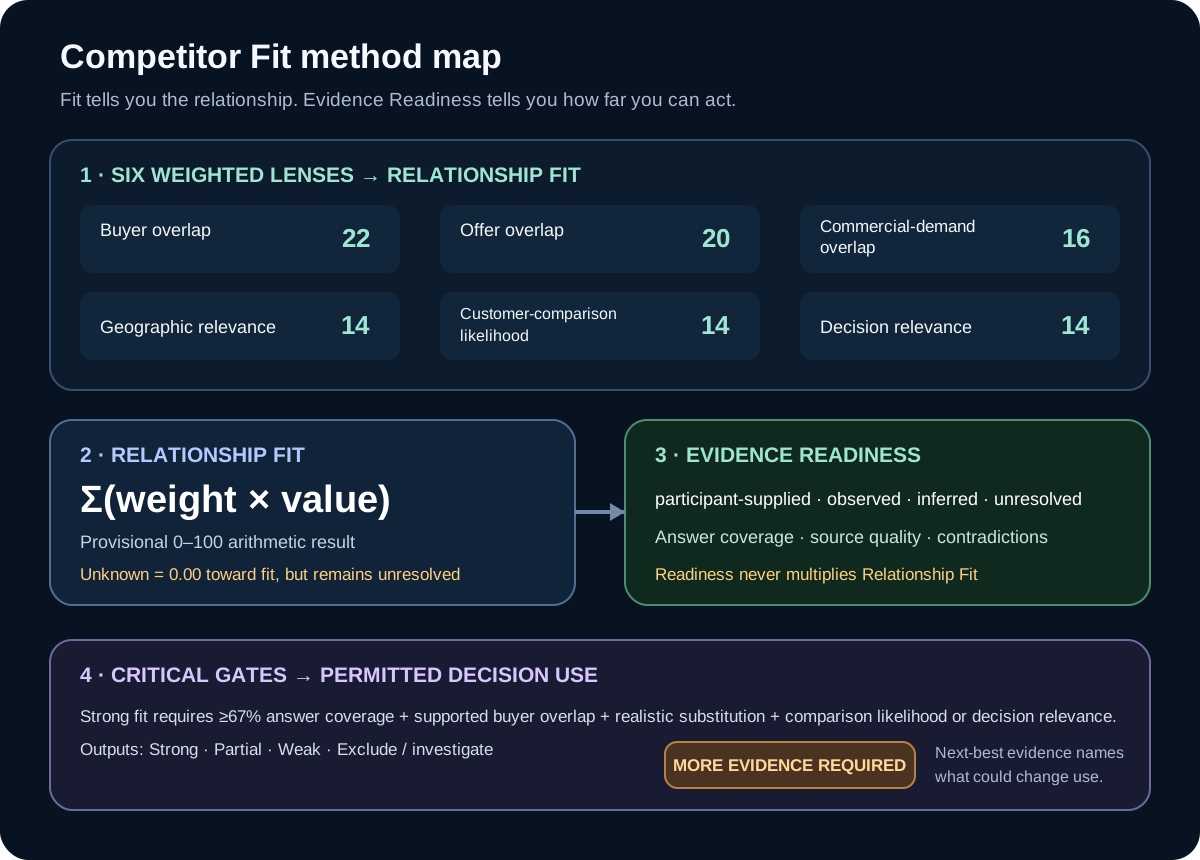
Fit tells you the relationship. Evidence Readiness tells you how far you can act. A candidate can look commercially plausible while the evidence needed for a consequential decision is still incomplete. Readiness therefore never multiplies or “adjusts” the fit score. See the Evidence Readiness guide for the decision-use boundary.
Up to five useful pages can cover offer, buyer, market, comparison and context roles. This reduces shallow “homepage-only” research but remains public-web evidence.
Customer comparisons, sales calls, CRM, win/loss and account evidence can resolve questions that a competitor website cannot answer about actual buyer behavior.
For consequential use, an accountable reviewer may need to validate the evidence, scope and permitted conclusion independently.
The discovery layer seeks complementary evidence roles. Repeated pages that tell the same story do not automatically improve readiness.
| Page role | What it can support | What it cannot prove alone |
|---|---|---|
| Offer | Displayed product/service scope, package, fulfilment | Actual buyer substitution or win rate |
| Buyer | Stated target segments, use cases, problem framing | Who actually buys or compares in live deals |
| Market | Published geography, service area, jurisdiction | Actual availability in every observed case |
| Comparison | Named alternatives, replacement language, differentiators | Independent buyer preference |
| Context | Documentation, cases and role clarification | Commercial rivalry by itself |
The free scan can collect bounded first-party public observations and, when an exact entity match is available, separate structured external context. Those sources can strengthen evidence integrity without changing the six dimensions, weights, answer values or critical gates.
Product, buyer, market, pricing, comparison and other public-site observations are preserved with source URLs, retrieval time and source role. Repetition across a company’s own pages can deepen the evidence but does not make it independent.
An independent structured source may corroborate a bounded entity or industry/category proposition after exact domain identity matching. It cannot by itself prove buyer substitution, demand overlap, serviceability, shortlist behaviour or decision impact. If the external adapter is unavailable or has no exact match, the field remains unresolved.
A strong numerical fit is not sufficient. The current public method requires at least 67% answer coverage plus supported buyer overlap, realistic substitution and customer-comparison likelihood or decision relevance.
A candidate cannot become a strong business competitor merely by scoring well on geography and topic similarity if the evidence does not support a shared buyer or realistic substitution.
When a critical relationship is unresolved, the appropriate output is a limited or provisional classification plus a verification action—not a more precise-looking decimal. If the unresolved relationship could change permitted use, the result should explicitly remain MORE EVIDENCE REQUIRED. See the uncertain-result guide.
The useful question is not “how many score points disappear?” It is “does weakening this evidence change how the candidate may be treated?”
A candidate whose permitted use changes when one critical evidence state weakens is decision-sensitive even when its overall numerical fit still looks high. Reopen or rerun only when a named material condition changes; elapsed time alone is not a trigger. See the rerun guide.
This example demonstrates the calculation, not an authoritative competitor verdict.
High supported relevance with sufficient coverage and critical gates satisfied.
Meaningful overlap exists, but the evidence or competitive relationship is incomplete.
Some similarity exists without enough supported competitive relevance.
Evidence points outside the set or remains too unresolved for safe inclusion.
High similarity in commercial market role.
Meaningful shared audience but incomplete substitution.
Adjacent category or offer with bounded overlap.
Visible in search or AI discovery without enough evidence of buyer substitution or business rivalry.
Plausible candidate whose material evidence remains unresolved.
The current public contract is Version 1.0. A new version should be created when decision logic changes materially—not for ordinary copy, accessibility or layout maintenance.
| Change | Governance treatment |
|---|---|
| Copy, spelling, metadata or accessibility repair | Page maintenance; no method-version claim needed unless the change alters decision meaning. |
| Clarifying an existing rule without changing its effect | Document the clarification; review whether a version increment is necessary. |
| Changing a dimension, weight, answer value, coverage threshold or critical gate | Material methodology change; create a new method identity and retest fixtures/parity. |
| Changing archetype meaning or classification logic | Material methodology change; document migration and decision impact. |
The method structures evidence supplied to it. It cannot independently observe private customer behaviour, pipeline or commercial substitution.
Fit does not estimate the magnitude of commercial threat, market share or future performance.
A fit classification may inform later analysis; it does not approve spend or competitor-response action.
A named material change in buyer, offer, geography, substitution, comparison evidence or evidence quality can justify a rerun. Passage of time alone does not.
These are the shortest safe answers to the questions most likely to be extracted out of context.
Relationship Fit is the sum of six weighted lens values: Buyer overlap 22, Offer overlap 20, Commercial-demand overlap 16, Geographic relevance 14, Customer-comparison likelihood 14 and Decision relevance 14. Strong fit additionally requires at least 67% answer coverage and the critical competitive relationships to be supported.
No. Unknown contributes 0.00 toward provisional Relationship Fit but remains unresolved. It is not evidence of absence and cannot be used as a hidden negative.
No. Search or AI visibility can identify candidates, but business rivalry still requires evidence of commercial relevance such as shared buyers, realistic substitution, customer comparison or decision impact.
Rerun only when a named material condition changes—such as buyer, offer, geography, substitution evidence, comparison evidence or evidence quality. Do not rerun merely because time passed.
External sources benchmark evidence and competitor-analysis practice. The six-dimension weighting, coverage rule, classifications and archetypes are SERPIFAI methodology and are not supplied or certified by those sources.
Start with evidence you can defend. Choose Unknown rather than inventing precision.
The result should preserve Answer → Proof → Next: Relationship Fit, Evidence Readiness, critical gates and the next-best-evidence task remain separate rather than collapsing into one confidence number.