

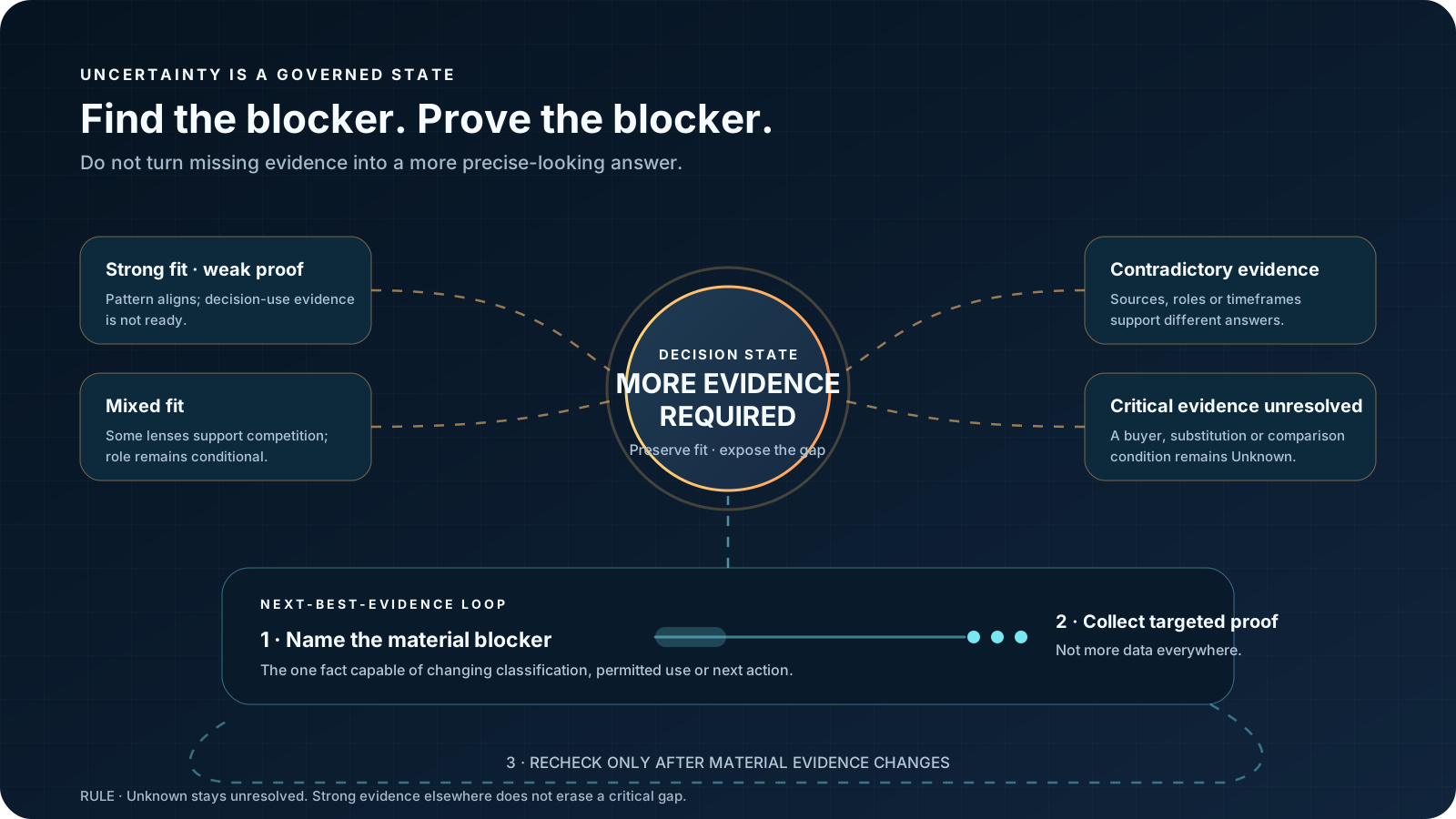
An uncertain competitor-fit result means the evidence cannot yet support a stable decision. It is not a failed score and it is not permission to average missing knowledge into a tidy midpoint. In the current Competitor Fit Challenge, the correct state is often MORE EVIDENCE REQUIRED: preserve the provisional relationship, expose the material gap and collect the smallest proof capable of changing what you are allowed to conclude.
Four different patterns can produce an uncertain result
“Uncertain” is a decision state, not a single cause. The first job is to identify which kind of evidence problem is blocking the result.
| Pattern | What you know | What remains unresolved | Correct treatment |
|---|---|---|---|
| Strong fit, weak proof | Buyer, offer or comparison signals point in the same direction. | Coverage, provenance or a critical gate is not strong enough for consequential use. | Keep the provisional fit, lower the permitted use and name the next evidence task. |
| Mixed fit, incomplete proof | Some lenses support competition while others do not. | The candidate’s role may be direct, indirect, substitute, reference or mixed. | Preserve the role hypothesis; verify the lens capable of changing classification. |
| Contradictory evidence | Sources or stakeholders support different answers. | Which source role, timeframe or market scope should control. | Keep the contradiction visible and resolve it with a discriminating test. |
| Critical evidence unresolved | Other dimensions may look strong. | A buyer, substitution, comparison or other critical relationship remains Unknown. | Do not let strengths elsewhere compensate for the missing competitive fundamental. |
Uncertainty is a map of the missing decision—not a request for more data everywhere.
Relationship fit and evidence readiness answer different questions
A candidate may look strongly competitor-like while the evidence is still too weak to support an expensive or irreversible decision. The current Challenge keeps those outputs separate on purpose.
| Output | Question | When it can be strong | What it cannot prove |
|---|---|---|---|
| Provisional relationship fit | How competitor-like does the supported relationship look? | Several fit lenses align and critical fundamentals have support. | That the evidence is complete, independent or safe for every decision. |
| Evidence readiness | How far can the result legitimately travel? | Coverage is sufficient, critical gates are supported and material unresolved evidence is bounded. | That the company is a competitor merely because many sources were collected. |
MORE EVIDENCE REQUIRED is therefore compatible with plausible or even strong provisional fit. The state means the evidence ceiling—not necessarily the relationship hypothesis—is blocking the next action.
MORE EVIDENCE REQUIRED is not a probability that the competitor classification is wrong. It is a governed decision-use state: the evidence record is not yet strong enough for the next permitted action. Do not translate it into a synthetic confidence percentage unless a separate model genuinely supports that interpretation.
Use the same five Evidence States to name the blocker
A70 does not invent a second uncertainty vocabulary. It uses the same exact Evidence State tokens as the confidence/readiness guide, then asks what each state permits you to do next.
| Evidence State | What it means here | A70 treatment |
|---|---|---|
| OBSERVED | A bounded source directly supports the decision-critical proposition. | This state is not an uncertainty cause by itself. If current and in-scope, recheck the result because the blocker may now be resolved. |
| INFERRED | Evidence suggests the proposition but does not directly establish it. | Keep the inference explicit. For consequential use, collect a discriminating proof before promoting the treatment. |
| PARTICIPANT-SUPPLIED | A human provides decision knowledge not established by the available public evidence. | Preserve it as participant-supplied. Corroborate it when the decision consequence makes that material. |
| UNRESOLVED | The decision-critical proposition is not established. | Keep it Unknown and return MORE EVIDENCE REQUIRED. Do not score it as Neutral or No. |
| CONTRADICTORY | Material sources support incompatible positions on the same decision-critical proposition. | REFUSE / REOPEN until the conflict is resolved or explicitly bounded. |
OBSERVED does not automatically resolve a SOURCE ROLE / PROVENANCE blocker. OBSERVED means the proposition is directly supported by a bounded source. If source role itself is the blocker, the result stays MORE EVIDENCE REQUIRED until the source is appropriate for the specific claim or the provenance limitation is explicitly bounded.
Canonical Evidence State tokens: OBSERVED · INFERRED · PARTICIPANT-SUPPLIED · UNRESOLVED · CONTRADICTORY. The article, browser triage and portable handoff use these same five tokens.
Choose the smallest piece of evidence that can change the decision
Open-ended research is usually the wrong response. The useful next task is the one with the highest chance of changing classification, permitted use or the next action.
Check target-account definitions, customer interviews, sales qualification, win/loss records or other evidence of who actually buys.
Compare the job solved, scope, pricing, switching logic and whether a buyer could choose one offer instead of the other.
Look for shortlist, alternatives, migration, competitive-deal or direct customer-comparison evidence.
Verify actual serviceability and commercial presence in the defined market—not general brand reach.
Refresh the source that controls the decision rather than adding unrelated new sources.
Identify which source role, timeframe or first-party/independent distinction explains the disagreement.
Collect the smallest credible proof capable of moving the blocking state. More pages are not automatically more certainty.
Fast Action: choose the smallest evidence task that can change the result
Use this local teaching router to turn one unresolved result into one governed next-evidence task. It does not recalculate fit, estimate probability or approve a real commercial action. It begins at AWAITING INPUT and classifies nothing until every field is explicitly chosen. If SOURCE ROLE / PROVENANCE is the blocker, direct observation alone does not clear it.
Worked example: strong fit, incomplete proof
Illustrative composite only. Assume a B2B software company is evaluating a candidate that appears to sell to similar teams, solve a closely related job and show up in the same buying conversations. The provisional fit pattern is strong, but the available evidence does not yet show whether customers actually shortlist the two products against each other.
| Evidence area | Current state | Implication | Next test |
|---|---|---|---|
| Buyer overlap | Supported | Same broad buying team is plausible. | Keep as provisional support. |
| Offer overlap | Supported | The offers can solve overlapping jobs. | Keep as provisional support. |
| Customer-comparison likelihood | Unknown | A critical substitution signal is missing. | Check shortlist, alternatives, win/loss or switching evidence. |
| Evidence provenance | Mostly first-party | Useful for offer facts, weaker for buyer behaviour. | Add a bounded independent or customer-side check if consequential use requires it. |
The correct output is not “score the unknown as average.” It is: plausible direct competitor; MORE EVIDENCE REQUIRED before using the result for a high-stakes exclusion, budget shift or market claim.
Guided mode tells you what to do; Analyst mode shows why
Both modes use the same method and evidence. The difference is how much detail is exposed.
| Mode | Lead with | Use it when |
|---|---|---|
| Guided | Current treatment, strongest reason, missing proof and next action. | You need to understand the result without interpreting every score or source record. |
| Analyst | Lens answers, weighted score, answer coverage, critical gates, source roles, unresolved evidence and sensitivity. | You need to inspect, challenge or hand off the reasoning. |
Analyst mode exposes more mechanics; it does not create additional evidence or grant the result more authority.
When the result must stay unresolved
The correct system behaviour is sometimes to refuse a cleaner-looking conclusion. Keep the result in MORE EVIDENCE REQUIRED when a material fact remains unresolved and a stronger label would exceed the evidence.
- Buyer overlap is Unknown and could change whether the candidate belongs in the competitive set.
- Substitution or customer-comparison evidence is missing for a claimed direct competitor.
- Sources conflict across market, product version or timeframe and the conflict has not been resolved.
- Critical evidence is stale enough that the current offer or serviceability may have changed.
- The only evidence for private buyer behaviour is inference from public pages.
Do not convert missing knowledge into a more precise label just because the workflow expects an answer.
Reopen the result only when material evidence changes
An uncertain result should not be rerun repeatedly just to see whether the score moves. Reopen it when the named blocker changes.
| Material trigger | Why reopen |
|---|---|
| New buyer or win/loss evidence | It can change buyer overlap, comparison likelihood or substitution. |
| Offer/pricing/packaging change | It can change offer overlap and realistic substitution. |
| Verified entry/exit from a geography | It can change serviceability and market relevance. |
| Conflict resolved by a stronger source | The previously blocked lens may become support or evidence of absence. |
| Previously Unknown critical lens answered | The evidence ceiling or classification may legitimately change. |
If none of those material conditions changed, preserve the prior unresolved state instead of creating churn.
Portable handoff: make uncertainty usable by someone else
A useful handoff separates what is supported from what remains unresolved. This prevents a downstream reader from mistaking a provisional result for a verified fact.
Plausible direct / indirect / substitute / reference / unresolved role.
The specific buyer, offer, market or comparison facts currently defended.
The one material Unknown, contradiction or stale fact that limits decision use.
Screening, shortlist discussion, provisional planning—or not yet suitable for consequential action.
The smallest test capable of changing the blocking state.
The exact new evidence or market change that justifies reassessment.
A70's browser handoff uses the same controlled Evidence State token and adds the blocking decision area, permitted use, smallest next evidence task, authority boundary and reopen trigger. It creates no handoff while inputs are incomplete.
Common ways uncertain results become false certainty
| Failure | Why it fails | Better move |
|---|---|---|
| Averaging Unknown into a midpoint | Missing evidence becomes fake neutrality. | Leave Unknown unresolved. |
| Collecting more evidence everywhere | Volume increases without resolving the decision blocker. | Target the material lens or gate. |
| Calling uncertainty “low fit” | An evidenced negative judgement is confused with missing knowledge. | Separate low supported fit from unresolved fit. |
| Letting a strong total overrule a critical gap | Strength elsewhere compensates for a missing competitive fundamental. | Respect the critical gate and evidence ceiling. |
| Using public pages to claim private buyer behaviour | Inference is presented as observation. | Label inference and seek buyer-side evidence when the decision requires it. |
Questions people ask about uncertain competitor-fit results
Does an uncertain result mean the candidate is a weak competitor?
No. Low fit and uncertainty are different states. Low fit is a supported negative judgement; uncertainty means the available evidence cannot yet support a stable classification or level of decision use.
What does MORE EVIDENCE REQUIRED mean?
It means a material evidence gap, critical gate or unresolved contradiction prevents the result from travelling further. The next step is a targeted verification task, not a more confident-looking score.
Should Unknown be scored as neutral?
No. In the current method, Unknown contributes no positive fit support and remains explicitly unresolved. Treating it as a midpoint manufactures precision.
Can a high provisional fit still be uncertain?
Yes. Relationship fit and evidence readiness are separate. A candidate can look strongly competitor-like while the evidence needed for a consequential decision remains incomplete.
How much more research should I do?
Only enough to resolve the material blocker. Identify the evidence that could change classification, permitted use or next action, and collect that first.
When should I rerun an uncertain result?
When the named blocking evidence or a material market condition changes—not simply because time passed or because you want the score to move.
Continue with the guide that matches the blocker
Method and evidence boundaries
- SERPIFAI — Competitor Fit Challenge methodology
- HM Treasury — The Green Book 2026 on risk, uncertainty and sensitivity
- NIST — Technical Note 1297 introduction to expressing uncertainty
- NIST — Reporting a result together with its uncertainty
- W3C — PROV overview for provenance and traceability
- ODNI — ICD 203 analytic standards on uncertainty, evidence and judgments
The Green Book supports explicit communication of incomplete or inconclusive evidence; NIST supports disciplined uncertainty reporting and cautions that probability/confidence interpretations need a basis; W3C PROV supports traceable provenance; ICD 203 is an analytic-communication analogue for naming uncertainty and separating source information from judgment. None of these sources validates SERPIFAI's proprietary competitor-fit weights, certifies competitor truth or replaces buyer-side evidence.
Open the current result and find the one unresolved fact capable of changing the treatment. Collect that evidence first. If it remains unavailable, preserve MORE EVIDENCE REQUIRED rather than manufacturing certainty.