

Team disagreement is diagnostic evidence. It usually means reviewers are using different scopes, interpreting the same evidence differently, or making different role claims about the candidate. Do not average those judgements into a cleaner score. First identify what is disputed, which competitor-fit lens it affects, and what evidence could actually resolve it.
Disagreement is not one problem. First decide whether the team is disagreeing about the decision scope, the underlying facts/evidence, the governed interpretation of a relationship lens, or the decision standard itself. Each class has a different authority and a different next step.
Why this matters operationally in 2026: competitive intelligence is cross-functional by design. Crayon's 2026 State of Competitive Intelligence reports that marketing owns the compete function at 42% of companies, followed by strategy/executive and product teams, and warns that programs without a clear owner and sales connection stall. Info-Tech's 2026 research identifies functional silos and poor alignment between CI, sales and product marketing as a reason competitive insight fails to influence live deals. A75 does not treat alignment itself as proof; it governs how cross-functional disagreement is decomposed and resolved.
Four different problems can look like “the team disagrees”
The disagreement itself is not the problem definition. Before anyone argues about the result, classify the disagreement.
| Disagreement type | What is happening | First corrective move |
|---|---|---|
| Scope disagreement | Reviewers are evaluating different markets, buyer groups, offers, geographies or decision windows. | Normalize the decision boundary before comparing answers. |
| Evidence disagreement | Reviewers are looking at the same question but relying on different sources, timeframes or evidence states. | Put the claims and source roles side by side. |
| Role disagreement | Reviewers agree on many facts but classify the candidate differently: direct, indirect, substitute, reference, intermediary or unresolved. | Identify the lens or critical condition that would change the treatment. |
| Decision-standard disagreement | Reviewers agree on the facts but disagree about the threshold, risk tolerance, priority or action the decision should permit. | Let the decision owner state the policy/decision standard explicitly; do not change the facts to manufacture agreement. |
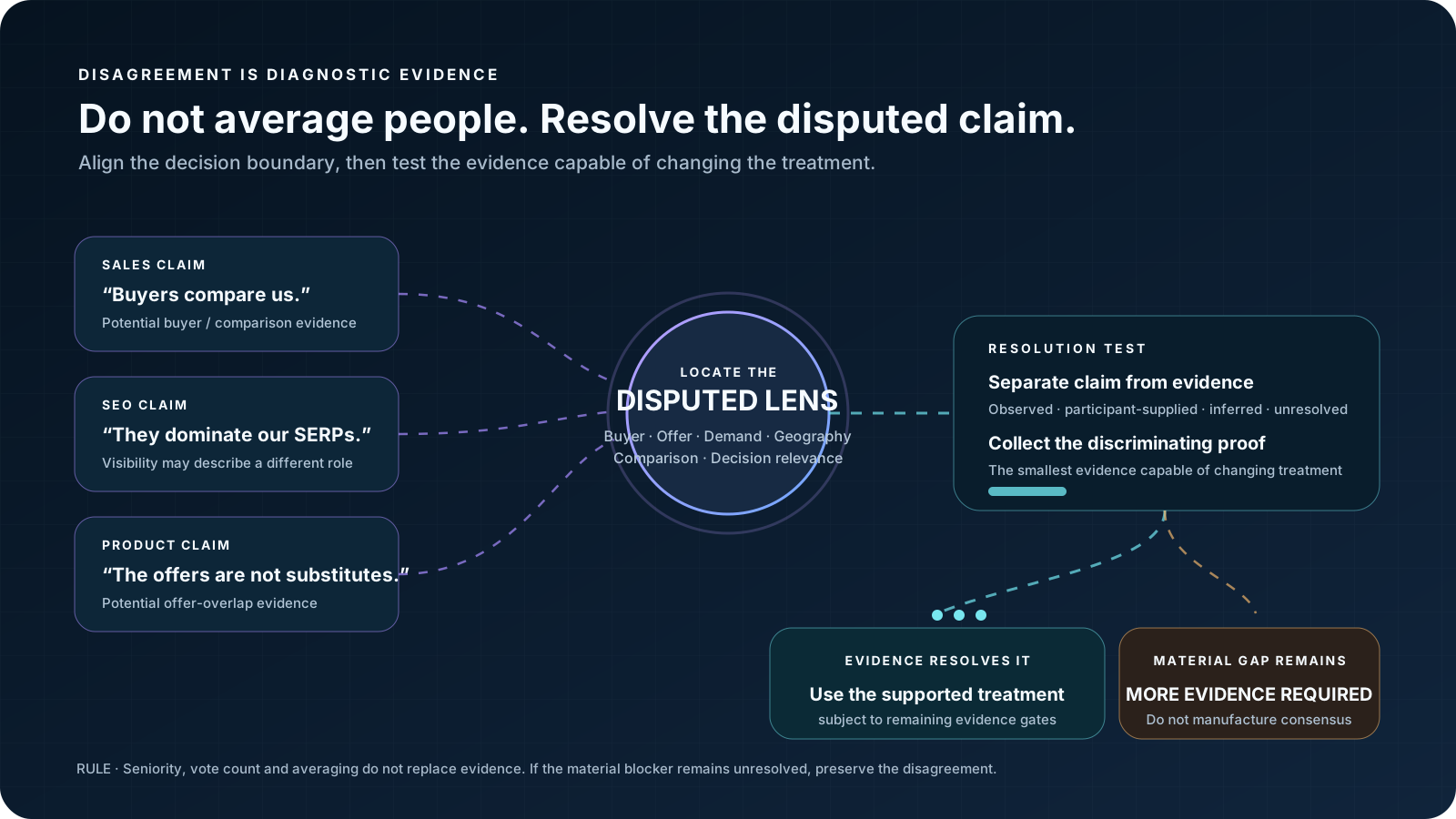
Do not average people. Align the object, then test the evidence.
Lock the object before comparing answers
Two answers are not comparable until the reviewers are evaluating the same bounded object. Write the scope once and make every reviewer point to that same scope before you discuss the competitor label.
The same company/domain/business unit.
The same decision maker, segment or account type.
The same product, service, workflow or bundle.
The same serviceable market or jurisdiction.
The same current/as-of evidence period.
The same decision the competitor relationship is supposed to inform.
Fast Action: route the disagreement without voting or averaging
The Disagreement Resolver routes one material dispute to the correct next action. It does not calculate a competitor score, count votes, weight departments or create a synthetic confidence penalty.
Future reopening trigger: this field records the future condition that should reopen the disagreement record. It does not assert that the change has already happened and it does not affect the current routing state.
Locate the disputed competitor-fit lens
The Competitor Fit Challenge uses six protected relationship lenses. A disagreement becomes actionable when you can point to the lens where the interpretations diverge.
| Typical dispute | Likely lens | Question that clarifies it |
|---|---|---|
| “They sell to our buyers” versus “their audience only looks similar.” | Buyer overlap | Do the same decision makers plausibly buy, shortlist or compare both offers? |
| “They solve the same problem” versus “the delivery model is completely different.” | Offer overlap | Can the candidate realistically satisfy the same job or use case? |
| “They rank for the same topics” versus “the traffic serves a different commercial intent.” | Commercial-demand overlap | Does the shared demand represent a substitutable buying problem? |
| “They operate in our market” versus “they cannot serve this geography.” | Geographic relevance | Can the candidate actually serve the market under review? |
| “Customers mention them” versus “that is only an internal assumption.” | Customer-comparison likelihood | Is there credible evidence that buyers compare or substitute the candidate? |
| “We should track them” versus “they cannot change this decision.” | Decision relevance | Would including or excluding the candidate materially change the current decision? |
Do not create a seventh “team confidence” dimension. The disagreement should be attached to the relationship lens or evidence gate it actually affects.
Separate each claim from the evidence behind it
Statements such as “Sales knows the market” or “SEO has the data” are authority claims, not evidence. Record what each reviewer is asserting, what source supports the assertion and what remains unresolved.
The specific proposition being asserted: same buyers, substitutable offer, real comparison, serviceable geography or another defined relationship.
Observed, participant-supplied, inferred, unresolved or contradictory. Do not upgrade an inference because several reviewers repeat it.
What the source can legitimately establish. A product page can show an offer; it cannot by itself prove private buyer comparison behaviour.
Give every source only the authority it can actually carry
Browser-tool source-role labels are controlled routing labels, not automatic provenance verification. Selecting CRM / SALES NOTES, for example, records what authority the participant is claiming for that evidence; it does not independently prove the evidence exists or is accurate.
| Source | Can help establish | Cannot establish by itself |
|---|---|---|
| Product/pricing/service pages | Offer, packaging, fulfilment claims, published geography | Private buyer comparison or win/loss behaviour |
| Search results / visibility | Retrieval overlap, visible domain role clues, demand surfaces | Commercial substitution or same-buyer choice |
| CRM / sales notes | Participant-supplied buyer objections, mentions, shortlist signals | Independent buyer truth unless provenance is traceable |
| Win/loss / RFP records | Observed or participant-supplied comparison behaviour when records are specific | Market-wide substitution outside the recorded scope |
| Buyer interviews / reviews | Buyer-side comparison, alternatives, decision criteria when attributable | Every segment, geography or time period |
| Internal product judgement | Expert interpretation of use cases and substitution | Observed buyer behaviour without supporting evidence |
Choose the smallest evidence test capable of resolving the dispute
The next step is not a vote, workshop score or larger average. Choose evidence that discriminates between the competing claims.
| If the dispute is about… | Useful resolving evidence | Avoid |
|---|---|---|
| Buyer overlap | Target-account criteria, sales qualification patterns, customer interviews, win/loss records or credible buyer-side comparisons. | Assuming shared keywords prove shared buyers. |
| Offer substitution | Pricing, packaging, implementation requirements, use cases, replacement language or documented alternatives. | Equating category wording with realistic substitution. |
| Search visibility | Map the visible domain to its commercial role: seller, publisher, marketplace, directory, reference or substitute. | Treating SERP presence as competitor status. |
| Geography | Service-area evidence, contractual availability, local coverage or jurisdiction-specific offering details. | Inferring serviceability from global brand presence. |
| Customer comparison | Win/loss notes, buyer interviews, review comparisons, RFP shortlists or other comparison evidence with a clear source role. | Turning internal recollection into observed buyer evidence. |
Materiality test: ask whether resolving this dispute could change the candidate’s treatment, permitted decision use or next action. If not, record the disagreement but do not let it consume the analysis.
Falsifier rule: for each material claim, name what evidence would make the team abandon or revise it. If nobody can state a possible falsifier, the disagreement is being treated as identity or preference rather than an analytical claim.
Worked example: three teams are describing three different decision surfaces
Suppose a B2B company is reviewing one domain. Sales calls it a direct competitor because prospects mention its consulting offer. SEO calls it a major competitor because the domain owns many of the same search results. Product says it is not a direct competitor because the candidate’s software is rarely substitutable for the company’s platform.
| Reviewer | Claim | What the claim may actually describe |
|---|---|---|
| Sales | “We lose deals to them.” | Buyer comparison or consulting substitution in a particular segment. |
| SEO | “They dominate our search territory.” | Commercial-demand overlap or reference/publisher visibility. |
| Product | “The products are not substitutes.” | Weak direct offer overlap for the software buying decision. |
Those statements do not have to collapse into one average. The correct resolution is to define the decision boundary—such as US mid-market platform selection—then test the buyer, offer and comparison evidence relevant to that decision. The domain may legitimately be a direct competitor for one offer, an indirect competitor for another, and a reference domain for search analysis.
A disagreement can reveal that the original competitor question was too broad. That is a better outcome than forcing a single label across multiple decision surfaces.
Turn the three opinions into a reproducible claim ledger
| Claim ID | Disputed lens | Evidence role | Smallest resolving test |
|---|---|---|---|
| CLM-SALES-01 | Customer-comparison likelihood | Sales/CRM participant-supplied evidence | Traceable deal, shortlist or win/loss record for the defined segment |
| CLM-SEO-01 | Commercial-demand overlap | Search visibility / public retrieval evidence | Map high-value queries to the same buying problem and commercial role |
| CLM-PROD-01 | Offer overlap | Product expert inference + published offer evidence | Compare use case, implementation and replacement capability for the named platform decision |
Disagreement can limit evidence readiness without rewriting relationship fit
If a material dispute remains unresolved, the evidence may not be ready for consequential use even when the provisional relationship looks plausible. Keep those concepts separate.
| State | What it means | Permitted treatment |
|---|---|---|
| Disagreement resolved by evidence | The competing claims are reconciled against a common scope and supported source role. | Use the resulting fit treatment subject to the remaining evidence gates. |
| Disagreement immaterial | The disputed point cannot change classification or decision use. | Record it; do not over-invest in resolution. |
| Material disagreement unresolved | The disputed evidence could change treatment and cannot yet be resolved. | MORE EVIDENCE REQUIRED for that decision use. |
Disagreement does not automatically lower a fit score or create a numerical confidence penalty. It changes what evidence must be inspected and, when material, how far the result can legitimately travel.
Guided mode should protect the decision; Analyst mode should expose the dispute
Guided mode should keep the user focused on the disputed lens, the evidence state and the next resolving action. It should not require a first-time user to arbitrate hidden numerical mechanics.
Analyst mode can expose the underlying answers, source roles, unresolved evidence and lens detail needed to review why the reviewers diverged. The presentation can differ; the protected six-lens method cannot.
Parity rule: Guided and Analyst modes may expose different detail, but they must return the same routing state, disputed-lens identity, evidence limitation and permitted decision use for equivalent inputs.
When not to force consensus
Consensus is not the objective. A decision-usable evidence record is.
- Do not vote when the decisive evidence is missing.
- Do not average contradictory answers that describe different scopes or objects.
- Do not let seniority resolve an empirical claim. Authority may set the decision boundary; it does not manufacture buyer evidence.
- Do not relabel Unknown as neutral. Missing knowledge remains unresolved.
- Do not erase minority evidence. A dissenting observation may be the clue that exposes a wrong scope or stale source.
Disagreement alone is not a rerun trigger. Reopen the CFC only when the dispute exposes a material scope change or new material evidence that can change an input, gate, treatment or permitted decision use. No material change, no rerun.
Portable handoff: record the disagreement so another reviewer can reproduce it
A useful handoff does not say “the team was split.” It records the decision-relevant structure of the split.
A reproducible ledger needs more than two opinions. Each material claim should have a stable Claim ID, an explicit source role, participant-supplied evidence/source labels and a falsifier: the evidence that would make that claim change.
The market, buyer, offer, geography and decision under review.
Each materially different proposition without collapsing them into a vote count.
The specific relationship dimension or gate affected by the disagreement.
What is observed, participant-supplied, inferred or unresolved.
The smallest credible test capable of changing the treatment.
Resolved, immaterial disagreement, or MORE EVIDENCE REQUIRED.
Stable identifiers or labels for the competing claims and the evidence each reviewer actually used.
Any credible minority claim that remains capable of changing the treatment.
Who owns the next evidence task, what test is required, and what future change reopens the decision.
Common ways teams destroy the diagnostic value of disagreement
| Failure | Why it fails | Better move |
|---|---|---|
| Averaging reviewer answers | It creates a synthetic answer that nobody actually supports. | Resolve scope and evidence first. |
| Weighting departments by authority | Organizational power is substituted for source quality. | Weight the evidence role, not the job title. |
| Calling disagreement “low confidence” | The cause of the disagreement disappears inside a generic label. | Name the disputed lens and blocker. |
| Using search overlap to overrule buyer evidence | Visibility and commercial substitution answer different questions. | Classify the domain’s role before treating it as a competitor. |
| Forcing one competitor label across every market | Different decision surfaces are collapsed into one object. | Re-scope and allow role to vary by decision. |
Questions teams ask about competitor disagreement
Should we average different team scores?
No. Averaging is only meaningful when reviewers are evaluating the same object under the same rules and the underlying observations are commensurable. In competitor-fit review, disagreement often signals different scopes or evidence states, so averaging can hide the actual defect.
Does disagreement automatically mean low confidence?
No. Disagreement identifies a review need. The important question is whether the disputed evidence is material and whether the evidence needed to resolve it is ready.
What if Sales and SEO identify different competitors?
They may both be describing valid but different roles. Sales may observe buyer substitution while SEO observes search visibility. Define the decision boundary and classify the domain’s role before forcing one label.
Who should have the final say?
The decision owner can define scope and acceptable evidence standards, but empirical claims should be resolved by evidence rather than seniority. If material evidence remains unavailable, preserve the unresolved state.
When is disagreement material?
When resolving it could change competitor classification, permitted decision use or the next action. If treatment would remain the same either way, record the disagreement without over-expanding the analysis.
What if the team still cannot agree after reviewing the evidence?
If the dispute is material and the resolving evidence is unavailable or contradictory, keep the issue explicit and use MORE EVIDENCE REQUIRED rather than a fabricated consensus.
Continue with the guide that matches the disagreement
Method and evidence boundaries
- SERPIFAI — Competitor Fit Challenge methodology
- SERPIFAI — How to Read the Six Competitor Fit Lenses
- SERPIFAI — Separate Fit From Evidence Readiness
- SERPIFAI — What an Uncertain Competitor Fit Result Means
- UK Government Analysis Function — The AQuA Book (2025 analytical quality assurance guidance)
- UK Government — PHIA Common Analytical Standards
- UK Government — Explaining Uncertainty in UK Intelligence Assessment (2025)
- UK Government Communication Service — RESIST 2 structured analytic techniques
- SERPIFAI — When to rerun after a material change
- SERPIFAI — Search visibility versus commercial competition
- Crayon — The 2026 State of Competitive Intelligence
- Info-Tech Research Group — 2026 research on disciplined competitive intelligence, functional silos and cross-functional alignment
Source roles are separated. SERPIFAI's CFC methodology controls the proprietary six lenses, Evidence Readiness and rerun logic. Crayon and Info-Tech document the current 2026 operating problem of cross-functional CI ownership/alignment; they do not validate A75's routing states. The AQuA Book, PHIA standards, UK uncertainty guidance and RESIST 2 provide general analytical-quality context for scope, challenge, uncertainty, dissent and structured assumptions. None of the external sources validates a specific competitor classification or SERPIFAI score.
Take the strongest disagreement in your current result and name the disputed lens. Write the competing claims separately, identify the evidence capable of resolving them, and keep MORE EVIDENCE REQUIRED if that material proof is still unavailable.