

Confidence should not change the underlying Competitor Fit score. Keep relationship fit and evidence readiness as separate controls. The fit pattern answers how competitor-like the relationship is; evidence readiness answers how far the current evidence may safely travel into a decision.
If a material proposition is inferred, participant-supplied, unresolved, stale or contradictory, restrict the permitted use. Do not multiply the score by a confidence percentage, convert Unknown to Neutral, or rerun the model until the number feels safer.
Use this guide when: a fit result looks plausible, but you still need to decide whether the evidence is sufficient for orientation, prioritisation or a consequential action. Article review state: prepared for browser/editorial review; not represented as founder-reviewed.
Fast Action: keep the same fit result, change only the permitted use
This local teaching tool deliberately preserves the selected fit result. It changes only evidence readiness, permitted use and the next evidence task. It begins at AWAITING INPUT and will not classify anything until all five fields are chosen.
Evidence readiness is not a probability of being correct
In this guide, evidence readiness is an operational decision-use control. It is not a statistical confidence interval, a probability that the fit classification is true, or a percentage to multiply into the fit score.
| Concept | Question | A69 treatment |
|---|---|---|
| Relationship fit | How competitor-like is the scoped relationship? | Preserve the fit result/pattern. |
| Evidence readiness | How far may the current evidence safely support action? | Control permitted use and next evidence. |
| Probability / confidence interval | What statistical uncertainty is attached to an estimate under a defined model? | Not claimed by the CFC evidence-readiness label. |
Fit and readiness answer different questions
Keep the relationship result and the evidence-use control separate. A strong fit may be decision-usable, conditionally usable or blocked depending on the evidence record and the consequence of the next action.
| Control | Question | What it may change | What it must not do |
|---|---|---|---|
| Relationship fit | How competitor-like is this company for the scoped decision? | The provisional relationship treatment and underlying six-lens fit pattern. | It must not pretend missing evidence is known. |
| Evidence readiness | Is enough material evidence resolved to act on that relationship? | The permitted use: act, act conditionally, verify, or stop. | It must not become a hidden score multiplier. |
Fit tells you the relationship. Readiness tells you how far you can act.
Keep five evidence states separate
Treat provenance states as operational controls, not decorative badges. Each state changes what you may claim and what must happen next.
| State | Meaning | Safe treatment |
|---|---|---|
| OBSERVED | A bounded public or first-party source directly supports the stated proposition. | Use within the scope and limitations of that source. |
| INFERRED | Available evidence suggests the proposition but does not directly establish it. | Keep the inference explicit; do not present it as observation. |
| PARTICIPANT-SUPPLIED | The human provides knowledge the public web cannot safely establish, such as actual buyer comparison behaviour. | Use as self-reported decision input until independently corroborated. |
| UNRESOLVED | The required proposition is not established. | Keep it unknown. Do not convert it to No, Neutral or a midpoint. |
| CONTRADICTORY | Material sources support incompatible positions on a decision-critical proposition. | Preserve both positions and REFUSE / REOPEN until the conflict is resolved or explicitly bounded. |
Canonical Evidence State tokens: OBSERVED · INFERRED · PARTICIPANT-SUPPLIED · UNRESOLVED · CONTRADICTORY. The browser router, portable handoff and PDF use the same five tokens.
What evidence readiness permits
Readiness is decision-specific. The same evidence can be sufficient for discovery and insufficient for a consequential budget or market decision.
| Readiness state | Typical condition | Permitted use |
|---|---|---|
| Decision-usable | Material gates are supported, coverage is adequate and the evidence ceiling is explicit. | Use the relationship treatment within the stated decision boundary. |
| Conditionally usable | The relationship is plausible but one material proposition remains inferred or participant-supplied. | Use for prioritisation while naming the condition that still needs verification. |
| MORE EVIDENCE REQUIRED | A critical relationship such as buyer overlap, realistic substitution, customer comparison or decision relevance remains unresolved. | Do not strengthen the classification. Verify the smallest material unknown first. |
| Refuse / reopen | Evidence conflicts, scope changed, or the result is being reused for a different market, offer or decision. | Reopen the record before relying on the previous treatment. |
The CFC methodology may expose exact scoring and coverage in Analyst mode. Those diagnostics explain the result; they do not grant extra decision authority.
Same fit, four different evidence-readiness outcomes
The fit result below is intentionally held constant. Only evidence condition, scope and decision consequence change.
The evidence-readiness state changes decision authority, not the historical fit result. If new evidence later changes the relationship itself, that is a separate reason to rerun/reclassify fit.
Worked example: strong fit, incomplete proof
A software company appears to overlap with the same offer category, market and commercial demand as your business. Public evidence makes the relationship look competitor-like. But there is no reliable evidence that buyers actually compare the two vendors in the same shortlist.
| Evidence | State | What it means |
|---|---|---|
| Offer overlap is clear from current product pages. | Observed | Supports a competitor-like relationship. |
| Geography is directly serviceable. | Observed | Removes one obvious false-rival risk. |
| Buyer language appears similar. | Inferred | Suggests overlap but does not prove real comparison behaviour. |
| Customer shortlist behaviour is unknown. | Unresolved | Limits evidence readiness for a consequential competitor-response decision. |
Fit → Proof → Readiness → Permitted Use → Next Evidence
Use one sequence. First preserve what the fit model says; then inspect provenance and evidence state; then decide how far that result may travel; finally verify only the smallest unresolved proposition capable of changing the decision.
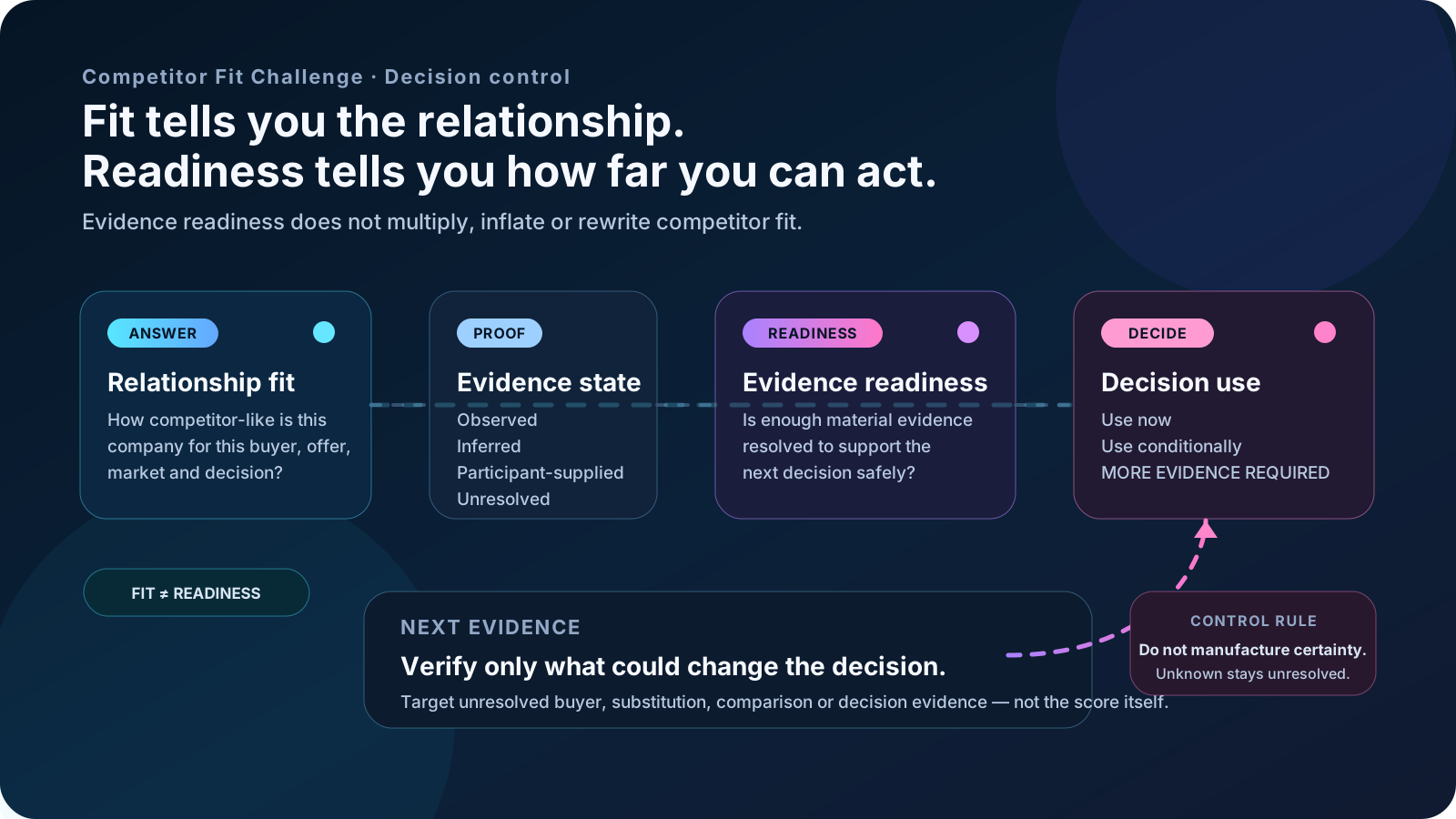
| Stage | Question | Output |
|---|---|---|
| 1 · Answer | What does the scoped fit model currently say? | A provisional relationship treatment and six-lens pattern. |
| 2 · Proof | Which propositions are observed, inferred, participant-supplied, unresolved or contradictory? | A visible five-state evidence boundary. |
| 3 · Readiness | Are the critical relationships sufficiently resolved for this decision? | Decision-usable, conditional or MORE EVIDENCE REQUIRED. |
| 4 · Decide | How far may this result safely travel? | A bounded permitted use—not a stronger-looking number. |
| 5 · Next | What smallest new evidence could change the treatment? | A targeted verification task. |
Portable handoff: record the evidence ceiling with the fit result
A saved competitor record should not contain a fit label without the evidence boundary that governed its use. The Fast Action router produces this structure automatically.
| Field | Record |
|---|---|
| Fit result | The relationship output exactly as produced; do not rewrite it to reflect confidence. |
| Critical evidence state | OBSERVED, INFERRED, PARTICIPANT-SUPPLIED, UNRESOLVED or CONTRADICTORY. |
| Readiness state | DECISION-USABLE, CONDITIONALLY USABLE, MORE EVIDENCE REQUIRED, or REFUSE / REOPEN. |
| Permitted use | The strongest action the current evidence may responsibly support. |
| Next evidence | The smallest material proposition capable of changing readiness or fit treatment. |
| Reopen trigger | New evidence, stale evidence, contradiction, scope/decision change, or a materially different buyer/offer/market context. |
| Authority boundary | Evidence readiness is not a probability of correctness and does not approve a real commercial action. |
What not to do
| Failure | Why it is unsafe | Better control |
|---|---|---|
| Multiply the score by confidence | It mixes relationship strength with evidence sufficiency and produces a number with unclear meaning. | Show fit and readiness separately. |
| Turn Unknown into Neutral | Missing evidence silently becomes support for a midpoint. | Leave the proposition unresolved. |
| Treat public positioning as buyer proof | A company website cannot establish actual shortlist or substitution behaviour on its own. | Use participant or independent evidence for buyer behaviour. |
| Open Analyst mode to manufacture certainty | More numerical detail explains the same record; it does not change its evidence authority. | Resolve the material evidence gap instead. |
| Label “80% confidence” without a statistical model | It implies probabilistic precision the evidence process has not earned. | Use named readiness states and explain the basis. |
| Treat high confidence as independent proof | Confidence/readiness describes the evidence record; it is not a new source. | Keep provenance, source limitations and unresolved propositions visible. |
Reopen readiness only when the evidence or decision boundary materially changes
- The buyer, offer, geography or investment decision changes.
- An unresolved critical proposition becomes observed or credibly corroborated.
- A previously trusted source becomes stale, contradictory or non-comparable.
- New buyer, sales, win/loss or account evidence changes the substitution picture.
- Decision Delta shows that one unresolved condition could materially change the current treatment.
Do not rerun simply to chase a different score. Reopen when the evidence record or decision boundary has changed enough to matter.
Use the next guide for the unresolved problem
Common questions
Can the same strong fit result be decision-usable in one case and blocked in another?
Yes. The relationship result can stay the same while evidence readiness changes because a critical proposition is inferred, unresolved, stale, contradictory, or the decision scope changed.
Is evidence readiness the probability that the competitor classification is correct?
No. In A69 it is an operational evidence-use state, not a statistical probability or confidence interval.
Should I multiply the competitor fit score by confidence?
No. That combines relationship strength with evidence sufficiency and creates a number with unclear meaning. Preserve the fit output and use evidence readiness to limit permitted use.
Does low evidence readiness mean the company is not a competitor?
No. It means the current evidence is not sufficient to support a stronger decision use. Relationship fit and evidence readiness are different questions.
Can a high fit score still produce MORE EVIDENCE REQUIRED?
Yes. A strong weighted result cannot safely overrule unresolved critical evidence such as buyer overlap, realistic substitution or customer-comparison likelihood.
Is Analyst mode more authoritative than Guided mode?
No. Analyst mode exposes more scoring and provenance detail for review. It does not create new evidence or grant additional authority to the result.
What is the best next evidence task?
Choose the smallest unresolved proposition capable of changing the current relationship treatment or the decision you are considering.
Sources, comparison context and method limits
- W3C PROV Overview: provenance can support assessments of quality, reliability and trustworthiness and explicitly supports versioning/derivation.
- NIST TN 1297 - Reporting Uncertainty: uncertainty statements should disclose their basis; probability/confidence interpretations require a defensible basis. Measurement context only.
- HM Treasury - Green Book 2026: evidence may be incomplete or inconclusive; uncertainty should be communicated clearly; avoid spurious accuracy.
- Friedman & Zeckhauser - Analytic confidence and decision-making: analytic confidence should be distinguished from the probability that a judgment is true.
- CEBMa - Evidence-Based Decision Making: decision quality depends on critically evaluated, trustworthy evidence from multiple sources.
These sources support transferable principles about provenance, uncertainty, analytic confidence and evidence quality. They do not validate the proprietary SERPIFAI fit model, assign a probability that a named company is a competitor, or certify a market outcome.