

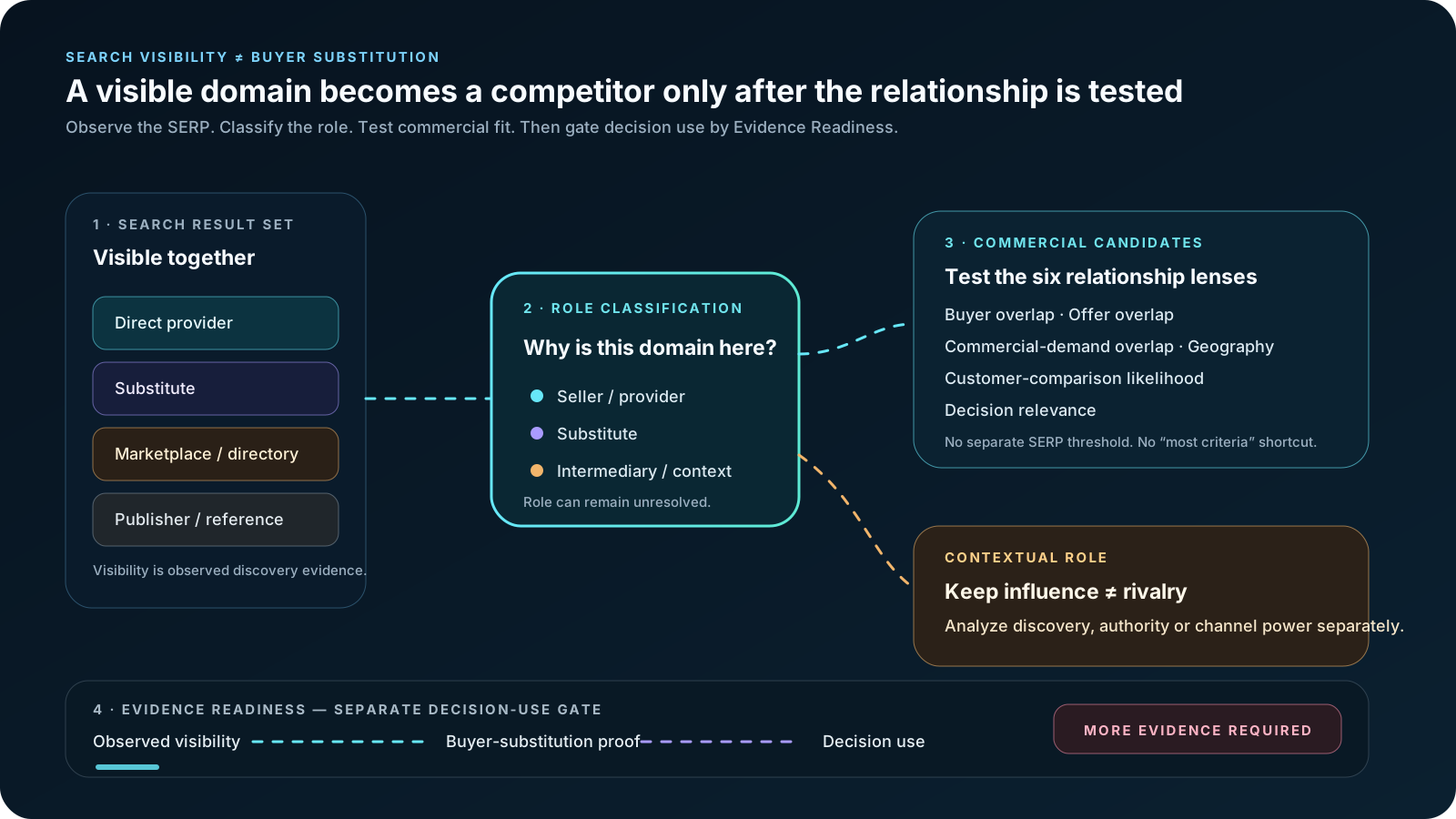
A domain is not a commercial competitor merely because it ranks beside you. Search visibility is discovery evidence. Competitor status requires a separate test of commercial role, buyer substitution and relationship fit. Evidence Readiness then determines how far that classification can be used.
Search competitor, commercial competitor and ecosystem influence are not synonyms. A search competitor overlaps with you in retrieval, rankings or AI-answer visibility. A commercial competitor can plausibly win the same buyer decision. A marketplace, directory, publisher or platform can shape discovery and comparison without fulfilling the buyer need itself.
The basic SEO-versus-business-competitor distinction is established market practice, not a proprietary SERPIFAI claim. Ahrefs identifies organic competitors through shared rankings, while Semrush's 2026 guidance explicitly includes sites appearing in search or AI results for the same queries, even when they do not sell the same thing. A73's information gain is the governed decision layer that follows discovery: role → first-party fulfilment → buyer substitution → decision boundary → Evidence Readiness → permitted treatment.
AI-search extension: being cited, mentioned or surfaced in an AI Overview, AI Mode, Gemini, ChatGPT-style result or another answer engine is retrieval visibility. It can raise monitoring priority, but it does not prove that the cited domain fulfils the buyer need or can win the same purchase.
A SERP can contain direct providers, substitutes, marketplaces, directories, publishers, associations and reference sources at the same time. They may all matter strategically, but they do not all belong in the same competitor set or deserve the same analysis.
Start with role classification, not ranking position
The first question is not “How often does this domain appear?” It is “What commercial role does this domain perform for this buyer and decision?” A role can be observed from the offer, fulfilment model and buyer path; where that role remains unclear, keep it unresolved rather than forcing a label.
| Visible role | What it does | Default analytical treatment |
|---|---|---|
| Direct provider | Sells an offer that can win substantially the same buyer decision. | Candidate for direct competitor analysis. |
| Substitute | Solves the same job through a materially different product, service or workflow. | Include in alternative-choice and switching analysis. |
| Marketplace / intermediary | Aggregates, brokers, refers or hosts offers. | Analyze discovery, channel power and influence unless it also fulfils the buyer need directly. |
| Directory | Organizes providers or category listings. | Use for discovery and category structure; do not treat as a seller by default. |
| Publisher / reference source | Educates, defines, compares or attracts attention without fulfilling the core offer. | Analyze authority and influence separately from commercial rivalry. |
| Platform / ecosystem | Provides software, infrastructure, community or workflow access that shapes the category without necessarily fulfilling the same buyer job. | Analyze ecosystem dependence, switching influence or channel power; promote to commercial-candidate treatment only if first-party fulfilment and buyer substitution are supported. |
The SERP tells you who is present. Role classification tells you why they are present.
Fast Action: screen a search-visible domain before benchmarking it
This local teaching router screens one visible domain into DIRECT, CONTEXTUAL, EXCLUDED or VERIFY treatment. It never calculates CFC points and intentionally does not ask for rank position, traffic, keyword count or SERP frequency. Those signals can discover a candidate; they cannot prove commercial rivalry.
Buyer substitution is the bridge from visibility to competition
A useful commercial competitor is one that can plausibly take the same decision, budget or job under the boundary you are analysing. Search overlap can suggest that possibility, but it cannot prove it.
- Buyer: Is substantially the same buyer making the decision?
- Job: Is the domain capable of satisfying the same underlying need?
- Offer: Does it fulfil the need directly, or merely describe, list or refer solutions?
- Market: Can it serve the relevant geography, segment and buying context?
- Comparison: Is there credible evidence buyers would consider the two choices against each other?
For commercial candidates, read the six relationship lenses
Once a domain is plausibly a provider or substitute, use the current Competitor Fit Challenge lenses to describe the relationship. Do not invent a separate SERP threshold or classify a competitor because it meets “most criteria.”
| Lens | What to test after visibility discovery |
|---|---|
| Buyer overlap | Whether substantially the same buyer can choose the domain. |
| Offer overlap | Whether the domain fulfils the same commercial outcome, not merely discusses it. |
| Commercial-demand overlap | Whether it competes for materially similar demand rather than informational attention alone. |
| Geographic relevance | Whether the offer is actually available in the market being decided. |
| Customer-comparison likelihood | Whether buyers plausibly compare the choices in the same decision. |
| Decision relevance | Whether the relationship matters to the decision the analysis is meant to support. |
A publisher can score high on audience visibility while remaining low on offer fulfilment. A marketplace can be commercially important while still being the wrong benchmark for product, pricing or positioning. A low-visibility vendor can still be a genuine competitor if the buyer relationship is real.
Keep relationship fit separate from Evidence Readiness
Role and fit answer what relationship appears to exist. Evidence Readiness answers how far you are allowed to act on that classification. These are not the same thing.
The domain appears for the bounded query, its pages describe a specific offer, or the service area is directly stated.
The domain appears substitutable because of offer or buyer signals, but direct comparison evidence is incomplete.
A material buyer, fulfilment, geography or comparison claim cannot yet be supported.
Unknown contributes no positive support. If the unresolved point could change the role or competitor treatment, the correct state is MORE EVIDENCE REQUIRED, not a cleaner-looking classification.
Fit tells you the relationship. Readiness tells you how far you can act.
For this role screen, VERIFY means the missing or contradictory evidence could change DIRECT / CONTEXTUAL / EXCLUDED treatment. Collect the smallest evidence capable of resolving that specific role, fulfilment, buyer, comparison or market claim.
Worked SERP: five visible domains, five different treatments
This illustrative example uses a fictional search around CRM software for dental practices. It demonstrates the classification method; it is not a benchmark for any real market.
| Visible domain type | Observed role evidence | Commercial treatment | Readiness note |
|---|---|---|---|
| Dental-specific CRM vendor | Sells the workflow directly to the target buyer. | Direct-like commercial candidate; apply all six lenses. | Decision use depends on evidence for market, comparison and fulfilment claims. |
| General CRM vendor | Sells CRM capability but requires configuration or partners for the dental workflow. | Potential substitute. | Keep substitution provisional until the buyer/job evidence is strong enough. |
| Software review marketplace | Lists and compares vendors but does not fulfil the CRM job itself. | Discovery intermediary and comparison influence. | Do not use as a product/pricing competitor unless first-party fulfilment evidence changes the role. |
| Dental association directory | Provides member or vendor listings and authority signals. | Directory / reference role. | Useful for ecosystem evidence, not direct rivalry. |
| Dental publication | Publishes educational content for the same audience. | Publisher / attention competitor. | Analyze influence separately from buyer substitution. |
Protect against both false positives and false negatives
| Error | How it happens | Control |
|---|---|---|
| False positive | A high-ranking directory, publisher or marketplace is treated as a product competitor. | Require fulfilment and buyer-substitution evidence. |
| False negative | A real provider is excluded because its new or weak site is not visible for the sample query. | Use sales, customer, market and product evidence outside the SERP. |
| Role collapse | A marketplace is permanently labelled “not a competitor” even after it launches a first-party offer. | Allow role reclassification when material evidence changes. |
| Search-volume substitution | Ranking frequency is used as a proxy for customer-comparison likelihood. | Keep visibility and buyer behaviour as separate evidence claims. |
Use Guided mode for treatment; use Analyst mode for evidence depth
Guided mode should answer the immediate question: Is this domain a commercial candidate, a substitute, an intermediary/reference role, or still unresolved? It should expose the next evidence task when the role cannot safely be assigned.
Analyst mode can show the underlying lens answers, evidence-state labels, source roles, contradictions and exact score mechanics where the current product exposes them. Analyst detail does not turn search visibility into buyer evidence and does not override a material unresolved gate.
Reclassify only when the commercial role materially changes
A role is not permanent, but it should not move because ranking position changed. Reopen the classification when dated evidence shows a material change such as:
- a marketplace launches a first-party offer or begins direct fulfilment;
- a publisher becomes a seller or a seller exits the offer category;
- the target geography or service boundary changes;
- sales or customer evidence shows genuine buyer comparison;
- an unresolved fulfilment or buyer claim is resolved.
Use the When-to-Rerun guide for the reopening rule: no named material change = no rerun.
Portable classification record
A useful handoff records the evidence rather than only the label. Capture:
- bounded query/market context;
- domain and observed search visibility;
- assigned role and the evidence supporting it;
- six-lens relationship treatment where commercially relevant;
- Evidence Readiness and any unresolved material claim;
- permitted use: direct comparison, substitute analysis, influence/context, monitoring, or MORE EVIDENCE REQUIRED;
- named reclassification trigger.
This lets another reviewer understand why a domain was included, excluded or retained for contextual analysis without rerunning the classification from memory.
Questions before adding a search-visible domain to the competitor set
Does ranking for the same query make a domain a real competitor?
No. It establishes shared search visibility. Commercial competition still requires evidence of a relevant buyer, job, offer, market and plausible substitution relationship.
Should publishers and directories be ignored?
No. They can shape discovery, trust, category language and referral paths. Keep them in the ecosystem analysis, but do not automatically use them as product, pricing or positioning benchmarks.
Can a marketplace be both an intermediary and a competitor?
Yes, if it also fulfils the same buyer need through a first-party or substitutable offer. Record the role that matters to the current decision rather than forcing one permanent label.
What if the commercial role looks plausible but the evidence is weak?
Keep the provisional relationship visible and set the decision-use state to MORE EVIDENCE REQUIRED when the missing proof is material.
What if a genuine competitor does not rank?
Search visibility is only one discovery channel. Sales, customer, product and market evidence can identify a real competitor that the sampled SERP misses.
Should ranking frequency become a competitor score?
No. Visibility can be useful discovery evidence, but it is not a substitute for the six relationship lenses or Evidence Readiness.
Move from visibility to the right follow-up test
Method and evidence boundaries
- SERPIFAI — Competitor Fit Challenge methodology
- SERPIFAI — How to Read the Six Competitor Fit Lenses
- SERPIFAI — Separate Fit From Evidence Readiness
- SERPIFAI — What an Uncertain Competitor Fit Result Means
- UK Competition and Markets Authority — Merger Assessment Guidelines
- U.S. Department of Justice — Market definition and effective competition
- Ahrefs — Organic competitors report (shared-ranking discovery context)
- Semrush — SEO competitors can appear in search or AI results without being business competitors (2026)
Source roles are deliberately separated. Ahrefs and Semrush illustrate established search/AI-visibility competitor-discovery practice. CMA and DOJ materials provide general customer-substitution and market-boundary context. SERPIFAI's CFC method controls the proprietary relationship lenses, Evidence Readiness and analytical treatment. None of the external sources validates a specific domain as a SERPIFAI competitor.
For each visible domain, write two lines before benchmarking it: “Role: ___” and “Evidence that it can win the same buyer decision: ___.” If the second line is unresolved and material, keep the domain out of direct-comparison treatment until the evidence is strong enough.