
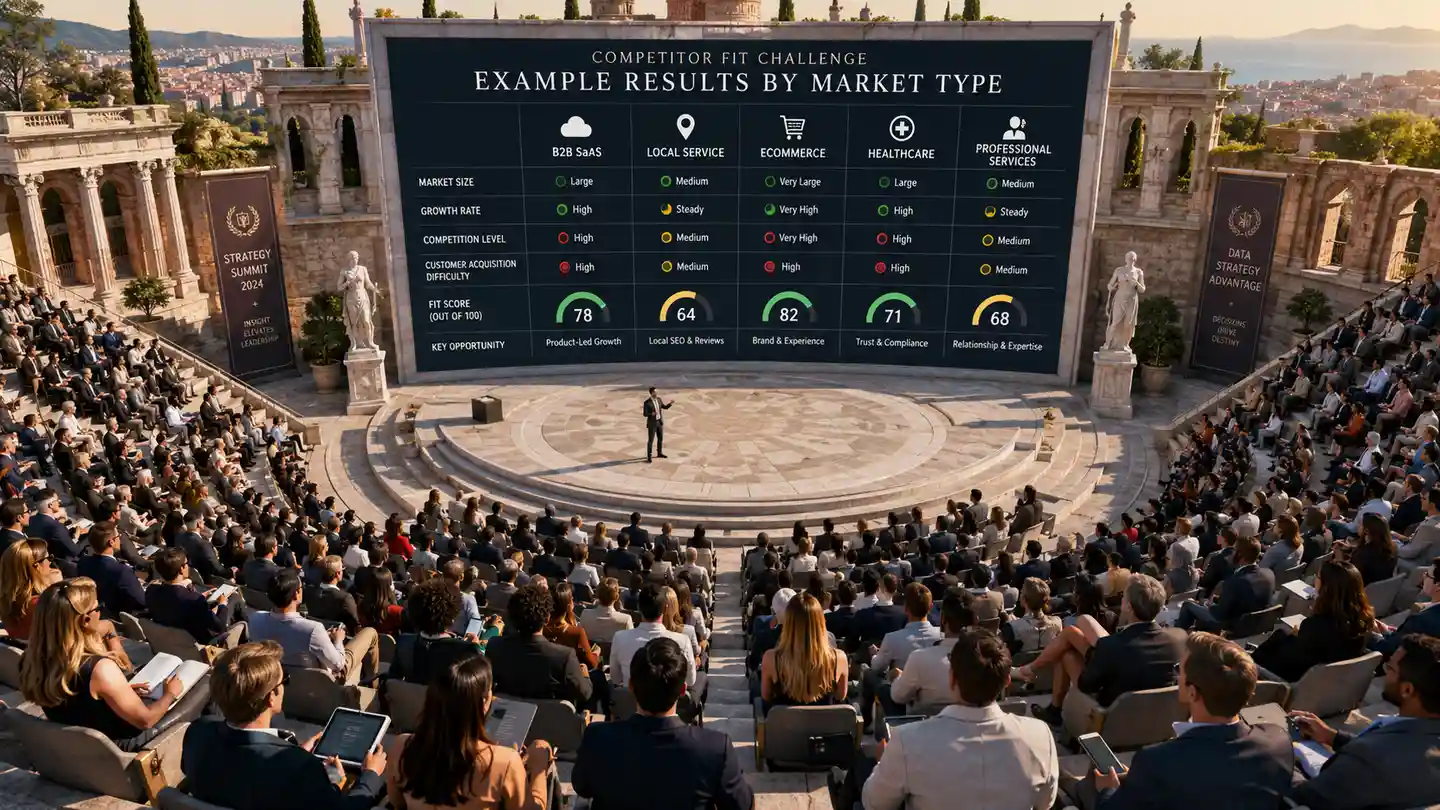
Competitor analysis examples only work inside a defined market context
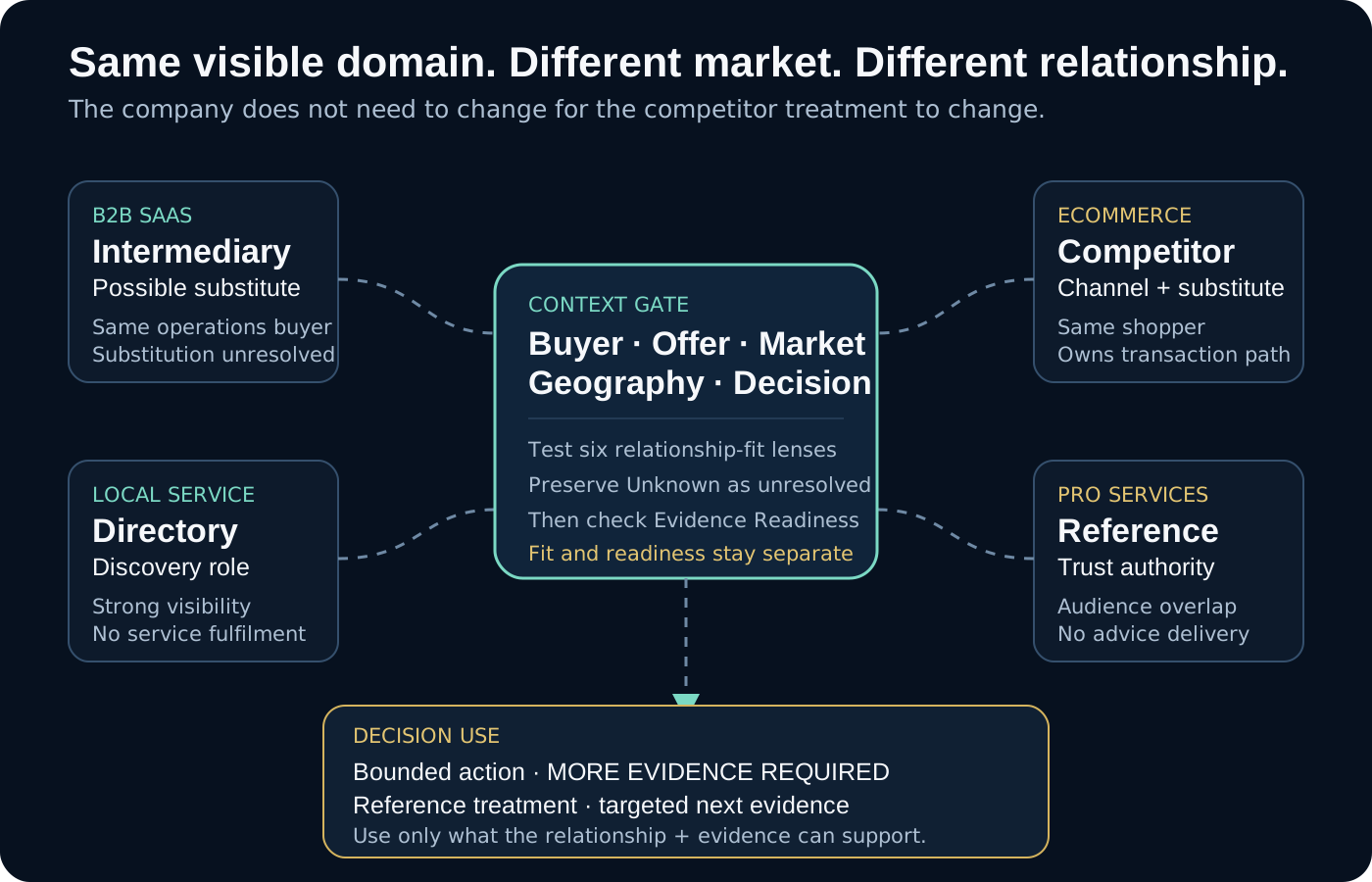
The same domain is not one fixed competitor type. In the Competitor Fit Challenge, competitor status is a relationship between a candidate and a specific buyer, offer, market, geography and decision. These fictional examples show how one visible domain can move from ecosystem intermediary to directory, commercial competitor or reference authority as the context changes.
| Market context | What the domain does | Provisional role | What must still be proved |
|---|---|---|---|
| B2B SaaS | Owns an integration marketplace beside the focal workflow | Ecosystem intermediary / possible substitute | Can the same buyer complete the job without the focal product? |
| Local services | Ranks strongly and sends leads but does not perform the service | Discovery intermediary | Does it fulfil the service or merely influence discovery? |
| Ecommerce | Owns the transaction, assortment and fulfilment path | Channel + substitute + commercial competitor | Is the same shopper choosing between the marketplace and focal offer? |
| Professional services | Shapes trust and referrals but does not deliver the advice | Reference authority | Does it enter the same paid engagement decision? |
Reuse the questions and evidence fields, not the fictional role or score. Rebuild the classification for the real buyer and decision.
Read each example through six fit lenses, then check Evidence Readiness
A market label such as “SaaS” or “ecommerce” does not determine the answer. Test the candidate through the six current Competitor Fit lenses. Then judge whether the evidence is strong enough to use the result. Relationship Fit and Evidence Readiness are separate.
| Lens | Question in an example result | Evidence to look for |
|---|---|---|
| Buyer overlap | Are the same buyers genuinely in scope? | Audience, segment, account, persona and purchase evidence |
| Offer overlap | Are the compared offers meaningfully substitutable? | Product/service scope, package, fulfilment and use case |
| Commercial-demand overlap | Do they compete for the same commercial demand? | Transactional/comparison demand and buying-stage evidence |
| Geographic relevance | Can both offers serve the same market? | Service area, delivery, jurisdiction and availability |
| Customer-comparison likelihood | Would a buyer realistically compare the two? | Alternatives, shortlist, switching, review or win/loss evidence |
| Decision relevance | Would the classification change the named decision? | Budget, positioning, content, market or response implications |
Evidence rule: observed evidence supports what was actually seen; participant-supplied claims remain self-reported; inference must be labelled; Unknown remains unresolved and contributes no positive support.
Answer: market context can change a candidate’s relationship to the buyer. Proof: inspect the six fit lenses and the evidence behind them, rather than copying a teaching result. Next: use the classification only as far as Evidence Readiness permits; if a material lens is unresolved, keep MORE EVIDENCE REQUIRED and collect the smallest proof that could change the decision.
Status: Fictional teaching cases. Prepared for browser/editorial review; no reviewer approval is claimed.
Transfer the questions, never the fictional result. A market example is a teaching scaffold, not an industry prior. Even when your buyer, offer, fulfilment, geography and decision look similar, the real role must be rebuilt from current evidence.
The four examples are deliberately different because the same visible domain can own discovery, fulfilment, trust or the transaction in different contexts. Those functions change buyer substitution; the market label itself does not.
Why this guard is needed now: current 2026 competitor-analysis resources increasingly publish filled, industry-specific worked examples. Deckary's February 2026 guide presents populated examples across SaaS, professional services, consumer goods, healthcare and fintech; Elogic's 2026 ecommerce guide provides an ecommerce-specific worked structure. These resources demonstrate the current example landscape only. They do not establish a SERPIFAI market prior, expected role, score or evidence state.
Information-gain boundary: A74 does not claim that industries differ as a proprietary insight. Its distinct contribution is Example Transfer Governance — a controlled rule for deciding what may transfer from a worked example (questions, evidence fields and reasoning structure) and what may not (role, score, confidence, benchmark or action).
Fast Action: check whether an example can transfer to your real decision
This local teaching guard never predicts a competitor role or generates an industry benchmark. It checks whether the fictional example is close enough to transfer its questions—or whether your real case must be rebuilt from a different context.
CONTEXT CLOSE means structural similarity only. It means the selected teaching conditions appear similar enough to reuse the investigation structure. It does not establish market equivalence, predict the same competitor role, or transfer the fictional result.
These examples transfer only with matching buyer, offer, market and decision conditions
How role classification changes across market structures, how the six lenses are interpreted and how Evidence Readiness limits decision use.
Industry benchmarks, normal score ranges, verified market shares, proof that a real company is a direct competitor, or permission to convert Unknown into No.
A critical relationship question is unresolved, the example is being copied across a different market, or the evidence does not support the stronger role being claimed.
The same fit pattern can support a different decision when readiness changes
Two example results can point to the same provisional relationship while supporting different actions. A plausible direct-like pattern with weak evidence is not decision-equivalent to the same pattern backed by observed buyer, offer and substitution evidence.
| Relationship Fit | Evidence Readiness | Safe use |
|---|---|---|
| Strong/direct-like pattern | Low or materially unresolved | Provisional screening only; MORE EVIDENCE REQUIRED |
| Strong/direct-like pattern | Adequate for the named decision | Use as a bounded competitor treatment with evidence trail |
| Weak/reference pattern | High | Confidently treat as contextual/reference evidence rather than force into the competitor set |
| Mixed pattern | Mixed | Target the unresolved lens instead of averaging uncertainty away |
Use a six-step example-result workflow
| Stage | Control | Output |
|---|---|---|
| 1 | Scope one buyer, offer, geography and decision. | Bounded context |
| 2 | Observe what the candidate actually sells, fulfils and influences. | Evidence statements |
| 3 | Test all six relationship-fit lenses without filling Unknowns. | Provisional fit pattern |
| 4 | Classify the role: direct-like, indirect/substitute, intermediary/reference, limited or uncertain. | Relationship treatment |
| 5 | Qualify Evidence Readiness and critical unresolved claims. | Decision-use boundary |
| 6 | Act with the smallest next evidence task or bounded action. | Answer → Proof → Next |
Five mistakes that make competitor-analysis examples misleading
| Failure mode | Why it fails | Correct treatment |
|---|---|---|
| Cross-market copying | A result is reused where buyer, offer or fulfilment changed. | Rescope and rerun the affected relationship tests. |
| Search visibility = competition | A publisher, directory or authority is treated as a commercial rival because it ranks. | Separate discovery role from buyer substitution. |
| Unknown = No | Missing evidence is converted into evidence of absence. | Preserve Unknown; add no positive support. |
| Fit = readiness | A plausible relationship is treated as verified because the pattern looks strong. | Report Fit and Evidence Readiness separately. |
| Score as benchmark | A fictional total becomes a supposed “normal” score for an industry. | Use qualitative treatment and evidence, not invented norms. |
The company did not change; the relationship did. A domain can be a direct-like rival in one purchase decision, a substitute in another, and only a discovery or trust source in a third.
Healthcare and multi-location are overlays, not extra market benchmarks
A74 does not add separate healthcare or multi-location 'normal results' because those contexts mostly change the evidence ceiling or geographic boundary, not the underlying rule that competitor status belongs to a specific buyer, offer, market and decision.
Reopen an example treatment only when a named material condition changes
- The buyer or decision stage changes.
- The offer, fulfilment model or transaction owner changes.
- The geographic/service boundary changes.
- New evidence changes buyer substitution or customer-comparison likelihood.
- A previously unresolved critical lens receives material proof.
- The candidate moves from intermediary/reference activity into direct fulfilment.
No material change, no rerun. A calendar reminder can prompt a check for triggers, but elapsed time alone does not change the example result.
Decision Delta rule: compare a changed real treatment only with that candidate's prior real treatment. Do not compare the real result with MarketHub or use a fictional example as the baseline.
Questions readers ask about competitor analysis examples
Can I reuse the example score for my industry?
No. These are fictional teaching cases, not benchmarks. Reuse the six-lens questions, evidence states and decision logic, then build the result from your own buyer, offer, market and evidence.
Why can the same company be a different competitor type?
Because competitor status depends on the specific purchase decision. The same organization may fulfil the job directly for one buyer, substitute for another, and only influence discovery or trust in another context.
What does MORE EVIDENCE REQUIRED mean in an example result?
It means a material claim needed for safe decision use is not established yet. The correct next step is targeted proof—not filling the gap with a neutral value or forcing a stronger label.
Should a high competitor-fit score override missing evidence?
No. Relationship Fit and Evidence Readiness are separate. A strong provisional fit pattern can still be unsafe for a consequential decision when critical evidence is unresolved.
What does CONTEXT CLOSE mean?
It means only that the selected buyer, fulfilment, offer, geography and decision conditions look structurally similar enough to reuse the investigation structure. It does not establish market equivalence or predict that the real candidate should receive MarketHub's fictional role.
What these Competitor Fit Challenge examples actually demonstrate
- Context changes role: competitor status belongs to a buyer/offer/market/decision relationship, not permanently to a company.
- Six lenses explain the fit: buyer, offer, commercial demand, geography, comparison likelihood and decision relevance reveal why the relationship exists.
- Evidence Readiness limits use: unresolved critical evidence can keep a plausible result at MORE EVIDENCE REQUIRED.
- Examples are not benchmarks: transfer the method, never the fictional role, score or confidence label.
- Next evidence should be bounded: collect the smallest material proof capable of changing the treatment.
Four fictional market examples: same domain, different relationship
Can the buyer complete the focal workflow without the focal product?
Does the domain fulfil the service itself in the same service area?
Does the same shopper choose between the marketplace transaction path and the focal offer?
Does the domain enter the same paid engagement decision or only shape trust/referrals?
Assume one fictional domain—MarketHub—appears prominently in all four contexts. The table does not assign a reusable numerical score. It shows how a bounded relationship treatment, evidence state and next action can differ.
| Context | Six-lens pattern | Provisional role | Evidence Readiness | Safe next action |
|---|---|---|---|---|
| B2B SaaS | Buyer overlap strong; offer overlap partial; substitution unresolved | Ecosystem intermediary / possible substitute | MORE EVIDENCE REQUIRED | Verify whether the buyer can complete the focal workflow without the focal product |
| Local services | Buyer/demand overlap in discovery; no observed service fulfilment | Directory / discovery intermediary | Adequate for discovery-role treatment | Analyze visibility and referral economics; do not benchmark service pricing |
| Ecommerce | Same shopper, transaction, assortment and fulfilment path | Channel + substitute + commercial competitor | Adequate for bounded comparison | Compare assortment, fees, fulfilment, switching and conversion mechanics |
| Professional services | Audience and trust overlap; paid advice fulfilment not observed | Reference authority | Adequate for reference-role treatment | Assess citations, trust and referral influence rather than force offer parity |
Why the roles differ: the same domain can own discovery, fulfilment, trust or the transaction in different markets. Those functions change buyer substitution and therefore the appropriate competitor treatment.
The MarketHub roles above are fictional outputs, not priors. A real candidate with the same market label can land in a different treatment when fulfilment, buyer substitution, geography, evidence or the named decision differs.
Use the adjacent guide that matches the unresolved question
Example results are most useful when they route the reader to the exact uncertainty that remains.
Primary sources that inform market and substitution context
- SERPIFAI — Search visibility versus commercial competition
- SERPIFAI — When to rerun after a material change
- SERPIFAI — How to read the six Competitor Fit lenses
- SERPIFAI — Competitor Fit Challenge methodology
- U.S. Census Bureau — North American Industry Classification System
- U.S. Department of Justice — Merger Guidelines and market analysis context
- UK Competition and Markets Authority — Merger Assessment Guidelines
- Deckary — Competitive Analysis Examples: five worked frameworks with populated industry examples (6 February 2026)
- Elogic Commerce — Ecommerce competitive-analysis example and template (published 12 May 2026; updated 3 August 2026)
Source roles are deliberately separated. SERPIFAI's CFC methodology controls the proprietary lenses, Evidence Readiness, rerun rules and Example Transfer Governance. Deckary and Elogic document the current 2026 landscape of populated, industry-specific competitor-analysis examples. NAICS supplies industry-classification context; DOJ and CMA supply general market-boundary and customer-substitution context. None of the external sources validates MarketHub, creates an industry benchmark, predicts a real competitor role, or certifies a SERPIFAI result.