
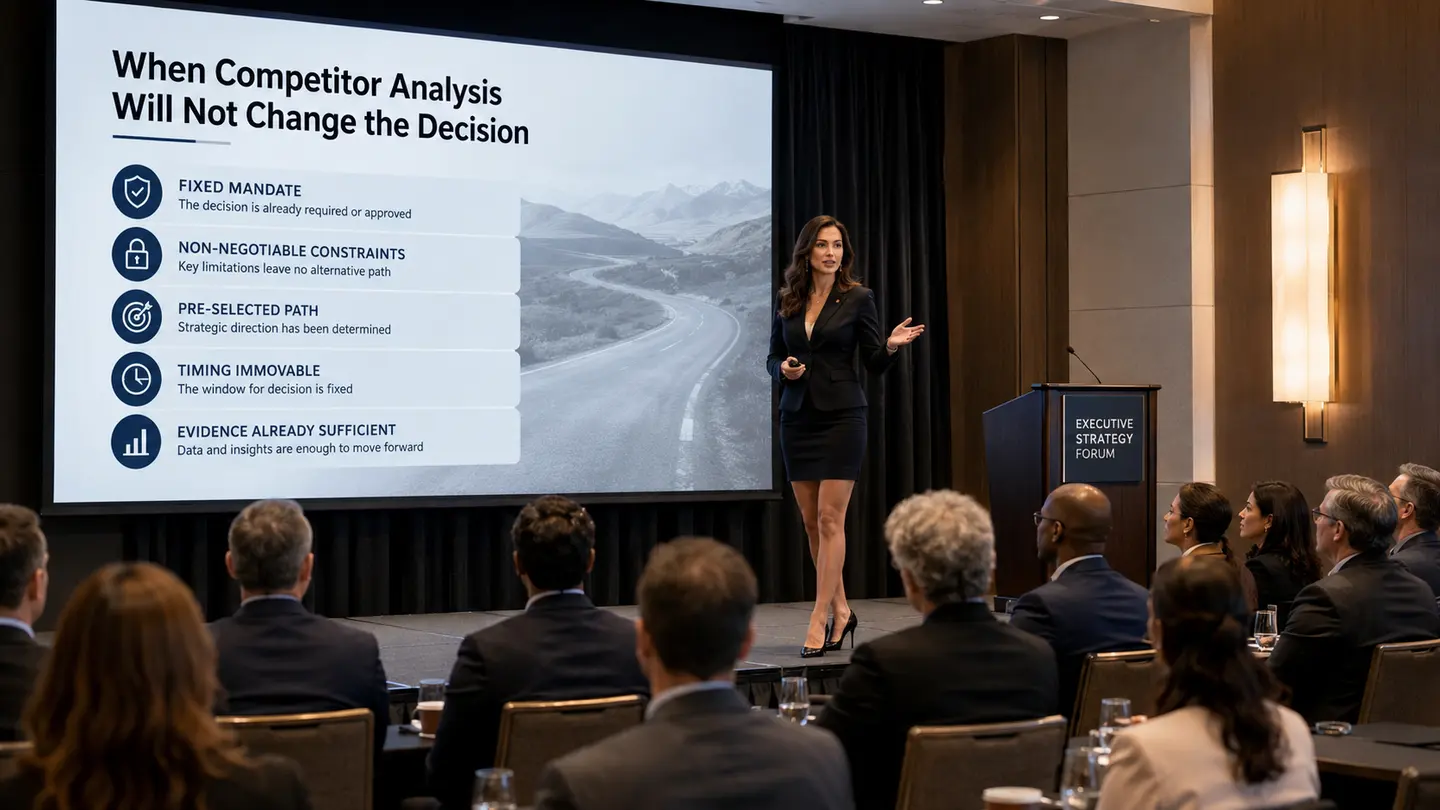
Stop competitor analysis when no credible additional competitor evidence can materially change the decision, permitted action, scope, commitment, risk boundary or reversal condition. Continue only when a specific unresolved issue still has a realistic pathway to changing what you do next. Remaining uncertainty alone is not a reason to keep researching.
No-buy rule: If no credible new competitor evidence can change the bounded decision, do not buy another competitor-analysis cycle merely to feel more certain. Preserve the review trigger, make the permitted decision and spend the next unit of time or budget on execution, measurement or the different evidence gap that actually controls the commitment.
When More Analysis Stops Paying
How to read it: select a checkpoint to isolate that part of the method. The canvas shows the relationship; the inspector explains what the checkpoint changes in the decision.
This is a decision-sensitive stop rule, not a completeness rule. It does not ask whether you have found every competitor, read every source or eliminated every unknown. It asks a narrower and more useful question: what could additional competitor evidence still change?
More analysis is useful only when it can still change the decision
Competitor research creates value by changing a choice, not by making a report look complete. Decision-analysis literature treats further information as useful when it can reduce uncertainty that matters to the decision. UK appraisal and analytical-quality guidance similarly emphasizes proportionate analysis, explicit uncertainty and work that is fit for the intended decision. Those ideas do not create a ready-made competitor-analysis formula; they support the discipline behind this rule: connect further work to a material decision consequence before commissioning it.
The next research step is itself a decision. Decision-analysis and optimal-stopping research make the underlying trade-off explicit: information can be worth acquiring, but another survey/search can also provide little or no useful information and still consume time or money. A37 therefore does not ask whether more evidence exists. It asks whether the next bounded evidence action has a credible path to changing a material decision variable.
This is a qualitative decision rule, not a disguised expected-value formula. Unless probabilities, utilities and information costs are defensible, do not invent a monetary value-of-information score.
Uncertainty can remain
You do not need omniscience. An unresolved fact can stay unresolved if every credible answer leaves the permitted action unchanged.
Evidence volume is not evidence value
Ten pages repeating the same underlying source can add volume without adding independence or changing the decision.
Discovery is not qualification
SEO, PPC, AI-visibility and CI systems surface different entity sets. A newly discovered domain or brand should extend research only if it qualifies for the bounded commercial decision.
Six variables that make additional analysis decision-bearing
Before another research cycle is approved, name at least one material variable that the new evidence could realistically change:
- Decision: go/no-go, choose A/B, enter/avoid, prioritize/deprioritize.
- Permitted action: what the team is allowed to execute next.
- Scope: buyer, offer, market, geography, product, funnel stage or competitor-set boundary.
- Commitment: budget, tranche, resource allocation, sequencing or scale.
- Risk boundary: the exposure the decision owner will accept before changing course.
- Reversal condition: the observable event that would reopen or reverse the decision.
If no credible new competitor evidence can move any of those variables, continuing analysis has no remaining decision value for this bounded decision.
The decision-change stop rule
Close the bounded analysis cycle when
- the decision, scope and current permitted action are defined;
- no material contradiction can change the action;
- competitor qualification is sufficiently resolved for this decision;
- required first-party evidence is present or genuinely not required;
- the remaining evidence base is adequate to support the bounded decision;
- additional competitor evidence cannot materially change the decision, action, scope, commitment, risk boundary or reversal condition;
- more sources would be duplicative rather than independently decision-bearing; or
- a reversible action will generate better evidence than another desk-research cycle.
Continue only when
- a named material unknown could reverse or materially alter the action;
- a material contradiction remains unresolved;
- the decision boundary itself is unresolved;
- competitor/substitute qualification could change the recommendation;
- required first-party evidence is missing;
- source dependency leaves the material claim inadequately supported;
- a hard-to-reverse commitment still depends on unresolved competitor assumptions; or
- one bounded check can efficiently resolve the material unknown.
Evidence saturation is not the same as decision readiness
Research saturation describes diminishing new information. It can be useful, but it is not sufficient for a decision stop rule. Saturation can be genuine, apparent or caused by dependent sources that repeat one another. Decision readiness requires a different test: whether unresolved evidence can still change what you do.
| Evidence state | What it means | Stop-rule implication |
|---|---|---|
| Many sources, material contradiction | Volume is high but the conflict can change action. | Continue narrowly: resolve the contradiction. |
| Few sources, reversible action | The next step is small and real-world execution can generate better evidence. | Act and learn if required evidence and safety boundaries are satisfied. |
| Many repeated sources | Apparent confirmation may trace back to one underlying claim or dataset. | Do not treat duplication as independent support. |
| Remaining uncertainty, no change pathway | An unknown exists, but credible answers leave all material decision variables unchanged. | Stop this bounded competitor-analysis cycle. |
| Abundant data, wrong scope | The analysis answers a different buyer/offer/market question. | Define or repair scope before using the stop rule. |
Duplicate evidence versus independent evidence
Independent evidence matters because a decision can appear well supported when several pages merely repeat the same originating source, vendor dataset or unverified claim. For the material pathway, record provenance and dependency. If independence is insufficient and the claim can change the action, the correct result is not “more sources” in general; it is better independent evidence for that exact claim.
Premature stopping is the mirror-image failure
Repeated evidence can justify closure only when no material blocker remains. If scope is unresolved, a contradiction can still reverse the action, competitor qualification is materially unresolved, or required first-party evidence is missing, apparent saturation is a false stop. In A37 those blockers outrank convenience, elapsed time and source repetition.

When one bounded check is better than another broad research cycle
A bounded check is justified when the uncertainty is material, one specific evidence action can resolve it, and the result will arrive in time to change the decision. The check should have a named question, evidence source, owner, completion condition and the exact decision variable it can change.
Run one bounded check
Example: one disputed buyer alternative could reverse the positioning decision. Interview the relevant sales/customer source or inspect the governing first-party evidence. Do not reopen a generic market scan.
Act and learn
Example: the choice is a small reversible pilot and the pilot can generate direct evidence faster than another desk review. Define the pilot’s success, stop and reversal conditions before acting.
Reversibility changes the burden of analysis. A hard-to-reverse market entry, large budget commitment or contractual lock-in can justify stronger evidence because the cost of error is harder to unwind. A small reversible test can often tolerate more uncertainty—provided it does not bypass legal, safety, customer, governance or required first-party evidence.
Stopping the analysis does not mean stopping competitive monitoring
Modern CI systems can monitor competitors continuously and AI-search tools can keep surfacing brands, prompts and cited sources. That is a sensing lifecycle, not a reason to keep every bounded decision analysis open. Close the current analysis when the decision is invariant; keep monitoring only as a trigger source, and reopen when a predefined signal can materially change the closed decision.
Ten worked examples: what changes the stop result
1. Reversible pilot, no material change pathway
A team has chosen a small landing-page pilot. Additional competitor screenshots may refine language but cannot change whether the pilot runs, its budget, scope or reversal condition.
Outcome: STOP_ANALYSIS_AND_DECIDE.
2. One buyer competitor can reverse positioning
Sales evidence suggests an omitted alternative wins the same buyer decision. If confirmed, the positioning frame changes.
Outcome: RUN_ONE_BOUNDED_CHECK or REQUALIFY_COMPETITOR_SET, depending on what remains unresolved.
3. SEO tool surfaces more domains
Additional ranking-overlap domains do not serve the same buyer and do not change content priority, benchmark or budget.
Outcome: STOP_ANALYSIS_AND_DECIDE. Discovery alone does not expand the commercial set.
4. AI visibility finds more cited sources
Brand Radar or another AI-visibility tool discovers more cited domains, but none changes the buyer alternative, source strategy or action.
Outcome: STOP_ANALYSIS_AND_DECIDE for this decision; monitoring may continue separately.
5. Duplicate reports inflate evidence volume
Five articles trace back to the same dataset. The material claim still lacks independent corroboration and can change the decision.
Outcome: MORE_COMPETITOR_EVIDENCE_REQUIRED — specifically independent evidence.
6. Sales evidence contradicts the current set
Desk research says a firm is a direct rival; sales calls consistently describe it as a non-competing reference option. The conflict changes qualification.
Outcome: RESOLVE_CONTRADICTION.
7. High-commitment market entry
A market-entry budget is difficult to reverse and depends on one unverified competitor-pricing assumption.
Outcome: RUN_ONE_BOUNDED_CHECK if a focused validation can resolve the assumption; otherwise MORE_COMPETITOR_EVIDENCE_REQUIRED.
8. A live pilot will produce better evidence
The action is reversible, required evidence is present, and a small test will reveal buyer response faster than another comparison deck.
Outcome: ACT_AND_LEARN.
9. “One more competitor” after decision invariance
An executive asks for another profile, but the team can state in advance that positive, negative or ambiguous findings leave the same action and budget unchanged.
Outcome: STOP_ANALYSIS_AND_DECIDE; document the review trigger rather than extending the report.
10. The scope is not defined
The team cannot agree which buyer, offer or geography the recommendation concerns. A stop/continue conclusion would be meaningless.
Outcome: RESOLVE_DECISION_SCOPE.
Interactive decision-change stop-rule check
This tool uses the same controlled vocabulary and outcome precedence as the downloadable workbook. It does not calculate a score. It fails closed on missing or unsupported controlled values.
The result is bounded to the inputs you provide. It does not prove that the market is fully known or that ongoing monitoring should stop.
The full workflow: stop, continue narrowly, or reopen
- Define the decision. State the choice, owner, current permitted action and relevant buyer/offer/market/geography boundary. If you cannot, use Define the Decision Before Competitor Analysis before applying this rule.
- Identify the material unknown. Do not list every unknown. Name only conditions whose credible resolution could change a material decision variable.
- Resolve blockers before stopping. A material contradiction belongs in How to Handle Contradictory Competitor Evidence. A materially unresolved set should be validated with the appropriate competitor-qualification and first-party evidence workflow.
- Check evidence quality and dependency. Use the reliable-evidence standard and keep observed, inferred and unresolved states distinct in Observed, Inferred and Unresolved Evidence.
- Map evidence to change pathways. Could it change the decision, permitted action, scope, commitment, risk boundary or reversal condition?
- Choose the smallest useful next step. Stop if no material pathway remains; run one bounded check if one question can resolve it; act-and-learn when a reversible action is the stronger information source; continue only on the named material pathway.
- Record the disposition. Capture outcome, reason, evidence/provenance, owner, review trigger and reversal condition in the workbook or your auditable evidence record.
- Reopen only on a trigger. A new tool alert, domain or AI mention is not automatically a trigger. Reopen when the new information creates a material pathway to changing the action.
Portable handoff: workbook and field guide
The web tool is best for a quick bounded check. Use the workbook when another reviewer must audit the evidence state, run the same stop-rule logic, retain a decision record or test canonical fixtures. Use the PDF field guide when the rule needs to travel into a meeting or approval workflow.
Decision-Change Stop Rule Register
Quick review, advanced decision register, competitor evidence register, continuation record, worked examples, controlled definitions and executable canonical fixtures.
Download the Excel workbookCompetitor Analysis Stop-Rule Field Guide
A portable direct answer, stop/continue table, decision-change chain, independence check, reversible-action rule, worked example and reopening checklist.
Download the PDF field guideEdge cases that should not be scored away
| Edge case | What not to do | Correct handling |
|---|---|---|
| Team still feels uncomfortable | Commission broad research to reduce discomfort. | Name the feared condition and ask whether evidence about it can change a material decision variable. |
| New competitor alert | Automatically add the entity to the set. | Qualify its relationship to the buyer decision first. |
| Contradiction is real but immaterial | Force consensus on every difference. | Record it and stop if neither resolution can change the bounded action. |
| Decision already implemented | Research post hoc merely to justify it. | Reopen only if the commitment can still change or a recorded reversal condition has been met. |
| Evidence is old but stable | Refresh it only because of age. | Refresh when volatility or changed conditions can affect the decision. |
| Monitoring continues | Assume a stopped analysis means no monitoring. | Separate ongoing sensing from whether a particular decision needs another analysis cycle. |
| More research could improve explanation, not action | Confuse narrative polish with decision value. | Close analysis; improve communication only if it is needed for governance or handoff. |
| Hard-to-reverse commitment | Use ACT_AND_LEARN to bypass required evidence. | Keep analysis proportional to exposure and target the material assumption that can change the commitment. |
| AI prompt corpus keeps expanding | Treat broader prompt coverage as proof that analysis must remain open. | Stop adding prompts when new prompts cannot change topic, source, brand or commercial priority; keep a future model/platform update as a review trigger if material. |
| CI automation keeps producing alerts | Assume every alert reopens the decision. | Keep monitoring active, but reopen only when the signal hits a recorded material trigger or reversal condition. |
| Evidence repeats but a blocker remains | Declare saturation and close the analysis. | Do not stop while scope, a material contradiction, competitor qualification or required first-party evidence can still change the action. |
Direct-answer FAQ
When should competitor analysis stop?
Stop when no credible additional competitor evidence can materially change the bounded decision, permitted action, scope, commitment, risk boundary or reversal condition. Keep a review trigger so the decision can be reopened if those conditions change.
How much competitor research is enough?
There is no defensible universal number of competitors, sources, days or confidence percentage. Enough for this stop rule means the remaining competitor uncertainty no longer has a realistic material pathway to changing what you do next.
Should you keep researching until uncertainty disappears?
No. Some uncertainty can remain after a decision is ready. The relevant question is whether resolving that uncertainty could materially change the decision or action.
Is evidence saturation the same as a stop rule?
No. Saturation concerns diminishing new information. A decision stop rule asks whether additional evidence can still change the decision. You can have many repetitive sources and still have a material contradiction, or few sources and enough evidence for a reversible action.
When is one more competitor worth analyzing?
Analyze one more competitor when its qualification or evidence could materially change the recommendation, scope, benchmark, commitment, risk boundary or reversal condition. Do not add it simply because a tool surfaced another domain or brand.
When should you run a test instead of more desk research?
Use a bounded test when the action is reversible, the test can generate decision-relevant evidence faster or more directly, and it does not bypass required safety, legal, customer or first-party evidence.
Does a hard-to-reverse decision require more analysis?
Often it justifies stronger evidence and assurance because the cost of being wrong is harder to unwind. That does not mean unlimited research; the additional work must still target a material uncertainty that can change the commitment.
Does conflicting evidence mean you must continue?
A material contradiction that could change the action must be resolved before a stop outcome. An immaterial contradiction can remain documented if it cannot change the bounded decision.
Should AI-generated or SEO-tool competitors extend the research set?
Not automatically. Search competitors, paid-search advertisers, AI-mentioned brands, cited domains, monitored companies and buyer alternatives are different discovery sets. Qualify an entity for the commercial decision before allowing it to expand analysis.
What should trigger reopening competitor analysis?
Reopen when a changed buyer, offer, market, geography, competitor qualification, first-party signal, commitment, risk exposure or other recorded material condition creates a realistic pathway to changing the action.
Can competitor monitoring continue after the analysis stops?
Yes. A bounded analysis can close while monitoring continues. Monitoring should reopen the decision only when a predefined material trigger can change the action, scope, competitor qualification, commitment, risk boundary or reversal condition.
When should AI competitor research stop?
Stop expanding AI brands, prompts or cited sources when additional observations cannot change the target topic, source strategy, buyer framing or commercial action. Keep a review trigger for material model, market or competitor changes.
What is a false stop in competitor analysis?
A false stop occurs when research is closed because evidence looks repetitive even though a material blocker remains, such as unresolved scope, a contradiction that could reverse the action, unresolved competitor qualification or missing required first-party evidence.
Research basis and source roles
The external sources below support specific concepts or document current tool behavior. They do not certify the SERPIFAI stop-rule method, its outcome names, the web tool, workbook or any commercial result. Tool documentation is used to describe the provider’s own discovery/monitoring model; it is not treated as independent proof of commercial competitor qualification.
- HM Treasury — The Green Book (2026) — Proportionate appraisal, uncertainty, sensitivity and switching values for assumptions that can change the preferred option.
- UK Government Analysis Function — The AQuA Book — Fit-for-purpose analysis, proportional assurance, explicit scope and validation against intended use.
- UK Government — Test and Learn — Critical assumptions, targeted tests and pre-agreed continue/adapt/stop decision points.
- UK Government — Magenta Book (2026) — Adaptive evaluation, proportionate learning and Test-and-Learn use where key assumptions are weakly evidenced.
- ISPOR Value of Information Task Force — Analytical Methods — Value-of-information framing: research matters through decision-relevant uncertainty and consequences.
- Ades, Lu & Claxton — Expected value of sample information — Foundational decision-analysis work on whether additional information can improve a decision.
- Bhattacharjya & Deleris — Value of Information in Stopping Problems — Sequential stop/continue decisions where another survey may provide imperfect or no useful additional information.
- Monahan — Optimal Stopping with Costly Information — Foundational evidence that information acquisition itself can be a costly sequential decision.
- Saturation in qualitative research: evolutionary concept analysis — Evidence redundancy/saturation and the risk of apparent or premature saturation.
- Semrush — Discover competitors / competitive analysis — First-party documentation for channel-specific competitor discovery.
- Semrush — AI Competitor Research Report — First-party AI-search comparison for mentions, prompt/topic gaps, missing sources and suggested competitors.
- Ahrefs — Brand Radar — First-party documentation for AI mention/citation visibility and competitor benchmarking.
- Ahrefs — AI Search Competitor Analysis — Distinguishes AI-mentioned brands, cited sources and audience comparisons and provides event-based repeat-analysis triggers.
- SE Ranking — AI Search in Competitive Research — Cross-platform AI presence, mentions, links, prompts and gaps across major AI-answer systems.
- Google Ads Help — Auction Insights — First-party documentation for advertisers participating in the same paid-search auctions.
- SISTRIX — Competitors — First-party keyword/ranking-based competitor discovery.
- SpyFu — Compare Against Top Competitors — First-party shared organic/paid-keyword competitor inference.
- Crayon — Automated Competitor Tracking — Continuous monitoring and prioritised alerts: useful as a trigger stream, not a requirement to keep a decision analysis open.
- Contify — Market and Competitive Intelligence — Continuous competitive/market monitoring across strategy, product, marketing and sales workflows.
- Kompyte — Competitive Intelligence Automation — Automated high-volume competitor monitoring, filtering, battlecards and win/loss workflows.
- Klue — Competitive Intelligence and Win-Loss — Competitive monitoring combined with verified buyer, seller, CRM and win/loss evidence.
Close the loop, not the evidence record
If no material competitor-evidence pathway remains, record STOP_ANALYSIS_AND_DECIDE, preserve the review trigger and move to the permitted action. If one unresolved condition can still change the decision, write that condition down before commissioning any more analysis. That makes “continue” as accountable as “stop”.
When the unresolved issue is the size of the commitment rather than competitor evidence itself, continue with How Much Evidence Is Enough Before You Commit Budget?. When the problem is that the wrong entities are consuming attention, use The Commercial Cost of Analyzing the Wrong Competitors.