

Direct answer
Use Fund, Prepare, Defer and Ignore as governed action states, not as four labels added to a priority list. Start from a defensible opportunity comparison, then test whether the opportunity is inside scope, commercially supported, evidence-ready, executable, measurable, timely and free of blocking dependencies. If those conditions are not resolved, do not force a state. Record the reason, owner, next action, movement condition and review date so another decision-maker can understand what must happen next.
Fund means the opportunity is eligible to advance to a funding approval gate; it does not itself authorize spending. Prepare means the opportunity deserves active internal prerequisite work. Defer means wait behind an external, timing or capacity condition. Ignore means remove it from the active queue under the current decision scope. When evidence is contradicted or materially unresolved, the correct output is do not classify yet.
Capital consequence: Every opportunity that advances consumes scarce budget, delivery capacity or management attention and therefore delays something else. Do not fund the reaction merely because the signal is loud. The opportunity must earn the next commitment by surviving the commercial, evidence, execution, measurement, timing and dependency gates—and the smallest reversible commitment should win when the larger one has not yet earned its proof.
Fund / Prepare / Defer / Ignore
How to read it: select a checkpoint to isolate that part of the method. The canvas shows the relationship; the inspector explains what the checkpoint changes in the decision.
From comparison to action
A ranking says what is higher. A queue says what the organisation should do.
A scored backlog can make two very different opportunities look comparable because both end with a number. That creates a governance problem. An item can rank highly while its buyer path is unproven, its prerequisite is missing, its measurement loop is not ready or its implementation depends on something outside the team’s control. A ranking does not tell a finance lead whether the item is eligible for commitment now, whether a capability owner should prepare it, whether someone should monitor a future trigger, or whether the item should leave the active agenda.
The four-state queue answers that operational question. It is intentionally non-compensating: a strong signal in one dimension does not automatically cancel a material blocker in another. The method therefore complements the preceding opportunity-comparison stage rather than replacing it with another weighted score.
Beginner bridge
Think of the queue as four different instructions. Fund says “this can advance.” Prepare says “work on what is missing inside the organisation.” Defer says “wait for a named condition outside the immediate work.” Ignore says “stop spending attention here under the current scope.” If you cannot explain which instruction is justified, keep the decision unresolved.
Audience and operating pain
Use this when the SEO roadmap is full but the decision is still unclear
This method is designed for the moment after an SEO or growth team already has more plausible work than it can execute. The problem is no longer finding another keyword, audit issue or idea. The problem is deciding which opportunities can advance, which need owned preparation, which should wait, and which should leave the active agenda.
Too many “high priorities”
You need a defensible way to stop a ranked backlog from turning every attractive opportunity into active work.
Commercial interest is not readiness
You need to know whether the opportunity can advance now, what blocks it and who owns the next condition.
Dependencies consume the roadmap
SEO work competes for development, analytics, content, legal and regional capacity. The queue makes those operating conditions explicit.
The handoff must survive the meeting
You need a record another reviewer can understand without reconstructing the scoring debate or trusting undocumented preference.
Strategic value
A41 is not trying to find a “better score.” It converts an already-defensible comparison into an accountable operating instruction: advance, prepare, wait or remove. That is useful precisely because SEO work often depends on scarce engineering/content capacity and stakeholder approval after the analysis is finished.
Competitor and framework gap
Impact-effort matrices and SEO scorecards are useful earlier. They do not finish this decision.
Current SEO prioritization guidance commonly uses impact, effort, traffic, business value, stakeholder feedback or weighted scorecards to rank work. Those tools are useful for building a roadmap. But the next governance question is different: what should the organisation do with this already-compared opportunity now?
| Common pattern | Useful for | What can remain unresolved | Four-state handoff |
|---|---|---|---|
| Impact-effort matrix | Relative prioritisation and quick-win identification | A high-impact item can still be unready, externally blocked or outside the current scope. | Test eligibility and assign an action state after comparison. |
| Weighted SEO scorecard | Combining multiple signals into a ranked list | A strong total can obscure one non-compensating blocker. | Blockers are applied by precedence rather than averaged away. |
| SEO roadmap / backlog | Sequencing tasks and communicating planned work | “Later” items can age without an owner, trigger or exit condition. | Prepare and Defer require different ownership and movement evidence. |
| Stakeholder buy-in case | Explaining SEO value to leaders and delivery teams | Approval discussions can conflate priority with readiness or spending authority. | Fund means eligible to advance to approval, never approved spend. |
Boundary: this does not make impact-effort, RICE, scorecards or roadmaps “wrong.” They answer earlier or different questions. A41 starts after the opportunity has survived the programme’s value, falsification and comparison stages.
SERPIFAI Four-State Investment Queue
The four decision states
Advance to funding approval
Use when: the comparison handoff is complete; scope and commercial path are supported; evidence is sufficient; execution and measurement are ready; capacity is available; timing is now; and no blocking dependency remains.
Required record: owner, proposed next decision, measurement signal, review date and the reversal-condition handoff required before final approval.
Do not infer: that budget has already been authorized, that ROI is guaranteed or that a budget percentage has been decided.
Do bounded internal prerequisite work
Use when: the opportunity remains relevant, but the organisation must build or complete something it controls: evidence, implementation readiness, measurement, capacity allocation or an internal dependency.
Required record: prerequisite, concrete deliverable, owner, completion evidence and the condition that permits reclassification.
Do not use: Prepare as a polite parking lot. It must contain active, owned work with an exit condition.
Wait behind a named condition
Use when: the decision depends on an external evidence event, an external blocker, unavailable capacity, a later timing window or an external dependency.
Required record: trigger to watch, monitoring owner, review date and the evidence that would make the opportunity worth reassessing.
Do not use: Defer when the team could resolve the issue itself now. That is Prepare.
Remove from the active queue
Use when: the opportunity is outside the decision scope, lacks a supported commercial path, is not feasible in the current operating model, falls outside the decision horizon or has a terminal dependency.
Required record: exclusion reason and a narrow reopen condition if a material change could make the decision relevant again.
Do not infer: that Ignore means “bad forever.” It means “no active attention under the current evidence and scope.”
Refusal state - not a fifth investment state
Do not classify yet when the handoff, scope, commercial path, evidence, readiness, capacity, measurement, timing or dependency state is unresolved, or when material evidence is contradicted. Uncertainty must be visible rather than converted into a convenient queue label.
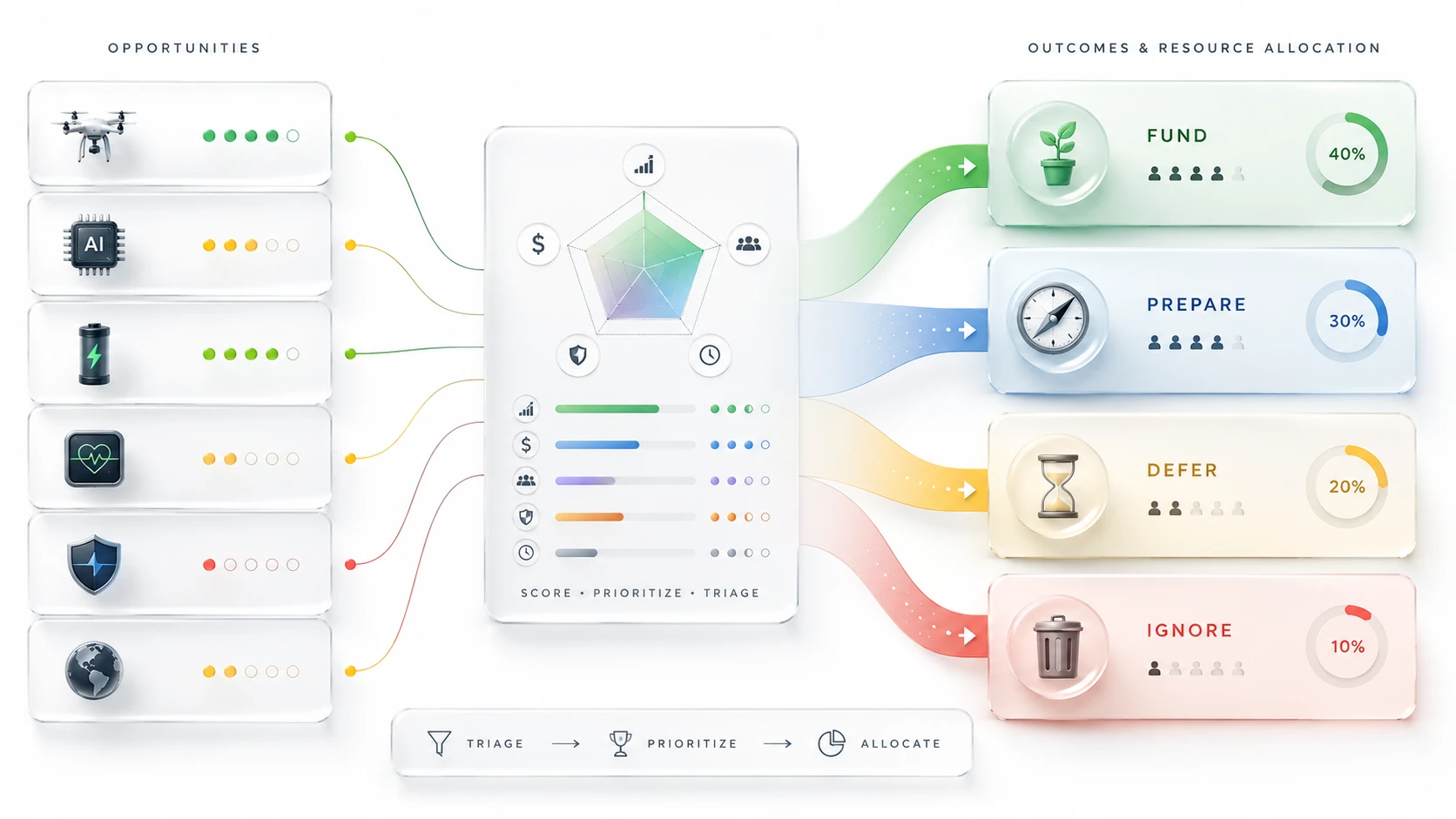
Canonical decision order
Test blockers before you choose a state
The order matters because it prevents a team from jumping directly to Fund after seeing an attractive opportunity. The queue uses an explicit precedence so that uncertainty and terminal exclusions cannot be averaged away by positive signals elsewhere.
- Confirm the comparison handoff.
Bring forward the bounded opportunity, decision horizon, commercial context, overlap/dependency findings and decision-changing evidence from the preceding comparison. If the handoff is missing, the immediate work is preparation rather than funding.
- Resolve material uncertainty first.
If a required field is unresolved or material evidence is contradicted, stop classification. Record what evidence is needed and who owns the next evidence action.
- Apply terminal exclusion rules.
Outside-scope opportunities, unsupported commercial paths, infeasible approaches, opportunities outside the decision horizon and terminal dependencies belong in Ignore under the current scope.
- Separate external waiting from internal preparation.
An external evidence event, external blocker, unavailable capacity, later timing window or external dependency means Defer. An internal evidence, readiness, measurement, capacity or dependency gap means Prepare.
- Use Fund only after every advance condition passes.
Fund is reached only when the handoff is complete and scope, commercial support, evidence, readiness, capacity, measurement, timing and dependency conditions all support advancing to the next approval gate.
Fast action + governed handoff
Four-State Investment Queue Workspace
Use the same deterministic engine as the workbook. The state is analytical; record completeness is a separate governance check. Nothing is submitted to SERPIFAI.
- Why
- Next action
- Canonical movement rule
- Reason code
- Next-stage handoff
Portable handoff
Queue record
Local browser utility: no network request is created by this workspace. Copy the record into your own decision system when the state and the handoff record are both decision-ready.
Deep work
Five worked examples: four states plus a refusal
The examples are fictional and illustrate the method rather than claiming market results. Notice that the same apparent “priority” can lead to different states because the blocker and next action differ.
Buyer-specific solution comparison
Northbridge has a complete territory comparison, a supported buyer-to-offer path, adequate first-party evidence, an available editor and subject-matter reviewer, a measurement plan and no blocking dependency.
Decision: advance to the funding approval gate. Movement condition: the final approval must still carry explicit reversal conditions; the queue itself does not authorize spend.
AI-answer visibility benchmark
The opportunity is commercially relevant and inside scope, but internal observation coverage is incomplete and the team cannot yet reproduce the baseline consistently.
Decision: prepare. Owned work: complete the observation protocol and baseline. Exit condition: repeatable evidence and measurement readiness.
Market-entry content programme
The commercial case is credible, but the product will not be available in the target market until a partner launch date outside the current quarter. The SEO team cannot remove that external timing dependency.
Decision: defer. Trigger: confirmed launch readiness. Review: at the agreed pre-launch checkpoint, not every weekly planning meeting.
Broad trend-news traffic expansion
The proposed traffic theme has volume but does not map to the defined buyer, offer or commercial outcome. It is outside the investment decision’s commercial scope.
Decision: ignore under this scope. Reopen only if: the buyer/offer model materially changes and a decision-relevant commercial path can be demonstrated.
Conflicting conversion evidence
Sales-call evidence suggests strong buyer demand while current site behaviour points in the opposite direction, and the disagreement has not been resolved. A team member proposes “Prepare” merely to keep the item alive.
Decision: refuse classification. Resolve the contradiction first. A queue state must not become a workaround for uncertain evidence.
Movement, not label permanence
A state is a controlled instruction until evidence changes
The queue becomes useful over time only when movement is evidence-led. Every active row should record both the current state and the condition that could justify a different state. A calendar review can trigger reassessment, but the date alone should not automatically promote an opportunity.
| Current state | Typical movement | Evidence required to move | Bad reason to move |
|---|---|---|---|
| Fund | To the next approval/reversal stage; or back to Prepare/Defer/Ignore if a gate changes | Current approval evidence plus explicit reversal/stop conditions; material new blocker if moving backward | “It was ranked first last month” |
| Prepare | Fund when internal prerequisite work is complete; Defer if the blocker becomes external; Ignore if the case fails | Named deliverable completed and verified against the exit condition | “We have worked on it for a long time” |
| Defer | Reassess when the external trigger occurs; Prepare if the remaining work becomes internal | Observed trigger, new capacity or changed timing/dependency evidence | “The review date arrived” without changed evidence |
| Ignore | Reopen only after a material scope, commercial, feasibility, horizon or dependency change | Evidence that directly invalidates the original exclusion reason | “Someone wants it back on the roadmap” |
| Unresolved | Any of the four states once the blocking uncertainty is resolved | Specific evidence that closes the contradiction or unresolved field | Choosing the least controversial label |
Portable handoff
What a decision-ready queue record must contain
A queue without a record is difficult to audit and easy to reinterpret. The minimum useful record is intentionally short enough to move into a planning tool, decision memo or spreadsheet without losing the logic.
| Field | What it must answer | Why it matters |
|---|---|---|
| Opportunity | What bounded opportunity is being classified? | Prevents a state from drifting across different buyers, markets or scopes. |
| State | Fund, Prepare, Defer or Ignore - or refusal to classify | Turns analysis into an explicit operating instruction. |
| Reason code and explanation | Which gate controlled the state? | Makes the decision challengeable without reverse-engineering a score. |
| Next action | What happens now? | Separates active preparation from passive waiting. |
| Named movement / reopen condition | What exact observed condition permits reassessment or promotion? | Prevents arbitrary state changes and forgotten deferred items. |
| Record completeness | Are opportunity, named condition, owner and review date actually recorded? | Separates a valid analytical state from an incomplete governance handoff. |
| Owner | Who is accountable for the next action or monitoring? | A queue without ownership is only documentation. |
| Review date | When should the state be checked again? | Creates a governance cadence without making time itself a decision trigger. |
| Funding authority boundary | Has funding actually been approved? | Protects the distinction between “eligible to advance” and “authorized to spend.” |
Portfolio governance
Classify opportunities individually, then govern the portfolio collectively
The four-state method is not a command to maximize the number of Fund items. A portfolio can contain several individually eligible opportunities and still lack the capacity to execute all of them well. Capacity, sequencing and shared dependencies therefore matter after state eligibility is established. If capacity is genuinely unavailable, the state may be Defer; if capacity can be created through owned internal work, the state may be Prepare.
Three portfolio rules
- Do not turn capacity into a hidden score. State the actual capacity condition and its owner.
- Do not duplicate dependent work. If multiple opportunities rely on the same prerequisite, make that relationship visible rather than funding each row as if it were independent.
- Do not treat the queue as a budget-allocation model. The queue says what can advance, what must be prepared, what waits and what leaves the active agenda. Budget mix and execution sequencing belong to later decisions.
The UK government’s 2026 Orange Book treats risk and opportunity management as part of option appraisal, resource prioritisation and decision-making, and stresses dependencies, assumptions, accountability and monitoring. The 2026 Green Book similarly separates initial ranking from the fuller judgement required to choose an option and explicitly warns that simple weighting-and-scoring approaches can reduce transparency. Those sources support the governance principles here; they do not prescribe SERPIFAI’s four states.
Common failure modes
What breaks a four-state queue
| Failure | Why it is dangerous | Correction |
|---|---|---|
| Fund means “top ranked” | A high rank can hide a blocker or unresolved commercial path. | Require every advance gate to pass before Fund. |
| Prepare becomes a parking lot | Nothing changes because no internal deliverable or owner exists. | Name the prerequisite, deliverable, owner and exit condition. |
| Defer means “not sure” | Uncertainty is concealed as a legitimate waiting state. | Use Defer only for a named external/timing/capacity condition; otherwise resolve the uncertainty. |
| Ignore means “never” | A good current exclusion becomes false certainty about the future. | State the current exclusion reason and, where material, a narrow reopen condition. |
| Every item gets a state | Contradictions are forced into the system and become false decisions. | Permit refusal to classify until required evidence is resolved. |
| States move by preference | Queue governance becomes score shopping with different labels. | Require observed movement evidence and keep a transition record. |
Decision sequence boundary
What this method consumes - and what it deliberately leaves for later
The queue should consume a defensible comparison rather than recreate one. Bring forward the opportunity boundary, buyer/problem/offer context, incremental-opportunity reasoning, comparability, overlap, dependency, commercial-path evidence, contradictions, reachability, frontier/stability information and decision-changing evidence from the territory-comparison stage.
Ownership boundary
This method owns the state decision. It does not set a budget percentage, define the detailed reversal conditions for final approval, write the one-page executive memo, decide the technical/content/authority budget mix, build a 30/60/90 execution plan or conduct the post-investment review. Those are distinct decisions so the queue can remain legible and auditable.
For a Fund result, the next handoff is especially important: eligibility to advance is not permission to spend. The final approval should define the evidence-based conditions that expand, revise, stop or reverse the investment before commitment.
Deep work and portable handoff
Use the workbook for a portfolio; use the field guide for review
Four-State Investment Queue Workbook
Run a visual queue cockpit, keep the operational register separate from the deep gate inputs, capture the named movement condition, track record completeness, record transitions and inspect state + reason parity fixtures.
- Visual queue cockpit and clean decision register
- Separate deep gate-input surface
- Named movement condition + record-completeness control
- Transition register and worked examples
- Canonical state + reason fixture parity
Four-State Investment Queue Field Guide
A compact printable reference for executive reviews: state definitions, decision order, refusal rule, transition controls, minimum record and handoff boundaries.
- Action-state definitions
- Prepare vs Defer distinction
- State movement rules
- Governance checklist
- Source boundary and evidence limits
Research basis and limits
Governance authorities define the boundary; SEO benchmarks show where current prioritization usually stops
The Four-State Investment Queue is a SERPIFAI synthesis for the post-comparison decision. Cross-domain authorities strengthen evidence, uncertainty, portfolio, capacity, authorization and review principles. SEO sources are used as competitor/practitioner benchmarks: they show that current guidance is strong at ranking and roadmapping, which is precisely why A41 focuses on the later action-state and handoff problem.
Primary governance authorities
- HM Treasury - The Green Book (2026): evidence-led appraisal, uncertainty, viability, dependencies and staged decision-making.
- HM Treasury / Government Finance Function - The Orange Book: integrates opportunity and risk with alternatives, assumptions, dependencies, ownership, resource prioritisation and monitoring.
- IFRS Foundation - IASB prioritisation framework: distinguishes technical and operational considerations, including capacity, timing, active/pipeline work, pause/restart and retirement.
- Project Management Institute - portfolio-management standard overview: useful for the boundary between prioritisation/selection and later authorization/resource allocation, plus portfolio review of ownership, dependencies and capacity.
- ISO 21504:2022 - Guidance on portfolio management: independent cross-organisational portfolio-management context; used only at the level supported by the public abstract.
SEO / prioritization benchmark sources
- Search Engine Land - How to create an SEO roadmap: impact, effort, dependencies, execution-team feedback and reprioritisation.
- Search Engine Land - SEO prioritization: How to focus on what moves the needle: high-impact focus and prioritisation patterns.
- Search Engine Land - 4 ways to strengthen buy-in for technical SEO work: business-impact translation, stakeholder requirements and implementation context.
- Seer Interactive - How to Prioritize SEO Opportunities: a weighted SEO opportunity scorecard benchmark.
- Ahrefs - How to Build an SEO Roadmap in 7 Steps: impact-effort categories and the roadmap as a living prioritisation document.
- Ahrefs - Keyword Research / Business Potential: a reminder that keyword value requires business value, not search metrics alone.
- Ahrefs - How to Get SEO Buy-In: decision-maker and stakeholder constraints around SEO implementation.
- Atlassian - Prioritization matrix: general collaborative impact/resource prioritisation benchmark.
Evidence limit: none of these sources validates SERPIFAI’s four labels or proves SEO investment outcomes. The governance sources are cross-domain analogues; the SEO sources are competitor/practitioner patterns. The four-state method is SERPIFAI’s bounded synthesis for this specific decision handoff.
Answer-ready questions
Questions decision-makers ask about the four states
What is the difference between Prepare and Defer?
Prepare requires active internal work. The organisation can resolve the blocker by completing a named prerequisite, evidence task, measurement setup, readiness task or capacity action. Defer waits behind an external, timing or unavailable-capacity condition. The distinction is who can change the state now.
Does Fund mean the budget is approved?
No. In this method, Fund means the opportunity passes the state-eligibility gates and can advance to funding approval. Spending authority, budget amount, allocation mix and detailed reversal conditions remain separate approvals.
When should an opportunity be left unresolved?
Leave it unresolved when a required decision field is materially unknown or when evidence is contradicted. Do not use Prepare or Defer simply to avoid saying that the evidence is not decision-ready.
Is Ignore permanent?
No. Ignore is a current-scope instruction. A material change in scope, commercial support, feasibility, decision horizon or dependency can justify reopening the item if that change directly addresses the original exclusion reason.
How many opportunities should be in Fund?
There is no fixed number. Fund eligibility is assessed opportunity by opportunity, while the portfolio still has to respect real capacity, dependencies and later budget decisions. A large Fund list that cannot be executed or measured is a signal to revisit capacity and sequencing rather than invent a quota.
Why not just use an impact-effort score?
A score can help summarize inputs, but it can also allow strength in one dimension to compensate for a blocker in another. The four-state queue is designed for the subsequent governance decision: advance, do internal prerequisite work, wait behind a named condition or remove the item from the active scope.
How do you prioritize SEO when developer, content or analytics resources are limited?
Do not use limited capacity as a vague reason to reshuffle a score. First complete the commercial comparison. Then classify the operating condition: capacity that can be created through an owned internal action is Prepare; genuinely unavailable capacity that the team cannot make available now is Defer. Record the owner, named condition and review date.
What is the difference between an SEO prioritization framework and an SEO roadmap?
A prioritization framework helps decide relative importance. A roadmap sequences planned work. The four-state queue sits between comparison and commitment: it says whether an opportunity can advance, needs internal preparation, should wait behind a condition or should leave the active queue.
How do you stop a deferred SEO backlog from becoming stale?
Every Defer record should name the external/timing/capacity trigger, a monitoring owner and a review date. Reaching the date does not automatically promote the item; the recorded trigger must actually change and the affected decision gates must be reassessed.
When should SEO work be ignored instead of merely deprioritized?
Use Ignore when a terminal exclusion is established for the current decision: outside scope, unsupported commercial path, not feasible, outside the decision horizon or blocked by a terminal dependency. Record a narrow reopen condition so “Ignore” means no active attention now, not “bad forever.”