

Direct answer
Define the evidence that would change the decision before the result is known
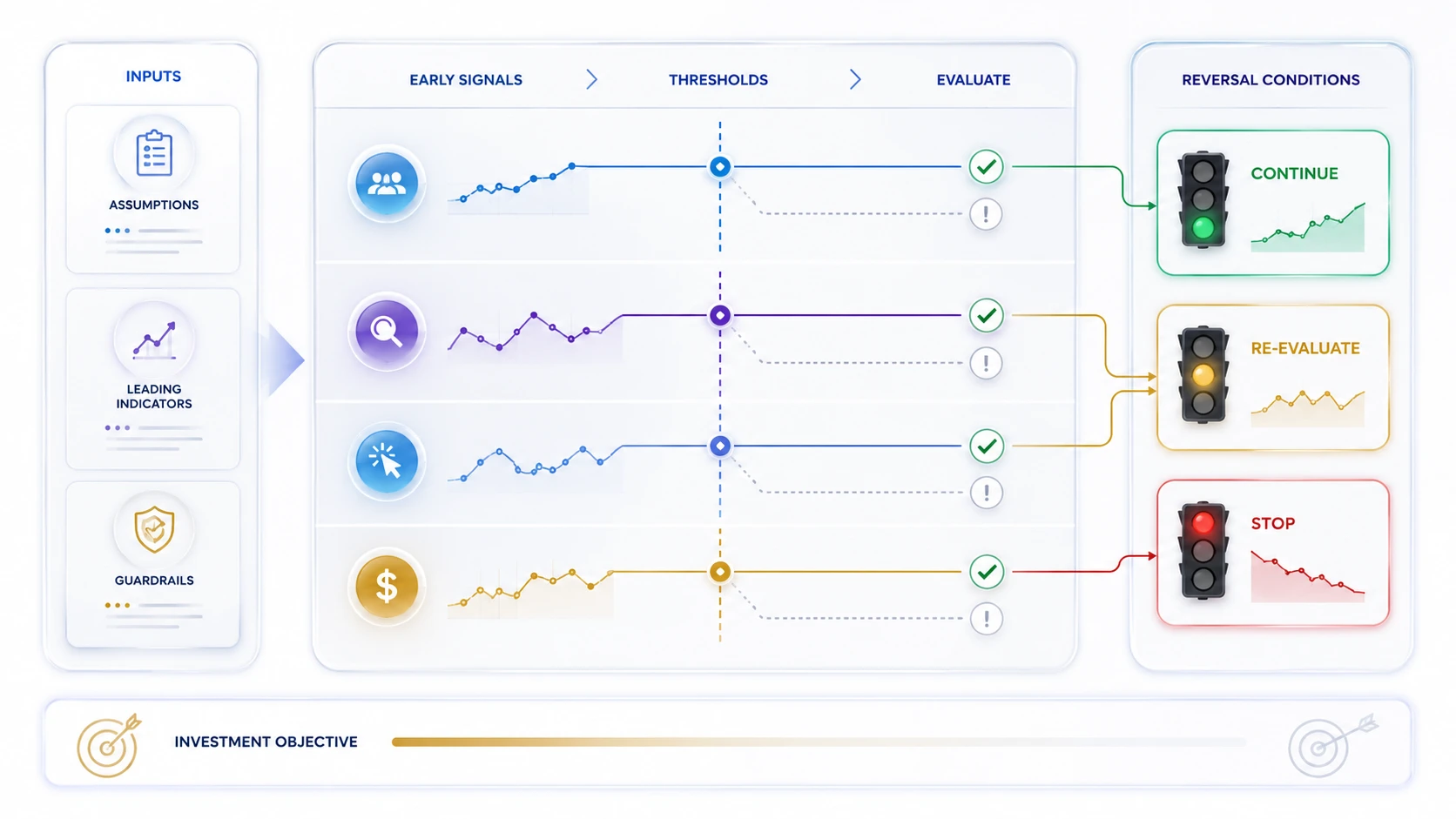
A reversal condition is a pre-agreed rule that links an important assumption to observable evidence, a fair observation window and a decision consequence. It tells the team what would make it reconsider, pause, revise, reduce or reverse an SEO investment.
The condition is not simply a KPI and it is not a success target. A useful condition also states what does not count as clean reversal evidence—for example, broken tracking, incomplete implementation or a review that happens before the evidence can reasonably appear.
Investment Reversal Tripwire
How to read it: select a checkpoint to isolate that part of the method. The canvas shows the relationship; the inspector explains what the checkpoint changes in the decision.
The first distinction
A target tells you what you hope will happen. A reversal condition tells you what would change your mind.
“Generate 40 qualified organic enquiries per quarter.”
Useful for direction and planning.
“If qualified organic demand remains outside the target buyer after two comparable review cycles, despite valid tracking and complete implementation, pause the next tranche and reassess the audience thesis.”
Useful for governing the decision.
A KPI can appear inside a reversal condition, but the KPI alone does not say when the evidence is interpretable, which failure it points to, or what action follows.
SERPIFAI Pre-Commitment Reversal Gate
The smallest complete method uses nine moves
The method deliberately separates the investment, the investment thesis—why you believe it should work—and the decision-critical assumption that must remain true. It then connects that assumption to interpretable evidence, false-trigger protection and explicit governance.
- Define the bounded investment.
Name the decision being approved, not the entire SEO programme. The rule should travel with one recognizable commitment.
- State why the investment should work.
Keep the thesis short enough that another reviewer can challenge it. Example: “Evaluation-stage pages should create qualified discovery among buyers already comparing approaches.”
- Identify what must remain true.
This is the assumption the investment actually depends on: buyer demand, commercial relevance, indexability, delivery capacity, economics or another material premise.
- Choose an observable signal and source.
Prefer evidence close to the assumption and record where it comes from. Rankings and impressions can be useful early signals, but they do not automatically prove commercial value.
- Define when the signal becomes interpretable.
SEO changes can take different amounts of time to appear in Google Search. Google says some effects may appear in hours while others can take months, and generally suggests waiting at least a few weeks before assessing many changes. Your own window still needs to reflect implementation, crawl/indexation, sales-cycle and seasonality realities.
- Write the evidence that would weaken the assumption.
The rule can be numerical or qualitative, and volatile signals may need persistence across comparable reviews. What matters is that another reviewer could recognize the evidence without moving the goalposts after seeing the result.
- Protect against false triggers.
Do not call the thesis invalid when the measurement is broken, the agreed implementation was not delivered, the observation window has not elapsed, or a material external change makes the old comparison invalid.
- Pre-commit the consequence.
Name what happens if valid evidence establishes the condition: investigate, pause, revise, reduce or reverse only to the extent the evidence can justify.
- Assign the review owner and review point.
A condition with no owner or scheduled review can become governance theatre. Record who reviews the evidence and when the next review occurs.
Fast action
Build one credible reversal condition before approval
The builder is for one fast condition. It helps you pre-commit to the evidence that would change the investment decision, while keeping false triggers visible. For several critical assumptions on one investment, use the workbook.
Reversal condition builder · SERPIFAI-PRECOMMIT-REVERSAL-1.1.0
Define what future evidence would change the decision
Plain-language inputs. Live qualitative checks. No score, no storage and no network request.
A rule for what future evidence would change this SEO investment decision.
The investment, what must remain true and evidence that would genuinely change your mind.
A reversal condition, false-trigger guardrails and an approval-ready decision card.
Approval decision card
Condition quality coach
Qualitative checks only. A PASS means the design field is explicit enough for this pre-approval record; it does not prove the future evidence is true.
Investment
Not set
Why it should work
Not set
What must remain true
Not set
What we will watch
Not set
When it is fair to judge
Not set
What would change the decision
Not set
Complete the core evidence and consequence fields to generate the pre-committed rule.
False-trigger guard panel
Pre-committed consequence
Not set
Owner · next review
Not assigned · Not scheduled
Evidence source
Not recorded
Deep work
Design several conditions for one investment
Use the workbook when one serious investment depends on multiple critical assumptions. It keeps the first condition simple, adds only necessary evidence/governance depth and produces an approval brief.
Open the reversal-condition workbookExecutive handoff
Carry the method into the approval meeting
The field guide explains the rule, false-trigger guards and quality check, then gives you a compact approval card without duplicating the workbook.
Open the executive field guideValidity gate
Four common reasons not to declare the SEO thesis dead yet
1. The window has not elapsed
Google documents that search effects can take from hours to months depending on the change. A fixed “three-month rule” or “six-month rule” is therefore too crude to use as a universal reversal threshold.
2. Measurement is not valid
If tracking, attribution or the baseline is materially broken, you do not have clean evidence about the thesis. Repair measurement before interpreting the signal as strategic failure.
3. The agreed implementation was not delivered
A strategy has not been fairly tested when core technical fixes, pages, internal links, distribution or other agreed prerequisites were never completed. Record implementation failure separately from thesis failure.
4. The environment changed
A buyer shift, market shock, product change or search-platform change can make the original assumption stale. That can justify reopening the investment, but it is not the same as proving the original execution was poor.
Bad result ≠ invalid thesis. First ask whether the evidence is timely, measurable, implementation-valid and still comparable to the original assumption.
No fake precision
How to choose a reversal threshold when no universal percentage exists
A threshold should be precise enough to change the decision, but it does not need a percentage merely to look rigorous. Use the strongest observable condition your evidence can support.
| Threshold form | Useful when | Example | Main risk |
|---|---|---|---|
| Numeric | The metric is stable, decision-linked and measured consistently. | “Cost per qualified organic opportunity remains above the approved ceiling across two comparable reviews.” | False precision when the baseline or attribution is weak. |
| Pattern | Repeated evidence matters more than one point estimate. | “Target-buyer engagement deteriorates across two complete review cycles while implementation remains valid.” | Vague language unless the pattern is observable. |
| Contradiction | The investment depends on a qualitative assumption. | “Sales interviews repeatedly show the search problem is not part of the buyer’s evaluation process.” | Cherry-picking anecdotes. |
| Constraint breach | Economics, capacity, compliance or delivery feasibility can invalidate the investment. | “Required production cost exceeds the approved envelope and the value case cannot be restored at smaller scope.” | Confusing temporary delivery friction with a permanent constraint. |
For volatile signals, add persistence: two comparable reviews, a defined sequence of observations, or a specific event. For slow commercial outcomes, use earlier evidence only as an interim signal—do not let an easy leading indicator permanently substitute for the outcome that justified the investment.
Adversarial examples
Four cases that expose weak reversal logic
Rankings improve, leads do not
Do not call this success automatically. If the thesis was qualified demand, rankings are only an upstream signal. Check whether the pages attract the intended buyer and whether the commercial path is working.
Possible condition: revise or pause expansion if qualified demand remains absent after the agreed window even though the visibility layer is working.
Traffic falls after tracking breaks
Do not call this thesis failure. The evidence system is invalid. Repair measurement, preserve the original condition and restart or extend the observation window only to the extent needed to obtain comparable evidence.
Developers deliver half the technical plan
Do not pretend the strategy received a fair test. Record implementation failure. The pre-commitment record should have stated the minimum implementation needed before the evidence clock starts.
Search behaviour changes materially
Reopen the assumption. If buyers migrate to a different discovery path or the addressable search opportunity changes, the original thesis may need revision even if the SEO team executed well.
Portable handoff
A reversal condition is incomplete until someone owns the review and the consequence
The UK Government’s benefits-management guidance emphasizes clear accountability, planned monitoring and review across an investment lifecycle. This method applies that governance principle to SEO without pretending the government guidance supplies SEO-specific thresholds.
| Record | Why it matters |
|---|---|
| Investment and original thesis | Prevents the team from silently changing what the budget was meant to prove. |
| Decision-critical assumption | Shows which belief the evidence is actually testing. |
| Signal and evidence source | Makes the observation traceable and challengeable. |
| Observation window and persistence | Reduces premature stopping and overreaction to one volatile observation. |
| Reversal evidence | States what would weaken or invalidate the reason for investing. |
| False-trigger guards | Separates thesis failure from measurement, implementation, timing and external-change problems. |
| Action, owner and review date | Turns a warning into a governed next decision. |
This method defines the condition before approval. The Post-Decision Monitoring and Reversal Loop governs ongoing observation after approval. The Post-Investment Review interprets live evidence and releases the later continue, expand, pause, redesign or reverse action. Keeping those jobs separate prevents this pre-approval method from becoming a monitoring dashboard or retrospective review tool.
Beginner questions
Questions people ask before they trust a reversal rule
What is a reversal condition?
A pre-agreed rule describing the future evidence that would make you reconsider an investment, when that evidence becomes fair to judge, and what action follows.
Is a reversal condition just a KPI?
No. A KPI describes performance. A reversal condition connects performance or other evidence to an assumption, a review window and a decision consequence.
Is it the same as a target?
No. A target says what you want to happen. A reversal condition says what evidence would make you change the decision.
Does reversal always mean stopping SEO?
No. Depending on what the evidence can justify, the pre-agreed response may be investigate, pause the next tranche, revise the thesis or scope, reduce exposure, or reverse the investment.
What if rankings improve but leads do not?
Judge the investment against the reason it was funded. If the thesis was commercial demand, rankings are an early signal rather than the final proof.
What if SEO needs more time?
Define the evidence window before approval. If the window has not elapsed, do not classify insufficient time as strategic failure.
What if tracking is broken?
Treat it as measurement failure. Repair the evidence system before using the affected data to judge the thesis.
Do I need a percentage threshold?
No. Use a number only when the metric and baseline support it. A repeated pattern, explicit contradiction or constraint breach can be more honest and more decision-useful.
Can the condition change later?
Yes, but not silently after seeing an inconvenient result. Preserve the original condition, record why the context changed, and reapprove the revised rule before using it.
Evidence and method boundary
Sources support the evaluation disciplines; SERPIFAI owns the SEO decision method
The sources below support specific principles such as delayed search effects, lifecycle evaluation, causality/context analysis, ownership and review. They do not certify the SERPIFAI framework and they do not provide a universal SEO stop threshold.
- Google Search Central — SEO Starter Guide Search changes can take very different amounts of time to appear; timing must be interpreted rather than assumed.
- Google Search Central — Core updates and reassessment timing Some effects can take several months, reinforcing the need for a fit-for-purpose evidence window.
- UK Government — Magenta Book 2026 Evaluation should be designed and used across the lifecycle rather than added only after delivery.
- UK Government — Magenta Book Annex A Theory-based evaluation considers whether an intervention caused an impact, how, why and under what context.
- Government Project Delivery — Teal Book, benefits management Supports explicit ownership, monitoring, reporting, review and evaluation arrangements.
- UK Government — Green Book 2026 Provides broader investment-appraisal context for costs, benefits, risks and management arrangements.