

Answer first
A one-page decision memo is a decision interface, not a smaller report
A one-page executive decision memo states one bounded decision, the recommended choice, why that choice is strongest now, the few pieces of evidence that materially support it, the strongest reason it could be wrong, the exact decision you need from the executive, and the first owned action after the decision. Detailed research stays behind the page through traceable supporting references.
The one-page constraint should remove non-decision detail. It should not shrink the typography, erase uncertainty or convert a complicated analysis into unjustified certainty.
Can the reviewer see the choice and your preferred answer immediately?
Can they see the case, the strongest counter-case and exactly what is requested?
Can they see what happens next, who owns it and where the detail lives?
These are editorial scan heuristics for QA, not measured user-testing results.
Fast executive map
Use eight visible moves
The deeper evidence engine can preserve alternatives, source roles, observed/inferred/unresolved states, assumptions, review dates and an upstream reopen condition. A beginner should not have to confront all of that before writing the decision.
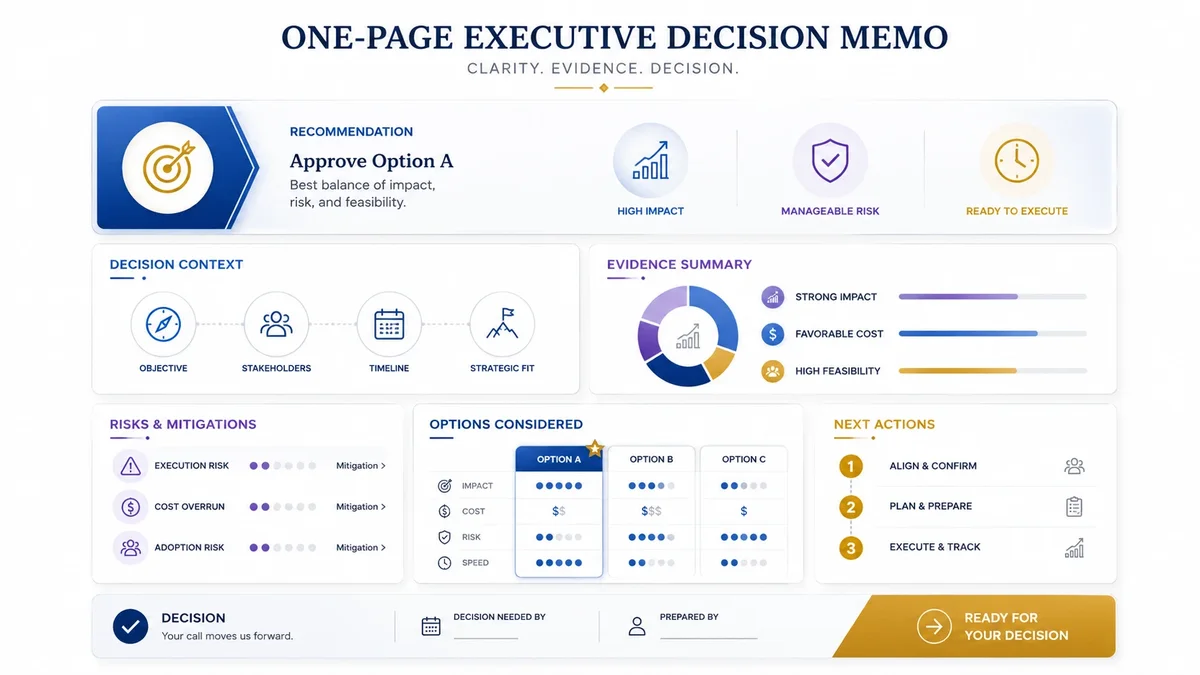
Finished memo anatomy
What belongs on the executive page
Recommendation
Approve the bounded pilot; do not approve the full programme yet.
Why this
Current evidence supports a reversible first move that can generate first-party commercial evidence before a larger commitment.
Key evidence
Keep only evidence that changes the recommendation, action size, decision request or boundary. Label inference when interpretation is doing work.
Strongest challenge
No first-party conversion history exists for the exact territory, so the larger investment remains unproven.
Decision request
Approve the pilot and its named owner.
Action + owner
Launch the first asset and evidence test - Head of SEO.
A useful memo is not a summary with a recommendation added at the end
“Organic search is an important opportunity…”
Three paragraphs of background, eleven metrics, a SWOT table and a final line saying “we recommend investing further.” The executive still has to infer the choice, approval and strongest challenge.
“Decision: approve the six-week pilot?”
The recommendation follows immediately. Two material evidence items support it. One counter-case is visible. The exact approval, first action, owner and supporting-analysis route are explicit.
Evidence → One-Page Decision Memo
How to read it: select a checkpoint to isolate that part of the method. The canvas shows the relationship; the inspector explains what the checkpoint changes in the decision.
1. Decision: write the choice before the context
A topic is not a decision. “SEO opportunity in category X” describes subject matter. “Approve a six-week pilot in category X?” gives an accountable reviewer something to decide.
If an executive can answer the first line with approve, reject, choose A/B, defer, or request one specific missing condition, you probably have a decision. If the answer is “interesting,” you probably have a topic.
2. Recommendation: state your judgment
The recommendation says what you think should happen. It can receive an upstream investment state or prioritization result, but A43 does not recreate those engines. If your analysis already concluded Fund, Prepare, Defer or Ignore, carry the relevant conclusion into the memo and explain it in ordinary executive language.
3. Why: connect the evidence to the decision
Evidence and rationale are different. Evidence is the inspectable support. Rationale explains why that support makes the recommendation stronger than the credible alternative for this particular choice.
“Competitor A ranks for 2,000 queries” is evidence only if the source and meaning are clear. “That footprint matters because it repeatedly captures the same buyer-comparison intent that our sales team says delays purchase decisions” is rationale - and it may include inference that should be labelled.
4. Evidence: include only what changes the choice
Material evidence changes at least one of four things: the recommendation, the size of the action, the exact decision request or the review boundary. Everything else can remain in the supporting record.
What the cited source or measurement directly shows.
What the evidence reasonably suggests after interpretation.
What the current evidence cannot settle yet.
An “observed” label does not make a claim important, causal or correct forever. It only tells the reviewer what kind of claim they are reading.
5. Challenge: show the strongest material reason you could be wrong
Contrary evidence is not a generic caveat. It is evidence or a material unknown that pushes against the recommendation. A useful challenge line lets the executive see whether the recommendation survives scrutiny or should become smaller, conditional or deferred.
Risk and uncertainty are not the same thing. A risk is a known potential adverse outcome or condition. Uncertainty is something material you do not know. An assumption is something you temporarily treat as true despite incomplete support. Keep those distinctions clear when they change the decision.
6. Ask: recommendation and decision request are different
What you think should happen.
Approve the bounded pilot.
What you want the executive to approve, reject or choose now.
Approve six weeks of work, the named owner and the agreed evidence test.
Avoid “thoughts?”, “please review” or “support the strategy.” Those request discussion, not a bounded decision.
Authority check: send the memo to the decision maker or approver who can actually grant the requested approval. If that authority is unclear, resolve it before treating a recommendation as an approved decision.
7. Action: name the first move and the accountable owner
The decision is the choice. The action is what happens after the choice. The decision owner and action owner may be different people. Your memo should at least make the next action owner explicit enough that the handoff cannot disappear into a team name.
8. Handoff: keep the page small and the evidence inspectable
A source citation tells the reader where a claim came from. Decision provenance is broader: it preserves what was decided, why, which evidence mattered, what could make it wrong, what remained uncertain, the action owner and where the supporting analysis lives.
If an upstream reversal/reopen condition has already been defined, carry only the concise condition needed to govern the handoff. Do not redesign thresholds or recreate the A42 engine inside this memo.
Fast action product
SERPIFAI Executive Decision Memo Builder
Start from a decision pattern, load a governed fictional example, or paste a prior SERPIFAI brief. Guided mode asks one question at a time; Analyst mode exposes the whole record. Templates never invent evidence, and the tool makes no network or AI calls.
Creates decision, recommendation, ask and first action. It deliberately leaves evidence, rationale and challenge for you to substantiate.
Examples are explicitly fictional and replace the current builder fields so you can see a complete memo immediately.
Import recognized fields
This is also the private save/resume path: copy a structured brief, keep it where you choose, then paste it back here later.
Write one bounded choice somebody can approve, reject or choose.
Advanced: credible alternative
Do not summarize the report. Explain why the evidence changes this decision.
Advanced: uncertainty, assumption and upstream condition
Review the memo and hand it off
The preview is standalone text. Copy the memo, save/resume through the structured brief, create an email-ready version, switch to meeting view or print the executive memo.
All remaining gaps
- Decision is missing.
Deep work
The executive page and the evidence record should be deliberately separate
| On the page | Behind the page | Remove from this decision |
|---|---|---|
| Bounded decision and recommendation | Full alternatives, trade-offs and calculations | Background that does not change the choice |
| Decision-linked rationale | Evidence statements, sources, dates and implications | Metric inventories without decision relevance |
| 1-2 strongest support items | Additional supporting/context evidence | Duplicate screenshots or repeated evidence |
| Strongest material challenge or uncertainty | Contradiction log, assumptions and unresolved evidence | Boilerplate risk lists |
| Exact decision request | Business case or financial model when needed | Generic “please review” language |
| Next action, owner and support route | Implementation plan and detailed governance | Dense execution detail that belongs after approval |
Worked examples
Three fictional decisions show how the same method changes with the evidence
Approve a bounded SEO pilot
Raw analysis: a large competitor-evidence pack, query comparisons, fictional sales notes and delivery constraints.
Remove: duplicate competitor screenshots, raw keyword inventories and metrics that do not change the decision.
Decision: Approve a six-week buyer-comparison SEO pilot?
Recommendation: Approve the bounded pilot; do not approve the full programme yet.
Why: The current fictional evidence supports a reversible first move that can generate first-party commercial evidence before larger commitment.
Challenge/uncertainty: No first-party conversion history exists for this exact territory.
Ask: Approve the six-week pilot and named owner.
Next action / owner: Launch the first decision-support asset and evidence test — Head of SEO.
Supporting analysis: Fictional evidence record A43-A.
Defer a competitor-led opportunity until buyer evidence exists
Decision: Commit budget to the territory this quarter?
Recommendation: Defer the budget decision and approve only a short evidence test.
Why: Competitor visibility and estimated demand are strong, but the fictional record does not establish that the buyer treats the problem as purchase-relevant.
Challenge: High competitor investment could represent real demand or merely awareness content.
Unresolved: Buyer urgency is not yet known.
Ask: Approve the evidence test, not the full budget.
Action / owner: Run structured buyer interviews — Strategy Lead.
Approve phase one with an already-defined reopen condition
Decision: Approve phase one of the programme?
Recommendation: Approve phase one within the existing evidence boundary.
Challenge: The recommendation weakens if the assumed sales-use case is not observed.
Ask: Approve phase one under the upstream condition.
Condition: Carry the concise A42 handoff condition; A43 does not redesign the trigger or threshold.
Action / owner: Launch phase one and record the first review evidence — CMO.
Design the memo to travel without you
A good executive memo should survive email, Slack, a meeting agenda, a printed packet and a later audit of “why did we decide this?” The web builder therefore produces plain-text memo, structured brief and email-ready outputs rather than a screenshot that depends on the interface.
The premium workbook serves a different job: it preserves the deeper evidence record and compresses selected material evidence into the executive page. The PDF is a meeting-ready handoff. The toolkit field guide remains the compact operational playbook; this Insights page owns the deeper method and coordinated product.
AEO / executive questions
Common questions about executive decision memos
What is a one-page executive decision memo?
It is a standalone page organized around one bounded choice: the decision, recommendation, decision-linked rationale, material evidence, strongest challenge or uncertainty, exact decision request, next action, owner and supporting-analysis route.
What should a decision memo include?
Include only information required to make, challenge, govern and hand off the decision. Detailed calculations, full research and additional evidence stay behind the page through stable references.
What is the difference between an executive summary and a decision memo?
An executive summary primarily compresses a larger body of information. A decision memo is structured around a choice somebody must make and therefore makes the recommendation, challenge case and decision request explicit.
What is the difference between a decision memo and a decision record?
A decision memo helps a decision maker make or approve a bounded choice now. A decision record or log is optimized to preserve decisions, alternatives and rationale over time. The memo and its structured brief can seed that durable record, but they do not replace a persistent decision log.
Decision memo vs business case: which do you need?
A business case develops the strategic, economic or financial justification in depth. A decision memo asks for a bounded choice using the minimum decision-bearing evidence, with the business case behind it when that depth is required.
How long should a decision memo be?
For this method, the executive decision page is one page because the detailed evidence stays behind it. One page is a product constraint, not a universal rule for every organization or decision.
How do you present competitor analysis to executives?
Do not lead with the competitor inventory. Lead with the decision the competitor evidence changes, state the recommendation, surface only the material evidence and strongest challenge, and link to the full competitor record behind the memo.
How do you communicate an SEO recommendation to leadership?
Translate technical findings into a bounded business decision: what should happen, why the evidence supports it, what could make it wrong, what approval is required and what the first owned action will be.
Should a decision memo include risks and contrary evidence?
Include the material downside or contrary evidence that could change the recommendation or action size. Avoid generic risk lists that do not affect the choice.
How much evidence belongs on one page?
Only enough evidence to support and challenge the decision. If a fact does not change the recommendation, action size, decision request or boundary, it usually belongs in the supporting record.
What is a decision request?
It is the exact approval, rejection or choice you want from the executive now. It is separate from the recommendation, which states what you think should happen.
How can you write a decision memo quickly without starting from a blank page?
Start from a decision pattern or a governed example, then replace the structure with your own evidence, rationale and challenge. The builder can also re-import its structured brief so you can resume work without an account, server or hidden AI rewrite.
How does a reversal condition fit into the memo?
If an upstream reversal/reopen condition has already been defined and remains material, carry its concise decision boundary into the memo. Detailed condition design stays in the upstream A42 method.
Method, evidence and limits
What informed this method - and what it does not claim
This method synthesizes established decision-writing, option-appraisal, evidence-quality, uncertainty and decision-record practices. External sources support component principles; none validates SERPIFAI's exact eight-step method or proves that a one-page memo improves business outcomes in every organization.
- Atlassian — DACI decision template: roles, options, decision and follow-through.
- GitLab — Making decisions: written context and durable organizational decisions.
- HM Treasury — The Green Book 2026: options, evidence and uncertainty in accountable appraisal.
- UK Government — The AQuA Book: fit-for-purpose analysis and quality assurance.
- National Audit Office — Managing uncertainty: questions for decision-makers under uncertainty.
The worked examples are fictional. Starter templates and sentence scaffolds never create evidence; bracketed prompts must be replaced with your own facts and judgment. The web quality coach is deterministic editorial guidance, not a prediction of decision quality, and the builder makes no server, AI, storage or tracking call of its own. The 10/30/60-second scan model is a heuristic. Native Microsoft Excel testing of the downloadable workbook is tracked separately from static file QA.
Monitoring or reference conclusion
The memo is finished when the decision can travel without the analysis disappearing
Use the one-page memo as the decision surface and keep the evidence record behind it. If the next question is how to compare the speed of value with the durability of the advantage, continue to Time to Value vs Defensibility. Reopen this memo when material evidence, an upstream condition or the decision boundary changes.