
Answer first
Analyze answer-engine competitors by role, not by appearance alone
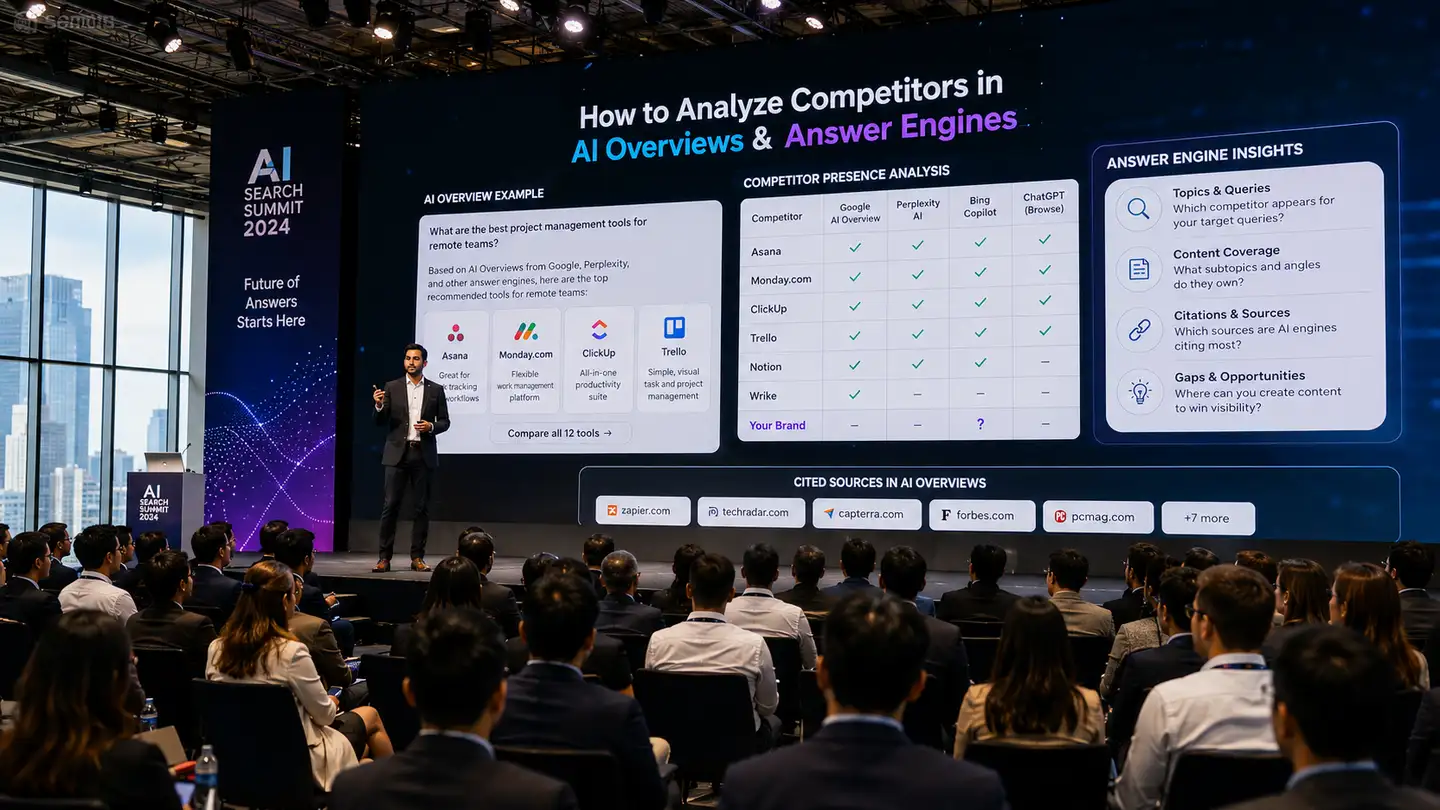
AI-search competitor analysis is the controlled comparison of which brands, pages and sources appear for a defined family of buyer questions, what role each one performs in the generated answer, and whether that role creates a real commercial or evidence gap. A cited publisher can shape an answer without selling against you. A direct rival can be recommended without its own site being cited. An official document can dominate technical support while having no commercial relevance at all.
The practical rule is simple: do not turn visibility into competition until you have classified the answer role and the buyer relationship. Capture the surface first, classify the source second, compare repeated observations third, and only then decide what deserves action. For budget decisions, SEO competitor analysis services test whether the visible entities are also credible buyer alternatives.
Buyer consequence: A competitor appearing more often in AI answers is a signal to investigate, not an automatic instruction to spend. Treat the gap as consequential only when the observed role can materially change discovery, buyer consideration, demand capture or a decision about what to fund.
Five observations that teams often collapse into one “AI visibility” number
The phrase AI visibility is useful as a broad monitoring label, but it hides several different evidence objects. Keep them separate when the decision is competitive.
| Object | Plain-English meaning | What it can support | What it cannot prove |
|---|---|---|---|
| Brand mention | The answer names a company, product or organization. | Presence in the generated narrative. | Recommendation, citation, positive sentiment or commercial competition. |
| Recommendation / comparison | The answer presents an entity as an option, alternative or comparison object. | A stronger commercial signal when buyer scope matches. | That the entity's own page was retrieved or cited. |
| Citation / supporting link | The surface exposes a URL or source as support. | Visible source inclusion for that observed answer. | Endorsement, first-party authority, passage fidelity or durable inclusion. |
| Passage contribution | Content from a source appears to support a specific claim, definition, comparison or procedure. | A source-role and answer-contribution hypothesis that can be checked against the cited page. | Why the platform selected the source or whether the contribution will recur. |
| Commercial competitor | An entity competes for substantially the same buyer, job, budget or decision. | Competitive response and prioritization. | That every page mentioning or citing it is also a competitor. |
Counterexample: A government standard, documentation page, analyst report or Reddit thread may be highly influential in an answer and still be a non-rival source. Conversely, a rival may be recommended because a third-party comparison page mentions it, even when the rival's domain is never cited.
Who needs this analysis—and what job are they actually trying to finish?
This analysis is not a generic brand-monitoring exercise. It is most useful when a team must decide why another entity or source is shaping a decision-relevant answer and what evidence should be collected next.
SEO / AEO / GEO practitioner
Trigger: a competitor appears more often across important answer surfaces.
Job: separate a retrieval/citation gap from a brand, entity, content or authority gap.
Output: a reproducible observation ledger and first material failure.
Content or editorial lead
Trigger: third-party pages or competitors supply the definitions, comparisons or evidence reused in answers.
Job: identify the missing answer role without rewriting everything.
Output: a bounded content/evidence brief tied to the observed passage role.
Competitive-intelligence / strategy lead
Trigger: AI answers introduce substitutes, publishers, marketplaces or category framers that were absent from the traditional competitor list.
Job: distinguish true commercial rivals from ecosystem influencers.
Output: a competitor/source map that can be defended to leadership.
Executive or budget owner
Trigger: a team asks for investment because “competitors are winning AI search.”
Job: know what was actually observed, what remains inferred, and which intervention is justified.
Output: a decision brief with evidence limits, owner and reopening trigger.
When a decision-relevant AI answer surfaces another brand or source, I need to classify the role and commercial relationship before choosing a tactic, so that I do not spend budget solving the wrong layer of the problem.
The visible pain is “they appear and we do not”; the root cause can sit in six different places
| Symptom | Possible root cause | Common bad response | Smallest valid next test |
|---|---|---|---|
| Rival is recommended, your brand is absent | Entity/category association, buyer-query fit, third-party evidence, retrieval or brand evidence. | Rewrite the homepage for “AI.” | Identify the answer's recommendation evidence and the sources that support the category relationship. |
| Publisher is cited repeatedly | The publisher supplies comparison, definition or evidence that the answer needs. | Treat the publisher as a product competitor. | Classify its source role and inspect the supported passage. |
| Your site ranks but is not cited | Search and answer authority may diverge; retrieval, passage fit or source role can differ. | Assume ranking authority should transfer automatically. | Compare matched search evidence with matched answer evidence. |
| Your page is cited but competitor gets recommended | Your page may support a category fact while the answer's commercial choice comes from another source or learned association. | Count the citation as a commercial win. | Separate citation from recommendation and inspect answer-level contribution. |
| One prompt changes day to day | Stochastic generation, source-set change, query interpretation or surface variation. | Chase every snapshot. | Repeat a governed prompt family across dates and relevant surfaces. |
| Tool reports a visibility gap | The tracked prompt set may not match your real buyer task or market. | Treat the vendor metric as market truth. | Audit prompt ownership, locale, surface and buyer relevance before action. |
Strategic consequence: misclassification creates expensive work in the wrong team. A publisher-role gap belongs to evidence/source strategy; a direct-provider recommendation gap may require entity, product, authority or third-party evidence work; an access problem belongs upstream in technical eligibility. The diagnosis should reduce the work surface, not expand it.
What current AI-visibility tools measure well—and the decision they still leave to you
Current products are increasingly good at observing prompt-level mentions, citations, source domains, position or share-of-voice style metrics. That is valuable monitoring evidence. The unresolved analytical step is deciding whether the observed entity or source is a commercial rival, substitute, reference authority, publisher, marketplace, community source or evidence provider for the buyer decision you care about.
| Current method | What it measures well | Decision gap A51 keeps explicit |
|---|---|---|
| Ahrefs Brand Radar / AI competitor analysis | Cross-platform mentions, citations, visibility comparisons, prompt/topic gaps and cited-page analysis. | A visible or cited domain is not promoted into the direct-competitor set until its answer role and buyer/job overlap are classified. |
| Semrush AI Visibility Toolkit | Share of voice, mentions, citations, cited pages, sentiment and competitor comparisons across tracked prompts. | Aggregate visibility remains a monitoring layer; the intervention still depends on the underlying evidence object and commercial relationship. |
| Peec AI | Prompt-level visibility, citation/source analysis, competitor benchmarks, position/sentiment and model-level monitoring. | A citation gap is separated from a commercial-competitor gap; source role and passage contribution can route the action elsewhere. |
| Scrunch AI | Prompt monitoring, citations, competitor presence, personas/regions, page audits and AI-referral/agent-traffic analysis. | Monitoring and optimization signals are kept downstream of a governed scope so unlike locales, surfaces or buyer jobs do not silently mix. |
| OtterlyAI | Prompt libraries, brand mentions, citations, competitor tracking and change monitoring across multiple AI-search surfaces. | Winners/losers and citation frequency are evidence to inspect, not a replacement for classifying whether the source is a rival, authority, publisher or other non-rival influence. |
| AthenaHQ | Visibility, mentions, citations, prompt/demand intelligence, competitive movement and business-impact reporting. | Business impact is interpreted after the evidence path is valid; an outcome metric cannot repair a broken source-role or buyer-overlap classification. |
| Manual observation | Exact answer wording, visible links, answer order, qualifiers and nuanced source context. | A repeatable ledger adds scope, provenance, role taxonomy, comparison discipline, handoff readiness and reopening rules. |
Competitive-content gap: many workflows move from “competitor appears” to a content, citation or share-of-voice action. This guide inserts a role-and-relationship gate so the intervention follows the evidence object rather than the dashboard label.
Build the prompt set from buyer decisions, not from a random list of clever questions
A prompt universe should be broad enough to expose different answer roles but narrow enough that repeated observations mean something. Start with the buyer decision, then sample materially different question families.
Category / definition
“What is enterprise SEO software?” “What does an answer-engine monitoring platform do?”
Likely roles: definitions, official references, category educators.
Problem / diagnostic
“Why are large sites losing crawl coverage?” “Why is our brand absent from AI recommendations?”
Likely roles: technical authorities, practitioners, solution providers.
Comparison / alternatives
“Platform A vs Platform B.” “Best alternatives to X for multi-market teams.”
Likely roles: direct providers, substitutes, publishers, marketplaces.
Implementation / evidence
“How do large sites manage crawl budget?” “How do I measure ChatGPT referrals?”
Likely roles: official documentation, technical references, implementation guides.
Purchase / selection
“Best enterprise SEO platform for international teams.”
Likely roles: providers, review sites, analyst sources, marketplaces.
Risk / objection
“What are the limitations of AI visibility tracking?”
Likely roles: research, documentation, critical analysis, vendors.
Rejected-query ownership: This guide does not cover generic “what is AI visibility?”, passage rewriting for extraction, entity-vs-keyword diagnostics, or search-authority-vs-answer-authority comparison. Those are downstream or adjacent tasks and should remain linked rather than duplicated.
Qualitative keyword and query matrix
Use keywords as clues to the reader's decision stage, not as a density target. Without licensed volume/KD data, the useful research product is a qualitative matrix that maps each query family to the answer object the reader expects and the evidence the analysis must preserve.
| Query family | Likely intent / stage | Expected answer object | A51 ownership |
|---|---|---|---|
| AI search competitor analysis | Method / evaluation | A governed competitor-analysis workflow | Primary |
| AI Overview competitor analysis | Surface-specific analysis | Observation protocol + competitor/source classification | Primary supporting |
| answer engine competitor analysis | Cross-surface method | Comparable evidence model across answer engines | Primary supporting |
| AI visibility competitor analysis | Monitoring → decision | How to interpret mentions/citations without collapsing roles | Supporting |
| AI share of voice competitors | Measurement | When aggregate visibility is useful and what it cannot decide | Supporting boundary |
| competitor citation gap analysis | Diagnostic | Source/passage gap separated from commercial rivalry | Supporting |
| competitors in ChatGPT / AI Overviews | Surface observation | Prompt/surface/date evidence + commercial classification | Supporting |
| AI competitor monitoring template / workbook | Operational handoff | Repeatable ledger, comparison and decision brief | Owned by downloadable product |
Map the entities and relationships that actually change the decision
Entity coverage matters only when the relationship is explicit. For competitor analysis, the useful graph is not “domain A appears near domain B.” It is a set of roles connecting a buyer question to an answer, an entity, a source and an evidence contribution.
The same domain can occupy different roles across prompt families. A review publisher can be a citation source for one answer, a comparison authority for another and commercially irrelevant to both. Classification belongs to the observation, not permanently to the domain.
Deep Work · one canonical method
Use six stages: SCOPE → CAPTURE → CLASSIFY → COMPARE → DECIDE → REOPEN
The method is deliberately evidence-first. Do not begin by assigning scores or copying a competitor's page structure.
SCOPE
Freeze the buyer job, market/locale, answer surface, prompt family, device/account conditions that matter, and observation window.
Output: governed scope.
CAPTURE
Save the prompt, generated answer state, visible brands, citations/links, exact URLs, date/time and any passage needed to understand the source role.
Output: raw observation evidence.
CLASSIFY
Assign appearance type, source role, passage contribution and buyer overlap. Mark unresolved relationships rather than guessing.
Output: role-classified record.
COMPARE
Compare like with like across prompt variants, dates and surfaces. Keep recommendation, mention, citation and passage-use observations separate.
Output: bounded competitive pattern.
DECIDE
Identify the first material gap and route it to the smallest intervention: scope, access, entity/category, evidence/source, passage, authority or measurement.
Output: next action with owner and prohibited inference.
REOPEN
Repeat only when scope changes, the source mix materially changes, new evidence contradicts the record, or the intervention needs evaluation.
Output: new observation cycle without erasing history.
The existing framework visual remains the process map
The static framework is useful because it keeps scope, source role and interpretation connected. Use it as orientation; use the six-stage method above as the operating sequence.

Platform reporting can strengthen the observation—but it does not classify the competitor for you
Google Search: Google's current documentation says AI Overviews and AI Mode may use query fan-out and can surface a wider, more diverse set of supporting links. Google also states that ordinary Search eligibility remains relevant and that there is no special AI-only schema or markup required for these features. The dedicated generative-AI Search Console reporting introduced in June 2026 can show site impressions and related dimensions, but site visibility data still does not tell you whether another cited domain is commercially competitive for your buyer task.
Bing: Bing Webmaster Tools' AI Performance reporting exposes cited pages and grounding-query phrases. Microsoft's own guidance warns against reading citation counts as placement or authority and against treating average cited pages as a ranking. That is exactly why the analysis ledger records source role and decision use separately.
ChatGPT search: OpenAI's publisher documentation distinguishes crawler access and referral measurement from outcome guarantees. Allowing OAI-SearchBot and seeing a ChatGPT referral can establish access/referral evidence; neither observation by itself proves a source will be cited, recommended or treated as a commercial authority in future answers.
Keep access → eligibility → retrieval → content/passage selection → synthesis → attribution separate. This method observes the downstream surface and its visible evidence; it does not pretend to reveal a platform's hidden ranking algorithm.
What 2026 research changes—and what it still cannot prove about live platforms
Research evidence update (KDD 2026; independent benchmark): In the KDD 2026 SAGEO Arena benchmark, search retrieval, reranking and generated-answer citation are distinct measured steps. Optimizing one step could harm another. This is a controlled research environment, not Google’s AI Overviews algorithm or a cross-platform market-share study. When comparing competitors, therefore keep query set, sampled surface, time, source role and commercial relevance separate. A competitor’s citation or ranking is an observation; it becomes an investment recommendation only after the evidence connects that competitor to actual buyer choice and a feasible action. Read the SAGEO Arena primary research. This study evaluates an experimental pipeline; it is not a specification for Google Search or other proprietary AI ranking systems.
Recent research supports a more careful measurement vocabulary. A 2026 cross-platform preprint distinguishes citation selection from citation absorption: a source can be selected and cited without contributing equally to the final answer. A SIGIR 2026 controlled two-document RAG study found topical relevance and context/list position more influential than many formatting-only changes when two already-retrieved candidates compete for the first citation. A July 2026 critical survey of GEO research argues that the field spans multiple partially observable stages and that results from already-retrieved contexts should not be promoted into universal claims about organic discoverability.
Those findings are useful for method design, but the boundary matters: controlled RAG experiments and observational datasets are not documentation of Google's, Microsoft's, OpenAI's, Perplexity's or any other commercial system's ranking algorithm. This guide uses them to justify separating evidence objects and repeated observations—not to promise a content formula that “wins citations.”
Classify the source before you decide whether it is a competitor
| Source / entity role | Typical answer contribution | Commercial rival by default? | Typical next action |
|---|---|---|---|
| Direct provider | Product claim, recommendation, alternative or comparison. | Potentially—verify same buyer/job/budget. | Competitive evidence, entity/category and product differentiation review. |
| Substitute | Different solution to substantially the same job. | Potentially. | Map substitution conditions and buyer trade-offs. |
| Publisher / reference | Definition, listicle, comparison, explanation or evidence synthesis. | No. | Inspect source ecosystem, evidence gap and third-party representation. |
| Official authority / documentation | Technical fact, policy, specification or implementation guidance. | No. | Use as authority evidence; do not imitate as a commercial page. |
| Marketplace / directory / review site | Alternative set, reviews, rankings or category framing. | No, though it can mediate competition. | Inspect inclusion criteria, category presence and cited evidence. |
| Community / witness | Experience, troubleshooting, opinion or social proof. | No. | Check representativeness and whether the answer relies on anecdote. |
| Analyst / research source | Market comparison, statistics, methodology or evidence. | No. | Trace methodology and decide whether your evidence base is weaker. |
| Unresolved | Role cannot yet be established. | Unknown. | Collect missing passage, buyer or source evidence before acting. |
Worked example: four visible entities, only one direct competitor
Assume a fictional B2B SaaS team is evaluating the buyer prompt “best enterprise SEO platform for international teams.” The observed answer recommends Provider A, cites Publisher B for a market comparison, cites Official Documentation C for an implementation statement, and cites Analyst D for an adoption statistic.
| Observed item | Surface role | Commercial relationship | Wrong conclusion | Valid next action |
|---|---|---|---|---|
| Provider A | Recommended provider | Same buyer/job in this fictional case | “They rank above us in AI.” | Review the answer's decision criteria, supporting sources and entity/category evidence. |
| Publisher B | Comparison source | Non-rival publisher | “Publisher B is a competitor.” | Inspect why its comparison is useful, what evidence it carries and whether your category representation is accurate. |
| Official Documentation C | Technical authority | Non-commercial authority | “We need a page that looks like documentation.” | Use the primary source for factual boundaries; improve your own technical claim only if a real evidence gap exists. |
| Analyst D | Evidence source | Non-rival analyst | “We lost share of voice to Analyst D.” | Check the study scope, freshness and whether stronger third-party evidence is needed. |
The insight: a flat citation count would put all four in one competitive table. The governed analysis produces four different actions. Only Provider A enters the direct-competitor set; the others enter the source ecosystem that shapes the answer.
Measure four layers separately so one metric cannot overwrite the diagnosis
Observation coverage
How many governed prompt/surface/date observations were captured and are reproducible?
Entity / answer presence
Was the brand mentioned, recommended, compared or absent?
Source / passage use
Was a URL cited, and what claim, definition, comparison or procedure did it appear to support?
Commercial consequence
Does the role affect the same buyer decision, and is there evidence that action is warranted?
Aggregate metrics such as share of voice can be useful for monitoring a fixed prompt universe. Keep the underlying records so the team can answer the harder question: which kind of visibility changed, for which buyer task, and what source or entity role created the change?
Answer Surface Competitive Lens
How to read it: select a checkpoint to isolate that part of the method. The canvas shows the relationship; the inspector explains what the checkpoint changes in the decision.
Fast Action · source-role diagnostic
Classify one observed AI-search source without producing a fake competitor score
Use this after you have one real answer observation. The diagnostic stops at the first missing evidence condition, then separates commercial competitors from influential non-rival sources. For citation-based evidence, readiness also requires the exact cited URL and the supported claim or passage so another reviewer can reproduce what was checked.
The result reports the first material limitation, the smallest next action and a prohibited inference. It intentionally does not produce a synthetic AI authority score.
Translate the evidence into strategic value before you choose a tactic
The practical value of competitor analysis is not a longer monitoring report. It is a smaller decision surface. The same visible gap can require a different owner, budget and intervention depending on what the evidence actually establishes.
| Observed pain | Decision risk | Evidence needed | Smallest justified action |
|---|---|---|---|
| “Competitors are everywhere in AI answers.” | Budget moves to broad content production before the competitor set is valid. | Role classification + same-buyer/job overlap for each material entity/source. | Clean the competitor set first; do not optimize against non-rivals. |
| “Our share of voice is lower.” | A single aggregate hides whether the gap is recommendations, citations, low-value mentions or an irrelevant prompt universe. | Underlying prompt, appearance type, source role and buyer-stage records. | Find the first material layer that changed before selecting a channel tactic. |
| “This publisher beats us.” | A reference authority is treated like a product provider. | Supported answer segment, source role and commercial overlap. | Strengthen the evidence/source ecosystem or earn inclusion where appropriate; do not copy a non-rival's business model. |
| “We rank organically, so we should be cited.” | Search authority is assumed to transfer automatically into answer-source use. | Matched search evidence + matched answer/citation/passsage evidence. | Route to authority, retrieval or passage-fit diagnosis rather than generic SEO expansion. |
| “One change produced a new citation.” | Temporal sequence is promoted into causal proof. | Matched repeated observations and a stable governed scope. | Record the observation, repeat only when the decision requires stronger evidence, and avoid causal language. |
The framework should reduce wasted work: identify the first material uncertainty, assign it to the right owner, and stop once the next evidence or action is bounded well enough for the decision.
Route the first material gap instead of sending every problem to content
| Observation | First material gap | Owner / next test |
|---|---|---|
| Important prompt family is not defined | Scope | Decision owner: define buyer job, market, surface and prompt ownership. |
| Answer cannot be reproduced because date/surface/source was not captured | Evidence capture | Analyst: rerun and record the full observation before interpretation. |
| Brand appears but buyer relationship is unknown | Commercial classification | Competitive intelligence: establish direct/substitute/non-rival status. |
| Publisher is cited for a comparison your site cannot support | Evidence/source ecosystem | Editorial/PR/evidence owner: strengthen the real comparison evidence, not the citation count. |
| Your page is retrieved/cited but the useful qualifier is dropped | Passage/fidelity | Move to extraction-ready content review. |
| Search strength and answer-source use disagree | Authority evidence | Move to search authority vs answer authority. |
| Keyword overlap suggests a rival but entity relationships do not | Entity/relationship evidence | Move to entity coverage vs keyword overlap. |
Portable Handoff
Carry the same evidence model into Excel and the review meeting
The browser diagnostic is for one fast classification. Repeated prompt families need persistence, provenance and comparison. The workbook stores observations without collapsing different roles into one score; the field guide keeps the source-role taxonomy, six-stage method and refusal rules usable away from the website.
A decision record is ready to share only when another reviewer can identify the scope, observation evidence, classification, permitted conclusion, unresolved evidence and next action without having to reconstruct the investigation from screenshots.
Reopen the analysis when the evidence universe changes—not whenever a dashboard wiggles
- The buyer job, market, locale or tracked answer surface changes materially.
- A platform changes the visible answer/citation interface in a way that affects what can be observed.
- The same prompt family develops a materially different source-role pattern across repeated observations.
- A direct competitor becomes a substitute, exits the market, changes category positioning, or the buyer set changes.
- New evidence contradicts the source or passage classification.
- An intervention has been implemented and needs a controlled before/after observation.
Do not reopen merely because one stochastic run is different. Keep the previous observation and add the new evidence so volatility remains visible instead of being rewritten out of history.
Counterexamples that prevent expensive misreads
Cited ≠ endorsed
A cited page can support a factual sentence while the answer recommends a different provider.
Mentioned ≠ cited
A brand can appear from model knowledge or a different evidence path without an exposed link to its own site.
Frequently cited ≠ direct rival
A publisher or official source can dominate supporting links while selling nothing to your buyer.
Higher share of voice ≠ better business outcome
An aggregate metric can rise on low-value prompts while purchase-stage representation remains weak.
Schema-rich ≠ citation-ready by guarantee
Structured data can help machines understand eligible content; current Google guidance does not describe special AI schema that guarantees generative inclusion.
One new citation ≠ causal proof
Without matched repeated observations and controls, the result is an observation after a change, not proof that the change caused it.
Questions teams ask about AI-search competitor analysis
What is AI-search competitor analysis?
It is a controlled comparison of which brands, sources and pages appear for a defined family of decision-relevant prompts, what role they perform in the generated answer, and whether the relationship creates a commercial or evidence gap. It should preserve the surface, date, locale and source evidence instead of treating one screenshot as a durable ranking.
Is every website cited in an AI Overview or answer engine a competitor?
No. A cited domain may be official documentation, a publisher, marketplace, community source, analyst or research authority. Treat it as a commercial competitor only when the buyer, job, budget or decision materially overlaps.
Should I use AI share of voice?
It can be useful for monitoring a fixed, relevant prompt universe, especially across time. Keep the underlying records so you can distinguish mentions, recommendations, citations and source roles; a single aggregate share should not decide the intervention by itself.
How many prompts should I test?
There is no universal correct number. Use enough prompts to cover the materially different buyer-question families in scope, then repeat the governed set as needed. Stop when the first material gap and next action are stable enough for the decision at hand.
How often should I repeat the analysis?
Repeat when the decision needs a new observation: after a material platform/surface change, a changed buyer scope, a meaningful source-role shift, a contradictory result or an intervention that needs evaluation. Do not chase every isolated answer variation.
Does a citation prove the answer used that page accurately?
No. A visible citation establishes source inclusion on that observed surface. Check the cited passage and answer claim separately when fidelity or contribution matters.
Can structured data make a page appear in AI Overviews?
Structured data can help Search understand content when it matches the visible page, but Google's current generative-AI guidance does not require special AI-specific schema and does not describe schema as a citation guarantee.
What should I hand to an executive?
A short decision record: scope, prompt family, observed pattern, direct competitor set, influential non-rival sources, evidence strength, prohibited inference, next action, owner and reopening trigger. Do not hand over a dashboard percentage without the evidence object behind it.
Research method, source roles and evidence limits
This article was refreshed on 17 August 2026 using three evidence classes: primary platform documentation for product/reporting boundaries; current competitor/vendor material to compare how monitoring platforms frame prompts, mentions, citations, competitors, sentiment and business impact; and original/academic research to test whether retrieval, citation selection, passage contribution and cross-interface variation should be treated as separate measurement objects. Vendor pages are used as evidence of market method, not as independent proof that their products cause visibility gains.
The competitor benchmark was widened across Ahrefs, Semrush, Peec AI, Scrunch AI, OtterlyAI and AthenaHQ. The repeated pattern is useful: current systems increasingly expose rich observation data, while the analyst still has to decide whether a visible source is a direct rival, substitute or influential non-rival for the scoped buyer job. That decision layer is the specific information gap A51 is designed to close.
The public method intentionally refuses hidden-platform claims. It records what can be observed, marks inference, and routes unresolved evidence to a narrower diagnostic. Current product interfaces and reporting definitions can change; recheck the linked platform documentation before using a metric operationally.
Primary documentation, research and market methods reviewed
Primary platform documentation
- Google Search Central — AI features and your website (platform documentation; query fan-out/supporting-link and eligibility boundaries).
- Google Search Central — Optimizing for generative AI features (platform optimization guidance and query fan-out terminology).
- Google Search Central — Search Generative AI performance reports (3 June 2026; reporting scope).
- Bing Webmaster Blog — AI Performance public preview (10 February 2026; citations, cited pages and grounding-query reporting limits).
- OpenAI Help Center — Publishers and Developers FAQ (OAI-SearchBot and ChatGPT referral measurement).
Original / academic research
- Zhang, He & Yao (2026) — From Citation Selection to Citation Absorption (measurement framework; observational/cross-platform research, not platform documentation).
- Vishwakarma, Kumar & Jamidar (SIGIR 2026) — What Gets Cited: Competitive GEO in AI Answer Engines (controlled two-document RAG study; use only within its experimental boundary).
- Martinez (2026) — Critical Survey of Generative Engine Optimization (research synthesis and evidence-boundary discussion).
- Zhen et al. (2026) — What Do Chinese-Language Generative Search Engines Cite and Surface? (large-scale cross-interface study; useful evidence that interface/surface can materially change observed source sets, not a universal B2B ranking rule).
Current market / competitor methods
- Ahrefs — How to Compare Your AI Visibility Against Your Competitors (market-method benchmark).
- Semrush — How to measure AI share of voice (market-method benchmark).
- Peec AI — Brand mention gap analysis in AI search (market-method benchmark).
- Scrunch AI — AI search monitoring and optimization platform (prompt, citation, competitor-presence and traffic/agent-monitoring method benchmark).
- OtterlyAI — AI Search Monitoring (prompt library, mention/citation and competitor-monitoring method benchmark).
- AthenaHQ — AI search visibility and competitive intelligence platform (visibility, prompt/demand, citation and business-impact method benchmark).
Continue through the evidence path without duplicating the diagnosis
- If the disagreement is between keyword overlap and the entities/relationships that define the task, use Entity Coverage vs Keyword Overlap.
- If the page has conventional search strength but weak answer-source evidence, use Search Authority vs Answer Authority.
- If the correct source is retrieved/cited but the answer cannot reuse the claim faithfully, use Extraction-Ready Content.
Use AI-search competitor analysis to narrow the next decision, not to create a new vanity ranking
The strongest competitor analysis does not end with “they appear more often.” It tells you where the observation occurred, what role the entity or source performed, what evidence supported that role, whether the buyer relationship is actually competitive, and what action is justified next.
That makes the analysis useful even when the platform, vendor dashboard or visibility metric changes. The durable product is the evidence record and the decision boundary.
Classify before you compare. Compare before you intervene. Reopen only when the evidence universe materially changes.