
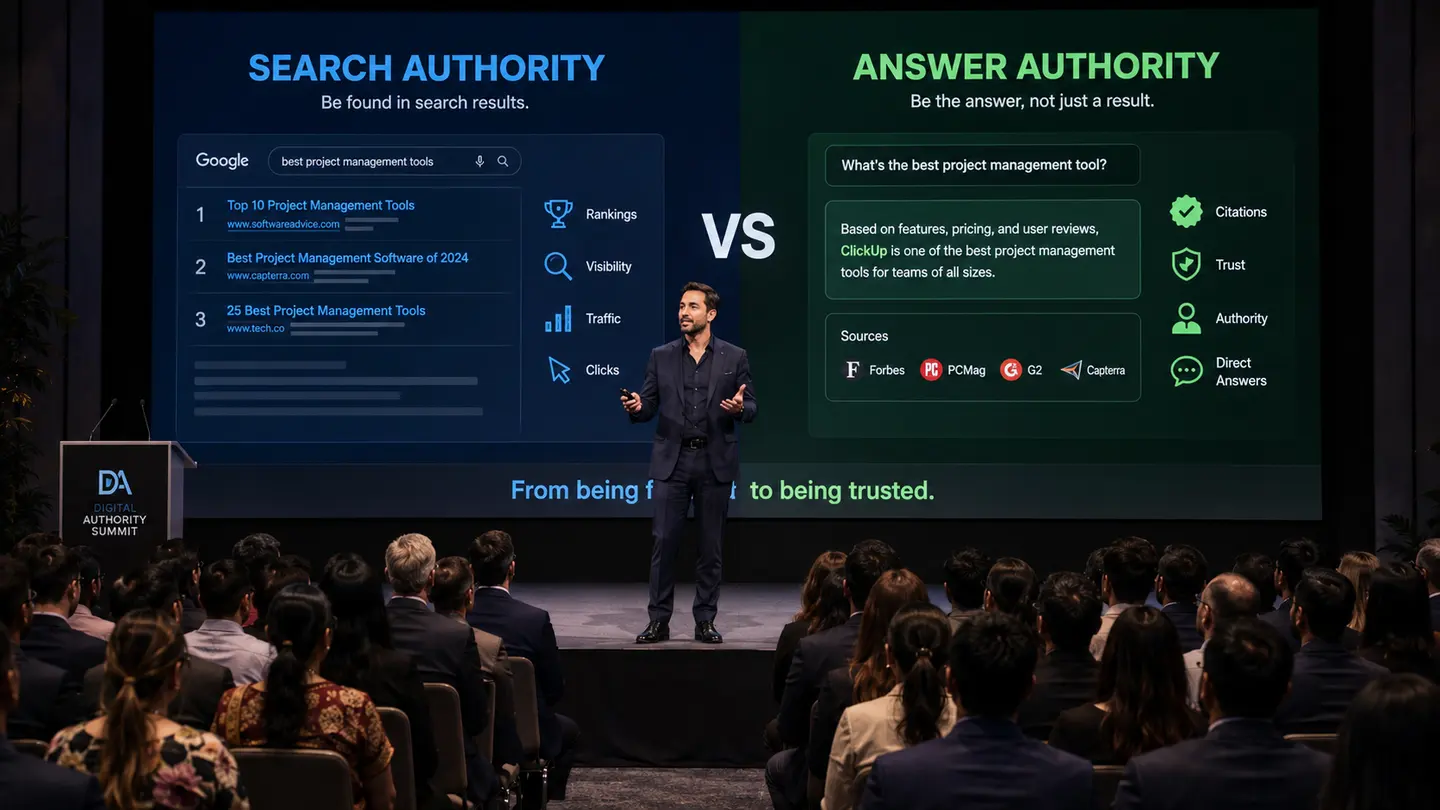
Search authority is an evidence state about whether a page, source or domain can earn conventional search visibility across a defined query set. Answer authority is an evidence state about whether a source or passage can support a specific claim on a defined answer surface, at a stated time and locale. They overlap through discoverability, relevance and source quality, but they are not interchangeable platform scores. High ranking does not prove that a page is the best evidence for a claim; a citation does not prove endorsement, correctness or broad search strength.
The practical rule is simple: search authority asks whether the source can win discovery; answer authority asks whether the source can support this answer. When the two disagree, diagnose the missing evidence instead of averaging them into one “AI authority” number.
Buyer consequence: Different ranking and citation outcomes can both be real without requiring the same action. A search/answer mismatch becomes a budget question only when it changes how buyers discover, evaluate or trust the evidence behind a decision.
Fast Action
Choose the authority question before you collect evidence
Search authority and answer authority are two different evidence objects
Neither term is a published universal score from Google, Microsoft or OpenAI. In this framework, they are analyst labels that keep two different questions from being collapsed into one metric.
| Evidence object | What it asks | Useful evidence | What it does not prove |
|---|---|---|---|
| Search authority | Can this page, source or domain earn visibility for the governed query set? | Ranking distribution, ranking URL breadth, impressions/clicks when owned, query-class coverage, indexability, stability over time, and relevant discovery signals. | That every claim is correct, that the page is the best source for a narrow fact, or that an answer system will cite it. |
| Answer authority | Can this source or passage responsibly support this specific answer or claim? | Question fit, cited/source inclusion, passage support, source role, provenance, freshness, recurrence across controlled observations, and answer-surface context. | Broad ranking strength, commercial importance, durable visibility, endorsement, or a universal “AI authority” level. |
Important boundary: third-party “domain authority,” “domain rating,” AI visibility, citation share and mention share can be useful observations or proxies, but none is a substitute for the two evidence objects above.
Ranking, retrieval, passage selection and citation are different stages
Research evidence update (KDD 2026; independent benchmark): The KDD 2026 SAGEO Arena benchmark follows web documents through retrieval, reranking and answer generation. Its stage-aware intervention improved retrieval hit rate from 0.58 to 0.75 and measured citation rate from 0.50 to 0.58 inside that benchmark. These results illustrate why discovery and evidential use must be measured independently; they are not Google ranking factors, guaranteed improvements, or universal AI-authority scores. Keep the decision unit fixed: query, page, answer surface, cited claim, observation time and locale. Read the SAGEO Arena primary research. This study evaluates an experimental pipeline; it is not a specification for Google Search or other proprietary AI ranking systems.
A large part of the confusion comes from treating every search or answer outcome as the same process. The stages can share infrastructure and signals while still producing different observable outputs.
- CrawlingA system discovers and fetches eligible content.
- IndexingContent is processed into a form that can be retrieved.
- RetrievalPotential documents, pages or passages are found for an information need.
- Ranking or rerankingRetrieved items are ordered or filtered for a result surface.
- Passage selectionSpecific supporting information may be selected from a larger page.
- Answer synthesisA generated response combines information into an answer.
- Source attribution or citationSources are shown or linked as support or further reading.
Google states that AI Overviews and AI Mode may use query fan-out, issuing multiple related searches and identifying supporting pages while a response is generated.[1] That alone is enough to reject a simplistic rule that the exact top blue link must also be the answer source. Google also says there are no special technical requirements to appear in its AI features beyond the Search fundamentals.[2]
Collect evidence that belongs to the question you are asking
| Evidence | Search authority role | Answer authority role | Common misuse |
|---|---|---|---|
| Rankings / impressions | Primary observation of conventional search visibility. | Context only; not proof of source fitness. | “It ranks, therefore it should be cited.” |
| Cited or referenced URL | May reveal discovery overlap. | Primary observable for source inclusion on a bounded answer surface. | “It was cited, therefore it is authoritative everywhere.” |
| Passage support | Can improve relevance and usefulness. | Core check: does the passage actually support the claim made? | Counting citations without checking what the source supports. |
| Backlinks / mentions | Can support discovery, reputation and search competitiveness. | Contextual evidence only unless the answer use is directly observed. | Treating a link metric as a citation probability. |
| Structured data | Can help machines understand eligible structured content when supported by documentation. | May clarify explicit facts and entities, but does not prove citation eligibility or selection. | Claiming schema guarantees AI inclusion. |
| Source role / provenance | Useful quality context. | Core: official, primary, original, secondary, commercial or community sources answer different questions well. | Assuming “primary” or “famous” is automatically best for every question. |
| Freshness | Important when rankings depend on current information. | Potentially decisive for time-sensitive claims. | Using a stale famous source over a current direct source without checking the question. |
Microsoft’s Bing Webmaster Tools now separates AI answer observations such as citations, cited pages and grounding queries from conventional search reporting, and explicitly notes that citation counts do not indicate ranking, authority or placement.[3] That is a useful measurement boundary: citation activity is an output to investigate, not an authority score.
Memorable Explanation
Use the four-state matrix only after both evidence objects are decision-ready
The matrix has four states. UNRESOLVED is not a fifth state. It is a gate that prevents the analyst from classifying weak or missing evidence as high or low.
Search Authority × Answer Authority
How to read it: select a checkpoint to inspect the decision state. The field keeps discovery evidence separate from claim-support evidence; if either record is incomplete, stop at UNRESOLVED.
Protect the evidence, maintain eligibility and monitor whether the state persists.
Does not prove durable ranking, durable citation or commercial leadership.Inspect passage fit, source role, provenance, freshness and answer-surface evidence before buying more broad authority.
Do not assume more links solve a claim-support problem.Protect the claim-level evidence, then test internal discovery, indexability, distribution and adjacent-query transfer.
Do not dismiss a direct source because it lacks broad rankings.Fix the most basic eligibility, relevance, evidence and source-fit problems before optimizing presentation.
Do not optimize extractability around unsupported content.Why a top-ranking page can still be a weak answer source
A page can be excellent at satisfying broad search intent while being poor evidence for a narrow claim. Common causes include a marketplace summarizing a product it does not own, an editorial page relying on old secondary data, a strong brand page omitting the exact implementation detail, or a long page containing no passage that directly supports the answer.
Distribution strength does not repair a passage that lacks direct support.
Reputation may help discovery without making every paragraph an appropriate source.
Machine-readable markup cannot turn a weak claim into evidence.
For a time-sensitive question, a fresher direct source may be the safer evidence choice.
Conversely, a low-ranking source can still matter when it is the official documentation, original dataset, standard, first-party release note or specialist evidence closest to the claim. Bing has described the answer-oriented role of its index in terms of finding “groundable” information with clear provenance rather than only ordering pages.[4]
The useful unit is not “the authoritative domain”; it is the evidence path
A defensible answer can be traced from the user’s need to the evidence that supports the resulting claim. This path is more useful than a single domain-level reputation label.
Source-choice rule: official documentation is usually strongest for what a product officially supports; original data is strongest for the measured result it produced; peer-reviewed research is often strongest for a research finding; a specialist secondary analysis may be better for interpretation. Primary does not automatically mean best for every question, and popular does not automatically mean best.

Diagram boundary: treat the diagram as a memory aid, not as a platform algorithm or causal model. “Gets chosen in answers” is shorthand for answer-source suitability or observed source inclusion within a defined context; it is not a guaranteed citation outcome, and the rows do not create a universal citation-likelihood score.
How to compare search authority with answer authority
Use one method from start to finish. Do not mix a domain score, a citation count and a ranking report into a single composite.
- Define the answer question.Write the exact question or claim you need to support.
- Define the search context.Fix the governed query set, locale, device or result context where material, and observation window.
- Collect search evidence.Record ranking breadth, ranking URLs, owned impressions/clicks where available, technical eligibility and stability.
- Define the answer claim.Separate the claim to be supported from the broader topic.
- Collect source and passage evidence.Record the source URL, source role, relevant passage, whether it supports the claim, and any visible citation/source inclusion.
- Check provenance and freshness.Identify where the evidence came from, whether it is direct or secondary, and whether the date fits the question.
- Classify the two evidence states.Use HIGH or LOW only when the record is sufficient; otherwise use UNRESOLVED and stop the matrix.
- Diagnose the mismatch.Is the limiting problem discovery, relevance, passage support, source role, provenance, freshness, technical eligibility or observation coverage?
- Route the smallest next action.Fix the limiting evidence object instead of defaulting to more content or more links.
- Record limits and reopening triggers.Preserve date, locale, surface, sample and the condition that should cause the decision to be reviewed again.
Google’s 2026 guidance for generative AI features reinforces the first half of this method: strong Search fundamentals and useful, original, people-first content remain the base; Google explicitly warns against chasing special “AEO/GEO hacks.”[2]
Worked example: a ranking marketplace versus official documentation
Fictional example. A software team asks: “Does Northstar Analytics support SAML single sign-on on its Pro plan?”
| Record | Observed evidence | Interpretation |
|---|---|---|
| Query set | “Northstar SAML SSO,” “Northstar Pro SSO,” and adjacent implementation queries in the same locale and week. | Defines the search territory; it does not define the answer by itself. |
| Marketplace page | Ranks strongly across several commercial queries and has broad category visibility. | Search authority: HIGH for the governed query set. |
| Marketplace passage | States that Northstar offers “enterprise security” but does not identify the Pro-plan SAML entitlement or a source for it. | Answer authority: LOW for this exact claim. |
| Official documentation | Ranks weakly for the broad category query but contains a dated entitlement table maintained by the product team. | Search authority: LOW in the broad query set; answer authority: HIGH for the product-support claim, assuming the document is current. |
| Decision | Use the official documentation to support the claim; treat the marketplace as a discovery/comparison source. | Different sources can be strongest for different jobs. |
The example does not prove that official documentation always outranks commercial sources in answer systems, that marketplaces are poor sources generally, or that low search visibility improves citation likelihood.
Measure rankings and answer citations separately, then compare the records
Google introduced dedicated Search Console reporting for generative AI features in 2026 while continuing to include those observations in the broader Search performance model.[5] Bing exposes citations, cited pages and grounding queries for supported AI experiences.[3] OpenAI’s publisher guidance documents how sites can be discoverable to ChatGPT Search and how referral traffic can be identified, but it does not publish a universal “answer authority” formula.[6]
Independent measurement also shows why a single-run or search-only model is unsafe. A 2026 study of Google AI Overviews found that 29.8% of cited domains did not appear on the corresponding first search-results page for the same query, and it separately found citation-support failures at the claim level.[7] Another 2026 study found that AI-visibility rankings can be unstable enough that many apparent domain differences fall within the measurement noise of the sample.[8]
Practical implication: record query/prompt, engine or surface, locale, date, visible source URL, passage support and repeated observations. Do not turn one run into a durable authority claim.
Use visibility tools for observation; use evidence review for authority decisions
Current AI-visibility products are useful because they automate prompt sets, mentions, citations, cited URLs, competitor comparisons and longitudinal tracking. Representative commercial methodologies also make an important limitation visible: these systems model or sample visibility outcomes; they do not by themselves prove that a cited passage faithfully supports a claim.[11][12]
| Measurement layer | Useful for | Does not prove | Best next validation |
|---|---|---|---|
| Conventional search reporting | Queries, pages, impressions, clicks, rankings and discovery trends. | That the page is a good evidentiary source for a narrow answer claim. | Inspect source role, passage support, provenance and freshness. |
| Generative-search visibility reporting | Prompt/surface visibility, cited pages, mentions, citations and changes over time. | Authority, placement, endorsement, actual user reach or claim-level fidelity. | Keep the prompt/surface/date and verify the cited source against the claim. |
| Citation or source-share metrics | Comparing which domains or URLs appear across a governed observation set. | That every citation is relevant, correct, influential or stable. | Retrieve the cited content and check link accessibility, relevance and factual support.[13] |
| Manual source/passage review | Determining whether the evidence path can responsibly support the exact answer. | That the source will rank, be selected again or become commercially important. | Combine with repeated search and answer observations rather than replacing them. |
Strategic implication: the tool category is not the decision. Use monitoring software to collect observable outcomes efficiently, then use the authority framework to decide what those outcomes mean and what they still fail to prove. A 2026 survey of GEO measurement likewise finds heterogeneous metrics and warns against treating citation selection or composite visibility measures as an internal causal trace.[14]
Signals that look equivalent but answer different questions
| Claim | Decision | Why |
|---|---|---|
| “Domain Authority predicts answer authority.” | Do not use as a rule. | Third-party link metrics can describe parts of search competitiveness; they do not directly test question-specific passage support or source selection. |
| “Ranking #1 means AI should cite the page.” | False equivalence. | Search ranking and answer-source selection overlap but can diverge by query expansion, retrieval, source role and passage fit. |
| “A citation proves endorsement.” | No. | A citation is an attribution event. The source may support only part of the answer, and citation fidelity itself must be checked. |
| “Schema guarantees AI visibility.” | No. | Structured data can clarify supported facts, but Google says no special markup is required for its AI features and does not promise citation from schema alone. |
| “E-E-A-T is an AI citation score.” | No. | Experience, expertise, authoritativeness and trust are quality concepts, not a published citation probability. |
| “More citations always means higher quality.” | No. | Citation frequency is an observable output. It does not by itself test factual support, user fit or source quality. |
Deep Work
Search Authority vs Answer Authority Diagnostic
Use this diagnostic after you have collected evidence. It does not estimate citation probability or create a synthetic score. If required evidence is missing, it withholds the four-state classification.
Tool boundary: this diagnostic organizes observations supplied by the analyst. It does not crawl search engines, verify factual claims, infer proprietary ranking systems or calculate citation probability.
Portable Handoff
Carry the same evidence model into a repeatable audit
The workbook is for repeated multi-source comparisons and team handoff. The field guide is for a review meeting or offline source check. Both use the same definitions, four-state matrix, UNRESOLVED gate and reopening logic as this article.
Product boundary: neither download proves that a platform will rank, retrieve, cite or recommend a source. They preserve the evidence and the reasoning used for the decision.
How to explain the difference to stakeholders
Search authority tells us whether a source can win discovery across a defined query set. Answer authority tells us whether that source can support this specific claim on a defined answer surface. If those signals disagree, we diagnose the missing evidence instead of averaging them into one score.
That explanation is intentionally narrower than “SEO authority versus AI authority.” It keeps the discussion tied to observable evidence and prevents a citation from being presented as an endorsement or a ranking from being presented as proof of claim quality.
Search authority and answer authority questions
What is search authority?
Search authority is an evidence state describing how well a page, source or domain can earn conventional search visibility within a defined query set, locale and observation window. It is not a universal Google score.
What is answer authority?
Answer authority is an evidence state describing whether a source or passage can responsibly support a specific answer or claim on a defined answer surface, with the source role, provenance, freshness and observation scope recorded.
Does ranking number one make a page more likely to be cited by AI?
Ranking and citation can overlap, but a number-one ranking does not guarantee citation. Answer systems can retrieve or select different sources, and current measurements show substantial divergence between conventional results and AI citations.
Can an AI system cite a page that does not rank on the first page?
Yes, this occurs in current measurements. That does not mean low ranking causes citation; it means source selection can extend beyond the first-page result set.
Do backlinks affect AI citations?
Backlinks can matter to search discovery and broader reputation, but public platform documentation does not establish a universal rule that backlink quantity directly controls AI citations. Test citation/source inclusion separately.
Does schema help AI visibility?
Structured data can help systems understand supported page facts and entities, but Google says there are no special markup requirements for its AI features. Schema does not guarantee source inclusion or citation.
Is E-E-A-T an AI citation score?
No. Experience, expertise, authoritativeness and trustworthiness are quality concepts. They are not a published numeric citation probability.
Is a citation the same as endorsement?
No. A citation is an attribution or source-link event. It can support only part of an answer, and the source should still be checked for relevance, fidelity and limitations.
Why do rankings and answer citations disagree?
Common causes include different retrieval paths, query expansion, source-role differences, passage fit, freshness, provenance, technical eligibility, surface-specific behavior and measurement volatility.
How should I measure AI authority?
Avoid a single “AI authority” score unless its method is validated for your decision. Record the question set, surface, citations or mentions, cited URLs, passage support, source roles, dates, locales and repeated observations, then compare those with conventional search evidence.
What should I do when search authority is high but answer authority is low?
Diagnose claim-level problems first: passage support, source role, provenance, freshness, answer-surface observation and extraction clarity. Do not assume more broad link building is the correct fix.
What should I do when search authority is low but answer authority is high?
Protect the source evidence that already works, then test discovery and transfer: internal linking, crawl/index eligibility, adjacent queries, distribution and whether the narrow answer fit persists beyond one observation.
Primary sources and current measurement context
Platform documentation is used for platform behavior and reporting claims. Independent studies are used as dated measurements, not as proof of proprietary algorithms.
- Google Search Central — AI features and your website. Official documentation; reviewed 5 October 2026. Describes AI Overviews/AI Mode, query fan-out and site-owner requirements.
- Google Search Central — Guide to optimizing for generative AI features. Official documentation; reviewed 5 October 2026. Recommends Search fundamentals and warns against special AI-search hacks.
- Bing Webmaster Blog — AI Performance in Bing Webmaster Tools. Official product documentation, 10 February 2026. Defines citations, cited pages and grounding-query reporting and states what those measures do not indicate.
- Bing Search Blog — Evolving role of the index: from ranking pages to supporting answers. Official technical discussion, 6 May 2026. Describes answer support in terms of groundable information and provenance.
- Google Search Central Blog — Generative AI performance reports in Search Console. Official announcement, 3 June 2026.
- OpenAI Help Center — Publishers and Developers FAQ. Official publisher guidance; reviewed 16 August 2026. Covers OAI-SearchBot discoverability and ChatGPT referral tracking.
- Xu, Iqbal & Montgomery — Measuring Google AI Overviews: Activation, Source Quality, Claim Fidelity, and Publisher Impact. 2026 preprint; independent measurement of source overlap and claim support.
- Schulte et al. — Quantifying Uncertainty in AI Visibility. 2026 preprint; independent analysis of sampling and citation-rank instability.
- Kai, Xinyue & Jingang — From Citation Selection to Citation Absorption. 2026 preprint; separates being selected as a citation from materially contributing to an answer.
- Google Search Central — Creating helpful, reliable, people-first content. Official guidance; reviewed 5 October 2026.
- Ahrefs — Brand Radar methodology. Commercial methodology, updated 26 February 2026; describes prompt-set construction, citations and mentions, and modeled visibility, including the boundary that estimated visibility is not actual audience reach.
- Semrush — How to find AI visibility gaps. Commercial workflow, 27 July 2026; separates prompt, mention, source, citation and narrative gaps and notes the limits of single probabilistic responses.
- Cited but Not Verified: Parsing and Evaluating Source Attribution in LLM Deep Research Agents. 2026 preprint; evaluates citation/source quality through link accessibility, topical relevance and factual accuracy.
- Optimizing Visibility in Generative Engines: A Critical Survey of Generative Engine Optimization (2023–2026). 2026 preprint; reviews heterogeneous GEO terminology and metrics and distinguishes observable citation/visibility measures from internal causal explanations.
Recheck trigger: review unstable platform claims when reporting definitions, crawler controls, AI-search surfaces or source-selection documentation materially change.
Do not blend disagreement away
If search and answer evidence disagree, preserve the mismatch. The mismatch is often the useful finding: it tells you whether the next investigation belongs to discovery, passage support, provenance, freshness, source role or answer-surface observation.
If the disagreement still changes an investment, competitor or content decision after the evidence gates above, use a Decision Scope Review to record the unresolved boundary, the evidence required next and the condition that reopens the decision.