
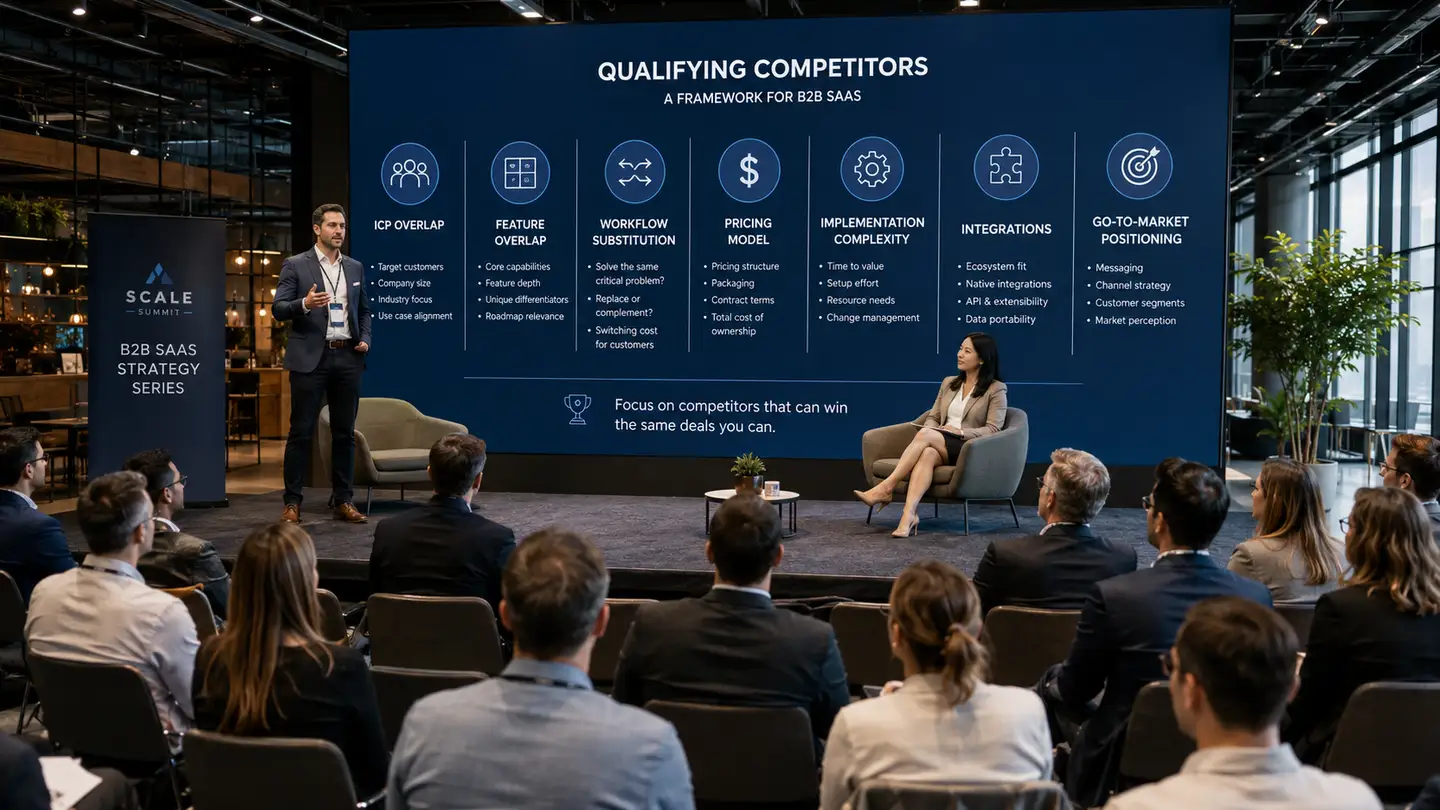
Worked application · fictional composite
The answer first: a SaaS competitor is a realistic replacement route, not a familiar logo
Portable field guide - fictional composite / commercial-substitutability method
This guide is a worked decision product, not a client case study, market-share report, product recommendation, security certification or claim that named public vendors compete in a specific deal.
Direct competitor means the same buyer could realistically choose the option for the same material job at the same buying stage, while implementation, security/procurement and switching conditions still permit substitution.
1. Scenario boundaries
| Boundary | Fictional case | Control |
|---|---|---|
| Buyer | Mid-market operations/compliance leader. | Keep consumer, SMB-only and enterprise-only contexts separate. |
| Material job | Evidence collection, control-work coordination and audit preparation. | Generic automation is not automatically the same job. |
| Buying stage | Shortlist/evaluation for a system to own the workflow. | Discovery and implementation entities can matter without being finalists. |
| Adoption | Integration, identity, migration, admin/change burden. | Feature overlap cannot erase implementation reality. |
| Security/procurement | Buyer-defined supplier and assurance requirements. | Badges/acronyms are bounded evidence, not universal fitness. |
| Switching/exit | Export, contract, transition and configuration portability. | Easy to buy is not necessarily easy to replace. |
2. Candidate roles before feature comparison
| Archetype | Governed role | Why |
|---|---|---|
| Regulated-workflow specialist | Direct if all gates match | Same buyer/job/stage and comparable adoption reality. |
| Compliance automation platform | Conditional direct | Core fit can be strong while implementation or switching remains partial. |
| General orchestration suite | Adjacent | Integration/workflow overlap may not equal the same buying decision. |
| Consultancy / managed service | Substitute | Can fulfil the outcome without a like-for-like software purchase. |
| Marketplace / review directory | Intermediary / discovery | Shapes visibility without owning the workflow outcome. |
| Security / standards authority | Authority / reference | Defines requirements/context rather than competing commercially. |
| Internal build / do nothing | Substitute / no-action | A real buying alternative can exist outside category pages. |
Buyer → Use Case → Implementation → Role
How to read it: select a checkpoint to isolate that part of the method. The canvas shows the relationship; the inspector explains what the checkpoint changes in the decision.
3. The seven evidence questions
| Gate | Question | False positive |
|---|---|---|
| Buyer fit | Would the same accountable buyer evaluate it? | Similar company logos or category labels. |
| Material-job fit | Does it own the same outcome, not one feature? | Both products automate something. |
| Buying-stage fit | Would it appear on the same realistic shortlist? | Marketplace visibility or partner presence. |
| Implementation fit | Are integration, migration, admin and change conditions comparable? | Connector exists, therefore deployment is equivalent. |
| Security/procurement | Can current evidence satisfy scoped buyer requirements? | One trust badge equals complete readiness. |
| Switching / exit | Can data, configuration and workflow state move at acceptable burden? | Vendor says migration is supported. |
| Evidence state | Is the fact current, observed and owned by this candidate? | Retyping stale/foreign evidence as current. |
4. Conflicting evidence
A material disagreement is an evidence object, not a reason to invent a confidence score. See why competitor-analysis scores can create false certainty.
| Conflict | Observation A | Observation B | Response |
|---|---|---|---|
| Implementation | Product evidence suggests quick setup. | Implementation evidence shows material configuration/support work. | Keep candidate conditional; collect current implementation proof. |
| Switching | Migration is described as supported. | Exit evidence shows manual configuration rebuilding. | Keep switching burden material in the replacement claim. |
| Security | Trust page advertises assurance. | Buyer requirement or current evidence remains unresolved. | Pause direct promotion until the scoped requirement is verified. |
A governed conflict requires two distinct valid evidence IDs, the same candidate, nonblank opposing statements, controlled material/status values, an owner and a reopen trigger.
5. What the decision changes
Before: software, broad automation platforms, consultancies, marketplaces, standards sources and internal alternatives are mixed together. A feature matrix makes the market look crowded.
After: only realistic same-buyer/same-job/same-stage software enters the direct comparison. Adjacent products inform architecture/positioning; services and in-house routes inform build/buy; intermediaries inform discovery; authorities inform requirements. For a real product or go-to-market choice, B2B SaaS competitive analysis tests which alternatives a buyer could realistically choose.
A role decision can be READY even when it is a refusal or substitute classification. Good governance rewards a correct boundary, not maximum inclusion.
Current 2026 procurement evidence sharpens the method
NIST's July 2026 SP 1326 supplier due-diligence guide defines due diligence as researching pertinent information about an ICT supplier or product so an acquirer can make an informed acquisition decision. This method uses that principle only to strengthen the security/procurement evidence gate; it does not create a universal vendor score.
NIST SP 1305 adds the complementary requirement-setting side: acquirers should define and communicate supplier requirements. Together, the two sources support a practical sequence: define the buyer requirement → collect scoped supplier/product evidence → decide whether the candidate can survive the same buying process.
G2's 2026 buyer research is used as directional market context rather than universal law. It reports evaluation as the longest buying stage for 40% of respondents and identifies IT-security review, budget approval and implementation planning as major post-selection delays. That reinforces why discovery similarity is not purchase equivalence.
6. Security, procurement and buyer evaluation
G2's 2026 buyer research reports evaluation as a major time-consuming stage and identifies security review, budget approval and implementation planning as post-selection delays. This is vendor-generated market research, useful as directional context rather than a universal law.
NIST Cybersecurity Framework 2.0 and NIST's C-SCRM quick-start guidance are used here for a narrower principle: technology acquirers should define risk and supplier requirements rather than infer supplier fitness from category membership.
AICPA SOC materials describe assurance around defined control criteria. A SOC label can be relevant evidence for a scoped buyer requirement; it does not independently establish implementation fit, commercial substitution or product superiority.
7. Implementation, identity and technical evidence
| Area | Examples to inspect | Boundary |
|---|---|---|
| Identity | SSO/SAML, SCIM, role model, privileged access. | Each capability answers a specific implementation/security question. |
| Integration | API scope, webhooks, connector permissions, rate limits. | Connector presence does not prove workflow equivalence. |
| Operations | Audit logs, SIEM export, data residency, admin burden, sandbox. | Check current scope and limits. |
| Resilience | Uptime commitments, RTO/RPO, backup/DR evidence. | Relevant only where required by the buyer's decision. |
SCIM is an IETF protocol for cross-domain identity provisioning. Supporting it may matter to the buyer; it does not make two products direct competitors by itself.
8. Switching and exit reality
For EU-scoped data-processing services, the EU Data Act makes switching, contractual terms, data portability, interfaces and switching conditions explicit concerns. That jurisdiction-specific rule is not generalized to every SaaS market, but it illustrates why exit belongs inside qualification.
| Exit question | Evidence to collect |
|---|---|
| Can data move? | Export formats, APIs, schema/documentation and data-egress conditions. |
| Can workflow state move? | Configuration portability, automation definitions, permissions and historical context. |
| Can operations continue? | Transition assistance, parallel run, migration timing and continuity requirements. |
| Can the customer leave commercially? | Contract term, termination, renewal mechanics and transition charges where applicable. |
Switching burden changes commercial equivalence; it does not prove a product is good or bad.
9. Audience, JTBD and pain-to-solution map
| Audience / JTBD | Pain | Decision value |
|---|---|---|
| Founder / product leader | Feature matrices make every lookalike direct. | Clearer market/category boundary. |
| Product marketer | Alternative pages compare whoever ranks. | Role-qualified comparison content. |
| Sales / revenue | Battlecards differ from actual deal losses. | Tie competitors to shortlist/win-loss evidence. |
| Security / IT | Marketing hides supplier/implementation gaps. | Exclude or escalate before deep evaluation. |
| Finance / procurement | Price is visible; transition burden is not. | More realistic total-decision comparison. |
| SEO / AEO | Keyword overlap promotes intermediaries into direct set. | Search research downstream of role qualification. |
| Implementation / customer success | Connector presence hides admin, migration and change-management burden. | Turn product similarity into a realistic adoption comparison. |
| RevOps / deal desk | CRM competitor fields and battlecards lag actual buying-stage evidence. | Tie competitor role to live shortlist, objection and approval evidence. |

10. Query and entity research without keyword-volume claims
No Semrush or keyword-volume platform was used for this build. These are qualitative territories observed through current manual SERP and primary/first-party source research, not measured-demand forecasts.
| Territory | User job | Entity chain | Canonical rule |
|---|---|---|---|
| SaaS competitor analysis | Build a credible set | buyer → job → shortlist → candidate → role | This guide owns qualification; consolidate close variants. |
| [vendor] alternatives / competitors | Find realistic replacements | incumbent → replacement route → buyer constraints | Create a separate page only for a distinct, evidence-supported decision. |
| Compliance automation comparison | Compare apparent category finalists | workflow → platform → buyer → evaluator | Qualify direct/conditional/adjacent role before feature comparison. |
| SaaS security review / vendor security questionnaire | Pass buyer diligence | supplier → requirement → evidence → reviewer → approval | Security/procurement is a gate, not a second competitor score. |
| SaaS procurement / vendor due diligence | Decide whether a finalist is actually buyable | shortlist → due diligence → finance/security approval → contract | Use current supplier/product evidence; do not equate shortlist presence with approval. |
| SaaS implementation checklist | Estimate adoption burden | product → integrations → configuration → administrator → users | Connector presence is not implementation equivalence. |
| Migration / switching / vendor lock-in | Estimate replacement effort | source → export → transform → destination → continuity | NO on a material switching gate breaks direct substitutability; PARTIAL may remain conditional. |
| Data portability / SaaS exit strategy | Plan reversibility before purchase | contract → exportable data/digital assets → destination | Use where exit conditions materially change the decision; keep jurisdiction explicit. |
| SOC 2 / supplier assurance | Assess scoped third-party risk evidence | service organization → control criteria → buyer risk | Assurance evidence is bounded; it does not establish overall product fitness. |
| SSO / SCIM / audit logs / data residency | Meet enterprise technical requirements | requirement → capability → tier → implementation evidence | Do not manufacture one URL per acronym or let one capability satisfy every gate. |
| Workflow automation vs compliance automation | Separate broad orchestration from specialist workflow ownership | workflow → platform role → buyer job | Use adjacency when the same buying job is not established. |
| Build vs buy vs consultancy / in-house | Compare non-software alternatives | buyer → outcome → software / service / internal / no action | Keep substitutes out of software-only feature grids. |
11. Controlled action and portable handoff
| Role | Permitted next action |
|---|---|
| Direct | Offer/CRO/product comparison with evidence limits. |
| Conditional direct | Collect missing implementation/security/switching evidence before like-for-like claims. |
| Adjacent | Architecture, positioning and workflow-boundary research. |
| Substitute | Build/buy/service/no-action comparison. |
| Intermediary | Discovery, query, review and ecosystem research. |
| Authority | Requirements, terminology and scoped assurance context. |
The portable handoff includes Candidate ID, six evidence IDs, evidence freshness/state, open conflicts, governed Decision ID/state, one linked READY Action ID, owner, reopen trigger and prohibited inference.
If a candidate, decision or action is disconnected from that chain, the workbook fails closed.
Fast Action tool: B2B SaaS Competitor Role Checker
Classify one candidate at a time. The checker returns a bounded role and next evidence action; it never generates a competitor score.
Select the governed evidence states.
Next evidence: —
Prohibited inference: —
Portable handoff files
The workbook carries the governed evidence-to-role-to-action chain; the PDF is the portable review guide.
Download the qualification workbook Download the field guide PDF
Questions raised by this B2B SaaS case
What makes a SaaS company a direct competitor?
A direct competitor is a realistic replacement route for the same buyer, material job and buying stage, with implementation and procurement conditions that do not break substitution.
Does sharing integrations make two SaaS products competitors?
No. Integration overlap is implementation evidence only; buyer, job, stage and operating reality must also align.
Should marketplaces and review sites be included?
Yes, usually as intermediaries or discovery sources rather than direct product competitors.
How should consultancies and in-house builds be treated?
As substitutes or no-action alternatives when they can fulfil the buyer job without buying like-for-like software.
Why do security and procurement belong in competitor qualification?
A product that cannot satisfy a material buyer requirement may never reach the same practical shortlist.
Why does switching cost matter?
Migration, portability, contract terms and configuration rebuilding can materially change whether replacement is realistic.
Can reviews or search rankings establish commercial competition?
No. They can surface discovery overlap or experience themes, but they do not establish same-buyer substitutability.
When should the competitor record be reopened?
Reopen it when buyer, scope, commercial model, implementation architecture, security evidence, switching conditions or real sales evidence changes materially.
12. What remains unresolved + source roles
Public evidence does not establish a real deal shortlist, win/loss rate, negotiated price, customer-specific implementation effort, current security-review outcome or migration burden for a particular deployment. Those remain unresolved until first-party buyer, commercial or implementation evidence exists.
Primary / authoritative context:
NIST CSF 2.0 - https://www.nist.gov/cyberframework
NIST SP 1326 - Cybersecurity Supply Chain Risk Management: Due Diligence Assessment Quick-Start Guide - https://csrc.nist.gov/pubs/sp/1326/final
NIST SP 1305 C-SCRM Quick-Start Guide - https://csrc.nist.gov/pubs/sp/1305/final
AICPA SOC for Service Organizations - https://www.aicpa-cima.com/resources/download/soc-for-service-organizations-engagements-overview
IETF RFC 7644 (SCIM) - https://www.rfc-editor.org/info/rfc7644/
EU Data Act - https://eur-lex.europa.eu/eli/reg/2023/2854/oj?locale=en
Market / positioning context:
G2 2026 Buyer Behavior Report - https://sell.g2.com/2026-buyer-behavior-report
Vanta / Drata / Secureframe public product materials and Workato documentation are used only as current positioning examples, never as proof of deal-level competition.
All vendor claims require current source verification for the actual decision. The fictional archetypes are not claims about named vendors.