
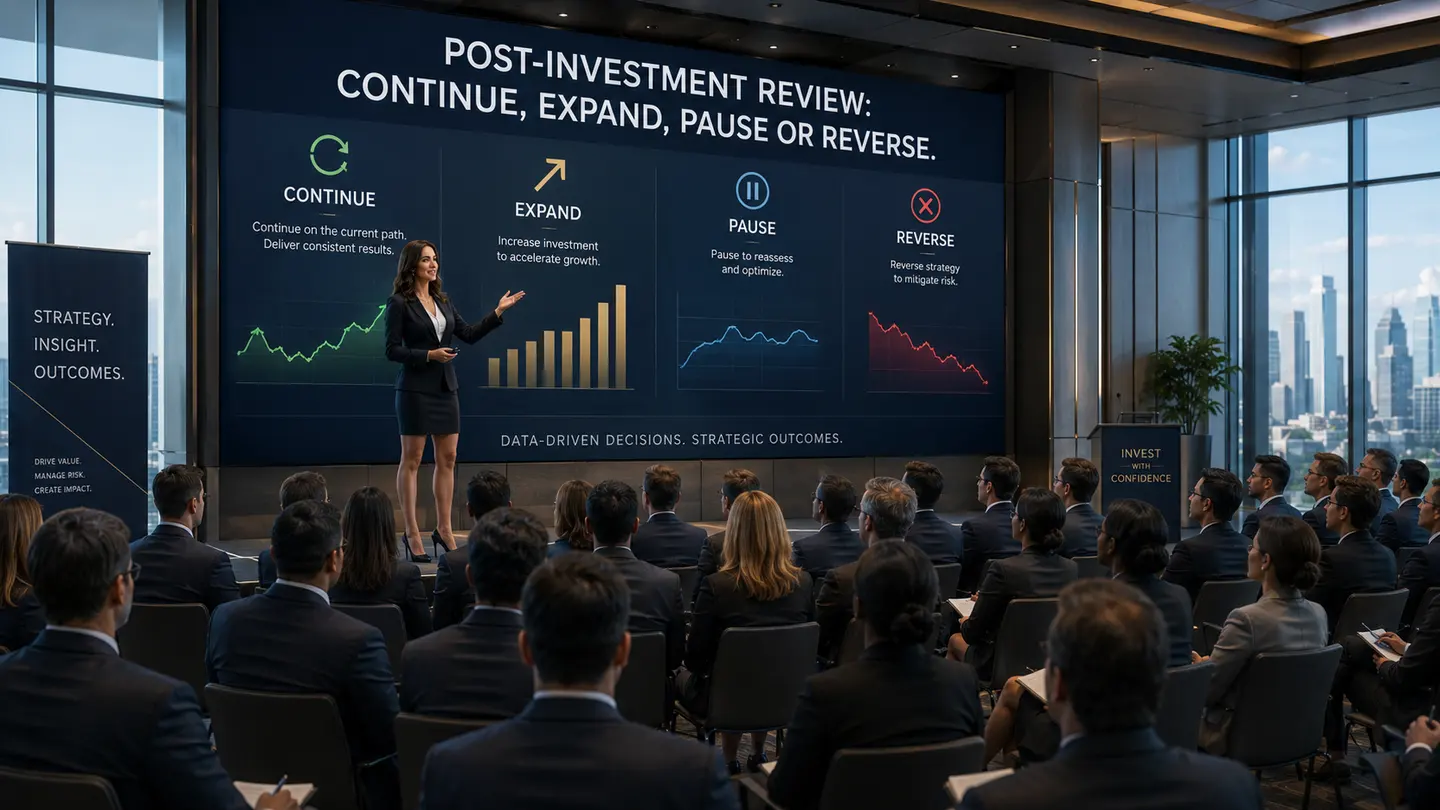
Post-investment resource decision
Do not ask whether the work finished. Ask what the evidence now permits you to do with resources.
A post-investment review should compare what was approved with what was actually executed, test whether the measurement is trustworthy, examine what the evidence says about the expected mechanism, account for material context change, and then release one bounded resource decision: Continue, Expand, Pause or Reverse.
The first question is not “which of the four?” It is “are we ready to decide?” If execution was materially incomplete, measurement is unreliable, or evidence is still insufficient or contradictory, the review should withhold a stronger conclusion rather than convert uncertainty into a confident label.
Fast Action
Are you ready to make the post-investment decision?
Fail-closed rule: if steps 1-4 do not pass, the output is a readiness blocker such as EXECUTION INCOMPLETE, MEASUREMENT UNRELIABLE or EVIDENCE INCOMPLETE - not a forced Continue/Expand/Pause/Reverse verdict.
Definitions that keep the review from turning into a KPI argument
| Term | Working definition | Why it matters |
|---|---|---|
| Investment thesis | The claim connecting committed resources to an expected mechanism and business value. | It is the proposition being reviewed, not the amount of effort completed. |
| Execution integrity | Whether implementation was complete and good enough to constitute a valid test of the thesis. | Poor outcomes after a materially invalid test are not clean thesis evidence. |
| Measurement integrity | Whether the baseline, instrumentation, attribution approach and observation window are reliable enough for the decision. | Measurement failure can block both optimistic and pessimistic conclusions. |
| Mechanism | The pathway by which the investment was expected to cause value. | A result can move without the expected mechanism, weakening scale confidence. |
| Observation window | The period in which the relevant leading, lagging and commercial effects could reasonably appear. | A calendar deadline alone does not make evidence mature. |
| Context change | A material change in buyer, market, competitor, platform, regulation, economics, product, capacity or organisation. | The investment can become obsolete even if execution was good. |
| Reversal condition | A forward-looking condition that removes the justification for future commitment. | It keeps reversal tied to current evidence rather than frustration or sunk cost. |
| Next evidence window | The owner, evidence task and reopening condition after the current decision. | It prevents Continue and Pause from becoming indefinite defaults. |
The post-investment review method: from original thesis to the next evidence window
Use the same nine-step sequence in the article, workspace, workbook and handoff. Do not create a parallel scoring system.
| Step | Question | Required output |
|---|---|---|
| 1. Re-anchor | What exactly was approved: thesis, mechanism, scope, evidence expectations, exclusions and conditions? | Decision baseline. |
| 2. Verify execution | Was implementation adequate to test the thesis? | Execution integrity finding. |
| 3. Verify measurement | Can the observed evidence safely carry the decision? | Measurement integrity finding. |
| 4. Compare evidence | What supports, contradicts or leaves the thesis unresolved? | Evidence basis with limitations. |
| 5. Diagnose mechanism | Did the expected pathway occur, or did results move for another reason? | Mechanism finding. |
| 6. Check context | Would the same investment still be approved under current conditions? | Material context-change finding. |
| 7. Apply conditions | Which continuation, expansion, pause or reversal conditions are actually met? | Allowed decision set. |
| 8. Release decision | Which bounded treatment does the evidence support now? | CONTINUE / EXPAND / PAUSE / REVERSE. |
| 9. Define next evidence window | What action, owner, evidence and reopening trigger come next? | Auditable handoff. |
Government evaluation guidance provides the methodological reason for separating implementation, outcomes, mechanisms and context; benefits-management guidance reinforces reviewing realised benefits against the original case. This post-investment review framework turns those ideas into a practical resource-decision sequence rather than claiming that external standards prescribe these four labels.
Continue / Expand / Pause / Reverse
How to read it: select a checkpoint to isolate that part of the method. The canvas shows the relationship; the inspector explains what the checkpoint changes in the decision.
Continue vs Expand: the difference is the evidence burden
Continue asks whether the investment still deserves its current level of commitment. Expand asks whether it deserves more. Those are not synonyms. Expansion increases exposure, so the review needs stronger evidence than it needs to maintain a bounded current commitment.
| Condition | CONTINUE | EXPAND |
|---|---|---|
| Execution | Adequate to interpret the current evidence. | Adequate and reproducible at the next scale step. |
| Measurement | Trustworthy enough to judge current commitment. | Trustworthy enough to support additional exposure and segment-level interpretation. |
| Mechanism | Plausible or supported enough for the current tranche. | Credibly supported; the result should not depend only on a lucky or one-off outcome. |
| Economics | Current economics remain acceptable. | Economics remain acceptable after expected scale effects and incremental cost. |
| Capacity | Current delivery can be sustained. | Additional capacity exists without destroying quality or creating an unowned dependency. |
| Scale step | No increase required. | The next increase is bounded, observable and reversible enough to learn from. |
Trustworthy experimentation research provides an important caution: average positive effects can conceal meaningful differences across segments. Before expanding, ask whether the result is reproducible in the markets, user groups, channels or conditions that the larger commitment would actually expose. Microsoft Experimentation Platform guidance on segment analysis illustrates why aggregate success is not automatically universal scale permission.
Pause vs Reverse: blocked decision quality is not the same as evidence against the investment
Pause when the investment may still be viable but a material decision condition is unresolved or the environment changed. Reverse when trustworthy forward-looking evidence materially removes the justification for continued commitment.
| If this is true | Do not assume | Current treatment | Next evidence |
|---|---|---|---|
| Execution materially incomplete | The thesis failed. | Readiness blocked; operationally stop adding exposure. | Complete or verify the intended implementation. |
| Measurement unreliable | Positive or negative outcome is trustworthy. | Readiness blocked. | Repair measurement. Any claim that independent evidence can carry the decision requires a separate documented human review; the automated workspace and workbook do not adjudicate that override. |
| Evidence contradictory | The average of conflicting metrics is “medium confidence.” | Readiness blocked. | Resolve the contradiction or document why one source should govern. |
| Context materially changed | The original business case still applies unchanged. | PAUSE candidate after readiness passes. | Revalidate the affected assumption against current conditions. |
| Core mechanism credibly contradicted | More time will necessarily fix it. | REVERSE candidate. | Document closure/reallocation and any condition that could reopen the case. |
| Predefined reversal condition met | Past spend requires one more tranche. | REVERSE. | Preserve learning and recoverable assets. |
Thesis failure, execution failure and measurement failure are different diagnoses
| Thesis | Execution | Measurement | Observed result | Permitted interpretation |
|---|---|---|---|---|
| Unknown | Incomplete | Trustworthy | Weak | Execution failed to provide a clean thesis test. Do not reverse solely from the weak result. |
| Unknown | Adequate | Unreliable | Weak or strong | The automated decision system withholds a final resource decision. Any independent-evidence exception requires a separate documented human review outside the automated workspace and workbook. |
| Supported | Adequate | Trustworthy | Positive | Continue is supported; Expand still needs economics, capacity, reproducibility and a bounded next step. |
| Contradicted | Adequate | Trustworthy | Weak | Reverse becomes defensible when the contradiction is material to forward commitment. |
| Supported | Adequate | Trustworthy | Mixed by segment | Do not collapse segments into one average decision. Continue, narrow, or bound expansion to the supported territory. |
Process-evaluation research makes this separation useful because it studies implementation, mechanisms and context alongside outcomes, rather than treating the outcome alone as the explanation. Moore and colleagues' process-evaluation guidance is methodological context for this diagnostic logic.
Measurement failure is a decision state, not a reporting footnote
If the primary measurement basis is materially unreliable, the post-investment decision workspace and workbook withhold both EXPAND and REVERSE. Typical blockers include a missing or reconstructed baseline, instrumentation that changed during the window, a window too short for the claimed outcome, attribution that cannot distinguish the investment from a major concurrent change, or a metric that does not represent the mechanism being claimed. If a human reviewer believes independent evidence can legitimately carry the decision, that evidence must be documented and adjudicated in a separate human review; the automated product does not release an override.
This does not mean “wait forever.” It means narrow the decision to what the evidence can support. You may be able to continue a small bounded commitment while repairing measurement; you may also need to stop adding exposure. What you should not do is convert a broken measurement path into a confident verdict.
When evidence conflicts, do not average the contradiction away
A contradiction can be informative. Revenue may rise while the expected mechanism does not appear. A leading indicator may improve while qualified demand remains unchanged. One segment may outperform while another deteriorates. A governed post-investment review records the conflict, asks which source is closer to the decision, and identifies what would resolve it.
- Name the disagreement. Which claims or signals cannot both support the same interpretation?
- Check validity first. Is one source stale, mis-scoped, confounded or outside the observation window?
- Check relevance second. Which evidence is closest to the mechanism and resource decision?
- Withhold false precision. Do not translate “one positive + one negative” into a made-up 50% confidence score.
- Define the resolver. Specify the next evidence that would change the decision.
Context change: would you approve the same investment today?
Re-run the thesis against material changes in buyer, market, competitor, channel, platform, regulation, economics, product, capacity and organisation. The question is not whether the external world moved at all. It is whether the change breaks an assumption that the approved investment depended on.
A changed context does not automatically mean Reverse. It often means Pause long enough to revalidate the affected premise. But if a new regulation makes the investment infeasible, a platform change removes the route to market, or the economics become structurally unacceptable, the change can satisfy a reversal condition directly.
Sunk cost: past spend is not evidence for future spend
The sunk-cost problem is not solved by pretending history has no consequences. Past irrecoverable spend should not become the reason to commit another tranche. But current facts created by past investment - reusable assets, learning, switching costs, recoverable value and preserved option value - can still matter because they affect the forward-looking choice.
Research on escalation of commitment treats prior investment, negative feedback and proceed/withdraw decisions as a recurring bias context. Feldman and colleagues provide useful behavioural context. A practical post-investment review control is simple: write the case for the next unit of commitment without using “we have already spent too much to stop” as evidence.
Memorable Explanation
The Post-Investment Decision Gate
The existing decision wheel shows the four outcomes. This complementary gate shows the sequence that must be passed before those outcomes are released.
Fifteen difficult review situations and the safest current interpretation
Do not conclude thesis failure. Readiness is blocked by execution. Complete or verify the intended test.
Investigate mechanism. If credible evidence contradicts the core pathway, Reverse becomes defensible.
Do not use the weak result to reverse. Repair measurement. Any independent-evidence exception requires a separate documented human review outside the automated decision surfaces.
Do not expand. Withhold the scale decision until the result is decision-ready.
Continue may be justified; Expand is blocked until capacity exists.
Activity can be real while the forward investment case fails. Reassess unit economics before further commitment.
Do not average away heterogeneity. Narrow the decision to the supported segment or gather targeted evidence.
Revalidate the premise under current conditions. Pause is often safer than pretending the original case is timeless.
Continue a bounded evidence window if justified; do not call early movement full investment success.
Do not automatically scale. Determine whether another factor caused the result.
Continue at current scope if viable; Expand waits for the dependency to become owned and feasible.
Move the argument from preference to claims, evidence, limitations and decision rules. If conflict remains material, withhold the stronger conclusion.
Continue only if the option/learning value is explicit, bounded and worth the carrying cost.
Local performance does not guarantee portfolio relevance. A material context or opportunity-cost change can block expansion or support reversal.
Do not extend the window automatically. Ask whether the missing evidence can realistically become decision-changing; otherwise narrow or reverse the commitment.

Deep Work
Post-Investment Decision Workspace
Use Quick Decision to test readiness. Use Full Review to release a bounded resource decision. Controlled values are exact; unsupported or wrong-case values fail closed in the decision logic.
Tool boundary: this workspace structures evidence and decision conditions. It does not infer missing facts, estimate causal effects, or replace domain-specific financial, legal, regulatory or technical review.
Portfolio context without turning a post-investment review into portfolio management software
An investment can perform well locally and still fail to deserve more resources if a materially better alternative emerges. The reverse is also possible: a modest current return can justify Continue when the investment preserves strategically valuable learning or option value at a bounded cost.
A post-investment review records that context, but it does not rank the whole portfolio. Enterprise strategic-portfolio products such as Planview and WorkBoard are designed for broader cross-investment visibility, benefits tracking, capacity and operating cadence. The review remains a transparent single-investment decision record that can hand off into those systems rather than pretending to replace them.
Observed SERPIFAI review record: calibration completed, expansion refused
This first-party record is preserved from the current post-investment review evidence record. It evaluates the 5 July 2026 SERPIFAI Batch 03 article-calibration process, not organic-search or commercial performance. The safe conclusion was to continue controlled calibration while refusing expansion to the remaining library.
| Review field | Observed record | Decision consequence |
|---|---|---|
| Original thesis | Five decision pages were ready to become the first evidence-calibrated cluster and then support broader scaling. | The thesis required page evidence and cluster reinforcement, not polished structure alone. |
| Baseline | Five frozen HTML pages; 17 unmet or undetected requirements; page diagnostics of 5.5-6.8/10; cluster diagnostic of 7.7/10. | Enough evidence for controlled remediation, not certification. |
| Observation window | One read-only audit completed on 5 July 2026. | Could verify implementation state; could not establish ranking or commercial outcomes. |
| Execution | Audit completed; five baselines preserved; website files modified: 0. | The audit process executed safely. |
| Actual cost | Not captured by the audit. | No ROI or efficiency conclusion permitted. |
| Leading evidence | Evidence-gap closure, differentiated sources, lifecycle links, overlap reduction, reproducibility and idempotency. | Useful for readiness, not proof of commercial success. |
| Lagging evidence | Search visibility, qualified demand, conversion, revenue and maintenance burden were not observed. | Expansion remained unsupported. |
| Decision | Continue controlled calibration; refuse expansion. | The system distinguished safe execution from permission to scale. |
This is process evidence only. It does not claim ranking, demand or revenue improvement.
Portable Handoff
Take the same decision logic into deep work and executive review
Fast, fail-closed readiness and decision logic with explicit refusal states.
Use the workspaceReview, evidence register, portfolio attention view and share record using the same controlled states.
Download the Excel operating systemThis download is installed only after the exact workbook passes native Microsoft Excel open, full recalculation, adversarial fixtures, save, close and fresh-reopen acceptance.A four-page portable review template for a decision owner and challenger.
Download the executive PDFPost-investment review questions
What is a post-investment review?
It is a structured review of what was approved, what was executed, what trustworthy evidence now exists, what changed and what remains uncertain, used to decide what should happen to the investment next.
What should a post-investment review include?
At minimum: original thesis and conditions, decision owner, execution integrity, measurement integrity, supporting and contradictory evidence, mechanism diagnosis, material context change, the released decision, rationale, next action and reopening condition.
When should you continue an investment?
Continue when the current commitment remains justified on a decision-ready evidence base, but the stronger conditions required for expansion are not fully met or more commitment is not currently needed.
When should you expand an investment?
Expand only when execution and measurement are trustworthy, the mechanism is supported, economics are acceptable, capacity exists, no reversal condition blocks the move and the next scale step is bounded enough to observe and reverse if needed.
When should you pause rather than reverse?
Pause when a material decision condition is unresolved or context changed, but the thesis remains plausible. Reverse when trustworthy forward-looking evidence materially removes the justification for continued commitment.
What if measurement is unreliable?
The automated workspace and workbook withhold EXPAND and REVERSE when primary measurement is materially unreliable. Repair measurement first. If independent evidence is claimed to carry the decision, document it in a separate human review; the automated product does not adjudicate that exception.
How do you distinguish strategy failure from execution failure?
First establish whether the intended intervention was delivered adequately. If execution was materially incomplete, poor outcomes are not a clean test of the strategy or investment thesis.
How much evidence is enough to scale?
There is no universal count or confidence percentage. The evidence must be trustworthy and decision-relevant enough to support the expected mechanism, acceptable economics, reproducibility/capacity and the bounded next scale step.
How should contradictory evidence be handled?
Identify which signals disagree, test validity and relevance, record limitations, and define the evidence that would resolve the conflict. Do not average contradictory signals into a fabricated score.
What happens after the review?
Every released decision should create a next evidence window: owner, action, evidence to observe and a reopening trigger. Ongoing monitoring belongs in the post-decision monitoring and reversal loop.
Where post-investment review fits in the SERPIFAI decision system
Boundary: The 30/60/90-day execution plan owns execution planning. Post-investment review owns the after-investment resource decision. The monitoring and reversal loop owns ongoing surveillance and reopening after the review decision.
Evidence and methodological context
- UK Government - Magenta Book: central government guidance on evaluation
- UK Government Project Delivery - Teal Book, benefits management
- HM Treasury - Green Book 2026
- Department for Business and Trade - post-implementation review best practice
- Moore et al. - process evaluation of complex interventions
- Microsoft Experimentation Platform - trustworthy experimentation patterns
- Microsoft Experimentation Platform - properties of a good metric
- Feldman et al. - sunk-cost / escalation-of-commitment research
Source roles differ. Government and research sources provide methodological context; competitor pages were used for capability/experience comparison; SERPIFAI's Continue/Expand/Pause/Reverse taxonomy and fail-closed state machine are a synthesis, not an externally certified standard.