
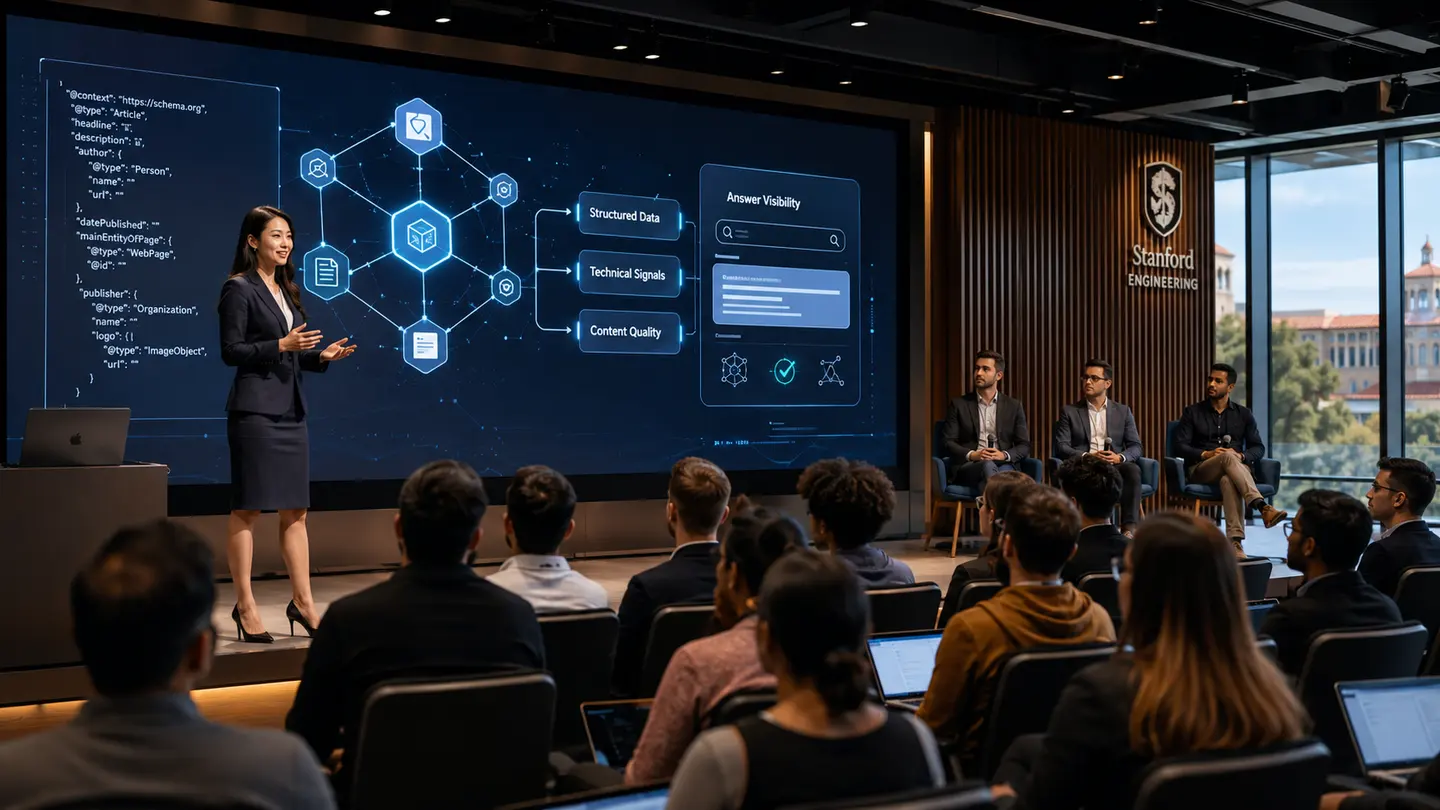
Answer first
Technical readiness removes disqualifying uncertainty; it does not manufacture answer visibility
A technically ready page is reachable, indexable where intended, canonically coherent, renderable, and machine-readable without contradicting the visible page. Those conditions can make a page eligible to participate in search and AI-answer systems. They cannot force an engine to retrieve, select, cite or recommend it. Broader accessibility remains a publication-quality requirement; it becomes part of this answer-visibility gate only when the main content or controls are no longer semantically exposed to the processor being tested.
The practical rule is simple: fix the first technical condition that makes the evidence invalid, then stop treating technology as the hypothesis once the page passes the gate. If the page is technically eligible and still absent from an answer surface, move the investigation to query fit, passage usefulness, source role, evidence, authority or selection volatility.
This distinction matters because teams often make the opposite error in both directions. They add schema to a page that cannot be crawled or rendered reliably, or they keep repairing markup after the page is already eligible and the real problem sits downstream.
Who this is for
Use the gate to decide who owns the next problem - not to create another technical checklist
The same missing-answer symptom creates different jobs for different teams. A technical SEO specialist needs to prove that the page can be accessed, reconciled and rendered. A content lead needs to know when technical work is finished so editorial changes are not used to compensate for infrastructure defects. A developer needs a reproducible failure state, not a vague request to “make the page more AI friendly.” A manager needs the minimum evidence required to assign the next owner. An executive needs to know whether further technical investment is justified at all.
| Reader | Job to be done | Decision at risk | Useful output |
|---|---|---|---|
| Beginner / content operator | Distinguish a real technical blocker from an unfamiliar technical term | Changing copy when the page cannot participate reliably | One first failure and one next action |
| Technical SEO / developer | Reproduce access, identity, rendering and markup conditions | Fixing the wrong layer or closing a defect without evidence | Evidence log with URL, state, locator and owner |
| SEO / AEO / GEO practitioner | Know when the page is technically eligible enough to test downstream visibility | Calling schema, crawler access or indexing a citation strategy | Eligibility state plus prohibited inference |
| Manager / consultant | Assign the next owner and stop unnecessary work | Long audit backlogs with no decision consequence | Action map and reopening trigger |
| Executive / budget owner | Separate prerequisite investment from differentiation investment | Funding technical polish after the prerequisite is already satisfied | Compact decision brief: state, evidence, risk, next owner |
| Product / web owner | Know whether the defect is template-level, page-level or outside the product surface | Changing shared components for a page-specific evidence gap | Scope + affected layer + regression boundary |
| Agency / external reviewer | Produce a finding the client can reproduce without proprietary tooling | Delivering a long issue list with weak provenance | Portable evidence record + owner + stop/reopen rule |
The emotional job is also important: the gate reduces the pressure to explain every missing AI citation with a new tactic. It gives the team a defensible way to say “the technical prerequisite is closed; the uncertainty now belongs elsewhere.”
Organizational JTBD: the same protocol must survive a handoff from SEO to engineering, content, product and leadership without changing what PASS, FAIL, UNKNOWN or NOT APPLICABLE mean. That is why the tool, workbook and field guide share the same controlled state model rather than inventing separate scoring systems.
Start with the symptom, then isolate the first failure
The visible symptom - “this page is not showing in AI answers” - is not a diagnosis. Several different failure classes can produce the same observation, and each belongs to a different owner.
| Observed symptom | Possible root cause | Wrong response | Smallest useful next action |
|---|---|---|---|
| Page cannot be fetched | HTTP, robots, authentication or resource-access failure | Rewrite the article | Restore intended crawler access and retain fetch evidence |
| Wrong URL is consolidated | Canonical, redirect or duplicate-URL conflict | Add more schema types | Reconcile canonical signals around one preferred URL |
| Main answer is missing after rendering | JavaScript/render dependency or blocked resource | Assume the raw HTML is enough | Inspect rendered output and remove the failing dependency |
| Markup validates but contradicts the page | Structured-data/visible-content mismatch | Treat validator success as quality evidence | Make the markup describe what users can actually verify |
| Page passes every technical check but is absent | Downstream retrieval, relevance, passage, source-role or selection issue | Keep “fixing technical SEO” | Close the technical gate and hand off to content/source analysis |
| Page has keyboard, focus or contrast defects but the main content remains technically exposed | Publication accessibility defect, not automatically an answer-selection prerequisite | Call the page “AI-ineligible” without platform evidence | Fix under publication QA; reopen the technical gate only if semantic exposure or processing is affected |
Stop rule: once the page is technically eligible and the evidence is repeatable, stop changing technical controls unless a new access, indexing, identity, rendering, structured-data-parity, platform-access or main-content-exposure defect appears. Broader accessibility failures remain mandatory publication work, but they do not automatically reopen the answer-visibility hypothesis.
Competitive research
The strongest 2026 guidance converges on foundations - but the market still overstates schema
Research evidence update (KDD 2026; independent benchmark): The KDD 2026 SAGEO Arena benchmark evaluates a simulated retrieval → reranking → answer-generation pipeline over 171,003 web documents and 2,700 queries. It preserves titles, descriptions, headings and schema as separate structural fields. Its results support checking that these fields agree with the page’s visible subject and evidence; they do not establish that schema markup causes Google AI Overviews citations, or disclose Google’s ranking systems. For this technical gate, verify accurate entity identity and visible-content parity first. Treat downstream selection as a separate, observed question. Read the SAGEO Arena primary research. This study evaluates an experimental pipeline; it is not a specification for Google Search or other proprietary AI ranking systems.
Current official documentation is unusually clear on one point: technical hygiene remains important, but there is no universal “AI schema” switch. Google says pages supporting AI Overviews and AI Mode use the same Search technical requirements and that supporting links must be indexed and eligible to appear with a snippet. Its current generative-AI guidance explicitly says no special AI markup is required. OpenAI separately documents OAI-SearchBot as the crawler used for ChatGPT search visibility. Bing now exposes cited pages and grounding query phrases in AI Performance, which is useful observation evidence rather than proof that any single technical factor caused inclusion.
The commercial content market is less disciplined. Many guides combine crawlability, structured data, entities, speed, content formatting and citation performance into one broad “AI readiness” list. That can be useful for discovery, but it creates a causal problem: if five layers change at once, a later visibility movement cannot be attributed to schema, rendering or crawler policy.
| Method / source type | What it does well | Common limitation | SERPIFAI response |
|---|---|---|---|
| Google Search Central | Defines Google eligibility, structured-data policies, rendering and AI-feature boundaries | Does not diagnose every cross-platform answer-selection mechanism | Treat as Google authority, not universal AI specification |
| OpenAI crawler documentation | Separates ChatGPT search crawler access from training controls | Access documentation does not describe a guaranteed selection rule | Test access as a prerequisite; do not promote it to citation causality |
| Bing Webmaster AI Performance | Provides cited-page and grounding-query observations | Observed citations do not isolate a technical cause | Use after the technical gate for downstream evidence |
| Ahrefs schema study | Pressure-tests the claim that adding schema automatically increases AI citations | Observational/experimental sample cannot specify every engine mechanism | Use as counter-evidence to schema-causality marketing |
| Semrush technical study | Surfaces correlations between technical factors and AI-search observations | Correlation is not a controlled causal guarantee | Use to generate hypotheses, then test the actual page |
| Sitebulb technical-AI guidance | Connects crawlability, rendering, structured data, performance and semantic interpretation | Broad readiness framing can mix prerequisites with quality factors unless each causal layer is isolated | Use as a coverage benchmark, then classify each observation by gate stage and evidence role |
| Generic AEO/GEO checklists | Fast discovery of possible issues | Often mix prerequisites, publication quality and outcomes in one score | Replace the score with first-failure routing, evidence completeness and explicit handoff |
Where current methods leave decision gaps
| Common market signal | Useful for | Missing decision control | A52 improvement |
|---|---|---|---|
| Site-health or “AI readiness” score | Fast triage | Does not show which prerequisite invalidates the conclusion | First material failure wins; later passes cannot override it |
| Schema present / valid | Syntax and feature checks | Does not prove visible-content parity or citation causality | Separate syntax, purpose, entity identity and visible-content parity |
| Rendered HTML comparison | Finding JS/resource exposure problems | Does not decide whether the difference matters to the answer object | Require a substantive-main-content consequence before blocking eligibility |
| AI citation / mention observation | Downstream performance evidence | Cannot backfill a missing technical causal record | Keep downstream observation separate from prerequisite state |
The technical eligibility stack has distinct layers
Do not collapse crawlability, indexing, canonicalization, rendering and structured data into one “technical SEO” score. Each layer answers a different question and permits a different conclusion.
1. Access
Can the intended crawler retrieve the canonical URL and the resources needed to expose the substantive content?
2. Indexability
Do status codes, robots directives and publication controls permit indexing for the surface being evaluated?
3. Canonical integrity
Do canonical tags, redirects, internal links, schema URLs and sitemaps converge on the same preferred identity?
4. Rendered parity
Does the rendered page expose the same substantive claims, links and identities that a user can see and use?
5. Structured identity
If markup is present, does it accurately describe visible entities, dates, authorship, content type and breadcrumbs?
6. Main-content semantic exposure
Does the substantive answer remain available as meaningful text, headings, links and controls to the processor being tested - rather than disappearing behind a failed component or non-exposed state?
Keep two gates separate: answer-visibility prerequisites vs publication quality
Accessibility matters independently of AI visibility. A page can fail keyboard, focus, contrast or assistive-technology expectations and still remain technically crawlable. Conversely, a main-content semantic exposure failure can make the answer object unavailable to a processor even when the page visually appears fine.
| Gate | What it protects | Can block technical eligibility? | Can block publication acceptance? |
|---|---|---|---|
| Answer-visibility technical gate | Access, indexability, URL identity, rendering, structured-data parity, scoped platform access and main-content semantic exposure | Yes - when the tested prerequisite is materially unresolved or failed | Yes, because a material technical defect is also a publication risk |
| Publication accessibility/quality gate | Keyboard/focus, contrast, landmarks, labels, responsive behavior, reduced motion, readable controls and assistive-technology usability | Not by default; only when the defect also breaks main-content semantic exposure for the scoped processor | Yes - independently of answer visibility |

The technical gate changes by platform - but the evidence boundary does not
Google currently states that pages shown as supporting links in AI Overviews or AI Mode must be indexed and eligible to appear in Google Search with a snippet, and that there are no additional technical requirements for those AI features. Google's newer guidance also explicitly warns against overfocusing on structured data: there is no special schema markup required for generative AI search.
ChatGPT search has a different platform-specific access control. OpenAI documents OAI-SearchBot as the crawler used to surface websites in ChatGPT search results; blocking it can therefore remove a site from ChatGPT search answers even though other search engines remain unaffected. That is a platform access decision, not evidence that allowing the crawler guarantees selection.
Bing Webmaster Tools now exposes AI Performance data such as citations and grounding-query information. Those observations are useful downstream evidence after technical eligibility; they still do not turn a technical pass into a causal explanation for citation.
| Platform/surface | Technical question to ask | Do not infer |
|---|---|---|
| Google Search / AI Overviews / AI Mode | Is the page indexed, snippet-eligible and compliant with ordinary Search technical requirements? | That special “AI schema” is required or that a technical pass guarantees inclusion |
| ChatGPT search | Is OAI-SearchBot allowed for the content you want eligible for search answers? | That crawler access guarantees retrieval or citation |
| Bing / Copilot-related discovery | Can Bing crawl/index the page, and what does AI Performance actually observe? | That citation count equals placement, importance or commercial authority |
| Other answer systems | Use that platform's documented access and publisher controls where available | That one platform's crawler or schema behavior transfers universally |
Google Search / AI Overviews / AI Mode
For Google, the most important boundary is official and specific: supporting pages for AI features still sit on top of Search eligibility. That makes conventional crawl/index/snippet eligibility foundational. Google also explicitly says generative AI features do not require a new AI-specific markup file or special schema vocabulary. The practical audit therefore begins with normal Search technical requirements, then verifies that structured data accurately represents visible content where it is used.
ChatGPT search
OpenAI documents OAI-SearchBot as the search crawler used to surface websites in ChatGPT search. This creates a platform-specific access test that should not be confused with model training controls. If the business wants ChatGPT search visibility, crawler policy belongs in the technical scope; passing that check still does not establish retrieval, citation, ordering or recommendation.
Bing and Microsoft AI experiences
Bing Webmaster Tools now exposes AI Performance observations such as cited pages and grounding query phrases. That is valuable after technical eligibility because it tells you where content is being used. It is not a replacement for the technical gate, and it does not make a citation count a causal technical metric.
Platform-neutral work
When the target is multi-surface, preserve the common technical object - accessible URL, coherent identity, renderable main content, truthful structured description - then add platform-specific crawler and measurement checks. Do not invent one robots policy or one structured-data rule and assume every answer system consumes it identically.
Accessibility-tree nuance: Google's current generative-AI guidance notes that agentic experiences may inspect visual renderings, the DOM and the accessibility tree. That is useful evidence for robust machine interaction, but it is not a disclosed universal AI Overview eligibility rule. A52 therefore keeps broad accessibility in publication QA and narrows the technical gate to material main-content semantic exposure.
Structured data is a consistency and eligibility layer, not a citation lever
Structured data is valuable when it reduces ambiguity about what a page is, who is responsible for it, how it belongs to the site and which visible facts it describes. Google uses supported structured data to understand page content and determine eligibility for specific rich-result experiences. Schema.org provides a shared vocabulary, but a vocabulary type is not the same thing as platform support for a search feature.
Three rules prevent the most common misuse:
- Markup must match visible content. Do not use JSON-LD to assert authors, ratings, prices, FAQs or entities that a user cannot verify on the page.
- Use supported properties for supported features. Schema.org may define far more types and properties than a search platform consumes for rich results.
- Do not infer causality from correlation. A technically strong page may also be a strong page editorially. The presence of schema on cited pages does not prove that adding schema caused those citations.
That last boundary is especially important because current industry evidence is mixed. A 2026 Ahrefs study of pages that added schema reported no citation lift attributable to the change, while other observational studies find structured data is more common on cited pages. The defensible interpretation is not “schema does nothing” or “schema gets citations”; it is that markup should be treated as a machine-readable consistency layer whose downstream visibility effect must be tested rather than assumed.
Use structured data for three defensible jobs
- Describe: make machine-readable facts agree with the visible page.
- Qualify: satisfy documented requirements for a supported search feature when the content is eligible.
- Connect: keep page, organization, author, product, breadcrumb or other relevant entities internally coherent.
None of those jobs is “force an answer engine to cite this page.” The Ahrefs 2026 study of pages adding JSON-LD is useful precisely because it challenges that causal shortcut: schema was more common among cited pages, but adding it did not produce a meaningful citation uplift in the tracked sample. That finding should not be universalized into “schema never matters”; it should be used to reject the stronger unsupported claim that schema addition alone is an AI-citation lever.
Structured-data parity test
For each material property ask: can a user verify this on the visible page, is the entity relationship correct, and does the target platform document a use for it? A syntactically valid graph can still be misleading, stale or irrelevant. When a property is unsupported or materially contradicts the page, the correct state is FAIL even if a parser accepts it.
Search and entity map
Own the technical-condition query family without pretending every AI-visibility query is the same task
The primary intent is diagnostic: what technical and structured-data conditions must be true before a page can be meaningfully evaluated for answer visibility? That is different from “how do I rank in AI Overviews?”, “how do I get cited by ChatGPT?” and “what schema type should I add?”. Those broader questions cross into content, source selection, authority and platform-specific behavior.
| Query family | Reader intent | This guide owns | Do not overclaim |
|---|---|---|---|
| technical SEO for AI search | Find prerequisites and failure states | Access, indexability, URL identity, rendering, parity, handoff | That one technical checklist guarantees citations |
| structured data for AI / schema for AI search | Understand whether markup changes answer visibility | Accuracy, parity, supported platform uses and limits | That schema is a universal citation lever |
| AI crawler access / ChatGPT crawler | Check whether a platform can access content | Platform-specific crawler evidence and scope | That allowing a crawler guarantees retrieval or recommendation |
| indexability and AI Overviews | Understand Google eligibility | Google-specific indexed/snippet eligibility boundary | That indexability guarantees AI Overview inclusion |
| JavaScript rendering AI search | Check whether substantive content survives processing | Rendered parity and resource dependencies | That server rendering alone creates answer authority |
| AI visibility measurement | Observe citations/mentions after prerequisites pass | Handoff criteria and evidence discipline | That this article owns prompt sampling or competitor citation analysis |
| AI technical audit / AI readiness audit | Turn broad site-health signals into a decision | Prerequisite state, evidence completeness, owner and stop rule | That a composite score is a platform metric |
| semantic HTML for AI search | Understand whether main content is exposed coherently | Main-content semantic exposure + publication-quality boundary | That generic accessibility conformance is a disclosed universal citation prerequisite |
Keyword and evidence-gap matrix
Keyword research is most useful here as an intent map, not a density target. The biggest strategic gap is between queries that ask “what should I check?” and queries that ask “what does this check actually prove?”.
| Intent cluster | Typical market coverage | High-value gap | A52 answer object |
|---|---|---|---|
| technical SEO for AI search | Long checklist of crawl, speed, schema and content tasks | Which failure is causally prior and when to stop | First-failure gate + handoff |
| schema / structured data for AI | Implementation examples and broad benefits | Visible-content parity, causal limits and when N/A is correct | Describe / Qualify / Connect + parity test |
| ChatGPT / AI crawler access | robots directives and bot names | Difference between access, retrieval and selection | Platform-specific prerequisite boundary |
| JavaScript rendering for AI | Rendering configuration and diagnostics | Whether the missing rendered difference is substantive to the answer object | Main-content consequence test |
| AI visibility audit | Mentions, citations and aggregate scores | Whether technical uncertainty is actually closed first | Prerequisite vs downstream observation split |
The entity relationships that matter
Entity coverage is useful only when the relationships are explicit. In this task, the critical relationships are: URL → crawler access → canonical identity → rendered main content → structured description → platform eligibility → observed answer use. Each arrow is conditional. A later state cannot repair a failed earlier state, and an earlier pass cannot guarantee the later state.
This relationship map also clarifies topical ownership. Canonicalization, robots directives, rendered DOM and structured data belong here because they determine whether the page is a coherent technical object. Passage usefulness, source-role competition and citation recurrence belong downstream in the AI competitor/citation-analysis articles.
Use one method: SCOPE → FETCH → RECONCILE → RENDER → VALIDATE → HAND OFF
| Stage | Question | Evidence to retain | Decision |
|---|---|---|---|
| SCOPE | Which exact URL, platform, locale, content type and observation window are being tested? | Canonical target, platform scope, test date, intended publication state | Refuse conclusions outside the scope |
| FETCH | Can the intended crawler retrieve the URL and required resources? | Status, robots outcome, fetch or inspection evidence | Repair access before downstream hypotheses |
| RECONCILE | Do canonical, redirects, internal links, metadata and schema identify the same page? | Canonical chain and identity comparison | Resolve conflicting identities |
| RENDER | Is the substantive answer present after rendering and usable without a failed interaction? | Rendered HTML/screenshot, main-content and accessibility review | Repair rendering/main-content loss |
| VALIDATE | Does structured data parse and accurately describe visible content? | Rich Results Test / validator evidence plus visible-content parity | Fix syntax or semantic mismatch |
| HAND OFF | If the gate passes, what downstream question remains? | Technical decision brief and next owner | Stop technical changes; test relevance, source, passage or selection |
The method deliberately ends with a handoff. A green technical ledger is a completed technical diagnosis, not a claim that the page deserves or will receive answer visibility.
SCOPE - define the claim you are about to make
Freeze the preferred URL, surface, locale, publication intent and observation window. “The page is technically ready” without a platform or inclusion intent is too broad to audit.
FETCH - prove intended access
Check status behavior, robots/access policy, authentication, resource availability and - when relevant - platform-specific crawler policy. A human browser view is not a crawler-access test.
RECONCILE - make one URL/entity identity win
Inspect redirects, canonical declarations, internal links, sitemap references and schema URLs. If those signals disagree, stop here and resolve the identity before attributing downstream absence to content.
RENDER - inspect what the processor can actually receive
Compare substantive rendered content with the intended page. Pay particular attention to client-side content, blocked resources, lazy rendering, consent layers and navigation that can hide the primary answer.
VALIDATE - test structured description against reality
Validate syntax where appropriate, then perform visible-content and entity parity. A valid parser result is only one piece of evidence.
HAND OFF - close technical ownership cleanly
Record the state, evidence locator, prohibited inference, next owner and reopening trigger. If the gate passes, the next hypothesis must be downstream unless new technical evidence appears.
Technical Path to Answer Visibility
How to read it: select a checkpoint to isolate that part of the method. The canvas shows the relationship; the inspector explains what the checkpoint changes in the decision.
A fail-closed gate prevents technical false positives
Use the gate below as a decision hierarchy rather than a scorecard. A single disqualifying failure outranks five passing checks. An unknown state is not silently converted into a pass.
Fail-closed priority order
- Scope missing: no valid conclusion.
- Access fails: TECHNICALLY BLOCKED - ACCESS.
- Publication/indexing intent conflicts: TECHNICALLY BLOCKED - INDEXABILITY.
- Canonical/URL identity conflicts: TECHNICALLY BLOCKED - IDENTITY.
- Main content fails rendering: TECHNICALLY BLOCKED - RENDERING.
- Markup contradicts visible content: TECHNICALLY BLOCKED - STRUCTURED DATA PARITY.
- Any required evidence is unknown: EVIDENCE INSUFFICIENT.
- All required technical states pass: TECHNICALLY ELIGIBLE; downstream selection remains a separate observation.
This order is deliberately conservative. A later PASS never overrides an earlier material FAIL. The gate also refuses to replace missing evidence with a numeric score.
Deep work
Run the gate as an evidence protocol, not as a browser-tab scavenger hunt
A world-class audit has to be rebuildable. The question is not merely whether the reviewer saw a green indicator; it is whether another reviewer can identify the same URL, reproduce the observation and understand what changed the decision.
1. Freeze the scope before collecting evidence
Record the exact preferred URL, platform, locale, observation date or window, publication intent and content type. If the page is intentionally excluded from a platform, “blocked” can be the correct state. The error is judging an intentional exclusion against an unstated inclusion goal.
2. Capture evidence at the layer where the claim is made
| Claim | Minimum useful evidence | Weak substitute |
|---|---|---|
| The page is fetchable | Timestamped HTTP/fetch or platform inspection evidence | “It opens in my browser” |
| The intended URL is canonical | Declared canonical + redirects + internal signal check + platform-selected state when available | Only reading the HTML tag |
| The main answer renders | Rendered DOM or screenshot/text comparison after required resources execute | Raw source only |
| Structured data is valid for its purpose | Syntax/feature validation + visible-content parity + correct entity relationship | Schema.org vocabulary existence |
| A platform can crawl the page | Platform-specific crawler policy plus actual access evidence where available | Assuming Googlebot rules govern every crawler |
| The page is used in answers | Platform report or governed observation with query/surface/time | Inferring from technical readiness |
3. Record the first failure, not every possible improvement
Suppose the page is accessible but canonicalized elsewhere. You can still note rendering or schema observations, but the decision state is already constrained by URL identity. The first material failure is what routes action. This keeps the backlog small and prevents teams from turning a prerequisite audit into a redesign project.
4. Separate three states in the record
- Technical decision state: blocked, evidence insufficient, or technically eligible.
- Evidence completeness: whether the supporting locator, observation and scope are recorded well enough to reproduce.
- Downstream visibility state: observed, not observed, or not yet checked.
These states must not be collapsed. A technically eligible page can have no downstream observation yet. A visible page can still carry an unresolved technical defect. And a reviewer can reach the right conclusion with evidence that is too weak to hand off safely.
5. Assign the next owner
The output should name who can actually change the state: infrastructure/development for access and rendering; technical SEO for directives and canonical reconciliation; content/editorial for unsupported or ambiguous visible content; structured-data implementation for markup parity; research/SEO strategy for downstream retrieval and answer-selection analysis.
6. Define the reopening trigger
A gate that can never reopen becomes stale. Reopen when the template, canonical, routing, crawler policy, rendering dependency, structured data, major page content or target platform changes. Otherwise preserve the evidence and move on.
Worked example: valid Article schema, wrong canonical, invisible answer
Consider a fictional B2B software guide at /guides/ai-search-audit/. The page returns 200 and its Article JSON-LD passes syntax validation. The team concludes that “technical SEO is fine” and starts rewriting paragraphs because the page is not appearing in an AI answer.
The technical gate changes the decision:
- SCOPE: the team freezes the exact guide URL, US English locale and the answer surface being observed.
- FETCH: the page and resources return normally.
- RECONCILE: the canonical points to an older campaign URL, while internal links and schema point to the new guide. This is the first material failure.
- RENDER: the main answer is present, but the canonical conflict means the URL identity is not yet clean enough for a downstream visibility diagnosis.
- VALIDATE: Article markup is syntactically valid and visible-content parity is good, but that does not override the canonical conflict.
- HAND OFF: after canonical repair and reprocessing, the page becomes technically eligible. If it still is not selected, the owner changes from technical SEO to content/source analysis.
Why the decision changes commercially
Before the gate, the content team could spend days rewriting a guide whose preferred URL is not even coherent. After the gate, the technical owner receives a bounded canonical repair. Once that is verified, the content team is protected from an endless technical backlog: if the page still is not selected, the next investigation moves to what the answer surface is actually rewarding for the scoped query.
That is the strategic value of a first-failure method. It reduces both false escalation (“we need a platform-wide technical overhaul”) and false closure (“the validator is green, so technology is done”).
Fast Action: Technical Answer Visibility Gate
Use this diagnostic to classify one page. It returns the first material limitation and the smallest justified next action; it does not calculate an “AI readiness score.”
Measure the layer you actually changed
A technical repair should first be evaluated with technical evidence. Do not jump directly from “schema changed” to “AI citations moved” and call the relationship causal.
| Layer | Useful evidence | What it can establish | What it cannot establish alone |
|---|---|---|---|
| Access / processing | Fetch, URL inspection, server evidence, rendered page | The page can be processed as intended | That it will be selected |
| Structured-data parity | Validator output + visible-content comparison | Syntax and semantic consistency | That markup caused visibility |
| Search eligibility | Indexing and canonical evidence | The preferred URL is eligible/processed | That every query or AI feature will surface it |
| Answer visibility | Platform reports or repeated governed observations | Observed appearance/citation for the scoped surface | That technical changes caused the appearance |
Reopen the technical gate when
- a route, canonical, redirect or template changes;
- robots, authentication or crawler policy changes;
- JavaScript or resource-loading behavior changes;
- structured data no longer matches visible content;
- a main-content semantic-exposure regression appears;
- a broader accessibility regression appears (reopen publication QA; reopen the technical gate only if semantic exposure is also affected);
- the page is republished under a materially different platform/locale scope.
Use before/after evidence without claiming more than it shows
If a technical repair is made, preserve the pre-change state, exact change, post-change technical evidence and the first downstream observation date. If visibility later changes, report the sequence honestly: technical blocker corrected; downstream inclusion later observed. Unless the design isolates the intervention, do not upgrade that chronology into a causal claim.
For Google, dedicated generative-AI performance reporting can provide a more direct visibility observation than manual screenshots alone. For Bing, AI Performance can expose cited pages and grounding query phrases. For ChatGPT, crawler policy and referral measurement are useful pieces of the evidence chain. Each source answers a different question.
Strategic handoff
Translate the technical state into an investment decision
The point of the gate is not technical neatness. It is to prevent misallocated effort. Different technical states imply different investment choices.
| Gate state | Strategic meaning | Next investment | Do not spend on yet |
|---|---|---|---|
| TECHNICALLY BLOCKED | The page has a prerequisite failure that can invalidate downstream diagnosis | Repair the first failure and preserve before/after evidence | Large content rewrite, authority campaign or citation optimization |
| EVIDENCE INSUFFICIENT | The page may be fine, but the team cannot defend that conclusion | Collect the missing fetch/render/canonical/parity evidence | Speculative implementation work |
| TECHNICALLY ELIGIBLE - DOWNSTREAM NOT CHECKED | Prerequisite uncertainty is sufficiently closed | Run scoped answer-surface/query observation | More technical polish without a new defect |
| TECHNICALLY ELIGIBLE - NOT OBSERVED | The next likely bottleneck is downstream of the technical gate | Investigate query fit, extractability, source role, evidence and authority | Assuming another schema type will solve selection |
| TECHNICALLY ELIGIBLE - OBSERVED | The page has demonstrated participation for the scoped observation | Preserve the state; measure recurrence and decision value if needed | Unnecessary technical churn |
Run two decision tracks without conflating them
| Track | Possible outcome | Decision consequence | Owner |
|---|---|---|---|
| Technical answer-visibility prerequisites | BLOCKED / INSUFFICIENT / ELIGIBLE | Determines whether downstream AI visibility can be diagnosed cleanly | Technical SEO / Engineering / SEO-AEO-GEO |
| Publication quality / accessibility | BLOCKED / INSUFFICIENT / PASS | Determines whether the page is acceptable for users and publication, independent of AI-selection claims | Product / Web / Accessibility owner |
Cost-of-error lens
| False conclusion | Likely cost | Control that prevents it |
|---|---|---|
| “Schema is valid, so technology is done” | Missed canonical/render/access defect | Ordered prerequisite gate |
| “The page is not cited, so add more schema” | Engineering/content churn with no causal basis | Eligibility vs selection boundary |
| “Accessibility failed, so AI eligibility failed” | Unsupported platform claim and misrouted diagnosis | Separate publication QA unless semantic exposure is affected |
| “Everything passed once, so never retest” | Stale evidence after template/platform change | Explicit reopening trigger |
Executive brief: five lines are enough
- Scope: exact page + platform + locale + observation window.
- Technical state: blocked / insufficient evidence / eligible.
- Evidence: the locator or test that supports the state.
- Boundary: what the state does not prove.
- Next owner: smallest action + reopening trigger.
This compression is important for shareability. A technical audit becomes strategically valuable when the decision can travel to development, content, leadership or an agency without forcing each recipient to reconstruct dozens of checks.
What makes this article worth citing or linking to
The reusable contribution is the separation of prerequisite state, evidence completeness and downstream selection, combined with a first-failure routing model. It gives other practitioners a compact way to discuss technical AI-search readiness without treating correlation, markup or crawler access as a universal citation mechanism.
Deep Work: keep the evidence, not just the conclusion
The workbook is designed for repeated page-level checks, evidence locators, controlled state validation, a separate publication-quality gate, owners and reopening history. The field guide compresses the same method for audits and meetings without turning accessibility or downstream visibility into a synthetic AI score.
Counterexamples that keep the method honest
- Valid schema + weak page: perfect JSON-LD cannot repair unsupported claims or a page that does not answer the query.
- Indexed + not selected: indexing is a precondition for some surfaces, not a guarantee of answer inclusion.
- Fast + inaccessible: a performant page can still fail publication accessibility. Treat it as an answer-visibility blocker only when the defect also removes or corrupts the main content/controls for the scoped processor.
- More schema + less clarity: adding unsupported or conflicting types can increase ambiguity instead of reducing it.
- One crawler allowed + universal access assumed: platform-specific crawler policies do not automatically transfer across engines.
- Visibility changed after markup: timing alone does not prove the markup caused the change.
Frequently asked questions
Does structured data make a page appear in AI Overviews?
No. Google states there is no special structured data requirement for AI Overviews or AI Mode. Structured data remains useful for supported rich-result eligibility and page understanding, but it is not a guarantee of AI inclusion.
Is valid schema enough to call a page technically ready?
No. Access, indexing intent, canonical identity, rendered main content and visible-content parity can fail even when the markup syntax is valid.
Should every page add Article, Organization and Person schema?
Use types and properties that accurately describe the visible page and that serve a real consumer or platform purpose. Do not add a type merely because it exists in Schema.org.
What is the first thing to test when a page is absent from AI answers?
Freeze the exact URL and platform scope, then verify fetch/access and publication eligibility before diagnosing content or authority.
When should OAI-SearchBot be checked?
When ChatGPT search visibility is in scope. OpenAI documents OAI-SearchBot as the crawler used for ChatGPT search results, so blocking it is a platform-specific access condition.
Can the Rich Results Test prove a page will be cited?
No. It can help validate supported structured-data implementation. It does not prove indexing, retrieval, citation or recommendation.
What should happen after every technical check passes?
Close the technical diagnosis. If visibility is still missing, route the next investigation to query fit, passage contribution, source role, authority or downstream selection rather than continuing technical changes without new evidence.
How often should the technical gate be rerun?
Reopen it after material route, canonical, crawler-policy, rendering, structured-data or main-content semantic-exposure changes, or when the target platform/locale scope changes. Broader accessibility changes always reopen publication QA, but they reopen the technical gate only if they also affect semantic exposure.
Primary evidence and current research
Technical claims in this guide are bounded to the role each source actually documents. Vendor studies are treated as market-method or observational evidence, not as platform specifications.
- Google Search Central - AI features and your website
- Google Search Central - Generative AI optimization guidance
- Google Search Central - Introduction to structured data
- Google Search Central - General structured data guidelines
- Google Search Central - JavaScript SEO basics
- Google Search Central - Canonicalization
- Google Search Central - robots.txt introduction
- OpenAI - Overview of crawlers
- OpenAI - Publishers and developers FAQ
- Bing Webmaster Blog - AI Performance in Bing Webmaster Tools
- Schema.org - Article
- Schema.org - BreadcrumbList
- Ahrefs - study of schema additions and AI citations
- Semrush - technical SEO and AI-search observational study
- Sitebulb - Technical SEO for AI Search
- Screaming Frog - SEO Spider configuration for structured data and rendered HTML
Decision boundary still unresolved?
Use a scope review when the technical gate passes but ownership of the next problem is unclear
A scope review is useful when access, content, authority and answer-surface evidence point in different directions and the next investment decision still cannot be assigned safely.
Start free Scope Review