
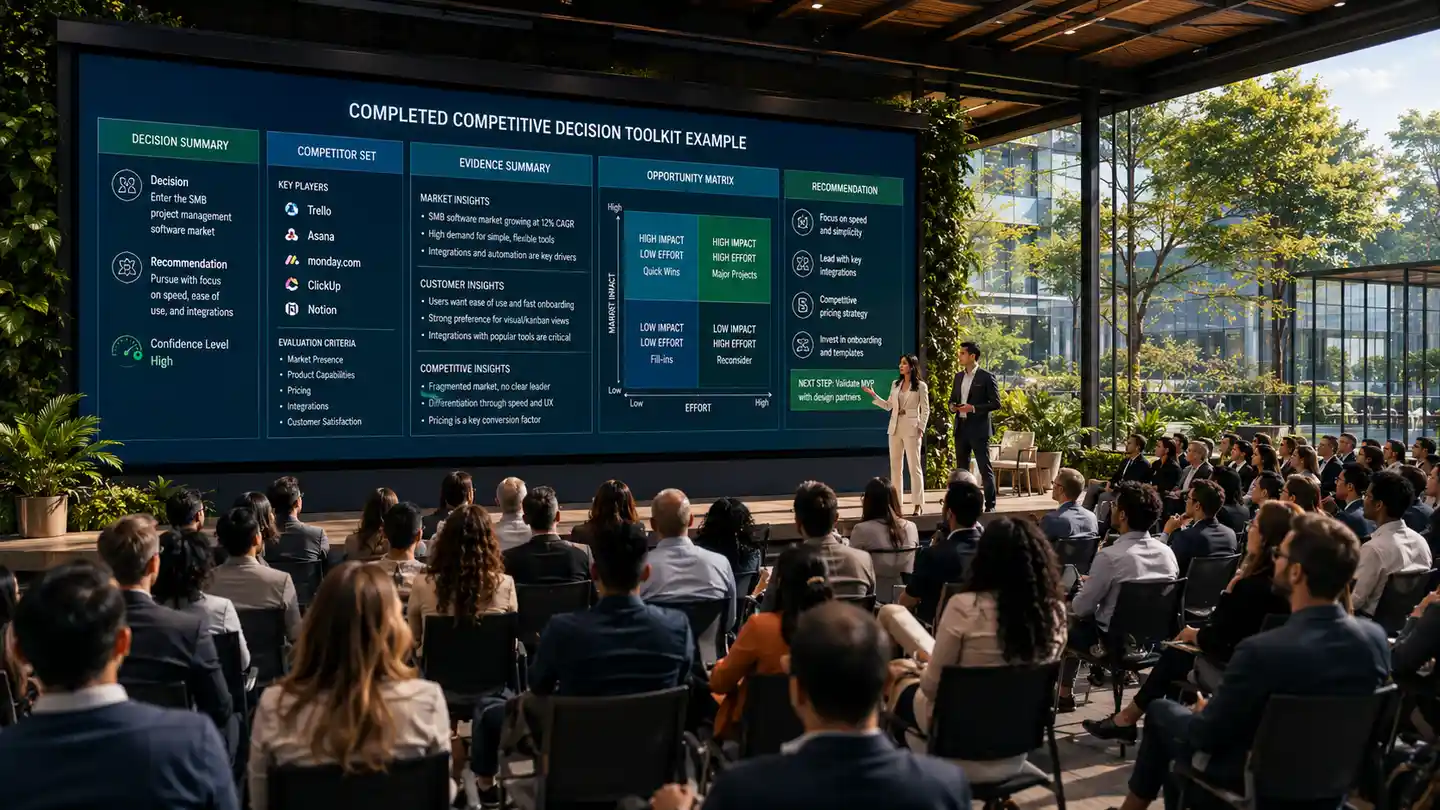
A completed competitive analysis is not a stack of filled worksheets. It is one traceable decision lineage: the same Decision ID constrains who can be compared, which evidence can be used, which actions are permitted, what the memo may say and when the handoff must reopen.
Most completed competitor-analysis examples show a filled comparison grid. This example shows what happens after the grid: how one frozen decision governs competitor qualification, a competitive-implication bridge, evidence, opportunity actions, the executive memo and the final handoff. The grid is still useful; A65 adds the lineage controls that determine whether its conclusions remain usable.
This page uses a fully fictional composite, CASE-WS-001, for a fictional workforce-scheduling SaaS called Northstar Roster. Every candidate name, evidence record and opportunity is synthetic training data. The example demonstrates workflow integrity; it does not describe a client, real competitor performance, real search demand or a market result.
If a downstream conclusion cannot be traced back to the same frozen decision, qualified candidate set and governed evidence records, the worksheet may look complete while the decision is still invalid.
Status: Founder reviewed by Pero Baldjiev. Founder reviewed by Pero Baldjiev.
Fast Action: trace the fictional recommendation in 60 seconds

Start at the output and walk upstream. The fictional recommendation is PILOT OPP-001, “care rota compliance software.” It is permitted only because the opportunity belongs to DEC-WS-001, its support and challenge evidence are governed fixtures owned by OPP-001, the opportunity remains inside scope, and the fictional execution state is READY.
Interactive teaching tool
Completed Example Lineage Explorer
Choose an output. The tool shows the exact upstream objects that make it usable. It does not authenticate real evidence or persist data.
1. Freeze one decision before filling the worksheet
The fictional case starts with CASE-WS-001 and one Decision Contract: DEC-WS-001. The buyer is operations leaders at UK care providers; the offer is a fictional workforce-scheduling SaaS; the market is the United Kingdom; and the decision is which search territory to pilot first over a fictional 90-day horizon.
| Decision field | Fictional governed value | Why it matters downstream |
|---|---|---|
| Case ID | CASE-WS-001 | Identifies the teaching case, not a client engagement. |
| Decision ID | DEC-WS-001 | Every candidate, evidence record, opportunity and memo must bind to this decision. |
| Buyer | Operations leaders at UK care providers | Prevents unrelated HR or global workforce questions entering later sheets. |
| Offer | Fictional workforce scheduling SaaS | Sets the job being compared. |
| Decision request | Choose the first search territory for a 90-day fictional pilot | Defines what the final memo is allowed to recommend. |
| Evidence mode | SYNTHETIC TRAINING FIXTURE ONLY | Stops illustrative data being mistaken for market evidence. |
2. Qualify competitor roles before comparing them
A common completed worksheet puts every visible alternative into one comparison grid. This example does not. It separates DIRECT candidates from CONTEXTUAL sources before any comparison permission is granted.
| ID | Fictional candidate | Role | Qualification state | Comparison permission |
|---|---|---|---|---|
| CAND-001 | ShiftPilot | DIRECT | QUALIFIED | SCOREABLE |
| CAND-002 | CareGrid | DIRECT | QUALIFIED | SCOREABLE |
| CAND-003 | RosterFlow | DIRECT | QUALIFIED | SCOREABLE |
| CAND-004 | CareOps Directory | CONTEXTUAL | CONTEXT ONLY | CONTEXT ONLY |
| CAND-005 | Workforce Advisory Collective | CONTEXTUAL | CONTEXT ONLY | CONTEXT ONLY |
Each candidate also carries a qualification Evidence ID owned by that same candidate. The workbook rejects wrong-case controlled tokens, duplicate IDs, a Decision ID that does not match DEC-WS-001, and candidate evidence owned by another candidate.
A directory may be strategically important without being a like-for-like provider. Context can inform the decision without being forced into the scoreable competitor set.
The missing bridge in ordinary completed worksheets
Qualified competitors must produce a governed competitive implication before an opportunity can be actioned
The workbook now makes that relationship explicit. CAND-001 through CAND-003 must all remain QUALIFIED, DIRECT, SCOREABLE and backed by exact governed QUALIFICATION evidence. Only then does the Competitive Implications sheet become READY.
| Comparison record | Candidate | Fictional observation | Downstream implication |
|---|---|---|---|
| COMP-001 | CAND-001 | General scheduling coverage; no compliance-specific territory is established in the fixture. | Feeds COMP-IMP-001. |
| COMP-002 | CAND-002 | Care-scheduling language is closer to OPP-002 in the fixture. | Supports keeping OPP-002 as the serious alternative. |
| COMP-003 | CAND-003 | Broader workforce-suite coverage increases breadth, not first-pilot specificity. | Helps explain why broad OPP-003 remains refused. |
Fail-closed rule: if the direct candidate set is no longer scoreable, the competitive-analysis state becomes REQUALIFICATION REQUIRED. OPP-001 can no longer remain PILOT and MEMO-001 can no longer remain READY FOR EXECUTIVE REVIEW.
Content-sensitive bridge: each COMP-* comparison record and COMP-IMP-* implication is versioned. Changing the substantive observation or implication text without a version update invalidates the bridge; accepting the change under a new version preserves validity but still causes any older frozen handoff to drift.
3. Govern the evidence instead of filling blanks with confidence
The Evidence Register contains EVID-001 through EVID-014. Every record declares its Decision ID, entity owner, role, state, source type, source location, as-of date, permitted wording and limitation. Because the case is fictional, the only allowed source type is SYNTHETIC TRAINING FIXTURE ONLY.
| Evidence | Owner | Role | Permitted wording | Limitation |
|---|---|---|---|---|
| EVID-001 | CAND-001 | QUALIFICATION | In this fictional example, ShiftPilot serves the defined buyer/job. | Not market evidence. |
| EVID-006 | OPP-001 | TERRITORY SUPPORT | In this fictional example, care rota compliance aligns strongly to the buyer/job. | No real search-volume claim. |
| EVID-007 | OPP-001 | TERRITORY CHALLENGE | In this fictional example, the territory requires legal/product review before launch. | Not a real legal requirement. |
| EVID-014 | DEC-WS-001 | EXECUTION | In this fictional example, one 90-day pilot can be supported. | Not a real resource commitment. |
The key lesson is not the fictional content of those records. It is that the limitation travels with the conclusion. A downstream memo may reuse the permitted wording; it may not silently upgrade a training fixture into a real-world fact.
Versioned evidence rule
Decision-bearing evidence now carries a Record Version ID, a Versioned Content Snapshot and a Version Control. If permitted wording, limitation, ownership, role, state, source or as-of identity changes without an accepted version update, the record returns VERSION UPDATE REQUIRED and dependent outputs fail closed. If the change is accepted, the record receives a new version ID; an older frozen handoff then detects drift even though the record is valid again.
4. Turn governed evidence into permitted actions—not a decorative ranking
The Opportunity Matrix uses a governed COMP-IMP-* competitive implication plus support evidence and challenge evidence for each territory. Scope, competitive-analysis readiness, evidence sufficiency and execution readiness act as gates. An attractive-looking territory can still be refused when it falls outside the frozen decision.
| ID | Fictional territory | Scope | Buyer fit | Evidence | Execution | Permitted action |
|---|---|---|---|---|---|---|
| OPP-001 | care rota compliance software | IN SCOPE | STRONG | SUFFICIENT | READY | PILOT |
| OPP-002 | care home staff scheduling app | IN SCOPE | MODERATE | SUFFICIENT | READY | MONITOR |
| OPP-003 | workforce management software | OUTSIDE / TOO BROAD | MODERATE | SUFFICIENT | READY | REFUSE - OUTSIDE DECISION |
| OPP-004 | generic HR scheduling | OUTSIDE / TOO BROAD | WEAK | SUFFICIENT | READY | REFUSE - OUTSIDE DECISION |
5. Write the executive memo without deleting the alternative or the challenge
MEMO-001 recommends piloting OPP-001 first, keeps OPP-002 as the serious alternative, carries EVID-007 as the strongest challenge, names a fictional decision owner and preserves the reopen trigger.
MEMO-001
Recommendation
Pilot care rota compliance software first; keep care home staff scheduling app as the serious alternative.
- Decision ID
- DEC-WS-001
- Recommended Opportunity
- OPP-001 · PILOT
- Serious alternative
- OPP-002 · MONITOR
- Strongest challenge
- EVID-007
- Owner
- Head of Growth - fictional role
- Memo state
- READY FOR EXECUTIVE REVIEW
READY FOR EXECUTIVE REVIEW does not mean approved. It means the fictional memo has the required lineage, alternative, challenge and ownership needed for accountable review.
6. Freeze the decision-bearing handoff, not every worksheet cell
The portable handoff freezes the Decision ID, Decision Contract state, Competitive Analysis state, a compact upstream version/control signature, Memo ID, recommendation, recommended Opportunity ID, permitted action, serious alternative, challenge Evidence ID, challenge wording, owner, reopen trigger and memo state. The signature contains the Record Version IDs and Version Controls for the decision, qualification evidence, competitive comparison/implication records, the recommendation/alternative opportunities and their support/challenge evidence.
Two changes both create drift: (1) an unversioned content edit changes Version Control to VERSION UPDATE REQUIRED; (2) a properly governed content edit changes the Record Version ID. Either way, a previously frozen signature no longer matches and Share State returns to NOT READY.
Current governed values are visible; integrity is NOT FROZEN; sharing is blocked.
Exact selected Decision ID + snapshot ID/date + matching frozen values produce READY TO SHARE.
Any mismatch becomes DRIFTED / INVALID and the recipient must receive a new governed snapshot.
READY TO SHARE means the fictional handoff is internally consistent. It is not approval of a real-world decision.
What happens if an upstream assumption changes?
Suppose the buyer changes from UK care-provider operations leaders to a general HR audience. A weak worksheet would simply edit the buyer field and keep the old candidate scores, evidence and memo. The completed example does the opposite.
- Decision Contract: DEC-WS-001 must reopen because the buyer boundary changed.
- Competitor Set: CAND-001 through CAND-005 must be requalified for the new job; prior comparison permission is provisional.
- Evidence Register: candidate- and opportunity-owned fixtures must be requalified or replaced.
- Opportunity Matrix: OPP-001 through OPP-004 may receive different scope and buyer-fit states.
- Executive Memo: MEMO-001 is no longer review-ready until the dependent objects are repaired.
- Handoff: a previously frozen snapshot becomes a historical record, not a current answer.
The value of a completed example is not that it shows a polished final answer. It shows exactly which outputs become provisional when an upstream assumption moves.
Versioning is part of reopening. A content-bearing record is not current merely because its IDs and controlled states still validate. If its governed wording changes, either the Version Control blocks the chain or the accepted new Record Version changes the frozen lineage signature.
How to adapt this completed example without copying the fictional answers
Use the structure, not the sample values. Start a new Decision ID for your own buyer, offer, market and decision. Build a real candidate universe for that decision. Record attributable evidence with its actual source, date, permitted wording and limitation. Only then create opportunity states and a memo.
| Copy from the example | Do not copy from the example |
|---|---|
| ID discipline and relation checks | Fictional candidate names or qualification states |
| Support + challenge evidence for an opportunity | Synthetic evidence wording |
| Scope/evidence/execution gates | PILOT or MONITOR outcomes |
| Alternative + challenge in the memo | The fictional recommendation |
| Frozen handoff + reopen logic | The 90-day horizon unless your decision actually uses it |
Current competitive-analysis templates from Asana, Shopify and Smartsheet are useful for organizing competitors, features, pricing, direct/indirect roles, SWOT and action ideas. A65 deliberately adds a different layer: cross-worksheet decision lineage and explicit refusal states, so the reader can see not only what was filled in, but why the final action is permitted.
Download the completed fictional workbook and field packet
The workbook is the deep-work surface. It contains the Decision Contract, Competitor Set, Evidence Register, Opportunity Matrix, Executive Memo, frozen Handoff, end-to-end Walkthrough, source roles, controlled-token list and change log. The PDF is a compact meeting/reference packet for the same fictional case.
Questions about a completed competitive analysis worksheet
What should a completed competitive analysis worksheet contain?
At minimum: one bounded decision, a role-qualified competitor set, traceable evidence, explicit opportunity states, a decision-bearing output, an owner and a reopen condition. A full table of competitor attributes is not sufficient if those objects are disconnected.
Can I copy the values from this competitive analysis example?
No. The values are synthetic training fixtures. Copy the control structure and rebuild every buyer, competitor, evidence and opportunity field from your own attributable evidence.
Why are directories and advisers not scored with the SaaS competitors?
Because role comes before comparison. In this fictional decision they are contextual alternatives, not like-for-like providers. Contextual entities can influence research without receiving a provider score.
Why does an out-of-scope opportunity get refused even when evidence is sufficient?
Because the Decision Contract governs the action. Evidence can support a fact about a territory without making that territory eligible for this particular decision.
Does READY FOR EXECUTIVE REVIEW mean the recommendation is approved?
No. It means the fictional memo has the required lineage and review inputs. Approval belongs to the accountable human decision-maker.
When should a completed competitive analysis be reopened?
Reopen when the buyer, offer, market, competitor role, evidence state, execution capacity or another decision-bearing assumption changes enough to alter a dependent output.
Where the completed example fits in the wider decision system
Sources, search-landscape context and methodological limits
The worked result itself is proprietary and fictional. External sources play narrower roles: they show common template/example patterns or provide transferable decision/evidence principles. They do not validate CASE-WS-001 or any fictional action.
- Asana — Competitive analysis template (2026): conventional template components, including direct/indirect competitors and common comparison fields.
- Asana — Competitive analysis example (2026): common example flow from competitor identification and research to an action.
- Shopify — Competitive analysis guide: current template/example landscape and the principle that research should lead to action.
- Smartsheet — Competitive Analysis Landscape: a conventional worksheet beginning with the question/goal and side-by-side competitor attributes.
- HM Treasury — The Green Book 2026: transferable principles around objectives, options, uncertainty, monitoring and evaluation.
- Center for Evidence-Based Management — What is evidence-based management?: transferable principles around evidence quality, critical appraisal and context.
- Google Search Central — Creating helpful, reliable, people-first content: publication/search context only.
Evidence mode for the worked case: SYNTHETIC TRAINING FIXTURE ONLY. No fictional record should be cited as a real company, market, traffic, revenue, demand or performance claim.