
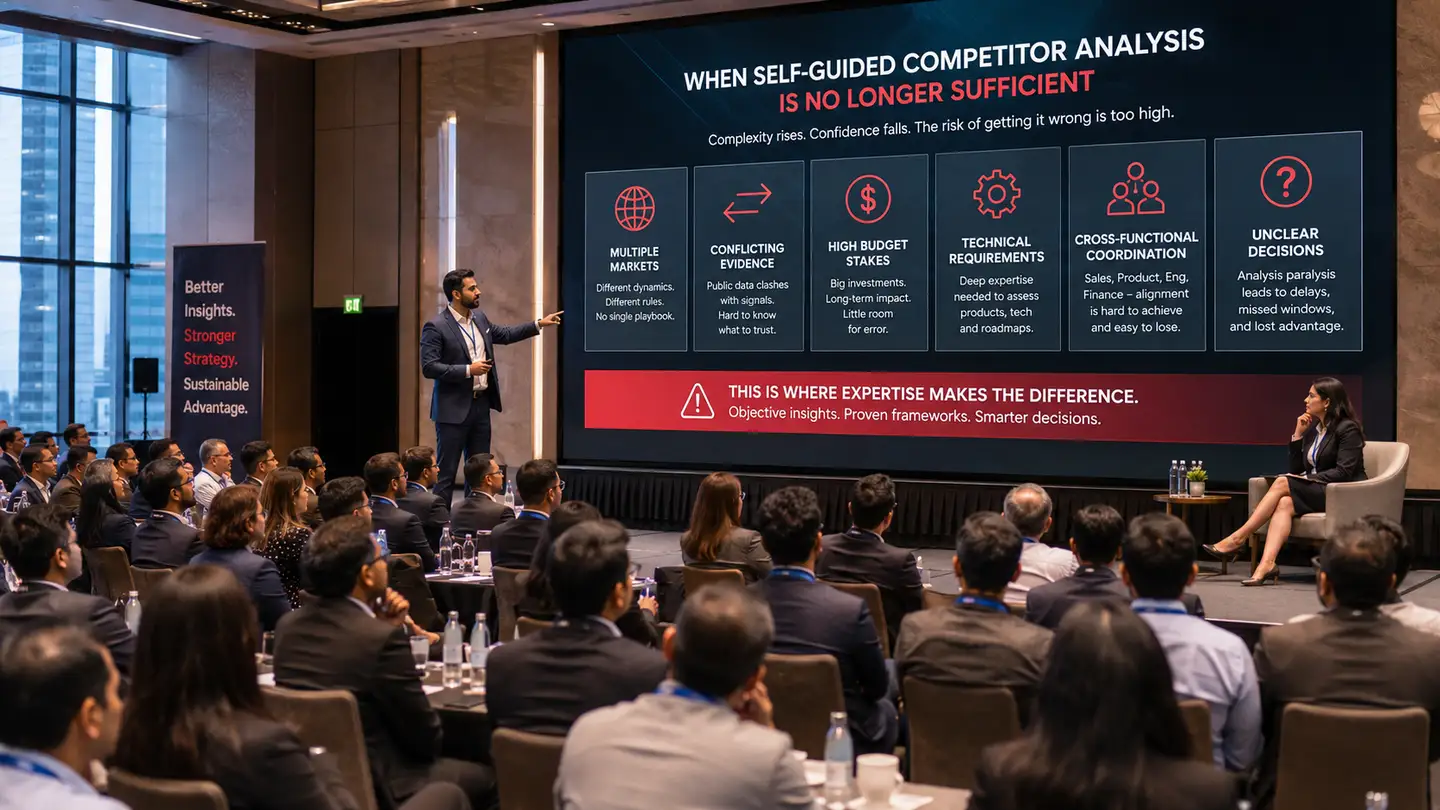
Escalation guide · Competitive Decision Toolkit
Self-guided analysis stops being sufficient when the method can no longer challenge the decision safely
Keep competitor analysis self-guided while the decision is bounded, the evidence can be checked, the important assumptions are stable enough to test, and at least one person can challenge the method without having to defend the original recommendation.
Move beyond self-guided work when a material decision depends on evidence, expertise, independence or implementation conditions that the team cannot resolve on its own. Escalation is not measured by page count, number of competitors or how impressive the research deck looks.
Memorable explanation: self-guided research is like using a map. You do not call for help because the road is long; you call for help when the map can no longer resolve the fork that changes the destination.
Run this 60-second escalation screen before collecting more data
Ask four questions. If the answer to all four is yes, self-guided work is usually still defensible. A no does not automatically mean “hire a consultant”; it identifies the control that needs repair or independent challenge.
- Decision: Can you state the exact decision, owner and next action?
- Evidence: Are the material claims attributable, current enough and scoped to the decision?
- Challenge: Can someone test the assumptions without being responsible for defending the recommendation?
- Execution: If the recommendation is accepted, are the material dependencies, owners and constraints understood?
If one answer is no: identify why. If the gap is fixable internally, repair it. If the gap is consequential and cannot be resolved with the team's current evidence, competence or independence, escalate only that part.
There are three permitted outcomes—not “DIY” versus “consultant”
Proceed, but preserve the decision record
Use this when scope is clear, the decision is reversible or proportionate to the evidence, assumptions do not overturn the conclusion under reasonable challenge, and the team can review its own method independently enough.
Output: decision, evidence used, material assumptions, owner and reopen trigger.
Do not buy certainty for a problem you can still fix
Use this when the issue is an unclear decision, a stale or missing source, untested sensitivity, incomplete implementation ownership or a disagreement that can be resolved with better definition or evidence.
Output: named repair, owner, evidence required and the condition for resuming self-guided work.
Escalate the unresolved boundary, not ownership of the business decision
Use this when the preferred action is materially sensitive to assumptions and the consequence is material, the decision is costly to reverse, specialist judgement is outside the team's competence, an ethical/legal boundary is reached, or nobody can provide a credible independent challenge.
Output: precise review question, evidence packet, decision owner, review limit and post-review action.
Memorable Explanation · At a glance
See the escalation system before you enter the ten-boundary detail
Start with one question: can the current method still challenge the action safely? Then use the consequence of the unresolved boundary—not research volume—to choose the next state.
Self-guided still defensible
Decision clear · evidence scoped · assumptions stable · challenge available · execution owned.
Proceed and record the reopen trigger.Repair before proceeding
Scope unclear · evidence fixable · sensitivity untested or safely testable · review independence improvable · implementation owner missing.
Repair the control, then rerun.Independent review warranted
High consequence + unstable evidence · material sensitivity flip · no credible challenger · specialist judgement outside competence · authority/risk conflict.
Escalate only the unresolved boundary.Three fictional mini-cases make the states tangible
A reversible landing-page pilot
A product-marketing team is deciding whether to test a competitor-comparison message for two weeks. The buyer/job evidence is current, another marketer can challenge the assumptions, the experiment is cheap to reverse and a failed test has limited consequence.
Result: proceed self-guided. Preserve the hypothesis, evidence, owner and the metric that would reopen the decision.
Search visibility has polluted the competitor set
An SEO/CI team has included review directories and marketplaces because they rank for comparison queries. Buyer/job ownership has not been verified, but the gap is easy to repair with first-party role evidence before more analysis is collected.
Result: repair first. Reclassify the entities, document the evidence role, then rerun the analysis without purchasing external certainty.
A major repositioning flips under one material assumption
A leadership team is considering a costly product repositioning. A plausible switching-cost assumption reverses the preferred action, the decision is expensive to unwind, and part of the security/regulatory judgement is outside the commercial team's competence.
Result: use a bounded decision challenge plus qualified specialist review of the specialist question. Leadership still owns the business decision.
Ten boundaries that can make self-guided competitor analysis insufficient
The useful question is not “How complex is this project?” It is “Which control can no longer be defended?” Current appraisal and risk guidance supports a proportionate approach: uncertainty should be visible, assumptions should be stress-tested, responsibilities should be clear, and higher-risk decisions justify stronger assurance rather than more decorative analysis.
| Boundary | Self-guided remains defensible when… | Repair first when… | Independent review is warranted when… |
|---|---|---|---|
| 1. Decision consequence | The choice is bounded and reasonably reversible. | Consequences are material but can still be staged, piloted or reduced. | The wrong decision is expensive, slow or difficult to reverse and the evidence is not stable. |
| 2. Decision definition | Owner, action and refusal condition are explicit. | Teams are answering different questions. | Competing definitions change budget, authority or strategic direction and cannot be reconciled internally. |
| 3. Evidence sufficiency | Critical claims are attributable, current enough and comparable. | Known gaps can be filled or bounded. | Material evidence is contradictory, inaccessible or requires judgement the team cannot independently validate. |
| 4. Sensitivity | Reasonable assumption changes do not reverse the action. | Sensitivity has not been tested, or the preferred action flips but the decision is bounded and reversible enough to test safely. | A plausible assumption change reverses the preferred decision and the consequence is material, difficult to reverse or time-critical. |
| 5. Independence | A reviewer can challenge scope, evidence and inference without defending the recommendation. | The advocate and reviewer are too close, but another internal reviewer is available. | No credible independent challenger exists for a consequential decision. |
| 6. Team disagreement | Differences are non-material or resolved in the evidence record. | People disagree about a source, classification or criterion that can be tested. | Disagreement is really about risk appetite, authority, acceptable uncertainty or the decision itself. |
| 7. Specialist competence | The team can evaluate the required commercial and research claims. | Specialist input would improve one bounded area. | The decision depends on legal, regulatory, security, technical, statistical or other specialist judgement outside the team's competence. |
| 8. Ethical / evidence boundary | Required evidence can be obtained and used through defensible methods. | The boundary is unclear and must be checked, or a known-unacceptable method must be refused and replaced with a defensible evidence route. | Qualified judgement is needed to determine what is permissible or to interpret a material legal, regulatory or ethical boundary; review cannot authorize a method already known to be prohibited. |
| 9. Implementation readiness | Owners, dependencies and constraints are understood. | Execution gaps are known and can be assigned. | The recommendation cannot be implemented as assumed, or critical ownership remains absent. |
| 10. Time asymmetry | Delay and error are both low-cost. | Time pressure exists but a short repair window is available. | The cost of delay or a wrong action is material enough that structured independent challenge is proportionate. |

Fast Action · Interactive
Decision Escalation Diagnostic
This diagnostic does not calculate an escalation score. It applies transparent precedence rules to the decision conditions you select. The output is a triage state and a portable handoff—not a guarantee that external support will improve the decision.
Choose the smallest review that resolves the boundary
Escalation should be proportionate. Independent assurance guidance uses risk and complexity to determine the degree of review required; this guide applies the same general principle to competitor analysis without claiming that public-sector assurance rules govern commercial CI.
| Unresolved boundary | Smallest useful review | What the reviewer should return | What they should not own |
|---|---|---|---|
| Decision or competitor scope is unstable | Scope review | One decision definition, inclusion/refusal rule, owner and reopen trigger. | The business choice itself. |
| Critical evidence is weak, stale or contradictory | Evidence review | Source-role audit, unsupported claims, unresolved conflicts and bounded conclusions. | Inventing confidence where evidence is absent. |
| Legal, regulatory, security, ethical or technical judgement is genuinely uncertain or exceeds competence | Qualified specialist review | Scoped judgement on the bounded question, its limits and the evidence relied upon. A method already known to be prohibited remains refused. | Authorizing a prohibited evidence method or making unrelated commercial conclusions. |
| The preferred action changes under plausible assumptions | Decision challenge | Sensitivity record, switching condition, alternative action and residual uncertainty. | Replacing the accountable decision owner. |
| Execution crosses many owners or systems | Readiness review | Dependencies, owners, blockers, sequencing and stop conditions. | Rewriting the competitive evidence to make implementation easier. |
| Several of these boundaries are material at once | Managed engagement | Governed evidence, integrated review and a decision-ready handoff. | A promise of certainty or guaranteed outcome. |
Team disagreement is an escalation signal only when it changes the decision
Disagreement is not automatically a problem. Product, sales, finance, security and leadership can look at the same competitor through different responsibilities. The important distinction is between different perspectives and different governing assumptions.
Keep it self-guided
People disagree on wording, emphasis or a non-material classification, but the same evidence and decision rule still lead to the same action.
Repair internally
People disagree because a source is missing, criteria were never defined, or one team is using stale evidence. Resolve the evidence or definition first.
Escalate
People disagree about acceptable risk, who has authority, whether a specialist claim is supportable, or whether the preferred action survives the evidence. That is a governance conflict, not a research-volume problem.
Current risk guidance emphasizes clear roles, appropriate escalation and information that can be challenged. The transferable lesson for competitor analysis is to expose disagreement that changes the permitted action rather than average it away.
More evidence is not always the answer: test whether the decision is sensitive first
A self-guided team can waste days collecting more competitor screenshots when the real problem is an unstable assumption. Sensitivity analysis asks a better question: what would need to change for us to choose differently?
- Name the preferred action. “Prioritize competitor A” is not enough; state what the team will actually change.
- Name the assumptions that make it preferred. Buyer overlap, replacement feasibility, implementation burden, evidence freshness, price, switching cost or another material condition.
- Stress-test the uncertain assumptions. Use plausible alternatives, not extreme scenarios chosen to protect the existing recommendation.
- Find the switching condition. Identify the assumption change that would make another action preferable or make no-decision safer.
- Set the review level from the consequence. If the action is stable and reversible, proceed. If the action flips and the consequence is material, independent challenge becomes proportionate.
The escalation threshold is not “we still have unanswered questions.” Every serious decision has unanswered questions. The threshold is that the unresolved question can materially change the action and cannot be resolved with the team's current evidence, competence or independence.
Escalation should have an exit condition: when may self-guided work resume?
Independent review should not create permanent dependency. The handoff should say exactly what changed and what lets the team return to normal self-guided operation.
- Scope repaired: the decision, owner, alternatives and refusal condition are explicit.
- Evidence repaired: the critical claims are attributable, current enough, comparable and linked to the decision.
- Sensitivity understood: the team knows which assumption would reverse the action.
- Specialist boundary closed: required specialist judgement is documented with its limits.
- Conflict governed: material disagreement has an owner, decision rule or explicit unresolved state.
- Implementation owned: dependencies have owners and the action is feasible under the accepted assumptions.
- Reopen trigger recorded: the team knows what future change invalidates the current conclusion.
The same escalation signal means different work for different decision-makers
| Audience | Job to be done | Typical pain | Root cause | Best next action |
|---|---|---|---|---|
| Founder / CEO | Know whether a consequential competitive decision is defensible before committing. | Too much data, too little confidence in the decision boundary. | Decision and review ownership are mixed together. | Scope or decision challenge, not another generic market scan. |
| Product / product marketing / CI | Turn competitor evidence into positioning, roadmap or battlecard action. | Research keeps expanding without a stopping rule. | No materiality, sensitivity or refusal condition. | Evidence audit plus sensitivity check. |
| Sales / revenue | Use competitive claims that survive real buyer scrutiny. | Battlecards contain stale or anecdotal claims. | Source roles and freshness are not governed. | Evidence review; escalate specialist claims when needed. |
| Security / legal / compliance | Prevent commercial research from making claims outside competence or acceptable collection methods. | Marketing evidence gets treated as assurance. | Specialist and ethical boundaries are invisible. | Qualified specialist review of the bounded issue. |
| Finance / procurement / strategy | Understand whether the recommendation survives cost, switching and implementation reality. | A persuasive competitor story hides downside sensitivity. | Assumptions were never stress-tested. | Decision challenge with switching conditions. |
| SEO / content / AEO | Use competitor/search research without converting visibility into commercial truth. | Ranking domains are treated as real competitors. | Discovery evidence is allowed to control business-role classification. | Repair the entity/role model before escalating research volume. |
Eight escalation mistakes that waste money or preserve bad decisions
A 50-page analysis can still be low-risk; a one-page decision can be consequential.
Internal confidence does not create evidence or independent challenge.
An external reviewer can improve challenge and evidence quality; they cannot remove uncertainty.
The reviewer should challenge the decision system, not become the accountable owner of the business choice.
More data cannot solve a decision that has no agreed buyer, alternative, action or refusal rule.
Legal, security or technical review should answer its scoped question, not certify every commercial conclusion.
A blended score can conceal a real conflict about risk appetite, authority or evidence.
If nobody can say when self-guided work may resume, the review has created dependency rather than assurance.
Portable handoff: what to send when escalation is warranted
A useful review brief is small enough to challenge and complete enough to prevent the reviewer from rebuilding the project from scratch.
Decision: What exact action is under review?
Owner: Who remains accountable for the final business decision?
Escalation boundary: Which control is unresolved—scope, evidence, sensitivity, competence, independence, disagreement, ethics or implementation?
Evidence packet: Which sources support, contradict or fail to answer the material claims?
Review question: What precise question must the reviewer answer?
What remains out of scope: Which adjacent questions should not expand the engagement?
Reopen / exit condition: What result allows self-guided work to resume?
Where this escalation guide fits in the SERPIFAI decision system
This guide owns only the boundary between self-guided analysis, internal repair and independent review. It does not replace the rest of the Competitive Decision Toolkit.
Questions about when self-guided competitor analysis is no longer sufficient
Is a high budget enough reason to hire outside help?
No. Budget increases consequence, but escalation should still be tied to an unresolved material boundary. A high-value but well-defined, reversible and evidence-stable decision may remain self-guided; a smaller decision can require specialist review if the team lacks the competence to evaluate a material claim.
Does conflicting competitor data always require independent review?
No. First identify whether the conflict can be resolved through source-role, freshness, scope or definition checks. Escalate when the conflict is material to the action and cannot be resolved with the team's current evidence or independence.
Can an AI tool replace independent review?
No. Tools can accelerate collection, comparison and documentation, but they do not create accountability or independence. The important question is whether the method and inference can be challenged by someone who is not required to defend the original recommendation.
What does “independent” mean here?
Independent does not necessarily mean external. It means the reviewer can challenge the question, evidence, assumptions and inference without being structurally responsible for protecting the original answer. Consequential or specialist decisions may still justify an external qualified reviewer.
What if the decision is easy to reverse?
Reversibility lowers the assurance burden. A bounded test or pilot may be more proportionate than a full external review if the downside is contained, learning is quick and the team records what would trigger reconsideration.
When is specialist review better than a managed engagement?
Use specialist review when one bounded issue—such as legal, security, regulatory or technical judgement—is outside the team's competence. Use a managed engagement only when several material boundaries need coordinated evidence, challenge and handoff.
What should an escalation brief contain?
State the decision, owner, unresolved boundary, evidence packet, precise review question, out-of-scope questions and the condition that lets the team resume self-guided work. The diagnostic above creates a concise starting handoff.
When should the team return to self-guided analysis?
Return when the material boundary is closed: scope is explicit, evidence is sufficient for the claim, sensitivity is understood, specialist limits are documented, conflicts are governed and implementation ownership is clear. Keep a reopen trigger for material change.
Evidence base, source roles and limits
This guide combines current external decision/risk/assurance guidance with SERPIFAI's bounded competitor-analysis method. The external sources support principles such as proportionality, uncertainty disclosure, sensitivity testing, clear ownership, independent challenge and ethical collection boundaries. They do not certify SERPIFAI's proprietary escalation states or guarantee a commercial outcome.
| Source | Role in this guide | What this guide does not infer |
|---|---|---|
| HM Treasury — The Green Book (2026) | Uncertainty, sensitivity analysis, switching conditions and proportionality for consequential decisions. | That public-sector appraisal rules directly govern commercial competitor analysis. |
| HM Treasury / Government Finance Function — Orange Book | Risk appetite, clear responsibilities, challengeable assumptions, escalation and unbiased risk information. | That a commercial team must copy government governance structures. |
| HM Treasury — Treasury approvals and independent assurance | Risk potential and complexity can justify a proportionate level of independent assurance. | That SERPIFAI reviews are equivalent to government assurance reviews. |
| CEBMa — Evidence-Based Decision Making | Critically appraised evidence from multiple sources rather than overreliance on one evidence stream. | That evidence mechanically dictates a business decision. |
| SCIP — Ethical Intelligence | Ethical and transparent competitive-intelligence practice and explicit collection boundaries. | That SCIP endorses this escalation guide or any specific SERPIFAI engagement. |
Research boundary: Current competitor-analysis/template pages were also reviewed to understand content gaps. They commonly explain scoping, comparison fields, data collection and update cadence; a smaller set discusses consulting versus in-house capacity. this guide's distinct task is the decision-governance threshold for when self-guided work becomes insufficient, not another competitor-analysis template.